Open up Your Cycling Potential
Spin bike workout routines are an effective, low-impact way to burn calories, build lower-body strength, and boost cardiovascular health. For beginners and seasoned athletes alike, a properly structured indoor cycling session can transform your results.
Key Elements of an Effective Spin Bike Workout:
- Proper bike setup: Seat at hip level, slight knee bend at full pedal extension.
- Intensity control: Use the Rate of Perceived Exertion (RPE) scale from 1-10.
- Workout structure: Include a warm-up, main set, and cool-down.
- Resistance management: Use enough tension when standing to protect your knees.
- Form fundamentals: Engage your core and use controlled movements.
The beauty of spin workouts lies in their adaptability. Research shows indoor cycling can improve body composition, aerobic capacity, and help lower blood pressure and cholesterol. A 45-minute session can burn over 500 calories while strengthening your quads, hamstrings, glutes, and core.
Getting started doesn’t require perfect technique. The key is learning to adjust resistance based on your effort and building intensity gradually. Even stationary and recumbent bikes offer similar cardiovascular benefits when used correctly.
I’m Pleasant Lewis, and in my 40+ years in fitness, I’ve seen countless people transform their health with consistent spin bike workout routines. The most successful cyclists master the fundamentals before chasing advanced techniques.
Mastering the Setup and Fundamentals for a Safe, Effective Ride
Correct bike setup is the foundation of every great spin bike workout. It ensures comfort, maximizes power, and prevents injury. Once you learn these basics, you can dial in any bike in minutes.
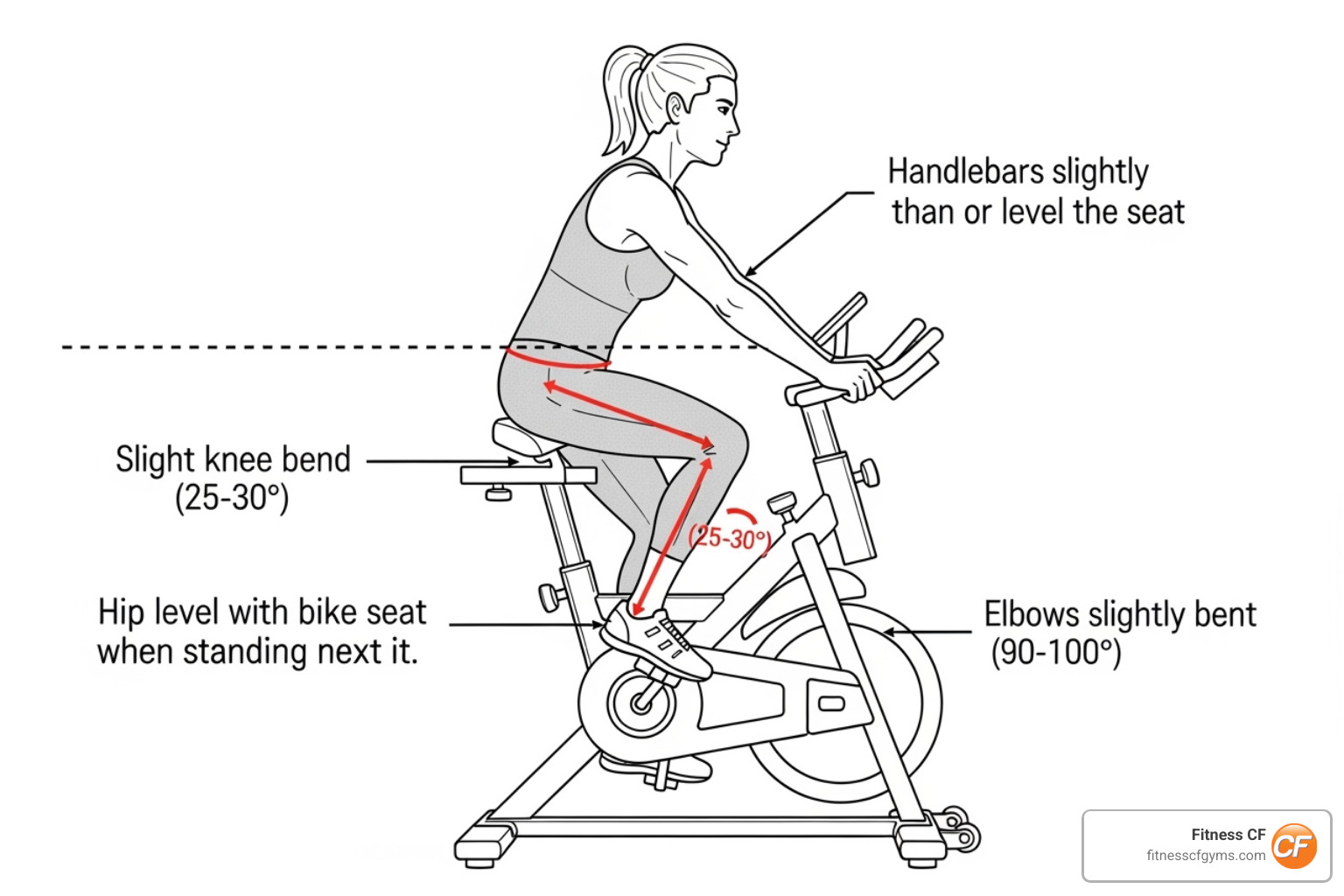
Proper bike fit starts with seat height. Sit on the bike and place your heel on the pedal at its lowest point. Your leg should be almost straight. If it’s locked or has a significant bend, adjust the seat accordingly. Once you find your spot, note the number on the seat post for next time.
Handlebar positioning should allow for a comfortable forward lean with a slight bend in your elbows. Beginners may prefer higher handlebars, which can be lowered over time as core strength improves.
As you pedal, check your knee alignment. Your knees should track straight up and down over your feet. If they wobble, adjust your seat or focus on engaging your core. Core engagement is key—think of pulling your belly button toward your spine to create a stable base for powerful pedaling.
Basic cycling form involves relaxed shoulders, a forward gaze, and relatively flat feet on the pedals. Avoid hunching over the handlebars. When these elements come together, your spin bike workout becomes more effective and enjoyable. For more on what to expect, see What to Expect From Your First Spinning Class.
Understanding Key Cycling Terms
Learning the language of indoor cycling helps you structure your workouts with confidence.
- Cadence (RPM): Your pedaling speed in revolutions per minute. A comfortable pace is 80-90 RPM. Higher cadences build cardio fitness, while lower cadences with more resistance build strength.
- Resistance: The knob that controls workout intensity. More resistance simulates hills and builds strength, while less is used for speed work and recovery.
- Hand positions: First position (center of handlebars) is for warm-ups. Second position (wider grip) is for seated climbs. Third position (front of handlebars) provides leverage for standing efforts.
- Seated vs. standing: Seated positions focus on smooth pedaling. Standing engages the whole body. Always add significant resistance before standing to support your knees.
- Sprints: Short, 15-60 second bursts of high-cadence pedaling with moderate resistance.
- Climbs: High-resistance efforts, done seated or standing, that simulate riding uphill and build leg strength.
Spin Bikes vs. Other Stationary Bikes
While any stationary bike provides a cardio workout, each type has unique features.
| Feature | Spin Bike (Indoor Cycle) | Upright Bike | Recumbent Bike |
|---|---|---|---|
| Flywheel | Heavy, weighted flywheel | Lighter flywheel | Lighter flywheel |
| Posture | Forward-leaning, athletic | Upright, relaxed | Reclined, back support |
| Muscle Engagement | Full lower body, core, upper body | Primarily lower body | Primarily lower body |
| Workout Style | High-intensity intervals, standing | Steady-state cardio | Steady-state cardio |
Flywheel momentum on a spin bike creates a smooth, road-like feel that allows for dynamic movements like standing climbs and sprints. The forward-leaning body position and ability to stand also lead to greater core activation compared to other bikes.
For those with back issues, recumbent bikes for accessibility are an excellent alternative, offering support while still providing cardiovascular benefits. The best bike is the one you’ll use consistently to improve your health and fitness.
The Art of Intensity: Your Guide to a Powerful Spin Bike Workout
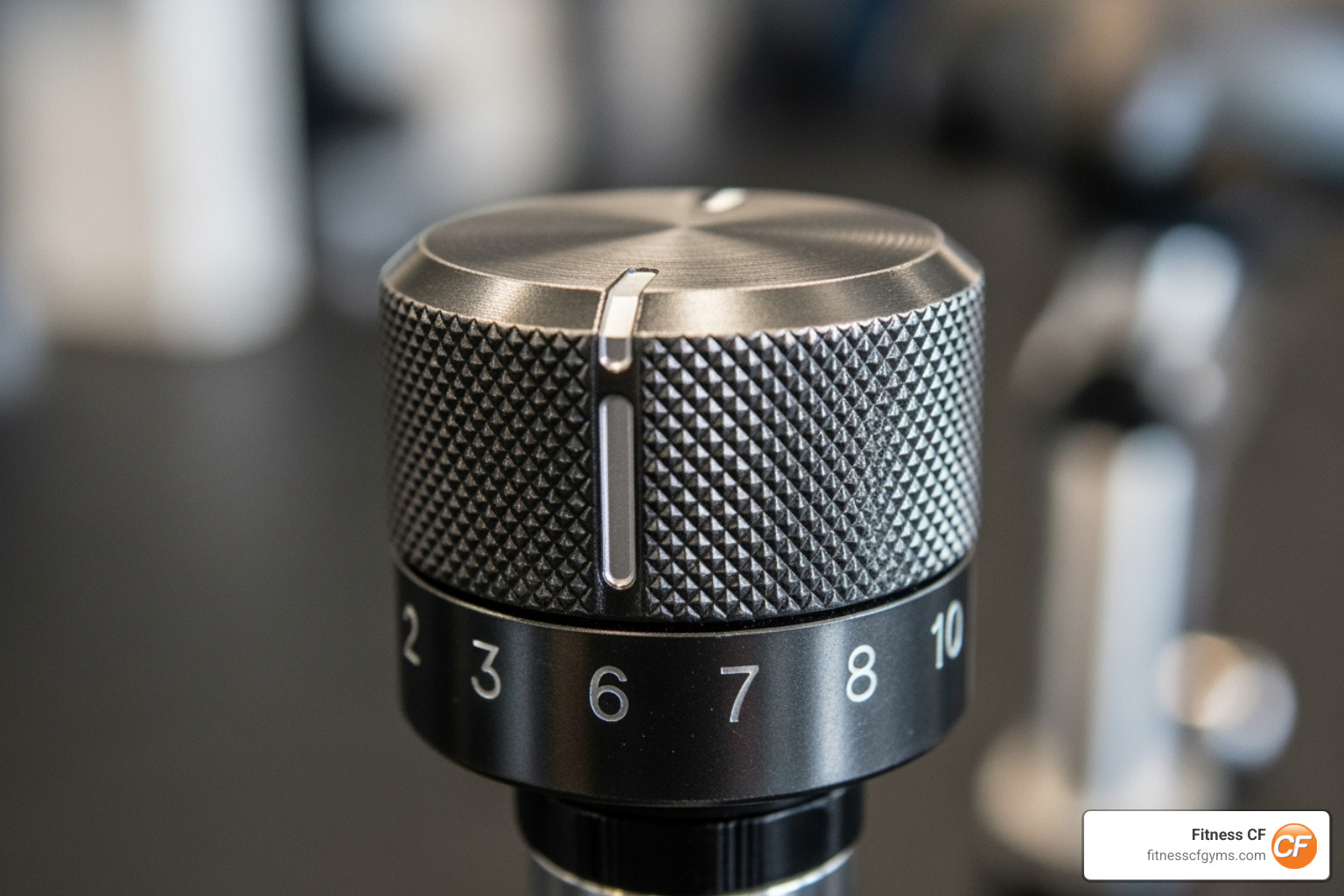
A transformative spin bike workout isn’t about pedaling as hard as possible—it’s about working smarter with intensity. Properly gauging your effort helps you build endurance, boost your metabolism, and improve cardiovascular health. By varying your intensity, you can avoid fitness plateaus and keep your body adapting.
Listening to your body is more valuable than any gadget. The most reliable metric for intensity is how you feel during the workout.
Using the Rate of Perceived Exertion (RPE) Scale
The RPE scale is a simple 1-10 tool to monitor intensity based on how you feel. RPE 1 is resting on the couch, while RPE 10 is an all-out sprint you can only hold for seconds.
- Light Zone (RPE 1-3): For warm-ups and cool-downs. You can hold a full conversation easily.
- Moderate Zone (RPE 4-6): You can speak in short sentences. This zone builds aerobic endurance.
- Vigorous Zone (RPE 7-8): Conversation is difficult. You’re breathing hard and pushing your cardiovascular limits.
- Maximum Zone (RPE 9-10): You can’t talk. This is for short, high-intensity bursts.
RPE is powerful because it’s personal and adapts to your fitness level on any given day. This makes every spin bike workout effective. For more details, the CDC offers resources on measuring physical activity intensity.
How to Safely Perform Standing Exercises
Standing adds a new dimension to your workout, but safety comes first. The golden rule is to add sufficient resistance before you lift off the saddle. Without enough tension, your pedals will spin too fast, creating a bouncing motion that is ineffective and can harm your joints.
When performing standing runs or climbs, keep your hips over the pedals and maintain a light grip on the handlebars. The goal is a smooth, powerful, and controlled movement, not a wild bounce. Throughout all standing work, engaging your core is crucial. Pull your belly button toward your spine to stabilize your torso and protect your lower back.
If you find yourself bouncing, either increase the resistance or slow your cadence until the movement feels controlled. Start with short 30-second standing intervals and gradually build up as you gain strength and confidence.
Structuring Your Ride: Sample Workouts and Techniques
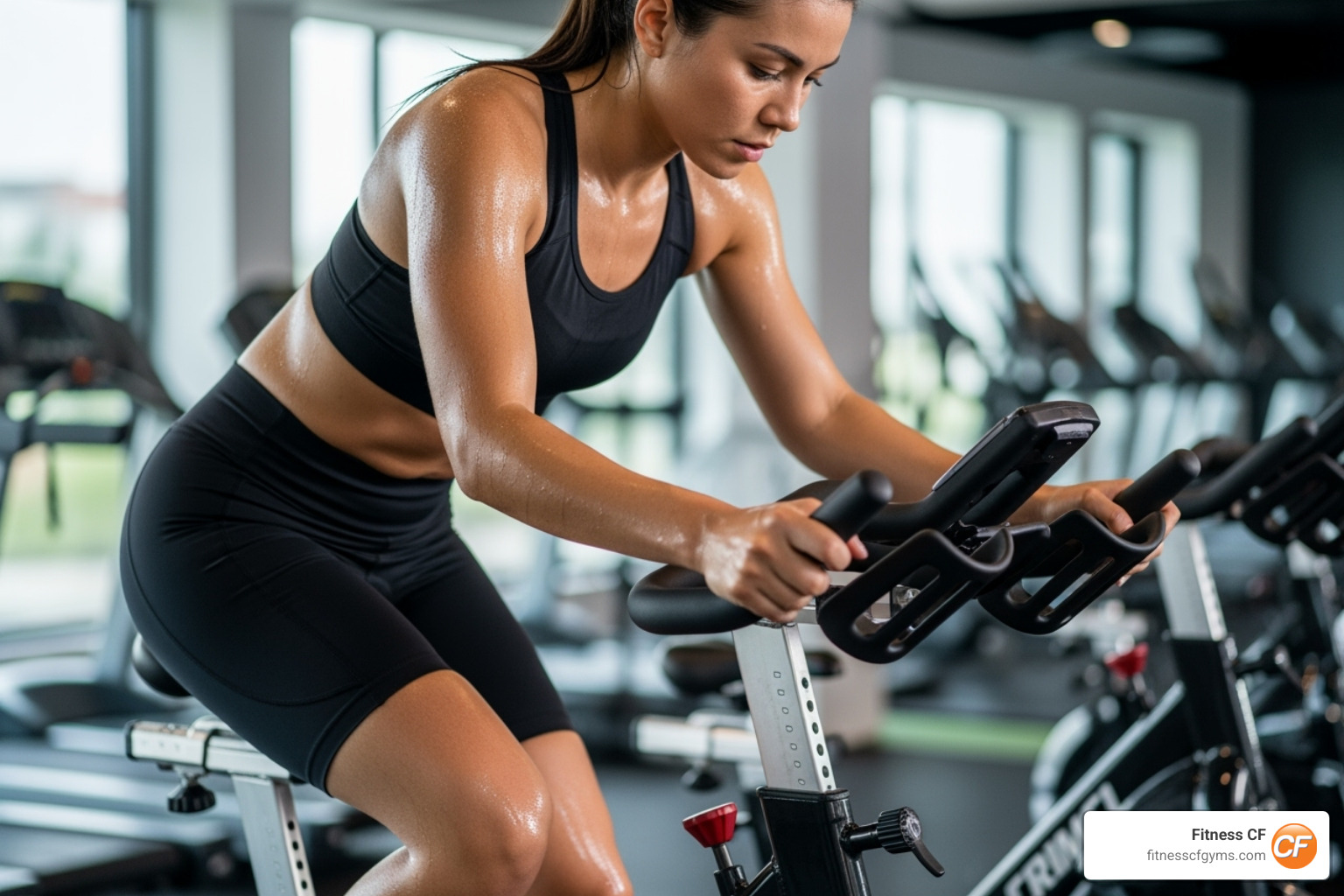
A great spin bike workout has a clear structure: a warm-up to prepare your body, a main set to challenge your fitness, and a cool-down to aid recovery. This planned approach, often guided by music in group classes, is what separates a good workout from a great one.
Interval training—alternating between hard work and recovery—is an effective way to burn more calories and build fitness faster than steady-state pedaling. For more on structured fitness, see these 8 Benefits of Joining Group Fitness Classes for Your Health.
Crafting Your First 30-Minute Spin Bike Workout
This 30-minute spin bike workout is perfect for beginners. Follow the RPE scale to guide your intensity.
- Minutes 0-5: Warm-Up (RPE 2-3)
Pedal at 70-80 RPM with light resistance. - Minutes 5-10: Build Pace (RPE 4-5)
Add resistance and increase cadence to 80-90 RPM. - Minutes 10-12: Seated Climb (RPE 6-7)
Add more resistance, slowing cadence to 60-70 RPM. - Minutes 12-13: Active Recovery (RPE 3)
Reduce resistance and pedal easily. - Minutes 13-15: Speed Intervals (RPE 5-7)
At moderate resistance, alternate 30 seconds at 90-100+ RPM with 30 seconds of recovery pace. - Minutes 15-18: Standing Climb (RPE 6-7)
Add significant resistance and stand, keeping your hips over the pedals. - Minutes 18-19: Active Recovery (RPE 3)
Sit down and reduce resistance. - Minutes 19-23: Mountain Climb (RPE 7-8)
Add heavy resistance, slowing cadence to 50-60 RPM. Push for 30 seconds each minute. - Minutes 23-25: Final Sprints (RPE 8-9)
Reduce resistance slightly and give an all-out effort for 1 minute, followed by 1 minute of strong, steady pedaling. - Minutes 25-30: Cool-Down (RPE 1-2)
Gradually reduce resistance and cadence to let your heart rate come down.
High-Intensity Interval Training (HIIT) Protocols
For a greater challenge, HIIT protocols boost fitness and maximize calorie burn in less time.
-
Tabata Protocol: This involves 20 seconds of maximum effort (RPE 9-10) followed by 10 seconds of rest. Repeat eight times for a four-minute block. Research supports Tabata’s effectiveness for improving cardiovascular fitness.
-
30-20-10 Protocol: This involves a repeating one-minute cycle: 30 seconds at moderate intensity (RPE 5-6), 20 seconds at high intensity (RPE 7-8), and 10 seconds at very high intensity (RPE 9-10). Repeat this for a five-minute block. Studies show this method can lower blood pressure and boost fitness.
Always warm up properly before HIIT and cool down afterward. Start with one protocol per session and build up as your fitness improves.
The Full-Spectrum Benefits of Indoor Cycling
Consistent spin bike workout routines offer a wealth of long-term health benefits for both body and mind. It’s how regular cycling transforms you over weeks and months that makes it so powerful.
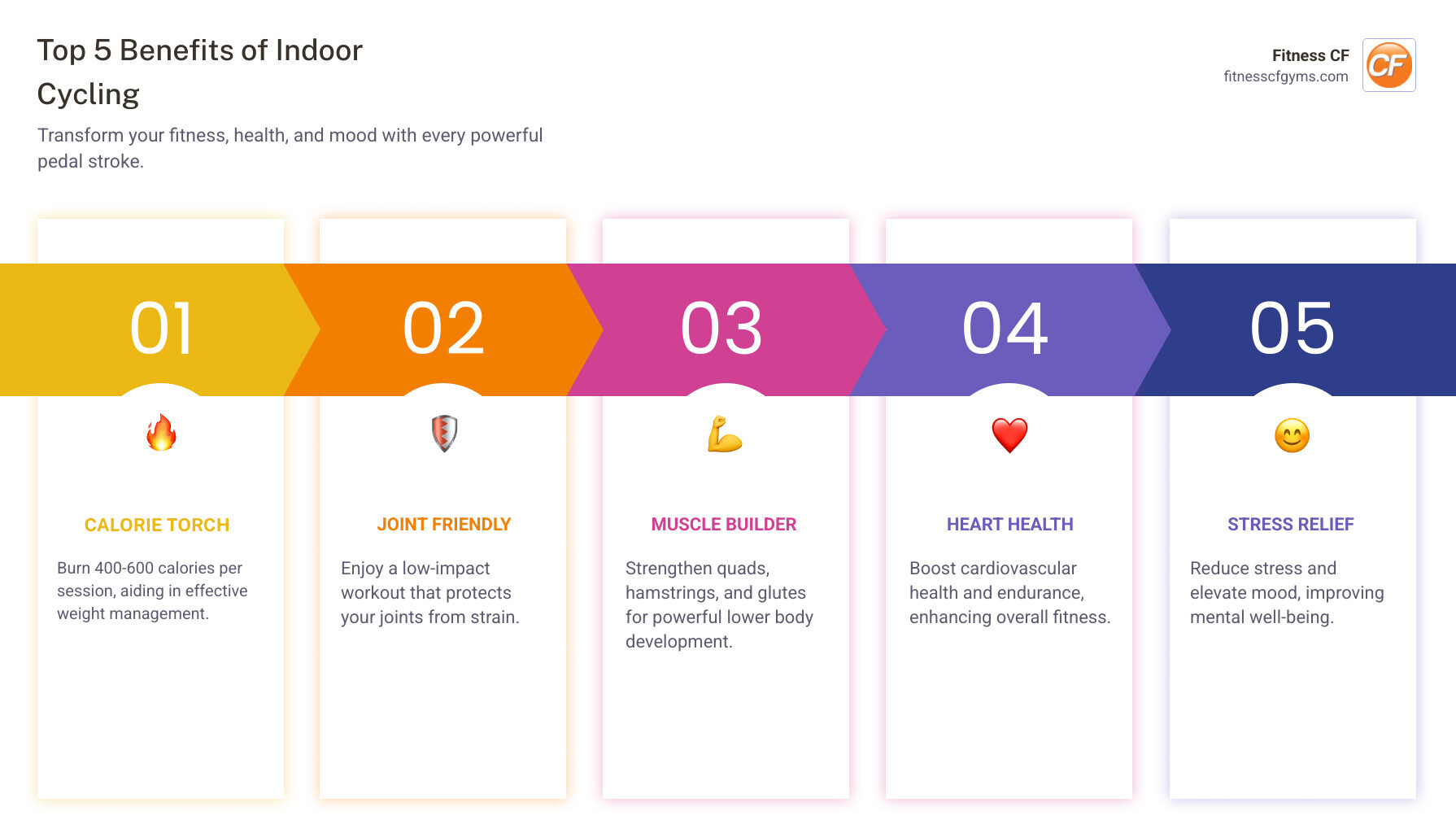
Indoor cycling aids weight management by burning 400-600 calories per session and building lean muscle, which boosts metabolism. It’s also a powerful tool for mental health, as the rhythmic nature of pedaling and focused concentration can reduce stress and increase energy levels. As a joint-friendly exercise, the smooth motion of pedaling places minimal stress on knees, hips, and ankles, making it ideal for all ages and fitness levels. For more reasons to start, see 5 Great Reasons to Take Spin Classes in 2021.
The Health Benefits of a Consistent Spin Bike Workout
Committing to a regular spin bike workout leads to profound physical health improvements.
- Improved cardiovascular fitness: A meta-analysis on indoor cycling health benefits found it significantly improves aerobic capacity, making your heart and lungs more efficient.
- Lower body strength: Spinning develops the quadriceps, hamstrings, and glutes. Standing climbs and sprints are particularly effective for building functional strength.
- Core stability: Maintaining proper posture, especially during standing efforts, requires constant core engagement, which improves posture and balance.
- Improved cholesterol and blood pressure: Regular cardio exercise helps lower bad LDL cholesterol and blood pressure, significantly reducing the risk of heart disease.
Why Spin is a Great Option for Students and Beginners
A spin bike workout is wonderfully welcoming to newcomers, making it an ideal starting point for a fitness journey.
It teaches lifetime fitness skills that are adaptable and can be pursued for decades. The physical exertion and focus provide natural stress reduction and can lead to improved focus for work or study. As a beginner-friendly activity, it has a low barrier to entry—most people can hop on a bike and start pedaling. The workout is adaptable for all fitness levels, as each person controls their own resistance and intensity.
Most importantly, indoor cycling builds confidence. Pushing through a tough climb or finishing your first ride creates a sense of accomplishment that extends far beyond the bike.
Conclusion: Ride Toward a Healthier You
You now have the tools to get a fantastic spin bike workout, from setup and form to intensity and structure. The beauty of indoor cycling lies in its simplicity and adaptability, making it a powerful exercise for everyone.
Remember these key takeaways:
- Consistency is key: Regular, shorter sessions are more effective than sporadic, long ones.
- Proper form trumps intensity: Always prioritize correct bike setup and posture to prevent injury.
- Listen to your body: Use the RPE scale to guide your effort. Some days are for pushing hard, others for steady recovery.
The health benefits are remarkable. Your heart gets stronger, your legs build power, and your mind finds relief from stress. Because it’s low-impact, spinning is an investment in your long-term health that you can enjoy for decades.
At Fitness CF, our programs are designed to support you at every stage. Our instructors create a welcoming environment that celebrates every milestone.
Ready to feel the energy of a group spin bike workout? Riding with others adds motivation and makes the journey more fun. Explore our Group Fitness Classes and see how the right support system can lift your fitness.
Your healthier, stronger self is waiting. It’s time to start pedaling.