Why Building Muscle Matters More Than You Think
Tips for gaining muscle go beyond aesthetics; they’re about improving your health, metabolism, and building a stronger foundation for life. The fundamentals remain the same: progressive resistance training, proper nutrition, and adequate recovery.
Here are the essential tips to get you started:
- Train with resistance at least 2-3 times per week using compound movements like squats, deadlifts, and bench presses
- Eat in a calorie surplus of 10-20% above your maintenance needs
- Consume 1.2-2.2g of protein per kg of body weight daily, spread across 3-4 meals
- Prioritize progressive overload by gradually increasing weight, reps, or sets over time
- Rest and recover with 6-8 hours of sleep and rest days between training the same muscle groups
- Be patient—expect to gain approximately 1-2 lbs of muscle per month as a beginner
Men tend to lose 3-5% of their muscle mass per decade after age 30, but you can slow or reverse this with consistent strength training and proper nutrition. Building muscle is about applying proven principles consistently, not shortcuts.
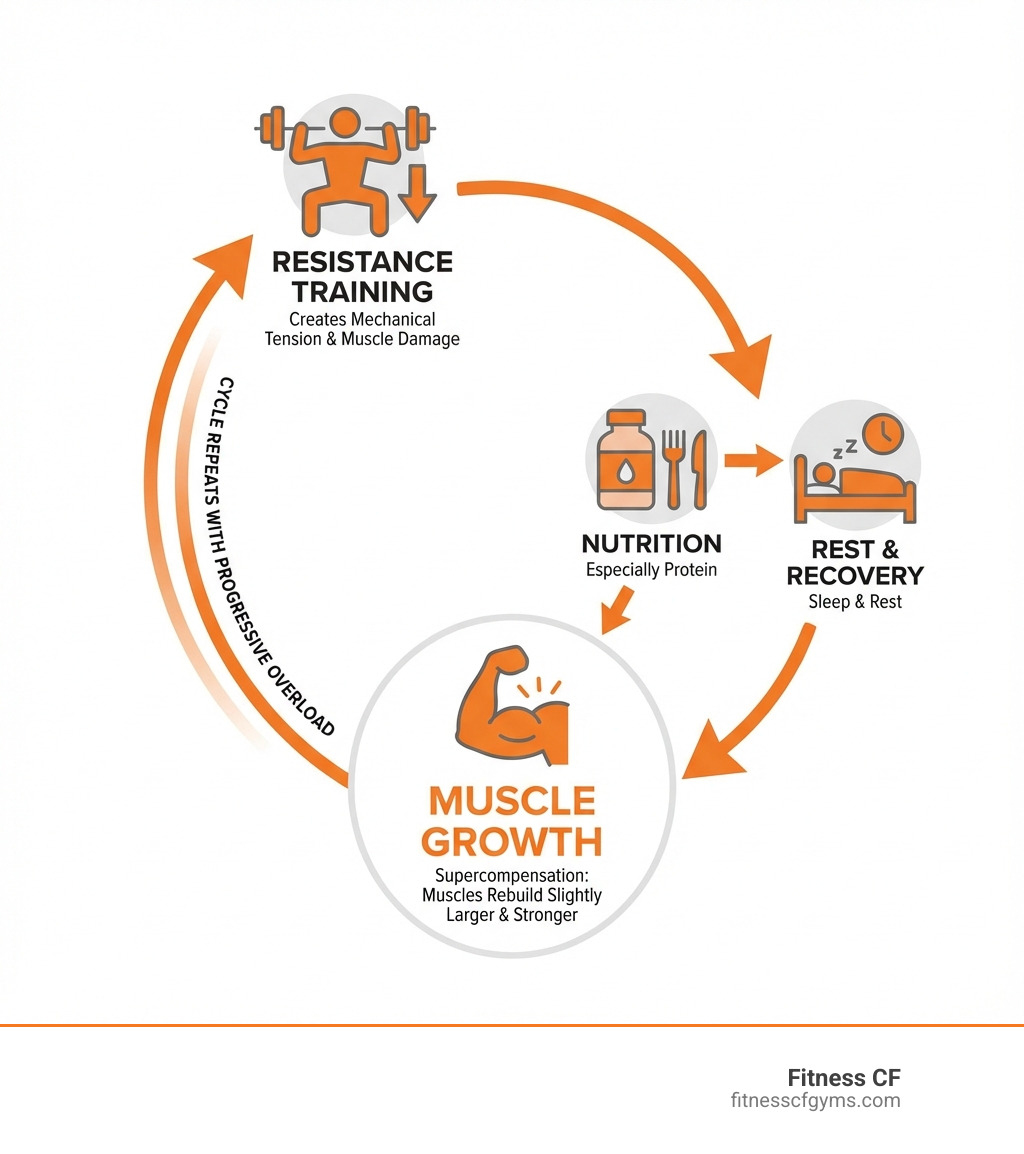
Muscle growth, or hypertrophy, occurs when resistance training creates microscopic damage to muscle fibers. Your body repairs these fibers with protein, making them bigger and stronger. This cycle of stress, repair, and growth is the foundation of building muscle.
I’m Pleasant Lewis, and over my 40 years in the fitness industry, I’ve helped thousands of members find effective tips for gaining muscle that fit their busy lives. At Fitness CF, we’ve seen how the right approach to strength training transforms not just bodies, but overall health and confidence.
Related content about tips for gaining muscle:
Why Build Muscle? The Surprising Health Benefits

Building muscle extends far beyond aesthetics; it’s a powerful investment in your long-term health.
One of the most significant advantages is an increased metabolism. A pound of muscle burns roughly 13 calories daily at rest, compared to about 4 for a pound of fat. More muscle makes your body a more efficient calorie-burning machine, simplifying weight management.
Beyond metabolism, building muscle is critical for improved bone density. Strength training stresses our bones, signaling them to become stronger and denser. This helps prevent osteoporosis and fractures, maintaining mobility as we age.
Strong muscles also offer fantastic joint support. They act as shock absorbers for your joints, protecting them from impact during daily activities. They also guide joints through a healthy range of motion, reducing injury risk.
Building muscle can also lead to improved insulin sensitivity. Muscles use glucose for fuel. More muscle mass improves your body’s ability to manage blood sugar, which helps reduce the risk of type 2 diabetes and supports cardiovascular health.
Stronger muscles mean a reduced risk of injury in daily life. They act as a protective shield, improving your quality of life by making everyday activities like carrying groceries or playing with kids easier and safer.
Finally, building muscle combats sarcopenia, the age-related muscle loss that begins after 30. Maintaining muscle preserves strength and mobility, leading to a more active and independent life in your later years.
Core Training Principles: The Best Tips for Gaining Muscle
Building muscle comes down to a few core principles. The most fundamental concept is progressive overload, which means continually challenging your muscles to do more than they’re accustomed to. If you always lift the same weight for the same number of reps, your muscles have no reason to grow. Progressive overload can be achieved by:
- Increasing the weight you lift
- Doing more repetitions with the same weight
- Performing more sets
- Reducing the rest time between sets
- Improving your form to make an exercise harder
Resistance training itself is the stimulus. Whether it’s lifting weights, using resistance bands, or bodyweight exercises, you need to work your muscles against resistance to trigger the repair and growth process. We recommend strength training for all major muscle groups at least twice a week.
Training volume (total sets and reps) and training intensity (how hard you’re working) are also key. A good starting point is 3 sets of 8-12 repetitions, choosing a weight that makes the last few reps challenging. If you can easily do 15 reps when aiming for 10, the weight is too light.
Finally, consistency is key. Muscle building is a marathon, not a sprint. Consistent effort over weeks and months yields incredible results.

The Foundation: Compound vs. Isolation Exercises
Understanding the difference between compound and isolation movements is fundamental to designing an effective program.
Compound movements are efficient, multi-joint exercises that work several muscle groups at once. They are key for building overall strength and mass because they let you lift heavier and engage more muscle. Examples include:
- Squats: Engage your quads, hamstrings, glutes, and core.
- Deadlifts: Work your entire posterior chain, forearms, and core.
- Bench press: Targets your chest, shoulders, and triceps.
- Overhead press: Builds shoulders, triceps, and core stability.
Fitness director Ebenezer Samuel, C.S.C.S., emphasizes the importance of multi-joint movements, stating that while isolation training has value, it can’t be the core of your program.
Isolation movements target a single muscle group around one joint. They are great for adding targeted volume, addressing imbalances, or refining muscle shape. Examples include:
- Bicep curls: Specifically target the biceps.
- Tricep extensions: Isolate the triceps.
- Leg curls: Focus on the hamstrings.
Both types have their place. Compound movements should be the backbone of your routine, with isolation exercises used to supplement.
| Feature | Compound Exercises | Isolation Exercises |
|---|---|---|
| Muscles Worked | Multiple major muscle groups | Primarily one muscle group |
| Joints Involved | Two or more | One |
| Calorie Burn | High (due to more muscles working) | Lower |
| Typical Goals | Overall strength, mass, functional fitness, efficiency | Muscle shaping, addressing imbalances, extra volume |
| Examples | Squats, Deadlifts, Bench Press, Overhead Press, Rows | Bicep Curls, Tricep Extensions, Leg Curls, Lateral Raises |
Structuring Your Workouts for Success
A smart workout structure is crucial for hitting all muscle groups effectively while allowing for recovery. The Department of Health and Human Services recommends strength training for all major muscle groups at least two times a week.
Popular workout structures include:
- Full-body splits: Train all major muscle groups 2-3 times per week. Great for beginners, maximizing protein synthesis frequency, and allowing ample rest.
- Upper/lower splits: Dedicate separate days to upper and lower body. This allows more volume per session, hitting each muscle group twice a week (e.g., Upper, Lower, Rest, repeat).
- Body part splits: Focus on 1-2 muscle groups per session (e.g., Chest & Triceps). This allows high volume but trains muscles less frequently (once a week), often used by advanced lifters.
Rest days are non-negotiable, as muscle growth happens during recovery. Allow at least 48 hours between training the same muscle group intensely. On rest days, consider active recovery like a light walk or stretching to improve blood flow.
Always start with a 5-10 minute warm-up and finish with a cool-down to reduce injury risk and aid recovery.
Advanced Training Tips for Gaining Muscle
Once you’ve mastered the basics, you can use advanced techniques to improve growth.
Time under tension (TUT) is how long a muscle works during a set. Focus on controlling the movement, especially the lowering (eccentric) phase. For example, a 3-second lift, 1-second pause, and 3-second lower increases TUT and can spark more growth.
Training to failure means doing reps until you can’t complete another with good form. While taxing, occasionally pushing to failure on some exercises can be a powerful growth stimulus.
Understanding repetition ranges is crucial. The repetition continuum explained generally suggests:
- 1-5 repetitions: Primarily builds strength.
- 8-12 repetitions: Tends to build more muscle (hypertrophy).
- 15+ repetitions: Increases muscular endurance.
Varying your rep ranges can be beneficial. For example, start with a heavy compound lift for strength (3-5 reps), then move to accessory work for hypertrophy (8-12 reps).
Finally, cultivate a strong mind-muscle connection. Actively focus on feeling the target muscle contract and stretch during each repetition to improve activation and results.
Fueling for Growth: Your Muscle-Building Nutrition Blueprint
Training is the stimulus for muscle growth, but nutrition provides the building blocks. Without proper fuel, your muscles won’t grow, no matter how hard you train.
The most critical principle is a caloric surplus: consistently eating more calories than your body burns. This extra energy fuels workouts and builds new muscle. A 10-20% surplus above your daily needs is a good starting point to minimize fat gain.
Your macronutrients—protein, carbohydrates, and fats—are all vital. Micronutrients (vitamins and minerals) and hydration are also essential for energy and muscle repair, so prioritize a diet of whole foods and drink plenty of water.
The Power of Protein
Protein is the key macronutrient for muscle building. It provides the amino acids necessary to repair the microscopic damage from workouts, allowing muscles to grow back stronger.
For muscle gain, aim for 1.2-2.2 grams of protein per kilogram of body weight (or about 0.5-1.0 gram per pound). For a 165-pound (75 kg) person, this is 90-165 grams daily. You can dive deeper into the specifics of how much protein you need.
Excellent high-protein foods include:
- Chicken breast
- Greek yogurt
- Lentils
- Salmon
- Eggs
- Lean beef
- Tofu
- Cottage cheese
- Turkey
- Whey or plant-based protein powder (as a supplement)
Don’t Fear Carbs and Fats
Carbohydrates and fats are just as crucial as protein for muscle growth and overall health.
Carbohydrates are your body’s preferred energy source, fueling intense workouts. After training, they are essential for glycogen replenishment, which kickstarts recovery. As sports dietitian Sedlacek notes, “With exercises that require short bursts of energy, like weightlifting, carbs are more useful because those are used up faster for energy.”
Healthy fats are vital for hormone production (like testosterone), nutrient absorption, and energy. They offer longer-lasting fuel and are crucial for meeting calorie goals in a surplus. A 165-pound (75 kg) athlete should aim for at least 75 grams of fat daily from sources like avocados, nuts, seeds, and olive oil.
Nutrient timing can also help:
- Pre-workout fuel: Carbs before your workout provide readily available energy.
- Post-workout recovery: A combination of protein and carbs within an hour or two after your session helps repair muscle and replenish glycogen.
Essential Nutrition Tips for Gaining Muscle
Here are some actionable nutrition tips:
- Meal frequency: Spread your protein intake across 3-4 meals (e.g., 25-35 grams per meal) to optimize muscle protein synthesis.
- Whole foods first: Prioritize nutrient-dense whole foods. They provide a full spectrum of vitamins, minerals, and fiber that supplements can’t replace.
- Supplementation:
- Creatine: A well-researched supplement for increasing strength and size. It’s safe for healthy individuals, but those with pre-existing kidney disease should avoid it, as research advises.
- Whey protein: A convenient way to boost protein intake, especially post-workout.
- When to use sparingly: Supplements should not replace a healthy diet. Avoid products high in sugar.
- Avoiding empty calories: Make your surplus calories count. Choose nutrient-rich foods like nuts, seeds, and healthy oils over junk food.
Healthy Living: The Benefits of Strength Training, Cardio, and Overall Fitness
Building muscle is part of a holistic approach to healthy living. Combining strength training, cardio, and mindful lifestyle choices amplifies your results and improves overall well-being.
Why Strength Training Matters
Beyond muscle growth, strength training offers numerous health benefits:
- Builds muscle and strength: The foundation of physical resilience, making daily tasks and hobbies easier.
- Supports healthy metabolism: More muscle increases your resting metabolic rate, aiding in weight management.
- Improves posture and balance: A strong core and back reduce aches, while better balance lowers fall risk, especially as you age.
- Boosts confidence and mental health: Achieving fitness goals is empowering. Strength training is a powerful stress reliever that can improve mood and reduce anxiety.
The Role of Cardio in a Balanced Routine
While strength training is key for muscle gain, cardio is vital for overall fitness.
- Supports heart health: Cardio strengthens your heart and lungs, reducing disease risk. Aim for the recommended 150 minutes of moderate or 75 minutes of vigorous aerobic activity weekly for the full benefits of regular aerobic activity.
- Increases endurance: Better cardiovascular health gives you more stamina for longer, more productive weightlifting sessions.
- Aids in recovery: Light cardio improves blood flow, delivering nutrients to muscles and speeding up recovery.
- Helps manage body composition: Cardio can help manage fat gain during a bulk and improve overall body composition.
Creating a Sustainable, Healthy Lifestyle
An effective muscle-building plan fits into a broader healthy lifestyle.
- Consistency over perfection: Strive for long-term consistency, not daily perfection. A few missed workouts won’t derail your progress.
- Setting realistic goals: Muscle gain is slow. Beginners might gain 1-2 pounds per month, but this rate slows with experience. Focus on sustainable progress.
- Listening to your body: Pay attention to signals of fatigue or pain. Pushing through sharp pain can lead to injury.
- Prioritizing rest and recovery: Aim for 7-9 hours of quality sleep, when most muscle repair occurs. Manage stress to keep cortisol levels low, as this hormone can hinder muscle growth.
- Staying active in daily life: Look for opportunities to move more, like taking the stairs or walking during breaks. Every bit of movement contributes to your health.
Frequently Asked Questions about Gaining Muscle
How quickly can I realistically build muscle?
The rate of muscle gain depends on several factors, but here are some realistic expectations:
- Untrained individuals: Beginners might realistically gain 1 to 2 pounds of muscle per month.
- Moderately trained individuals: After the initial phase, gains slow to about 0.5 to 1 pound of muscle per month.
- Highly trained individuals: Advanced lifters may only gain 1 to 2 pounds per year as they near their genetic potential.
While genetics play a role, consistency is the most important factor for progress. For more on this, you can explore research on realistic training goals.
Do I need to do cardio if I want to gain muscle?
Yes. While strength training drives muscle growth, cardio is essential for overall fitness and supports your efforts.
- Heart health: It strengthens your heart and lungs, which is vital for long-term health.
- Increased endurance: A fitter cardiovascular system gives you better stamina during weightlifting sessions.
- Aids in recovery: Light cardio can improve blood flow to muscles, reducing soreness.
Integrate cardio intelligently so it doesn’t interfere with your recovery or calorie surplus. Aim for the recommended 150 minutes of moderate or 75 minutes of vigorous aerobic activity a week. Programmed correctly, cardio won’t “kill gains.”
Is muscle soreness a good indicator of a successful workout?
Delayed Onset Muscle Soreness (DOMS) is common after a new or intense workout. It’s a sign your muscles are adapting.
However, DOMS is not essential for muscle growth. You can have an effective workout without feeling sore. Conversely, extreme soreness doesn’t automatically mean you had a better workout.
Sharp or persistent pain is a warning sign. Always listen to your body and stop if an exercise causes pain. Distinguish between normal soreness and potential injury. Focus on progressive overload, not soreness, as your metric for success.
Your Path to a Stronger, Healthier You
Building muscle is a rewarding commitment to your health. The key pillars are consistent, progressive resistance training, smart nutrition to fuel growth, and dedicated recovery to allow your body to strengthen.
This journey is a marathon, not a sprint. It requires consistent application of these proven principles. Focus on making healthy habits a sustainable part of your life, listen to your body, and celebrate every step of progress.
At Fitness CF, we are committed to supporting your health journey. Whether you’re just starting out or looking to take your fitness to the next level, our team is here to help you reach your full potential. Explore our personal training options to get a customized plan that’s perfectly suited to your goals. Let’s build a stronger, healthier you, together.