Why a Structured Plan Beats Guesswork Every Time
A 30 day fitness plan is a structured fitness program designed to help you build consistent exercise habits, improve strength and endurance, and see noticeable results within one month. Here’s what makes an effective plan:
Key Components of a 30 Day Fitness Plan:
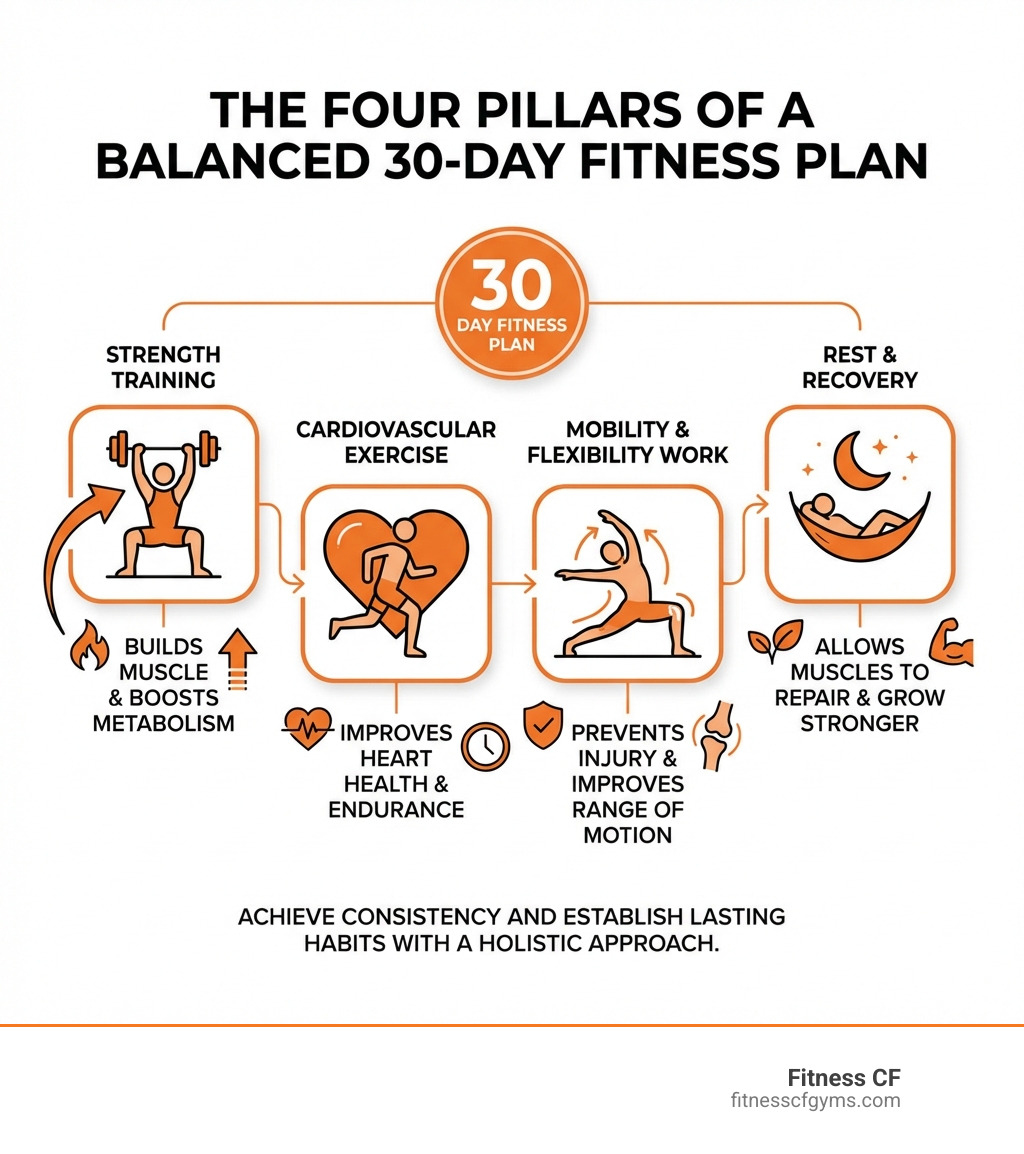
- Strength Training – 3-5 workouts per week using bodyweight or dumbbells
- Cardiovascular Exercise – Activities like walking, running, or HIIT for heart health
- Mobility Work – Stretching and movement to prevent injury
- Rest Days – At least 1-2 days weekly for muscle recovery
- Progressive Challenge – Gradually increasing intensity through reps, sets, or new exercises
Sometimes, the most challenging part of working out is knowing what to do. Cold weather, a hectic work schedule, or even boredom with your workout routine can throw you off your fitness and nutrition goals. That’s where a structured 30 day fitness plan becomes your roadmap.
The beauty of a 30-day commitment is simple: consistency over intensity. You’re not trying to transform overnight. Instead, you’re building a foundation that makes exercise a natural part of your daily routine. Research shows that committing to daily exercise activity for 4-5 weeks helps establish a lasting habit.
Within these 30 days, you’ll work on fundamental movement patterns, learn different training methodologies like intervals and AMRAP (As Many Rounds As Possible), and find what your body can actually do. By day 30, you’ll be moving better, feeling fitter, and looking different than you did on day one.
30 day fitness plan terms explained:
The ‘Why’ Behind the Workout: Core Principles for Lasting Health
Starting on a 30 day fitness plan isn’t just about changing how you look; it’s about fundamentally improving your health and establishing habits that serve you for years to come. We believe in a holistic approach that nurtures both body and mind.

Building Sustainable Habits, Not Just Temporary Gains
One of the most profound benefits of a 30 day fitness plan is its ability to foster sustainable habits. We often hear about “consistency over intensity,” and this rings especially true when starting a new fitness journey. Rather than pushing yourself to exhaustion daily, which can lead to burnout or injury, our focus is on showing up consistently.
The psychology behind habit formation is fascinating. Science tells us that by committing to a daily exercise routine for four to five weeks, you’re actively teaching your body a new groove and creating a new habit. It’s like paving a new neural pathway–the more you use it, the stronger it becomes. This isn’t just our opinion; scientific research on habit formation supports the idea that consistent activity makes it more likely to become a lasting habit.
Creating a new routine involves intentional steps. We recommend setting a specific time and place for your workouts, just as you would any other important appointment. This eliminates decision fatigue and makes it easier to simply start. The role of commitment cannot be overstated; deciding to do something every day for 30 days is a powerful first step. This commitment lays the groundwork for long-term benefits, ensuring that your fitness journey is not a fleeting sprint, but a marathon of sustained health and vitality. You’re building practices that will be useful for the rest of your fitness life.
The Pillars of Physical Fitness
A well-rounded 30 day fitness plan incorporates several key components, each offering unique and synergistic benefits to your overall physical health.
First, let’s talk about the incredible benefits of strength training. This isn’t just for bodybuilders; it’s fundamental for everyone. Strength training builds muscle, which in turn boosts your metabolism, helping your body burn more calories even at rest. It also plays a crucial role in improving bone density, reducing the risk of osteoporosis as we age. For beginners, it’s about building foundational strength, improving functional fitness, and supporting healthy weight management.
Next, we have cardiovascular exercise, often simply called cardio. This is vital for improving heart health, increasing your endurance, and burning calories. Activities like brisk walking, running, cycling, or swimming strengthen your heart and lungs, reducing the risk of heart disease–a leading cause of death for both men and women. Even short, effective bursts like HIIT (High-Intensity Interval Training) can blast calories and keep your heart strong.
Finally, we emphasize the importance of mobility and flexibility. These are often overlooked but are essential for injury prevention and improving your overall range of motion. Mobility and core work are critical components of a balanced fitness routine, helping your body move more efficiently and comfortably in everyday life. Think of it as the grease for your body’s engine, ensuring everything runs smoothly.
How to Build Your Own 30 Day Fitness Plan
Designing an effective 30 day fitness plan might seem daunting, but we’re here to simplify it for you. Our goal is to provide a blueprint that you can adapt to your own needs and lifestyle, ensuring it’s both challenging and sustainable.
Step 1: Choose Your Foundational Exercises
The philosophy behind using a limited pool of exercises for an entire challenge is quite clever: it helps you master form and simplifies your routine, reducing the intimidation factor. Instead of learning dozens of new movements, you focus on perfecting a select few. This allows you to truly “flex your muscles, both figuratively and literally,” as you become more efficient with each repetition. We prioritize quality reps for each move, ensuring you build strength safely and effectively.
For our 30 day fitness plan, we often use a core group of 11 exercises that cover mobility, upper body, lower body, and core. These are excellent compound movements that engage multiple muscle groups simultaneously, making your workouts more efficient.
Here are some examples of core exercises we might use:
- Mobility:
- Spiderman Lunge to T-Spine: Great for hip mobility and thoracic rotation.
- Squat to T-Spine: Combines a deep squat with upper body rotation, improving flexibility.
- Glute Bridge Reach Alternating: Activates glutes and core while adding a rotational reach.
- Upper Body:
- Pushup: A classic for chest, shoulders, and triceps.
- Close-Grip Pushup: Emphasizes triceps and inner chest.
- Bent-Over T Raise: Strengthens upper back and shoulders, improving posture.
- Lower Body:
- Paused Squat: Builds strength and control in the squat movement.
- Glute Bridge Single-Leg: Targets glutes and hamstrings, improving balance.
- Core:
- Hollow Rock: Develops core strength and stability.
- Plank Shoulder-Tap: Strengthens core while challenging stability.
- Mountain Climber: A dynamic core and cardio exercise.
Many of these can be performed as bodyweight options, requiring no special equipment, making them perfect for at-home workouts. For those ready to add intensity, dumbbell options can be incorporated, using weights that challenge you but still allow for perfect form.
Step 2: Structure Your Week for Balance and Recovery
Consistency is the name of the game, and a well-structured week is your secret weapon. For most beginners, we find that 3-5 workouts a week is ideal. This allows for sufficient training stimulus without overtraining, which can lead to injury or burnout.
We might structure your week with full body splits, where you work all major muscle groups in one session, performed 3-4 times per week. Alternatively, an upper/lower split, where you dedicate days to either upper or lower body, can also be effective. The key is to ensure each muscle group is worked adequately throughout the week.
Just as important as your workouts are your rest days. The critical role of rest days cannot be overstated. Your muscles don’t grow during your workout; they grow and repair during recovery. Rest days are crucial for your body and mind to recover and reset. We also encourage active recovery, which involves light activity that gets your blood flowing without stressing your muscles too much. Think gentle walks, yoga, or mobility work–these can aid in recovery and keep you moving without hindering progress. Listening to your body is paramount; if you feel overly fatigued or sore, an extra rest day is always a wise choice.
Step 3: Implement Smart Training Methodologies
To keep your 30 day fitness plan engaging and effective, we incorporate various training methodologies. This prevents boredom and constantly challenges your body in new ways, ensuring continuous progress.
One common method is Interval Training, where you alternate between periods of high-intensity exercise and short recovery periods. A popular format is 40 seconds of work followed by 20 seconds of rest. This is a fantastic way to improve cardiovascular fitness and muscular endurance efficiently.
Another exciting methodology is AMRAP, which stands for “As Many Rounds As Possible.” In an AMRAP workout, you perform a set number of exercises for a specified time, trying to complete as many rounds as you can. This pushes your limits and helps you build work capacity.
Then there’s EMOM, or “Every Minute On the Minute.” With EMOM, you perform a set number of repetitions at the top of each minute. If you finish before the minute is up, the remaining time is your rest. This method is excellent for improving strength, power, and pacing.
Finally, EMOM+1 takes EMOM a step further by having you add one repetition each round, creating a progressive challenge within the workout itself. By rotating through these methodologies, your body never quite knows what to expect, leading to better adaptation and preventing plateaus. This variety is key to keeping your motivation high and your results coming!
A Sample Blueprint for Your First 30 Day Fitness Plan
Now that we’ve covered the “why” and “how,” let’s look at a sample blueprint for your first 30 day fitness plan. This is a guide, and we encourage you to adjust it based on your fitness level and how your body responds.
Week 1: Mastering Form with Interval Training
Week 1 is all about establishing a baseline and mastering the form of our foundational exercises. We’ll primarily use an Interval Training format, typically working for 40 seconds, then taking 20 seconds off unless otherwise stated. The focus here is on quality reps, not speed.
A typical Week 1 might look something like this, rotating through our core exercises:
- Day 1: Mobility & Core Focus
- Warm-up
- Intervals: Spiderman Lunge to T-Spine, Squat to T-Spine, Hollow Rock, Plank Shoulder-Tap
- Cool-down
- Day 2: Upper Body Strength
- Warm-up
- Intervals: Pushup, Close-Grip Pushup, Bent-Over T Raise
- Cool-down
- Day 3: Lower Body Strength
- Warm-up
- Intervals: Paused Squat, Glute Bridge Single-Leg
- Cool-down
- Day 4: Rest or Active Recovery
- Light walk, gentle stretching, or complete rest.
- Day 5: Full Body Circuit
- Warm-up
- Intervals: Mountain Climber, Pushup, Paused Squat, Plank Shoulder-Tap (rotate through these for 2-3 rounds)
- Cool-down
- Day 6: Upper Body & Core
- Warm-up
- Intervals: Bent-Over T Raise, Hollow Rock, Close-Grip Pushup
- Cool-down
- Day 7: Rest or Active Recovery
Weeks 2-4: Increasing Intensity with AMRAP and EMOM
As you move into Weeks 2 through 4, we’ll gradually increase the intensity and introduce new training methodologies to keep your body adapting and growing stronger. This is where you’ll start to see and feel significant changes!
Here’s how the structure evolves:
| Week | Training Methodology | Typical Duration | Intensity Focus |
|---|---|---|---|
| 1 | Intervals | 40s work, 20s rest | Form & Baseline |
| 2 | AMRAP | 8 minutes per workout | Volume & Endurance |
| 3 | EMOM | 8 minutes per workout | Power & Pacing |
| 4 | EMOM +1 | 8 minutes per workout | Progressive Overload |
Week 2: AMRAP (As Many Rounds As Possible)
In Week 2, we’ll challenge you to complete as many rounds as possible of a given circuit within an 8-minute timeframe for each workout. This pushes your endurance and work capacity. You’ll use the same foundational exercises, but the goal shifts from strict timing to maximizing your output.
Week 3: EMOM (Every Minute On the Minute)
Week 3 introduces EMOM, again with an 8-minute duration for each daily workout. For example, you might do 5 push-ups at the top of every minute. If you finish in 20 seconds, you rest for 40 seconds before the next minute begins. This method builds strength, power, and helps you learn to manage your effort.
Week 4: EMOM +1 (Progressive EMOM)
The final week of your initial 30 day fitness plan takes EMOM up a notch. In EMOM +1, you’ll add one repetition to your exercise each round. If you started with 5 push-ups in minute one, you’ll do 6 in minute two, 7 in minute three, and so on, for 8 minutes. This is a fantastic way to apply progressive overload and truly test your limits.
Throughout these weeks, it’s crucial to push your limits safely. This means maintaining proper form even as you increase intensity. Remember what we said: beginners can certainly take on this challenge, and even fitness pros can push themselves to their full potential by maximizing their effort within these structures. If you need to modify an exercise (e.g., knee push-ups instead of standard), that’s perfectly fine–the goal is movement and consistency.
Beyond 30 Days: Progressing for Long-Term Success
Completing a 30 day fitness plan is a fantastic achievement, but it’s just the beginning of your journey to a healthier, stronger you. The real magic happens when you continue to build on that foundation.
Progressive Overload: The Key to Continuous Improvement
The secret sauce to continuous improvement and avoiding plateaus is something called progressive overload. Simply put, it means gradually increasing the demands placed on your body over time. Your body is incredibly adaptive, and once it gets used to a certain stimulus, it stops changing. To keep making gains, we need to challenge it more.
There are several ways we can apply progressive overload:
- Increasing Weight: If you’re using dumbbells, gradually increase the weight you lift. We aim for a weight where your last few reps are a struggle, but you can still complete the set with good form.
- Increasing Reps or Sets: If you’re doing bodyweight exercises, you can add more repetitions or an extra set to your routine. Over the course of a month, you should notice your ability to do more reps improving.
- Decreasing Rest Time: Shortening the rest periods between sets or exercises can make a workout more challenging and improve your endurance.
- Increasing Time Under Tension: Slowing down the movement of an exercise can increase the demand on your muscles.
- Introducing More Challenging Variations: As you get stronger, you can progress to more difficult versions of exercises (e.g., from knee push-ups to standard push-ups, or from standard squats to jump squats).
By consistently applying progressive overload, you’ll keep your muscles guessing and continue to build strength, endurance, and definition. This ensures you’re always moving better, feeling fitter, and looking different than you did on day one–even well past the 30-day mark.
How to Extend Your 30 Day Fitness Plan
A 30 day fitness plan is a fantastic springboard, and there’s no reason why your journey has to stop there. We encourage you to think of it as the first chapter in a much longer story. Turning 4 weeks into 8, 12, or even a lifelong routine is entirely achievable.
Here’s how we can extend and evolve your plan:
- Introduce New Exercises: Once you’ve mastered the foundational 11, we can gradually add new exercises to keep things fresh and target muscles in different ways. This prevents boredom and ensures comprehensive development.
- Change Training Methodologies: Continue exploring different training styles. Perhaps incorporate more circuit training, supersets, or even specialized programming focused on specific goals like strength or hypertrophy.
- Set New Goals: What do you want to achieve next? Maybe it’s running a 5K, performing a certain number of pull-ups, or simply increasing your overall strength. Setting new, measurable goals keeps you motivated and provides direction.
- Re-evaluate and Adapt: Periodically assess your progress and adjust your plan. What’s working? What needs more attention? Fitness is a dynamic process, and your plan should evolve with you.
The ultimate goal of any 30 day fitness plan is to kickstart your journey toward a permanent healthy lifestyle. By focusing on consistency, progressive overload, and enjoying the process, you’re not just getting fit for a month; you’re building a healthier, stronger future for yourself.
Frequently Asked Questions About Fitness Plans
We often hear similar questions from those starting on a new 30 day fitness plan. Let’s address some of the most common ones to help you feel confident and prepared.
How much weight should a beginner lift?
This is a fantastic question, and the answer is simpler than you might think: start light, and focus relentlessly on your form. When in doubt, always go lighter. It’s far better to perform an exercise with perfect technique using a lighter weight than to struggle with poor form using a heavier one, which significantly increases the risk of injury.
For beginners, we recommend selecting a weight that allows you to complete your prescribed repetitions (e.g., 8-12 reps) while still feeling challenged. A good rule of thumb is the “last few reps” rule: your chosen weight should be heavy enough that your last few repetitions are a struggle, but you are still able to complete the workout with control. If you’re doing compound exercises, you should finish a set feeling like you could have performed 1-3 more reps. For isolation exercises, you can push a little closer to complete failure.
Many of our foundational exercises can be done with bodyweight, which is an excellent starting point. Once you feel comfortable and stronger with your bodyweight, that’s when we can gradually increase the weight or add another set to continue progressing. Consistency and good form will always trump heavy lifting with bad technique.
What should I eat while on a workout plan?
Nutrition is absolutely critical to the success of any 30 day fitness plan. You can’t out-train a poor diet! We emphasize a balanced diet rich in proteins, healthy fats, and complex carbohydrates to fuel your body and support recovery.
- Proteins: These are the building blocks of your muscles. Adequate protein intake is essential for muscle repair and growth, especially after strength training. Think lean meats, poultry, fish, eggs, dairy, and plant-based sources like legumes and tofu.
- Complex Carbohydrates: Your body’s primary energy source. They provide sustained energy for your workouts and daily activities. Choose whole grains, fruits, and vegetables over refined sugars.
- Healthy Fats: Important for hormone production, nutrient absorption, and overall health. Avocados, nuts, seeds, and olive oil are great choices.
Beyond these macronutrients, the role of hydration cannot be overstated. Water is involved in almost every bodily function, including nutrient transport and temperature regulation. We encourage you to stay well-hydrated throughout the day, especially before, during, and after your workouts. Think of your food and water as the fuel and oil for your high-performance engine!
How do I stay motivated if I miss a day?
We’ve all been there! Life happens, and sometimes a workout gets missed. The most important thing we can tell you is: don’t let one missed day derail your entire 30 day fitness plan. This is where the “all-or-nothing” fallacy can become your biggest enemy.
Instead, we want you to focus on consistency, not perfection. Missing a single workout won’t undo your progress, just as one healthy meal won’t make you instantly fit. The power of a 30-day challenge lies in building a habit, and habits are formed by repeatedly showing up, even after a stumble.
If you miss a day, simply get back on track the next day. Don’t beat yourself up; practice self-compassion. If you struggle to get back into it, you can take a couple of days off and resume, or even do the challenge on alternate days if that fits your schedule better. These adjustments might extend the challenge duration slightly, but you’ll still reap the incredible benefits. The goal is to make fitness a sustainable part of your life, not a source of guilt.
Conclusion: Your Journey to a Healthier, Stronger You
We’ve explored the incredible potential of a 30 day fitness plan–not just as a short-term goal, but as a powerful catalyst for long-term health and well-being. We’ve highlighted the importance of consistency, the power of a structured approach, and the necessity of progressive overload to keep your body adapting and growing stronger. Fitness is a lifelong journey, and beginning with a clear, actionable plan is the most effective way to start.
The most challenging part of working out is often knowing where to begin. With a well-designed 30 day fitness plan, you gain clarity, direction, and the confidence to take that crucial first step. You’ll build sustainable habits, learn diverse training methodologies, and find a newfound strength, both physically and mentally.
At Fitness CF, we are committed to helping you achieve your health and fitness goals. Whether you’re a beginner looking for guidance or a seasoned enthusiast seeking a new challenge, we have the resources and expertise to support you.
Ready to transform your fitness journey and create lasting healthy habits? Take the next step with expert guidance and let us help you design a plan that truly works for you.