Can You Really Build Muscle in 30 Days?
A 30 day muscle gain plan is a structured workout and nutrition program designed to help you build noticeable muscle mass in one month. While you won’t transform into a bodybuilder overnight, beginners can realistically gain 1-2 pounds of muscle in 30 days through consistent training, proper nutrition, and adequate recovery.
What to Expect from a 30-Day Muscle Gain Plan:
- Realistic Gains: Beginners may gain 1-2 pounds of muscle per month
- Visible Changes: Increased muscle definition, especially for leaner individuals
- Training Frequency: 3-5 workout sessions per week
- Nutrition Focus: Slight calorie surplus with 1.6-2.2g protein per kg of body weight
- Recovery: 7-9 hours of sleep nightly for muscle repair and growth
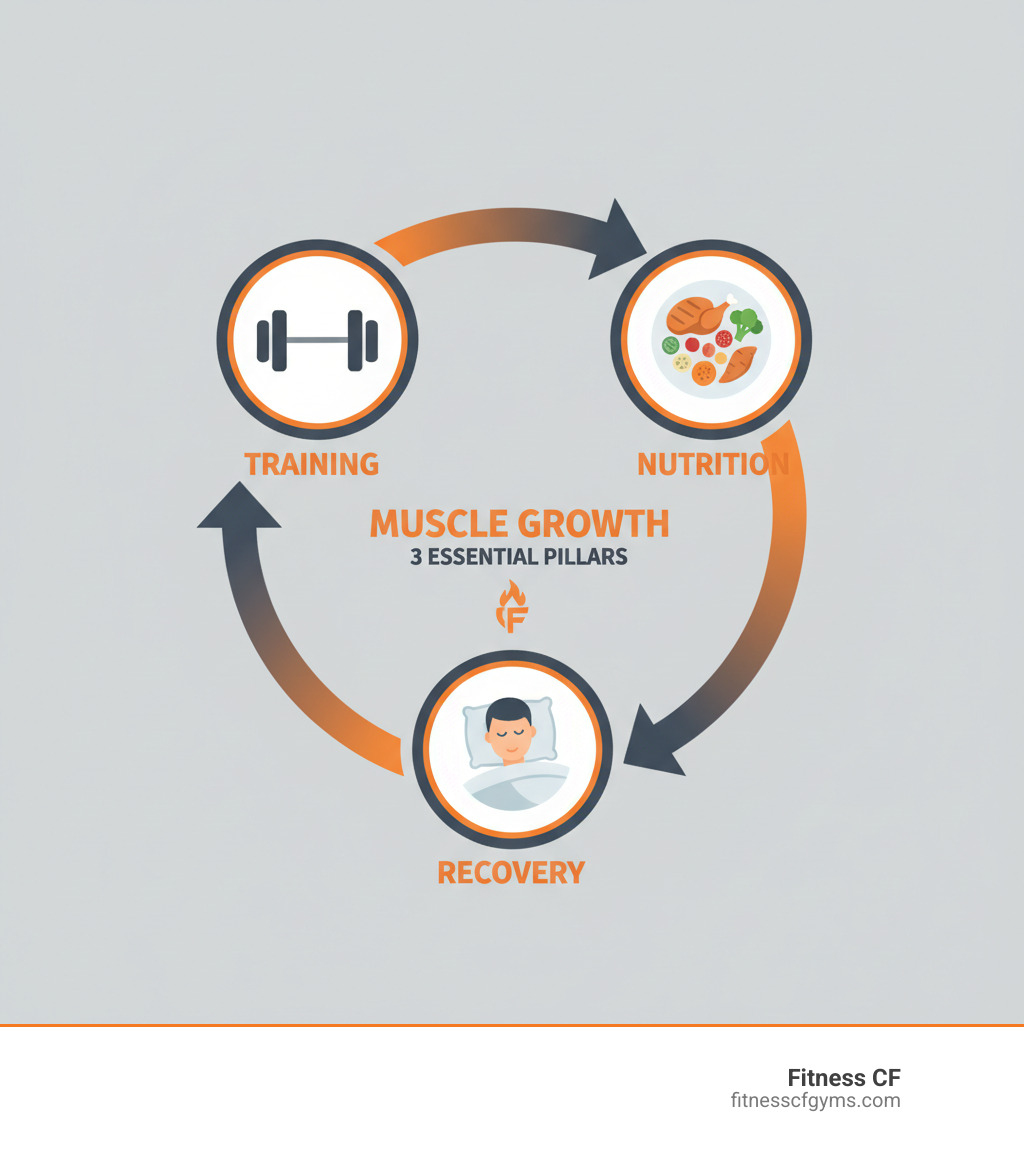
Building muscle in 30 days is absolutely possible, but it requires more than just showing up to the gym. You need three essential pillars working together: progressive resistance training, proper nutrition, and adequate recovery. The good news? Beginners often experience what’s called “newbie gains”—rapid muscle growth during the first few months of consistent training.
Beyond aesthetics, strength training offers profound health advantages like increased bone density, improved posture, reduced stress, and a boosted metabolism. A structured 30-day plan provides the clear direction needed to break through fitness plateaus.
I’m Pleasant Lewis, and I’ve spent over 40 years in the fitness industry helping thousands of members achieve their strength goals through structured 30 day muscle gain plans at Fitness CF. Throughout my career, I’ve witnessed how a focused month of training can jumpstart transformative fitness journeys for people at every experience level.
The Science of Muscle Growth: 3 Core Principles
Let’s talk about what’s actually happening inside your body when you’re working to build muscle. The process is called muscle hypertrophy, and it’s simpler than the fancy name suggests. When you challenge your muscles during a workout, you create tiny tears in the muscle fibers. Your body then gets to work repairing these microscopic tears, making the fibers thicker and stronger than before. This rebuilding process is driven by something called muscle protein synthesis—essentially, your body’s way of constructing new muscle tissue.
Here’s the thing: muscle growth doesn’t happen by accident. You need to create the right environment for your muscles to adapt and grow. This means showing up consistently with your training, eating the right foods, and giving your body time to recover. It’s not just about pumping iron and hoping for the best—it’s about all three pieces working together.
The benefits of resistance training extend beyond aesthetics to include stronger bones, better posture, and more energy for daily life. Committing to building muscle is an investment in healthy living that makes everything from carrying groceries to playing with your kids easier.
Progressive Overload: The Key to Continuous Gains
Your muscles are smart—maybe too smart. Give them the same challenge over and over, and they’ll adapt quickly. Once they’ve adapted, they stop growing. This is where progressive overload becomes your best friend. It’s the principle of continuously challenging your muscles to do a little more than they did last time.

Think of it this way: if you always lift the same 10-pound dumbbells for the same 10 repetitions, your muscles will quickly say, “Got it, we can handle this,” and stop adapting. To keep making gains during your 30 day muscle gain plan, you need to gradually increase the demands you’re placing on them.
This gradual increase can happen in several ways: increase the weight you’re lifting, increase your repetitions with the same weight, or increase your sets. You can also slow down movements to increase time under tension or decrease rest periods between sets.
The key is to be gradual. Small, consistent increases add up to significant gains over time. Scientific research on progressive overload confirms this is the cornerstone of muscle growth. Without it, your progress will stall.
Fueling Your Muscles: Nutrition for Hypertrophy
Trying to build muscle without proper nutrition is like building a house without bricks. Workouts break down muscle, but food is what builds it back up stronger.
The foundation of muscle-building nutrition is a calorie surplus. This simply means eating more calories than your body burns each day. Your body needs that extra energy to fuel intense workouts and to have the resources available for muscle repair and growth. For most beginners, a surplus of 300-500 calories above your maintenance level is a good starting point—enough to support muscle growth without adding excessive body fat.
But not all calories are created equal. The three macronutrients—protein, carbohydrates, and fats—each play distinct roles in your muscle-building journey.
Protein is the undisputed champion of muscle building. It provides amino acids, which are literally the building blocks your body uses to repair and construct new muscle tissue. For effective muscle growth, aim for 1.6 to 2.2 grams of protein per kilogram of body weight daily, as supported by ACSM guidelines on protein intake. If you weigh 70 kilograms (about 154 pounds), that’s roughly 112 to 154 grams of protein each day.
Carbohydrates often get a bad rap, but they’re essential for anyone serious about building muscle. They replenish glycogen stores in your muscles, providing the primary fuel source for those intense training sessions. Without adequate carbs, you’ll feel sluggish in the gym and won’t have the energy to push through challenging sets. Think of carbs as the high-octane fuel that powers your workouts.
Healthy fats are crucial for hormone production, including testosterone, which plays a significant role in muscle growth. They also provide concentrated energy and support countless bodily functions. Don’t fear fats—accept sources like avocados, nuts, olive oil, and fatty fish as allies in your muscle-building journey.
Finally, hydration is also essential. Your muscles are roughly 75% water, so staying well-hydrated is critical for performance and growth. Aim for at least 3 liters of water daily, adjusting for workout intensity and Florida’s warm climate.
Rest and Recovery: Where the Magic Happens
A surprising truth is that muscles don’t grow in the gym; they grow during rest. Workouts create the stimulus, but recovery is when your body repairs the microscopic tears in muscle fibers, making them larger and stronger. This process is highly dependent on sleep. Aim for 7 to 9 hours of quality sleep each night. During deep sleep cycles, your body releases growth hormones that are vital for muscle protein synthesis and overall recovery.
Skimping on sleep is like trying to charge your phone with a broken charger—you won’t get the full benefit of your hard work. I’ve seen countless people struggle with their 30 day muscle gain plan simply because they weren’t prioritizing rest.
There’s also a real risk of overtraining. Pushing yourself too hard without adequate recovery can lead to injuries, constant fatigue, decreased performance, and ironically, even muscle loss. It’s completely counterproductive. Your body needs time to adapt and grow stronger. Learning to listen to your body and recognize signs of fatigue is just as important as learning proper form.
This doesn’t mean you should be completely sedentary on rest days. Active recovery can be incredibly beneficial. Light activities like gentle stretching, foam rolling, or easy mobility work promote blood flow and aid muscle repair without adding significant stress. A leisurely walk or some gentle yoga can help reduce soreness and prepare your body for the next intense session.
Think of recovery as the foundation upon which all your gym efforts are built. Without it, everything else crumbles. Consistency in recovery is just as important as consistency in training and nutrition for a successful muscle-building journey.
Your Ultimate 30 Day Muscle Gain Plan
Now, let’s put the science into action with a structured program that combines everything we’ve learned about progressive overload, nutrition, and recovery.
Your 30 day muscle gain plan combines compound exercises (movements that work multiple muscle groups at once) with isolation exercises (movements targeting specific muscles) to ensure balanced, comprehensive development. Think of compound exercises as your “biggest bang for your buck” movements—exercises like squats and bench presses that recruit numerous muscles simultaneously. Isolation exercises then allow us to fine-tune specific areas that might need extra attention.
The plan has built-in progression. Instead of doing the same workouts for 30 days, we’ll strategically increase the challenge every two weeks with different workout splits.
Consistency is key. The best plan won’t work unless you follow it. Committing to this month means showing up for workouts, fueling your body, and prioritizing recovery. That’s the formula for success.
Weeks 1-2: Building a Strong Foundation (Full-Body Workouts)
The first two weeks establish fundamentals. This phase is crucial for beginners to learn proper form and build foundational strength, but it’s also an excellent re-entry point for experienced lifters.
We’ll be doing full-body training three times per week, with rest days between sessions. This frequency hits all your major muscle groups regularly, which triggers muscle protein synthesis throughout the week. It’s an efficient approach that maximizes results while giving your body adequate recovery time.
Proper form matters more than the weight you lift. Learning correct technique now prevents future injuries and ensures you’re targeting the right muscles. Start with a lighter weight; you can add more once your form is perfect.
Your full-body sessions should include goblet squats for legs and core (holding a dumbbell vertically against your chest while squatting), dumbbell bench presses to build chest, shoulders, and triceps strength, and bent-over dumbbell rows for back development. Round out each workout with dumbbell lunges to further challenge your lower body and planks to strengthen your core.
Aim for 3 sets of 8-12 repetitions for each exercise. Rest for 60-90 seconds between sets—long enough to catch your breath, but not so long that your muscles completely cool down. On your non-training days, focus on the recovery strategies we discussed earlier: quality sleep, proper nutrition, and maybe some gentle stretching or walking.
Weeks 3-4: Increasing Intensity (Upper/Lower Split)
By week three, your body is ready for more. We’ll shift to an upper/lower split, dedicating workouts to either upper or lower body. This allows for increased volume and greater targeted intensity for each muscle group.
You’ll train four times per week: two upper-body and two lower-body days, with rest days in between. This split allows for more thorough work on each muscle group while ensuring adequate recovery. You’ll be stronger than in week one, so you can push harder.
On your upper body days, focus on building strength and size in your chest, back, shoulders, and arms. The overhead press (with dumbbells or a barbell) builds powerful shoulders. Pull-ups or lat pulldowns create that coveted back width and strength—if pull-ups are too challenging right now, the lat pulldown machine is an excellent alternative. Continue with bench presses or try incline variations to target your upper chest more directly. Bent-over rows further develop back thickness, while bicep curls and tricep extensions round out your arm development.
Your lower body days are where you’ll build serious leg and glute strength. Barbell squats remain the king of lower body exercises, recruiting virtually every muscle from your hips down. Romanian deadlifts with dumbbells or a barbell specifically target your hamstrings and glutes through that critical hinge movement pattern. The leg press allows you to safely load heavier weight to build mass in your quads and glutes. Add in hamstring curls for isolated hamstring work and calf raises to develop your lower legs. Don’t forget to include planks or leg raises to keep your core strong and stable.
For these weeks, aim for 3-4 sets of 6-12 repetitions for most exercises. Rest 90-120 seconds between sets for compound movements like squats and presses—these exercises demand more from your body and require longer recovery. For isolation exercises like curls, 60-90 seconds is sufficient. And remember that progressive overload principle? This is where it really comes into play. Each week, try to increase either the weight you’re lifting or the number of reps you’re completing.
Beyond the Workout: Nutrition and Lifestyle Tips
Your 30 day muscle gain plan succeeds or fails based on what you do outside the gym. Workouts break down muscle, but nutrition and lifestyle habits build it back stronger. This holistic approach is what separates those who see real results from those who don’t.
Meal planning is a smart investment in your fitness. Planning ahead removes guesswork and helps you avoid unhealthy choices when you’re busy or hungry. Having nutritious, muscle-building meals ready keeps you on track.

What to Eat for Your 30 Day Muscle Gain Plan
Let’s get practical about fueling your body for muscle growth. We covered the basics earlier, but now it’s time to build your daily nutrition strategy.
Meal timing matters. Spread your protein intake throughout the day, eating a protein-rich meal or snack every 3-4 hours. This keeps your muscles in a constant state of repair and growth by maintaining muscle protein synthesis.
Hydration deserves its own spotlight because it’s so often overlooked. Your muscles are roughly 75% water, and even mild dehydration can hurt your performance and recovery. Aim for at least 3 liters of water daily, more if you’re sweating heavily during workouts. Keep a water bottle with you throughout the day as a constant reminder.
When it comes to lean protein sources, you have plenty of delicious options. Chicken breast and turkey are gym staples for good reason—they’re high in protein and low in fat. Salmon brings the added bonus of omega-3 fatty acids for heart health and reduced inflammation. Eggs are incredibly versatile and packed with nutrients. Greek yogurt and cottage cheese make excellent snacks with impressive protein content. If you prefer plant-based options, tofu, tempeh, and legumes can absolutely support muscle growth.
Complex carbohydrates are your workout fuel. Quinoa is a complete protein source and provides sustained energy. Brown rice, oats, and sweet potatoes replenish your muscle glycogen stores after training. Don’t forget fruits and vegetables—they provide carbohydrates plus essential vitamins, minerals, and fiber that support overall health and recovery.
Healthy fats play a crucial role in hormone production, including testosterone, which directly impacts muscle growth. Avocados are nutrient-dense and incredibly satisfying. Nuts and seeds provide protein, healthy fats, and important micronutrients (just watch portion sizes since they’re calorie-dense). Olive oil is perfect for cooking or drizzling on salads. The fatty fish we mentioned earlier, like salmon, does double duty as both a protein and healthy fat source.
Here’s what a day of muscle-building eating might look like: Start your morning with scrambled eggs loaded with spinach, a slice of whole-wheat toast, and a piece of fruit. For lunch, enjoy grilled chicken breast over mixed greens with quinoa and an olive oil vinaigrette. Mid-afternoon, reach for Greek yogurt with berries and a handful of almonds. Dinner could be baked salmon with roasted sweet potatoes and steamed broccoli. After your workout, blend up a protein shake with a banana to kickstart recovery. Simple, satisfying, and effective.
The Importance of Cardio and Active Recovery
Surprisingly, cardiovascular exercise supports strength training. While muscle gain is the focus, don’t ignore cardio. Low-impact cardio improves heart health and stamina, boosts blood flow for recovery, and helps manage body fat so your muscle definition shows.
The American Heart Association recommends getting 75-150 minutes of aerobic activity each week alongside your strength training. For our 30 day muscle gain plan, we suggest incorporating low-impact cardio like brisk walking, cycling, or swimming on your active recovery days. These activities lift your heart rate without beating up your joints or interfering with muscle recovery. A 20-30 minute walk can do wonders for your overall fitness without compromising your gains.
Active recovery days aren’t for being sedentary. They involve gentle movement that promotes healing without stress. Try yoga for flexibility, foam rolling to increase blood flow to sore areas, or gentle stretching to reduce soreness and improve your range of motion. Think of active recovery as maintenance work for your body.
Think of active recovery as maintenance work. You wouldn’t drive your car hard every single day without occasionally checking the oil and tire pressure, right? Your body deserves the same thoughtful care. These recovery practices reduce your injury risk, help you feel better day-to-day, and ultimately allow you to train harder when it counts. Consistency in recovery is just as important as consistency in training—both are essential pillars of a successful muscle-building journey.
Frequently Asked Questions about Building Muscle in 30 Days
Starting a 30 day muscle gain plan brings up plenty of questions—and that’s completely normal! When you’re investing time and energy into changing your body, you want to know what’s realistic and what’s actually achievable. Let’s tackle the most common concerns we hear from people just like you who are ready to build muscle but want to set the right expectations.
Can you see visible muscle growth in 30 days?
Here’s the exciting truth: yes, you absolutely can see visible changes in just 30 days! This is especially true if you’re new to strength training. Now, let’s be real—you’re not going to look like you’ve been bodybuilding for years. But you will notice something wonderful happening to your body.
For beginners, the changes can be quite striking. You’ll likely see noticeable muscle definition, particularly in areas you’re targeting with your workouts. Your arms might look more toned, your shoulders more defined, and your legs more sculpted. If you’re starting with a leaner physique and lower body fat percentage, these changes will be even more apparent because there’s less covering up your hard-earned muscle.
Consider this: gaining just 2 pounds of lean muscle can make a significant visual difference. Your clothes might fit differently, your posture may improve, and you’ll likely see more firmness and shape where there was once softer tissue. The key ingredient? Consistency is crucial. Skipping workouts or neglecting your nutrition will slow these visible results, but stick with your plan faithfully, and you’ll be pleasantly surprised by what you see in the mirror come day 30.
Is a 30-minute workout enough to build muscle?
This is one of my favorite questions because it challenges the myth that you need to spend hours in the gym to see results. The honest answer is yes—a 30-minute workout can absolutely build muscle, but there’s an important caveat: it needs to be the right kind of 30 minutes.
The secret lies in high-intensity training and making every minute count. If you’re focused, pushing yourself with proper progressive overload, and prioritizing compound movements that work multiple muscle groups simultaneously, you can stimulate significant muscle growth in half an hour. Think about exercises like squats, deadlifts, bench presses, and rows—these powerhouse movements recruit numerous muscles at once, giving you maximum return on your time investment.
Quality over quantity is the mantra here. A well-structured, intense 30-minute session where you’re truly challenging your muscles beats a lazy 90-minute workout where you’re spending more time scrolling through your phone than lifting weights. Focus on compound exercises, minimize rest between sets (while still allowing adequate recovery), and maintain proper form throughout. Your muscles don’t have a clock—they respond to the stress and stimulus you provide, not the amount of time you spend in the gym.
How much muscle can a beginner realistically gain in a month?
Let’s talk numbers, because having realistic expectations is essential for staying motivated throughout your 30 day muscle gain plan. For beginners, gaining approximately 1-2 pounds of lean muscle in a month is not only realistic—it’s a solid achievement you should be proud of.
This rapid initial progress is what fitness enthusiasts affectionately call “newbie gains.” When your body encounters resistance training for the first time (or after a long break), it responds enthusiastically. Your muscles are like, “Whoa, what’s happening here? We better adapt fast!” This leads to quicker strength improvements and muscle growth than you’ll experience later in your fitness journey.
Now, if you’re someone who’s been lifting weights consistently for years, your gains will be slower—typically around 0.5-1 kilogram (roughly 1-2 pounds) of muscle per month, and sometimes even less. This isn’t a failure; it’s simply biology. Your body has already adapted significantly to resistance training, so further improvements require more time and effort.
These numbers vary by individual. Your genetics, how consistently you follow your nutrition plan, your sleep quality, your stress levels, and your training intensity all play roles in determining your specific results. Some people might gain slightly more, others slightly less. The important thing is that you’re moving forward, getting stronger, and building healthy habits that will serve you for life.
Conclusion: Your Journey to a Stronger You
Congratulations on taking the first step! Starting on a 30 day muscle gain plan is more than just a fitness challenge—it’s the beginning of finding what your body is truly capable of. And here’s the beautiful truth: while you’ll absolutely see and feel changes in these 30 days, this is really just the opening chapter of your strength story, not the final page.
Think of this month as your launchpad. You’ll notice muscles you didn’t know you had, feel stronger carrying groceries, and probably catch yourself flexing in the mirror (we all do it!). But the real magic happens when you realize that building muscle isn’t about a finish line—it’s about embracing a lifestyle that makes you feel powerful, confident, and energized every single day.
Let’s quickly recap the three pillars that will carry you forward: consistency in your training with progressive overload, smart nutrition that fuels your body like premium gasoline, and quality rest where the actual muscle building happens. These aren’t just fitness principles; they’re the foundation of a healthier, more vibrant life. The strength you build in the gym carries over into everything else—chasing after your kids, tackling yard work, or simply feeling more capable in your daily activities.
Celebrate every victory along the way. Did you add an extra rep today? Awesome. Did you choose a nutritious meal when you were tempted by fast food? That’s progress. Did you prioritize sleep over late-night TV? You’re winning. These small choices compound into remarkable changes over time.
For Central Florida residents ready to accelerate their results with expert support and a community that has your back, the certified trainers at Fitness CF are here to help you succeed. We’ve guided countless members through their muscle-building journeys, and we’d love to be part of yours. Explore our personal training programs and find how personalized coaching can help you reach goals you never thought possible.
Your stronger self is waiting. Let’s get after it together.