Why Fitness for Beginners is the Most Important Step You’ll Ever Take
Fitness for beginners is about taking that first step toward better health—and it’s simpler than you think. Here’s what you need to know:
Quick Start Guide for Fitness Beginners:
- Start slowly – Begin with 5-10 minutes of activity and gradually build up
- Choose enjoyable activities – Walking, swimming, or bodyweight exercises work great
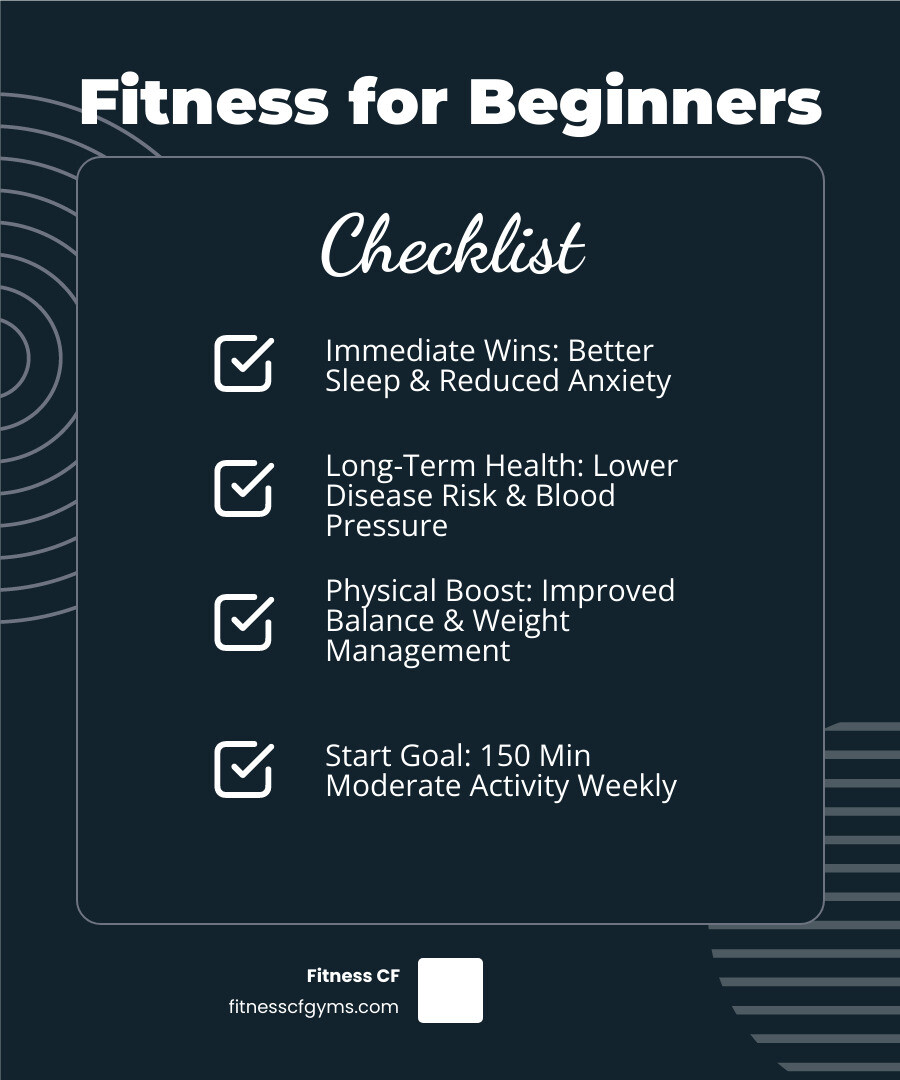
- Aim for consistency – Target 150 minutes of moderate activity per week (just 22 minutes daily)
- Include both cardio and strength – Balance aerobic exercise with resistance training 2-3 times weekly
- Listen to your body – Rest when needed and progress gradually
Does this scene sound familiar? You walk into a fitness space for the first time, or maybe the first time in a while, feeling energized and ready to become the kind of person who works out. But then reality hits—you realize you have absolutely no idea what you’re actually supposed to do.
You’re not alone. Starting a fitness routine can feel overwhelming, but the immediate benefits make it worthwhile. Regular physical activity delivers quick wins: better sleep, reduced anxiety, and lower blood pressure. These show up within days, not months.
The long-term benefits are even more compelling. Physical activity lowers your risk of chronic diseases like heart disease, type 2 diabetes, and certain cancers. It improves balance and coordination. It helps with weight management and boosts self-esteem.
The best part? You don’t need fancy equipment, expensive memberships, or hours of free time. You just need to start—and this guide will show you exactly how.
I’m Pleasant Lewis, and I’ve been helping people start their fitness journeys for over 40 years. I’ve seen thousands of beginners transform from uncertain first-timers into confident, consistent exercisers, and I know that fitness for beginners succeeds when we focus on simple, sustainable habits that fit your real life. Let’s break down exactly what you need to know to move from your couch to confident.
Quick fitness for beginners terms:
Your First Steps: A Practical Guide to Fitness for Beginners
Starting on a fitness journey is an exciting and marvelous venture. The most crucial advice we can offer for fitness for beginners is to start slowly, listen to your body, and accept gradual progression. We’re not aiming for a sprint; we’re aiming for a marathon of well-being. This thoughtful and gradual approach is key to preventing burnout and injuries, ensuring you build a lasting habit rather than a fleeting fad.
Setting clear, realistic goals is also incredibly helpful. Think SMART goals: Specific, Measurable, Achievable, Relevant, and Time-bound. Instead of “I want to get fit,” try “I will walk for 20 minutes, three times a week, for the next month.” This makes your journey tangible and gives you milestones to celebrate. For a deeper dive into kickstarting your health, check out our guide on How to start your fitness journey.
Consistency truly is key for long-term success. It’s better to do a little bit regularly than to attempt too much, get overwhelmed, and stop altogether.
How to Measure Your Current Fitness Level
Before you start any program, it’s a great idea to assess your current fitness level. This isn’t about judgment; it’s about establishing a baseline so you can track your amazing progress! Think of it as your starting line.
Here are a few simple ways to measure your fitness level, as recommended by the Mayo Clinic:
- Pulse Rate Test: Record your pulse rate before and after walking one mile. A lower post-walk pulse rate over time indicates improved cardiovascular fitness.
- 1-Mile Walk or 1.5-Mile Run Time: Time how long it takes you to walk one mile or, if you’re up for it, run 1.5 miles. This gauges your endurance.
- Push-Up Test: Count how many standard or modified push-ups you can do with good form. This assesses your upper body and core strength.
- Flexibility Check: Assess your flexibility by seeing how far you can reach in a seated forward bend or by checking the range of motion in your major joints.
- Waist Circumference: Measure your waist circumference. This is a good indicator of abdominal fat, which is linked to health risks.
- Body Mass Index (BMI): Calculate your BMI. While not a perfect measure, it gives a general idea of body fat based on height and weight.
We recommend reassessing your fitness every few months, perhaps six weeks after you initially start, and then every few months thereafter. This helps us see how far we’ve come and make any necessary adjustments to our program. For more details on these assessments, refer to this Fitness program: 5 steps to get started.
How to Start Exercising After Years of Inactivity
Returning to exercise after a long break can feel daunting, but it’s absolutely achievable! The key is to be extra kind and patient with ourselves.
First and foremost, if you have existing health conditions or haven’t been active for a very long time, we strongly advise consulting with a healthcare professional before starting any new routine. They can provide reassurance and advice custom to your specific needs, ensuring your journey is safe and effective.
When you’re ready, choose low-impact activities to minimize stress on your joints and muscles. Options like brisk walking, swimming, or cycling are excellent starting points. These allow you to build cardiovascular fitness and strength without overdoing it. We have a fantastic resource on Low Impact Workouts Perfect for Beginners and Those with Joint Concerns that might be just what you need.
Remember the mantra: gradual progression. Begin with shorter durations and lower intensities, then slowly increase as your body adapts. For example, if you start with a 10-minute walk, try increasing it by a minute or two each week. Listen carefully to your body’s signals. If you feel pain or discomfort, stop and rest. Pushing through pain can lead to injuries that derail your progress. Celebrate every small victory—whether it’s completing a workout, walking a little further, or simply showing up! Patience and consistency are your best friends on this path.
What Equipment Do I Need to Start?
One of the biggest myths about starting a fitness routine is that you need a lot of expensive gear. The truth is, for fitness for beginners, you need very little!

Many effective exercises rely solely on your body weight. Bodyweight squats, lunges, push-ups (even against a wall or on your knees), and planks are fantastic for building foundational strength without any equipment. In fact, many successful fitness journeys begin right in your living room!
If you’d like to add a little something extra, consider these minimal and affordable options:
- Resistance Bands: These versatile bands come in various strengths and can add resistance to squats, glute bridges, and upper body exercises.
- Dumbbells: A light set of dumbbells (2-5 pounds each) can be a great investment for strength training. You can even get creative and use household items like water bottles or cans of soup as makeshift weights.
- Proper Athletic Shoes: This is perhaps the most important piece of “equipment.” Good athletic shoes appropriate for your chosen activity (walking, running, general training) provide support and cushioning, helping to prevent injuries.
The best equipment is the equipment you’ll actually use. Don’t let the lack of fancy gear be a barrier to starting your incredible journey.
The Key Elements of a Well-Rounded Fitness Routine
To truly open up the benefits of fitness for beginners, we need to think beyond just one type of exercise. A well-rounded fitness routine is essential for overall health, preventing imbalances, and keeping things interesting. According to the Mayo Clinic, there are five key elements that contribute to a balanced plan: aerobic fitness, strength training, core exercises, balance training, and flexibility. Let’s explore each one. For more information, you can read their detailed guide on Fitness training: Elements of a well-rounded routine.
Aerobic (Cardio) Exercise
Aerobic activity, often called cardio or endurance exercise, is the engine of your fitness routine. It gets your heart pumping faster and your lungs working harder, boosting the oxygen supply to your muscles. This improves the efficiency of your heart, lungs, and blood vessels, leading to better cardiovascular health.
For most healthy adults, the Department of Health and Human Services recommends at least 150 minutes of moderate aerobic activity or 75 minutes of vigorous aerobic activity a week, or a combination of both. We can spread this throughout the week—even just 22 minutes a day of moderate activity adds up!
Great beginner-friendly cardio options include:
- Brisk Walking: A fantastic low-impact choice that can be done almost anywhere.
- Cycling: Whether on a stationary bike or outdoors, cycling is easy on the joints and great for endurance.
- Swimming: An excellent full-body workout that’s particularly gentle on the body.
The goal is to get your heart rate up and sustain it. You should be able to talk, but not sing, during moderate activity.
Strength Training
Strength training, also known as resistance training, is vital for building muscle, increasing bone strength, and boosting your metabolism. It’s not just about bulking up; it’s about making everyday activities easier and protecting your body.

We recommend aiming to do strength training for all major muscle groups at least twice a week. For beginners, 2-3 sessions per week with adequate recovery time are perfect. You don’t need heavy weights to start. Bodyweight exercises are incredibly effective.
Here are some examples of strength exercises that target major muscle groups:
- Bodyweight Squats: Works your glutes, quads, and hamstrings.
- Lunges: Great for legs and glutes, also helps with balance.
- Push-Ups: Targets your chest, shoulders, and triceps. Modify by doing them on your knees or against a wall.
- Dumbbell Rows: If you have light dumbbells, this exercise targets your back muscles. Stand, hinge at your hips, and pull the weights towards your chest, squeezing your shoulder blades.
- Planks: An excellent full-body exercise focusing on core strength.
For more tips on getting started with resistance training, check out our Beginner Fitness Tips. Start with 1-2 sets of 10-15 repetitions for each exercise, using a weight or resistance level that makes your muscles feel tired by the last few reps, but without compromising form.
Flexibility and Balance
Flexibility and balance are often overlooked but are incredibly important for injury prevention, maintaining good posture, and performing daily activities with ease.
- Flexibility: Regular stretching helps improve your range of motion, reduces muscle soreness and tightness, and can make you feel more agile. Activities like yoga and Tai Chi are excellent for promoting flexibility. We suggest stretching after your workouts when your muscles are warm and more receptive. Hold each stretch for at least 30 seconds.
- Balance: Balance training is crucial at any age, but especially as we get older, as balance tends to worsen, increasing the risk of falls. Simple exercises like standing on one leg (holding onto a wall if needed) can significantly improve your stability and help stabilize your core muscles. Incorporating activities like yoga and Tai Chi also naturally improves balance.
By including flexibility and balance work, we’re not just building strength; we’re building a more capable, resilient body.
Open uping Your Foundation: The Power of Deep Core Training
When we talk about fitness for beginners, the core is a star player. And we’re not just talking about a six-pack! We’re diving into the “deep core”—the unsung heroes that provide stability and support throughout your entire body.
Your core muscles are, quite literally, a core part of daily life and movement. They support activities like standing up, walking, gardening, and even carrying groceries. These muscles act like a natural corset or back brace, providing compression and stability to your spine and pelvis. A strong core leads to better posture, balance, and stability, which are foundational for all other movements.
What is the Difference Between Deep Core and Ab Exercises?
This is a fantastic question, and it’s where many beginners get confused. Let’s break it down:
| Feature | Deep Core Exercises | Ab Exercises |
|---|---|---|
| Primary Focus | Stability, functional strength, posture, balance, inner support | Aesthetic muscle definition, visible “six-pack,” spinal flexion, twisting |
| Muscles Targeted | Inner core muscles: transverse abdominis (TVA), pelvic floor, diaphragm, multifidus, deep obliques. These are the muscles beneath the surface. | Outer abdominal muscles: rectus abdominis (“six-pack” muscle), external obliques, internal obliques. These are the superficial muscles you see. |
| Movement Type | Often involves isometric contractions (holding a position), controlled movements, maintaining a neutral spine, and engaging muscles without large visible movement. | Typically involves spinal flexion (like crunches or sit-ups) or twisting movements, designed to shorten and lengthen the outer abdominal muscles. |
| Benefits | Improved posture, reduced back pain, improved balance, better support for internal organs, injury prevention, increased efficiency in all movements. | Muscle hypertrophy (growth) of superficial abs, improved core endurance for specific movements, aesthetic appearance. |
While traditional “ab exercises” like crunches primarily target the superficial abdominal muscles for aesthetic definition, deep core exercises focus on the inner muscles. These are the muscles in your midsection, pelvic floor, and diaphragm that are responsible for stabilizing your spine and pelvis. Deep core exercises are about enhancing stability, balance, and overall functional strength, which benefits everything you do!
What are Some Effective Deep Core Exercises for Beginners?
Engaging our deep core muscles can feel a bit different at first, as they’re not always easy to “feel.” The key is often in controlled, precise movements and conscious breathing.
Here are some effective deep core exercises perfect for beginners:
- Plank: A cornerstone of core strength! Get into a push-up position, but hold yourself up on your forearms. Keep your body in a straight line from head to heels, engaging your glutes and pulling your belly button towards your spine. Hold for 10-30 seconds, modifying by dropping to your knees if needed.
- Glute Bridge: Lie on your back with knees bent, feet flat on the floor hip-width apart. Lift your pelvis off the floor until your body forms a straight line from shoulders to knees. Squeeze your glutes and engage your core. Hold briefly, then lower. This targets your hamstrings, glutes, and pelvis, all part of your core system.
- Bird-Dog: Start on all fours, hands under shoulders, knees under hips. Extend your right arm forward and your left leg straight back simultaneously, keeping your back flat and core engaged. Hold for a moment, then return and switch sides. This challenges balance and stability.
- Dead Bug: Lie on your back with arms extended towards the ceiling and knees bent at a 90-degree angle over your hips. Slowly lower your right arm and left leg towards the floor without letting your lower back arch. Return to the start and switch sides. This is fantastic for anti-extension core strength.
- Diaphragmatic Breathing (Belly Breathing): This isn’t just an exercise; it’s a technique that helps activate your deep core. Lie down, place one hand on your chest and the other on your belly. Inhale deeply through your nose, letting your belly rise. Exhale slowly through pursed lips, feeling your belly contract. This consciously engages your diaphragm, a key deep core muscle.
Remember to maintain a neutral spine during these exercises and focus on quality over quantity.
How Often Should I Do Deep Core Exercises?
For fitness for beginners, consistency is more important than intensity when it comes to deep core work. We recommend starting with no more than 2 to 3 weekly sessions. This allows for adequate recovery, which is crucial for muscle repair and growth, especially when you’re just starting out.
As you build strength and confidence, you might find yourself wanting to incorporate these exercises more frequently. More advanced individuals may integrate deep core exercises into daily workouts or as part of a comprehensive strength training regimen. However, always listen to your body. If you’re feeling sore or fatigued, a rest day is a wise choice. Gradual progression is our guiding principle here.
Building a Sustainable Habit for Long-Term Success
The true secret to lasting fitness isn’t about how hard you can push yourself once; it’s about how consistently you can show up over time. For fitness for beginners, consistency over intensity is the golden rule. We want to build habits that stick, not just for a few weeks, but for life.
A great way to ensure consistency is to find activities you genuinely enjoy. If it feels like a chore, it’s hard to maintain. Explore different types of movement—maybe it’s brisk walking in your neighborhood, cycling through a Central Florida park, or a beginner’s yoga class. The more you enjoy it, the more likely you are to keep doing it. Our guide, The Complete Guide to Creating a Workout Plan for Beginners, offers more insights into designing a routine you’ll love.
Of course, we all face obstacles. Life happens! But recognizing common problems and having strategies to overcome them will keep us on track.
The Importance of Nutrition and Hydration
You wouldn’t expect a car to run without fuel, right? Our bodies are the same! For fitness for beginners, optimizing nutrition and hydration is just as important as the workouts themselves. It’s how we fuel our bodies for exercise, recover effectively, and support overall health.
Hydration is paramount. Drinking fluids throughout the day is essential for maintaining healthy hydration levels. The Academy of Nutrition and Dietetics provides clear recommendations: men should aim for about 15.5 cups (3.7 liters) of water daily, and women about 11.5 cups (2.7 liters). Replenishing fluids during exercise is especially critical for maintaining optimal performance, preventing injury, and maximizing recovery, particularly in warm Central Florida weather.
Nutrition provides the building blocks and energy:
- Carbohydrates: These are our body’s primary energy source. Consuming carbohydrates before exercise can help fuel your muscles, especially for higher-intensity or longer workouts. After exercise, carbs help replenish glycogen stores and aid in muscle recovery.
- Protein: Crucial for muscle repair and growth. Protein helps improve muscle recovery after exercise, repairs tissue damage, and builds muscle mass.
- Healthy Fats: Don’t fear fats! Regularly consuming healthy fats can help promote fat burning instead of muscle loss, increase energy levels, and manage blood pressure and cholesterol.
A well-balanced diet supports your fitness goals from the inside out.
How to Stay Motivated and Overcome Obstacles
Motivation can ebb and flow, but building sustainable habits helps us push through. We all encounter common obstacles when starting out, but with a little planning, we can overcome them. The CDC’s Steps for Getting Started With Physical Activity offers excellent advice.
- Lack of Time: We often feel we don’t have enough time. Try monitoring your daily activities for a week to identify three 30-minute slots you could dedicate to physical activity. Break up your exercise into shorter bursts—even 10-minute walks throughout the day add up!
- Fatigue: It sounds counterintuitive, but being active can actually make you feel less tired in the long run. Schedule physical activity for times when you generally feel more energetic. Adding movement to your workday, like walking during a lunch break or taking the stairs, can also help.
- Exercising Alone: If you prefer company, join a group activity or find a workout partner. Having someone else relying on you can be a huge motivator.
- Scheduling Workouts: Treat your exercise sessions like important appointments. Write them on your calendar and commit to them.
- Gym Anxiety: Feeling intimidated by a new environment is normal. Focus on your own workout, remember everyone started somewhere, and consider trying a class designed for beginners. Our article on Overcoming Gym Anxiety: Strategies for Newbies offers more helpful tips.
The goal isn’t perfection, it’s progress. Celebrate the small victories, learn from setbacks, and keep moving forward.
The Role of Warm-Ups and Cool-Downs
Think of warm-ups and cool-downs as the bookends of your workout. They are essential for preparing your body for activity and helping it recover afterward.
- Warm-Ups: Before you jump into your main workout, dedicate 5-10 minutes to a warm-up. This gradually increases your heart rate and blood flow, warms up your muscles, and prepares your joints for movement. Researchers suggest that warming up before exercising provides several physical and psychological benefits. Dynamic stretches, like arm circles, leg swings, or half-squats, are perfect for a warm-up as they involve movement.
- Cool-Downs: After your workout, take another 5-10 minutes to cool down. This helps your body gradually return to its resting state, restoring your breathing patterns and heart rate. Stretching after exercise, when your muscles are warm and pliable, can also help reduce muscle soreness and tightness. The American Heart Association notes that stretching after exercise can reduce lactic acid buildup, further easing discomfort. Static stretches, where you hold a stretch for 30 seconds or more, are ideal for a cool-down.
Skipping these steps is like starting and stopping a car abruptly—it puts unnecessary stress on the system. Give your body the respect it deserves!
Your Fitness Journey Starts Now
Taking the first step into fitness for beginners is a powerful act of self-care, and we are so proud you’re considering it. We’ve explored how to start slowly, measure your progress, and build a well-rounded routine that includes cardio, strength, flexibility, balance, and the often-overlooked power of deep core training. We’ve also highlighted the critical roles of nutrition, hydration, and strategies to overcome common obstacles.
Your journey is unique, and it’s about finding what works for you. Focus on consistency, listen to your body, and celebrate every small victory along the way. The long-term benefits—from improved health and energy to greater confidence and a better quality of life—are truly invaluable.
We at Fitness CF are here to support you every step of the way. If you’re looking for a supportive environment to kickstart your fitness journey, we offer diverse amenities and classes designed for all fitness levels. We even offer support for your fitness journey, even with a busy family schedule. Your journey from couch to confident starts now, and we’re excited to see you thrive!