Why Most People Are Training Their Core All Wrong (And What to Do Instead)
If you’ve been searching for the best full core workout but keep finding the same list of crunches and sit-ups, you’re not alone — and you’re right to want something better.
Here’s a quick answer before we dive in:
The Best Full Core Workout (No Crunches Required)
| Exercise | Level | What It Trains |
|---|---|---|
| Dead Bug | Beginner | Deep core stability, anti-extension |
| Bird Dog | Beginner | Spinal control, balance |
| Glute Bridge | Beginner | Posterior chain, pelvic stability |
| Forearm Plank | Beginner–Intermediate | Full core bracing |
| Side Plank | Intermediate | Anti-lateral flexion, obliques |
| Slow Mountain Climber | Intermediate | Dynamic stability, hip flexors |
| Pallof Press | Intermediate | Anti-rotation, deep core |
| Farmer’s Carry | Intermediate–Advanced | Loaded stability, grip, core |
| Hanging Leg Raise | Advanced | Rectus abdominis, hip flexors |
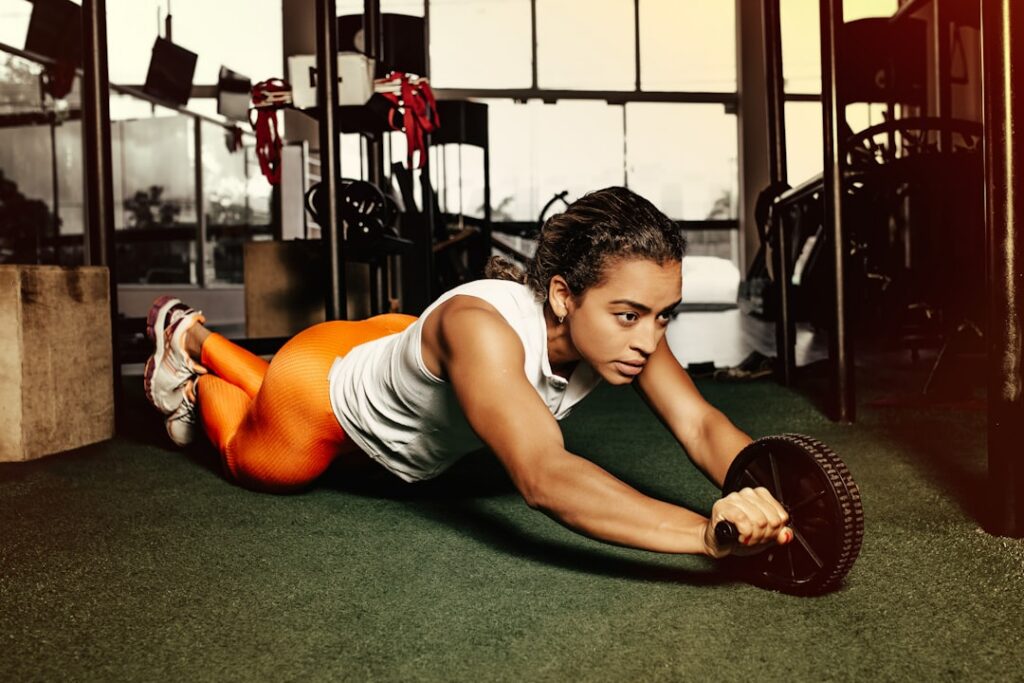
| Ab Wheel Rollout | Advanced | Anti-extension, full core |
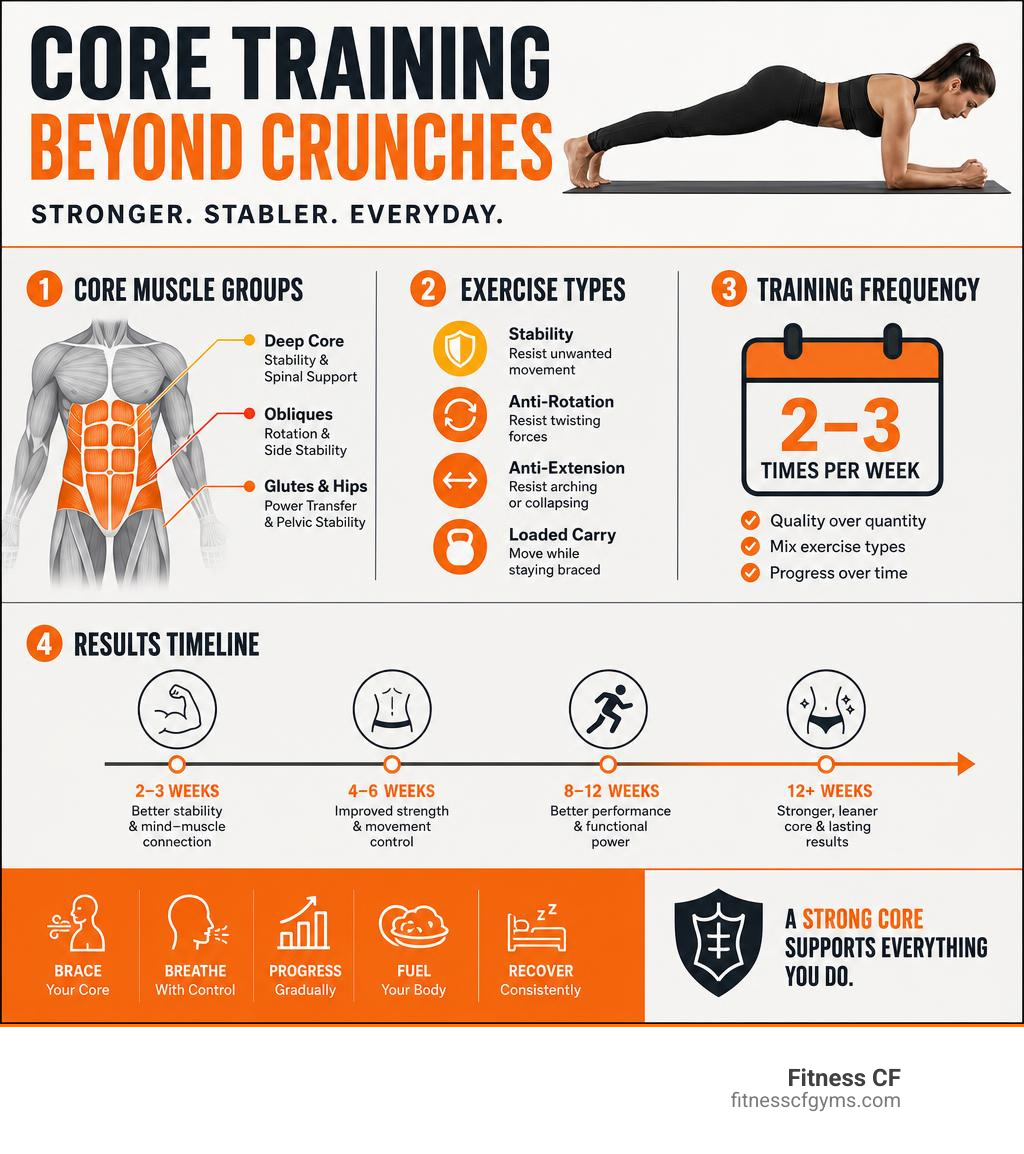
The short version: Train your core 2–3 times per week using a mix of stability, anti-rotation, and loaded carry exercises. Skip the endless crunches. Focus on bracing, breathing, and progressive overload. Pair it with good nutrition for visible results.
Most people think “core workout” means lying on the floor doing sit-ups until it burns. But research shows that exercises like dead bugs, carries, and planks build far more functional strength — and they’re much safer for your back.
A strong core doesn’t just look good. It supports every lift you do, improves your posture, reduces your risk of back pain by up to 40%, and can boost athletic performance by 15–20%. That matters whether you’re chasing a six-pack, keeping up with your kids, or just trying to get through the day without your lower back aching.
The good news? You don’t need fancy equipment or hours in the gym. You need the right exercises, done consistently, with smart programming behind them.
I’m Pleasant Lewis, owner and operator of Fitness CF and Results Fitness, with over 40 years in the fitness industry helping real people build real strength — including finding the best full core workout approaches that actually stick for busy people at every fitness level. In the guide below, I’ll walk you through exactly what works, what doesn’t, and how to put it all together.
Why Your Core Is More Than Your Abs
Your abs are part of your core, but they are not the whole story. Your core is the muscular support system that connects your ribs, spine, pelvis, hips, and even your shoulders. It helps you bend, rotate, resist movement, stand tall, lift safely, and move with control.
That is why the best full core workout should train more than the six-pack muscles. It should challenge your body to stabilize, rotate, resist rotation, transfer force, and maintain posture under fatigue.
This is also why core training fits so well into functional fitness. A strong core helps with real-life movement: carrying groceries, lifting a child, getting up from the floor, swinging a golf club, running, squatting, and reaching overhead.
What Muscles Make Up the Core?
The core includes several muscle groups working together:
- Rectus abdominis: The “six-pack” muscle that helps flex the spine.
- Transverse abdominis: A deep stabilizing muscle that wraps around your midsection like a natural weight belt.
- Internal and external obliques: Side abdominal muscles that help with rotation and resisting side bending.
- Multifidus: Small spinal stabilizers that support each vertebra.
- Erector spinae: Back muscles that help extend and stabilize the spine.
- Pelvic floor: Deep muscles that support the pelvis and help with pressure control.
- Diaphragm: Your main breathing muscle, also important for core pressure and bracing.
- Glutes: Key muscles for pelvic stability, posture, and hip power.
- Hip flexors: Muscles that lift the legs and connect the pelvis to the spine.
- Lats: Large back muscles that help connect shoulder movement to trunk stability.
In simple terms: your core is not just the front of your stomach. It is a 360-degree support system.
Why Core Training Matters for Fitness, Posture, and Injury Prevention
A stronger core can help you:
- Improve posture, especially if you sit for long periods.
- Reduce low-back stress during lifting and daily movement.
- Improve balance and coordination.
- Transfer force better in sports, running, and strength training.
- Protect your spine during squats, deadlifts, rows, presses, and carries.
- Move more efficiently during cardio and full-body workouts.
Research-backed fitness guidance suggests strong core training may reduce back pain risk by up to 40% and improve athletic performance by 15-20%. That does not mean planks are magic. It means a stable trunk helps the rest of your body do its job better.
Think of your core like the center of a wheel. If the center is wobbly, everything attached to it has to work harder.
Core Engagement: How to Brace Without Holding Your Breath
Bracing is not sucking in your stomach. It is creating firm tension around your midsection while still breathing.
Try this:
- Stand tall or lie on your back.
- Imagine someone is about to lightly poke your stomach.
- Tighten your midsection 360 degrees: front, sides, and back.
- Keep your ribs stacked over your pelvis.
- Breathe slowly through your nose or mouth without losing tension.
You should feel firm, not frozen. If you hold your breath during every rep, your form will break down quickly. Good core training teaches you to brace and breathe at the same time.
The Best Full Core Workout for People Who Hate Crunches
The best crunch-free core workouts include exercises that train your body to resist unwanted movement. That means anti-extension, anti-rotation, anti-lateral flexion, loaded carries, glute strength, and controlled rotation.
If you want to plug core training into a complete routine, our guide on how to build a full body workout plan is a great next step. For a weighted example, this 30-minute weighted core workout shows how dumbbells can challenge the core during compound movement.
Best Full Core Workout Warm-Up: 5 Minutes Before You Train
Do this before your core circuit:
| Move | Time |
|---|---|
| March in place | 45 seconds |
| Hip circles | 30 seconds each direction |
| Cat-cow | 8-10 reps |
| Dead bug breathing | 5 breaths per side |
| Bodyweight squats | 10 reps |
| Plank shoulder taps | 10 taps per side |
| Glute bridges | 12 reps |
The goal is to wake up your hips, glutes, spine, and deep core before asking them to work hard.
Best Full Core Workout Circuit: 20-30 Minutes, No Crunches Needed

Perform 2-4 rounds. Rest 30-60 seconds between exercises and 1-2 minutes between rounds.
| Exercise | Reps or Time | Focus |
|---|---|---|
| Dead Bug | 8-10 per side | Anti-extension |
| Bird Dog | 8-10 per side | Spinal control |
| Glute Bridge | 12-15 reps | Glutes and pelvis |
| Forearm Plank | 20-45 seconds | Bracing |
| Side Plank | 15-30 seconds per side | Obliques |
| Bear Crawl | 20-30 seconds | Total-body stability |
| Slow Mountain Climber | 10-12 per side | Dynamic control |
| Pallof Press | 10-12 per side | Anti-rotation |
| Farmer’s Carry or Suitcase Carry | 30-60 seconds | Loaded core stability |
| Reverse Lunge with Twist | 8-10 per side | Rotation and balance |
If you are new, start with 2 rounds. If you are intermediate, do 3 rounds. If you are advanced, use heavier loads or harder variations for 4 rounds.
Beginner Core Exercises: Stable, Safe, and Low Equipment
Beginner core training should feel controlled, not chaotic. Start with bodyweight and focus on breathing, position, and slow reps.
Best beginner exercises:
- Dead bug
- Bird dog
- Glute bridge
- Modified forearm plank
- Heel taps
- Wall plank
- Side plank from knees
Beginner structure:
- 2-3 sets
- 8-12 reps per side
- 15-30 second holds
- 2-3 sessions per week
These moves are low impact, back-friendly, and excellent for learning how to brace without overusing the neck or hip flexors.
Intermediate Core Exercises: More Control, Rotation, and Resistance
Intermediate core work adds movement, longer holds, and light to moderate resistance.
Best intermediate exercises:
- Side plank
- Plank shoulder tap
- Slow mountain climber
- Russian twist
- Single-leg glute bridge
- Dumbbell farmer’s carry
- Suitcase carry
- Resistance band Pallof press
- Cable or band woodchop
Intermediate structure:
- 3 sets
- 10-15 reps
- 20-45 second holds
- Controlled tempo
A Russian twist, for example, is not a speed contest. Move slowly, keep your spine tall, and rotate through your torso instead of flinging your arms side to side.
Advanced Core Exercises: Strength, Power, and Anti-Movement
Advanced core training is not just “harder abs.” It demands full-body strength, shoulder stability, hip control, and excellent bracing.
Best advanced exercises:
- Hanging leg raise
- Ab wheel rollout
- Turkish get-up
- Renegade row
- Copenhagen plank
- Landmine rotation
- L-sit
- Heavy farmer’s carry
- Heavy suitcase carry
Advanced structure:
- 3-4 sets
- 6-12 reps
- 20-40 second holds
- Longer rest when using heavy loads
Advanced does not mean sloppy. If your lower back arches during rollouts or hanging leg raises, regress the exercise. Your spine does not give bonus points for ego.
How to Program Core Training for Strength, Definition, and Real Results
Core training works best when it is part of a complete fitness plan that includes strength training, cardio, mobility, recovery, and nutrition. If you need help organizing your week, see our guide on how to create a workout routine.
How Often Should You Train Your Core?
Most people do well with 2-3 focused core sessions per week. That frequency is enough to build strength and stability while still allowing recovery.
A simple weekly plan:
- Monday: Full-body strength plus 10-minute core finisher
- Wednesday: Cardio plus mobility
- Friday: Strength training plus 20-minute core circuit
- Saturday or Sunday: Optional light core, walking, yoga, or active recovery
Your core also works during compound lifts like squats, lunges, rows, deadlifts, and overhead presses. So if you strength train regularly, you are already training your core indirectly.
Ideal Sets, Reps, Holds, and Workout Structures
Use these simple guidelines:
| Goal | Best Structure |
|---|---|
| Core strength | 3-4 sets of 6-10 challenging reps |
| Muscle endurance | 2-4 rounds of 30-45 seconds per move |
| Beginner control | 2-3 sets of 8-12 slow reps |
| Definition support | Strength training plus nutrition and cardio |
| Quick finisher | 3 exercises, 3 rounds, 10 minutes |
A practical core session can be as short as 10 minutes or as long as 30 minutes. Quality matters more than time. Ten focused minutes beats 30 minutes of flopping around like a fish on a dock.
Bodyweight vs. Weighted Core Exercises: When to Use Each
| Type | Best For | Examples | Equipment | When to Use |
|---|---|---|---|---|
| Bodyweight core | Learning control and endurance | Dead bug, plank, bird dog, side plank | None | Beginners, home workouts, warm-ups, back-friendly training |
| Weighted core | Strength and progressive overload | Farmer’s carry, cable Pallof press, weighted dead bug | Dumbbells, cables, bands | Intermediate and advanced training |
| Dynamic core | Conditioning and coordination | Mountain climbers, bear crawls, lunge twists | Optional | Circuits, athletic training, cardio pairing |
| Anti-movement core | Spine stability | Pallof press, suitcase carry, ab wheel | Bands, cable, dumbbells | Strength, posture, injury prevention |
Bodyweight exercises are not “easy.” A perfect dead bug can humble almost anyone. Weighted exercises simply give you more ways to progress once your form is solid.
For more dumbbell training ideas, check out 10 simple dumbbell exercises for a full body workout.
How to Progress Without Doing Endless Planks
Holding a plank forever is not the best use of your time. Once you can hold a clean plank for 45-60 seconds, progress it.
Ways to progress:
- Slow the lowering phase of leg raises.
- Add a reach to your plank.
- Move from two-leg bridges to single-leg bridges.
- Use a resistance band for Pallof presses.
- Carry heavier dumbbells.
- Use suitcase carries instead of two-sided carries.
- Reduce rest slightly.
- Add range of motion.
- Move slower and stay stricter.
- Try harder variations, not just longer holds.
Progressive overload is not only about adding weight. It is about making the body adapt safely over time.
Nutrition, Cardio, and the Truth About Visible Abs
Visible abs are built through training, but revealed through nutrition and body fat reduction. Core workouts strengthen the muscles. Nutrition helps determine whether you can see them.
For more on how exercise changes the body, read the science of fitness.
Why Core Workouts Do Not Spot-Reduce Belly Fat
Doing core exercises does not directly burn belly fat from your stomach. That is the spot reduction myth.
Fat loss happens when your body is in an overall calorie deficit over time. Your genetics decide where fat comes off first and last. Core workouts help by building muscle, improving posture, increasing training capacity, and supporting a more active lifestyle.
For the best results, combine:
- Strength training
- Cardio
- Daily movement
- Protein-rich meals
- Fiber-rich foods
- Hydration
- Sleep
- Consistency
Combining strength training and cardio several times per week tends to support better fat loss than cardio alone. If you want help balancing both, read combining strength training and cardiovascular exercise.
Body Fat Percentage and Visible Abs

Visible abs usually require lower body fat levels. Research-based fitness guidance often places visible ab ranges around:
| Group | Approximate Body Fat Range for Visible Abs |
|---|---|
| Men | 6-13% |
| Women | 14-20% |
These are general ranges, not moral scorecards. Genetics, muscle shape, fat distribution, hydration, lighting, and training history all matter.
Also, not everyone has perfectly symmetrical abs. The number and shape of visible ab “rows” are influenced by connective tissue and genetics. A strong core is always a win, even if your abs do not look like an anatomy chart.
Dietary Strategies That Support Core Definition
To support a leaner, stronger core:
- Eat enough protein to maintain muscle.
- Build meals around lean protein, vegetables, fruits, whole grains, and healthy fats.
- Choose high-volume foods like oats, potatoes, Greek yogurt, vegetables, and cauliflower rice.
- Drink water consistently.
- Limit alcohol if fat loss is a goal.
- Keep meals consistent instead of chasing extreme diets.
- Create a modest calorie deficit if you want fat loss.
- Fuel workouts so your training quality stays high.
Protein guidance varies, but many active adults benefit from roughly 1.2-1.5 grams of protein per kilogram of body weight or more depending on goals, body size, and training demands.
The goal is not to eat perfectly. The goal is to eat consistently well enough that your training can show.
Smart Modifications for Home Workouts, Older Adults, Women, Men, and Back Pain
The best core plan is the one that fits your body, your goals, and your current ability. For more exercise ideas, see our guide to 6 best core exercises for abs.
Home Core Workout Options With Minimal or No Equipment
You can build a strong core at home with:
- Floor space
- A towel for sliders
- A backpack for weight
- A resistance band
- A couch or bench for incline planks
- A water jug or dumbbell for carries
Simple home circuit:
| Exercise | Reps or Time |
|---|---|
| Dead Bug | 10 per side |
| Glute Bridge | 15 reps |
| Side Plank from Knees | 20 seconds per side |
| Towel Mountain Climber | 10 per side |
| Backpack Suitcase Carry | 30 seconds per side |
Do 2-4 rounds.
Gym-Based Core Workout Options With Weights and Machines
If you have access to weights and cable machines, you can add more resistance and variety.
Great options include:
- Cable Pallof press
- Cable woodchop
- Medicine ball slam
- Farmer’s carry
- Suitcase carry
- Hanging knee raise
- Landmine rotation
- Dumbbell Turkish get-up
- Renegade row
A gym-based core workout should still follow the same rules: brace well, move with control, and avoid turning every rep into a lower-back wrestling match.
Best Core Exercises for Older Adults
Older adults benefit from core training that improves balance, stability, posture, and confidence with daily movement.
Best options:
- Glute bridge
- Bird dog
- Wall plank
- Modified forearm plank
- Chair-supported marching
- Standing Pallof press
- Heel taps
- Opposite arm and leg raise
Use slow tempo, stable positions, and pain-free ranges of motion. Aggressive sit-ups and fast twisting are usually not the best starting point, especially if there is neck or back discomfort.
Best Core Exercises for Women and Men
The core training principles are the same for women and men: train stability, rotation, anti-rotation, flexion control, glutes, and breathing.
That said, individual needs may differ.
Women may benefit from extra focus on:
- Deep core activation
- Pelvic floor coordination
- Glute strength
- Postpartum-safe progressions
- Breathing and pressure control
Men may benefit from extra focus on:
- Hip mobility
- Anti-rotation
- Heavy carries
- Controlled rotation
- Not turning every core move into a max-effort ego lift
But the real answer is simple: the best core exercises depend on the person, not just gender.
Pregnancy and postpartum note: If you are pregnant, recently postpartum, or dealing with pelvic floor symptoms, get guidance from a qualified healthcare professional before doing intense planks, crunches, heavy carries, or high-pressure core work.
Safety Tips for Back Pain and Other Limitations
If core exercises hurt your back, stop and assess. Burning muscles are one thing. Sharp pain, pinching, numbness, or radiating pain are not things to “push through.”
Back-friendly tips:
- Keep a neutral spine.
- Start with dead bugs, bird dogs, and glute bridges.
- Avoid yanking your neck.
- Reduce range of motion if your back arches.
- Move slowly.
- Exhale during effort.
- Strengthen glutes to reduce hip flexor dominance.
- Avoid aggressive sit-ups if they trigger pain.
- Ask a physician or physical therapist for guidance if pain persists.
A good core workout should make you feel stronger, not like you need to negotiate with your spine afterward.
Frequently Asked Questions About the Best Full Core Workout
How Long Does It Take to See Results From Core Training?
Most people notice better control, posture, and strength within 4-8 weeks of consistent training. Visible changes often take 8-12 weeks or longer, depending on nutrition, body fat, sleep, genetics, and total workout consistency.
If you are already lean, definition may show faster. If fat loss is also needed, visible abs will take longer because nutrition becomes the main driver.
Are Sit-Ups and Crunches Bad?
Not always. Crunches and sit-ups are not automatically evil. They train spinal flexion, and some people can do them comfortably.
The problem is that they are limited. They do not train the full core by themselves, and they can bother the neck, hip flexors, or lower back when done poorly or excessively.
Better alternatives for most people include:
- Dead bugs
- Planks
- Side planks
- Bird dogs
- Pallof presses
- Carries
- Glute bridges
- Controlled rotational exercises
If you hate crunches, you are not doomed. Your core may actually thank you.
What Are the Most Common Core Training Mistakes?
Avoid these:
- Believing core workouts spot-reduce belly fat.
- Doing only crunches.
- Training abs hard every single day with no recovery.
- Holding your breath during every rep.
- Rushing through movements.
- Ignoring glutes and back muscles.
- Letting the lower back arch during planks or leg raises.
- Skipping progressive overload.
- Forgetting nutrition.
- Chasing soreness instead of strength.
The best core training feels controlled, repeatable, and purposeful.
Conclusion
The best full core workout is not a punishment circuit of endless crunches. It is a smart mix of bracing, breathing, stability, rotation, anti-rotation, glute strength, loaded carries, and full-body movement.
Train your core 2-3 times per week. Pair it with strength training, cardio, nutritious food, hydration, and recovery. Focus on getting stronger before obsessing over visible abs. The results that matter most are better posture, less pain, stronger lifts, improved balance, and more confidence in how your body moves.
If you are ready to build a complete plan, start with our guide on how to build a full body workout plan that actually works. And if you want support, structure, and a welcoming place to train, Fitness CF offers free trial passes, personal training, fitness classes, yoga, spin, child care, and options for all fitness levels.