Why Exercises for Shoulder and Neck Pain Are the Fix Most Desk Workers Need
If you’re dealing with exercises for shoulder and neck pain, here are the most effective moves to start with today:
- Chin tucks – glide your head straight back, hold 3-5 seconds, repeat 8-10 times
- Upper trapezius stretch – tilt one ear toward your shoulder, hold 20-30 seconds per side
- Levator scapulae stretch – turn head 45 degrees and look down toward your armpit, hold 20-30 seconds
- Doorway chest stretch – forearms on doorframe at shoulder height, step forward, hold 20-30 seconds
- Scapular wall slides – slide arms up and down a wall in a goalpost shape, 2 sets of 6-10 reps
- Shoulder circles – lean on a chair, let the opposite arm hang and swing gently, 5 reps each direction
Start with 2-3 reps per exercise, spread throughout your day. Build up gradually as your body adapts.
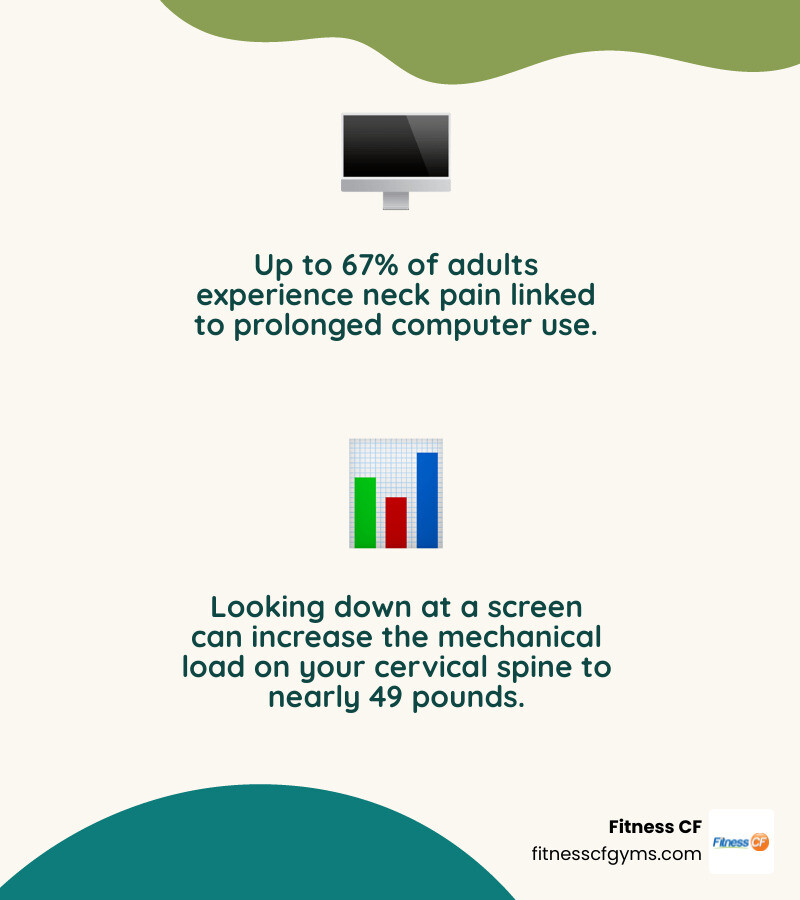
That nagging ache at the base of your neck after a long day of screen time? It’s more common than you might think. Up to 67% of adults experience neck pain linked to prolonged computer use, and 50.5% of computer users report shoulder pain too. And it makes sense — when you look down at a screen, the mechanical load on your cervical spine can climb to nearly 49 pounds, nearly four times the weight of your head in a neutral position.
The good news? The right exercises can make a real difference — and fast.
I’m Pleasant Lewis, owner and operator of Fitness CF, with over 40 years in the fitness industry helping people move better and feel stronger. I’ve seen how a simple, consistent approach to exercises for shoulder and neck pain can transform how people feel at work, at home, and everywhere in between. Let’s walk through exactly what works.
Exercises for shoulder and neck pain terminology:
Understanding the Causes of Desk-Job Discomfort
When we sit at a desk for eight or more hours a day, our bodies naturally look for the path of least resistance. This usually means our shoulders round forward, our upper back slumps, and our chin juts out toward the screen. This repetitive physical strain creates a massive muscle imbalance over time.
While it might feel comfortable in the short term, holding these static positions for hours on end is the primary culprit behind modern upper body aches. If you have ever wondered why your body feels so spent after a day of sitting down, you can learn more about how to address these daily patterns in our guide on how to relieve body aches from work.
What is Upper Crossed Syndrome?
This specific pattern of slouching and muscle imbalance has a clinical name: Upper Crossed Syndrome (UCS). First identified by Czech neurologist Vladimir Janda, UCS behaves like a literal “X” of muscle dysfunction across your upper body.
In this diagonal pattern, certain muscles become chronically tight and overactive, while their opposing muscle groups become weak, lengthened, and underactive. Specifically:
- The Tight Line: The chest muscles (pectoralis major and minor) and the muscles at the back of the neck and skull (upper trapezius, levator scapulae, and suboccipitals) become hyperactive and short.
- The Weak Line: The deep muscles at the front of the neck (deep cervical flexors) and the muscles that stabilize the shoulder blades (middle and lower trapezius, rhomboids, and serratus anterior) become weak and inactive.
This imbalance pulls our shoulders forward and forces the shoulder blades to track poorly. In fact, a 2023 study found that a staggering 89.9% of office workers had some form of scapular dyskinesis (poorly tracking shoulder blades) without even realizing it. To explore this muscle imbalance further and see how it reshapes your upper body, read about rounded shoulders and neck pain research.
The Biomechanics of Tech Neck
To understand why this posture hurts so much, we have to look at the basic physics of the human body. A human head in a neutral position weighs roughly 10 to 12 pounds. When your head is perfectly balanced over your shoulders, your spine holds this weight with ease.
However, for every single inch your head drifts forward from its neutral alignment, the effective load on your cervical spine increases by approximately 10 pounds.
When we look down at our phones or hunch over a laptop, we often hold our heads at a 45-degree forward angle. At this angle, the mechanical stress on your neck reaches a whopping 49 pounds or more. Your neck muscles are forced to contract constantly just to keep your head from falling forward. Over days, months, and years, this mechanical overload leads to chronic tightness, joint wear, and localized pain. You can read more about the physics behind forward head drift in this detailed breakdown of tech neck load statistics.
Effective Exercises for Shoulder and Neck Pain
To fix this imbalance, we cannot just rely on passive rest. Prolonged rest actually delays recovery for neck and joint issues. Instead, we need a strategic mix of active recovery, stretching, and targeted strengthening to restore joint mobility and rehabilitate our muscles. If you are currently dealing with discomfort, practicing gentle movements is a crucial first step. For a broader look at managing physical discomfort safely, check out our guide on how to ease body pain.
Targeted Mobility Exercises for Shoulder and Neck Pain
Mobility exercises help lengthen the chronically tight muscles on the “overactive” side of Upper Crossed Syndrome. Here are four foundational stretches to incorporate into your day. For a complete library of gentle movements, you can also view the Everyday360 stretching guide.
- Chin Tucks: Sit up tall with your shoulders relaxed. Look straight ahead and glide your head straight back, as if you are trying to make a double chin (avoid tilting your head down; keep the movement purely horizontal). Hold for 3 to 5 seconds, then relax. Repeat 10 times. This simple move activates the weak deep cervical flexors at the front of your neck.
- Upper Trapezius Stretch: Sit on your right hand to keep your right shoulder pinned down. Gently tilt your left ear toward your left shoulder. For a slightly deeper stretch, place your left hand on top of your head and apply very light assistance. Hold for 20 to 30 seconds, then swap sides.
- Levator Scapulae Stretch: Sit on your right hand again. Turn your head 45 degrees to the left, then look down toward your left armpit (think of this as the “armpit sniff” stretch). Gently use your left hand to guide your head downward until you feel a comfortable stretch along the back and side of your neck. Hold for 20 to 30 seconds, then switch.
- Doorway Chest Stretch: Stand in a doorway. Place your forearms flat against the doorframe with your elbows bent at a 90-degree angle (aligned with your shoulders). Slowly step one foot forward through the doorway until you feel a gentle stretch across your chest and the front of your shoulders. Hold for 20 to 30 seconds.
Strengthening Exercises for Shoulder and Neck Pain
Stretching only provides temporary relief if we do not strengthen the weak stabilizer muscles in our upper back. These three exercises help pull our shoulders back into their natural alignment. If you are experiencing deeper aches in these muscle groups, you might find our article on how to relieve deep muscle pain highly beneficial.
- Scapular Wall Slides: Stand with your heels, buttocks, upper back, and head flat against a wall. Raise your arms to a “goalpost” position, keeping your elbows and the backs of your hands in contact with the wall. Slowly slide your hands upward as high as you can without letting your hands or back lose contact with the wall, then slide them back down. Perform 2 sets of 6 to 10 repetitions.
- Band Pull-Aparts: Hold a light resistance band in front of you at chest height with your arms straight. Squeeze your shoulder blades together and pull your hands out to the sides, stretching the band until it touches your chest. Slowly return to the starting position. Perform 2 sets of 10 to 15 repetitions.
- Face Pulls: Anchor a resistance band at upper-chest height. Hold the band with your palms facing down. Pull the band directly toward your nose, flaring your elbows out and squeezing your shoulder blades together at the end of the movement. Hold for 2 seconds, then slowly release. Perform 2 sets of 8 to 12 repetitions.
Isometric vs. Isotonic Exercises: Which is Better?
When planning your routine, it helps to understand the difference between static holds (isometric exercises) and dynamic movements (isotonic exercises).
- Isometric Exercises: These involve contracting a muscle without moving the joint (for example, pushing your hand against your forehead while resisting with your neck muscles).
- Isotonic Exercises: These involve contracting a muscle through a range of motion (such as performing a row or a wall slide).
A randomized controlled trial published in 2025 looked at computer users with Upper Crossed Syndrome to see which style of training worked best. The results were highly encouraging for both groups:
- Isometric training yielded an incredible 70.4% reduction in pain and a 14.9% improvement in overall quality of life.
- Isotonic training resulted in a 47.6% reduction in pain and a 17.7% improvement in quality of life.
Because isometric exercises do not involve joint movement, they are often safer and more comfortable if you are in acute pain or have poor physical conditioning. Isotonic exercises, on the other hand, are fantastic for building functional strength and improving your body’s spatial awareness. Combining both styles gives you the best of both worlds. For more details on this research, you can access the full clinical trial on isometric vs isotonic training.
| Exercise Type | Muscle Action | Pain Reduction | Quality of Life Improvement | Best Used For |
|---|---|---|---|---|
| Isometric | Static contraction (no joint movement) | 70.4% | 14.9% | Acute pain, joint sensitivity, beginners |
| Isotonic | Dynamic contraction (moving through range) | 47.6% | 17.7% | Long-term posture correction, building strength |
Designing Your Pain-Relief Routine: Frequency, Intensity, and Micro-Exercises
Consistency is the absolute key to making these exercises work. A simple, realistic plan that you can actually stick to is far better than a complex, hour-long workout that you only do once a week. If you are starting out with a fresh muscle strain, you can find tailored advice on pacing your recovery in our article on how to relieve a strained neck muscle.
The Power of Micro-Exercises for Sedentary Workers
You do not need to block out a massive chunk of your day to find relief. In fact, taking tiny, frequent movement breaks—known as “micro-exercises”—throughout your workday is highly effective.
A comprehensive meta-analysis evaluating office workers found that performing brief, desk-friendly physical movements significantly reduced neck and shoulder pain, while also improving neck mobility and overall quality of life. Setting a simple timer to perform just 2 minutes of shoulder rolls, chin tucks, or chest stretches every 45 to 60 minutes can prevent your muscles from locking up in a slouched position. To read the science behind these mini-breaks, take a look at the meta-analysis on micro-exercises.
How to Safely Gauge Your Exercise Intensity
When you begin new movements, your body needs time to adapt. It is perfectly normal to feel some mild, short-term muscle soreness the next day. However, you should never push through sharp, intense pain.
To keep your exercises safe and effective, we recommend using a simple 0-10 pain scale:
- 0 to 3 (Minimal Pain): This is a safe zone. You might feel a deep stretch or mild discomfort, but it is completely manageable.
- 4 to 5 (Acceptable Discomfort): This is the upper limit of safe exercise. It feels challenging, but the sensation should resolve quickly once you stop.
- 6 to 10 (Excessive Pain): Stop immediately. If an exercise pushes you into this zone, you are overdoing it.
If you find your pain climbing above a 5, simply reduce the number of repetitions, slow down your movements, or reduce your range of motion.
Holistic Habits: Ergonomics, Home Remedies, and Overall Fitness
While targeted stretches are incredibly helpful, they can only do so much if we return to a poorly configured desk for the rest of the day. To truly keep pain at bay, we need to look at our daily environment and general physical health.
Ergonomic Adjustments for Posture Support
A few small tweaks to your workspace can make a massive difference in how much stress you place on your neck and shoulders:
- Monitor Height: Set your monitor so that the top third of the screen is at eye level. This prevents you from constantly tilting your head down.
- Neutral Pelvis: Sit all the way back in your chair. If your chair lacks support, place a small, rolled-up towel behind your lower back to maintain a natural lumbar curve.
- Keyboard and Mouse: Keep your elbows bent at a 90-degree angle, with your forearms parallel to the floor. This prevents you from shrugging your shoulders to reach your keys.
Home Remedies to Complement Your Routine
To support your active recovery, you can use these simple home remedies to soothe sore muscles:
- Hot and Cold Therapy: If you have a sudden flare-up, use an ice pack wrapped in a towel for 15 minutes to calm inflammation. For chronic, dull tightness, use a heating pad or take a warm bath with Epsom salts to relax stiff muscle fibers.
- Smart Sleep Positions: Avoid sleeping on your stomach, as this forces your neck to stay turned to one side for hours. Instead, sleep on your back or your side. Side sleepers can place a small, rolled-up towel inside the bottom of their pillowcase to support the natural curve of the neck.
- Stress Management: Mental stress causes us to unconsciously shrug our shoulders toward our ears. Take deep, belly-focused breaths throughout the day to release tension in your upper chest and neck.
The Role of Strength Training, Cardio, and Healthy Living
Keeping our joints healthy requires us to build a strong, resilient body. General cardiorespiratory exercise increases blood flow to our muscles, which speeds up healing and flushes out metabolic waste.
Meanwhile, full-body strength training balances out the postural weaknesses caused by modern life. When we strengthen our core, glutes, and upper back, we build a solid foundation that naturally supports great posture without constant conscious effort. For more ideas on integrating full-body mobility into your daily routine, check out The Community Voice exercise tips.
Frequently Asked Questions about Neck and Shoulder Pain
How long should I hold a neck or shoulder stretch?
For a safe and effective stretch, aim to hold the position for 20 to 30 seconds, repeating 1 to 2 times. If your muscles are feeling highly sensitive or irritated, you can start with shorter holds of 10 to 15 seconds and slowly build up as your tolerance improves. Avoid bouncing or forcing the stretch past a point of comfortable tension.
Can rounded shoulders cause headaches?
Yes, absolutely. When your shoulders round forward and your head drifts out of alignment, the small suboccipital muscles at the very base of your skull have to contract constantly to keep your head up. This chronic contraction can pinch nearby nerves and restrict local blood flow, resulting in “cervicogenic” headaches that start at the base of the neck and radiate up over the top of the head.
When should I stop exercising and seek medical help?
While mild muscle soreness is normal, you should stop exercising and consult a healthcare professional immediately if you experience any “red flag” symptoms. These include sharp or shooting pain, numbness, tingling, or weakness radiating down your arm or into your fingers. Additionally, if your neck or shoulder pain does not show any signs of improvement after 6 weeks of consistent, gentle self-care, it is a good idea to seek a professional medical evaluation.
Conclusion
Overcoming desk-job stiffness is entirely possible when you combine targeted exercises for shoulder and neck pain with a few mindful lifestyle adjustments. By incorporating quick desk stretches, strengthening your upper back, and setting up an ergonomic workspace, you can protect your spine and reclaim your comfort.
If you are ready to take your physical wellness to the next level, we would love to support you. At Fitness CF, we offer a welcoming community, expert guidance, and a variety of classes designed to help you move with ease. If you live in Central Florida—including Orlando, Clermont, Mount Dora, or St Cloud—come try our gentle, posture-opening Beginner Yoga Classes today and take your first step toward a pain-free life!