Why Exercise and Yoga Belong in Every Fitness Routine
Exercise and yoga together form one of the most complete approaches to physical and mental health available today. Whether you’re just getting started or looking to break through a plateau, this checklist covers everything you need to know.
Quick answer: What’s the difference between exercise and yoga?
| Feature | Traditional Exercise | Yoga |
|---|---|---|
| Primary focus | Strength, cardio, endurance | Flexibility, breath, mindfulness |
| Intensity | Low to high | Low to moderate |
| Mental component | Secondary | Central |
| Tools needed | Equipment optional | Mat, props optional |
| Evidence-based benefits | Heart health, weight, strength | Blood pressure, stress, pain, flexibility |
Both approaches improve your health. Research shows yoga interventions are equal or superior to conventional exercise in many health outcomes — including blood pressure, stress, and chronic pain.
Here’s what the science says at a glance:
- Cardiovascular health — Yoga reduces systolic blood pressure by about 4 mmHg on average
- Mental health — Yoga shows moderate effect sizes for reducing stress, anxiety, and depression
- Flexibility and strength — Just 8 weeks of yoga can significantly improve trunk flexibility and grip strength
- Chronic pain — The American College of Physicians recommends yoga as a first-line treatment for chronic low back pain
- Safety — Yoga is generally as safe as other exercise formats when practiced correctly
About 300 million people worldwide now practice yoga, and in the U.S., participation among adults has tripled from 5% in 2002 to nearly 16% in 2022. This isn’t a trend — it’s a fundamental shift in how people think about fitness.
I’m Pleasant Lewis, owner and operator of Fitness CF and Results Fitness, with over 40 years in the fitness industry helping people build sustainable exercise and yoga habits that fit real life. In this checklist, I’ll walk you through everything — from the science and history to practical routines you can start today.
The Evolution of Exercise and Yoga

To truly appreciate how exercise and yoga complement each other, we have to look at where they came from. Traditional physical exercise has largely evolved from military training, survival needs, and 19th-century European gymnastics. It was designed to build a body that could run faster, lift heavier, and endure external physical challenges.
Modern yoga as we know it today, however, took a very different path. It transformed from a deeply spiritual, meditative discipline into a global physical fitness phenomenon. If you have ever wondered how these two worlds collided, Exploring the Power of Yoga: Why You Should Add It to Your Fitness Routine is a great place to start understanding their modern synergy.
From Ancient Indian Philosophy to Modern Postural Practice
The word yoga originates from the ancient Sanskrit root Yuj, which means “to yoke” or “to unite.” Historically, this union was not about touching your toes or mastering a handstand; it was about connecting the mind, body, and spirit to achieve spiritual enlightenment and mental discipline.
For thousands of years, as outlined in Patanjali’s classical Yoga Sutras, physical postures (asanas) played a minor role. The physical poses were meant only to prepare the body to sit comfortably in silent meditation for hours. Early Hatha yoga texts described only a handful of poses—ranging from 2 to 84.
The massive shift occurred in the 20th century. Pioneers like T. Krishnamacharya (often called the “father of modern yoga”), teaching in places like the Mysore Palace in the 1930s, began blending traditional Hatha yoga with Western gymnastics, Indian wrestling exercises, and British physical culture movements. This fusion created a dynamic, flowing, and highly physical style of yoga.
This physical style spread rapidly to the West. By the 1960s and 1970s, books like B.K.S. Iyengar’s Light on Yoga (which documented around 200 asanas) and popular television shows made yoga accessible to the public. In Britain during the 1970s, women made up between 70% and 90% of yoga classes, transforming a historically male-dominated spiritual path into a female-friendly secular fitness practice.
Today, the number of documented asanas has exploded to over 2,100 in modern texts. Yoga has grown into a multi-billion dollar global business. By 2016, 36.7 million Americans practiced yoga, driving a $16 billion industry of classes, clothing, and gear. Athleisure sales alone topped $35 billion in 2014, making yoga pants a permanent fixture of modern daily wear. As we navigate the fitness landscape in 2026, yoga is no longer viewed as an alternative lifestyle; it is a mainstream pillar of healthy living.
Defining the Core Mechanisms of Exercise and Yoga
While both traditional exercise and yoga improve physical fitness, they do so through distinct physiological mechanisms. Understanding these differences allows us to use both tools more effectively.
Traditional exercise—such as weight lifting or running—primarily targets muscle fibers, the cardiovascular system, and energy pathways. The goal is often physical adaptation through progressive overload: you lift heavier weights to tear and rebuild muscle, or run faster to improve lung capacity.
Yoga, on the other hand, relies on three core pillars:
- Asanas (Posture Maintenance): Holding physical postures to build isometric strength, balance, and joint stability.
- Pranayama (Breath Regulation): Controlling the breath to consciously influence the autonomic nervous system.
- Meditation and Mindfulness: Keeping the mind focused on the present moment, lowering stress hormones.
To see how these mechanisms differ and overlap, let’s look at the science of how they impact your body:
| Physiological Mechanism | Traditional Physical Exercise | Yoga Practice |
|---|---|---|
| Nervous System Activation | Dominates the sympathetic nervous system (“fight or flight”) to boost energy and output. | Activates the parasympathetic nervous system (“rest and digest”) to lower heart rate and cortisol. |
| Muscle Engagement | Focuses on concentric and eccentric contractions (shortening and lengthening muscles under tension). | Focuses on isometric contractions (holding muscles in static positions) and deep stretching. |
| Breathing Patterns | Unconscious or task-driven (e.g., exhaling on exertion). | Highly conscious, rhythmic breath regulation (pranayama) coordinated with movement. |
| Mental Focus | External (tracking reps, speed, or environment) or associative. | Internal mindfulness, body scanning, and meditation. |
By combining these two approaches, you can build a body that is both highly resilient and exceptionally calm. To explore how traditional physical workouts alter your physiology, check out our guide on The Science of Fitness: How Exercise Impacts Your Body.
Scientific Evidence: Health Benefits of Mind-Body vs. Traditional Workouts

For decades, skeptics dismissed yoga as “just stretching.” However, modern clinical research has proven that yoga offers profound, measurable physiological benefits. In many cases, head-to-head clinical trials show that yoga is just as effective—and sometimes superior—to traditional exercise for managing chronic health conditions.
Cardiovascular and Metabolic Health Impacts
Cardiovascular disease and type 2 diabetes are among the leading public health concerns worldwide. Traditional aerobic exercise is highly recommended for these conditions, but research shows that yoga is a highly effective, low-impact alternative.
A comprehensive systematic review and meta-analysis published in PLOS Global Public Health investigated the impact of yoga on cardiometabolic health in adults with overweight or obesity. The researchers analyzed 30 randomized controlled trials (RCTs) with 2,689 participants. The findings were remarkable:
- Blood Pressure: Yoga significantly reduced systolic blood pressure by an average of -4.35 mmHg and diastolic blood pressure by -2.06 mmHg.
- Lipid Profiles: Yoga practice led to a reduction in LDL (“bad”) cholesterol and a significant increase in HDL (“good”) cholesterol.
- Glucose Metabolism: Yoga showed positive trends in improving long-term blood sugar markers like HbA1c and insulin resistance (HOMA-IR).
Furthermore, a massive community-based randomized controlled trial published in MDPI’s Medicines journal studied over 11,000 adults at high risk for diabetes. The study found that a 3-month integrated yoga lifestyle program did not just lower cholesterol—it had a unique regulatory effect. Yoga actually increased low lipid values and decreased abnormally high values, shifting participants toward a healthy, balanced state (metabolic homeostasis).
For those managing prediabetes or high blood pressure, incorporating gentle physical movement can be life-changing. You can read more about how these mindful movements protect your heart in our breakdown of What Are the Health Benefits of Yoga?.
Stress Relief and Mental Wellbeing
We all know that going for a run or hitting the gym can help blow off steam. But when it comes to long-term anxiety, depression, and emotional regulation, yoga’s combination of movement and mindfulness is uniquely powerful.
A systematic review and meta-analysis published in Frontiers in Psychology examined the effects of yoga on stress relief and emotional changes in healthy populations. Across 30 randomized controlled trials with 2,288 participants, yoga demonstrated moderate, highly significant effect sizes for reducing:
- Stress (Effect Size: -0.54)
- Anxiety (Effect Size: -0.52)
- Depression (Effect Size: -0.50)
The study highlighted that slow, conscious breathing exercises lower sympathetic nervous system activity, which in turn reduces heart rate, blood pressure, and cortisol (the primary stress hormone). Interestingly, the study found that older adults experienced even greater stress-reduction benefits from yoga than younger participants.
If you are looking to lift your mood and quiet a racing mind, combining traditional workouts with mindfulness is highly effective. Learn more about the mental health mechanics in our article on Exercise and Mental Health: Fitness & Wellbeing.
Strength, Flexibility, and Chronic Pain Management
If you suffer from stiff joints, arthritis, or chronic lower back pain, traditional high-impact exercise can sometimes feel too intense. This is where yoga shines as a therapeutic tool.
A study published in PMC evaluated the effects of an 8-week Surya Namaskar (Sun Salutation) yoga program on overweight and obese female university students. After practicing 50-minute sessions three times a week, the yoga group showed massive improvements:
- Forward trunk flexibility increased dramatically from an average of 4.62 inches to 10.35 inches.
- Physical strength (including handgrip and leg strength) and cardiovascular fitness ($VO_2$ max) increased significantly within the yoga group.
- Perceived stress scores dropped from 18.86 to 14.38.
Additionally, clinical organizations like the American College of Physicians now officially recommend yoga as a first-line, non-pharmacological treatment for chronic lower back pain. It has been shown to be just as effective as physical therapy stretching routines for reducing pain and improving mobility. For joint-friendly ways to improve your range of motion, explore our guides on Better Flexibility: 8 Fantastic Exercises to Increase Range of Motion.
Safety, Accessibility, and Modern Styles of Practice
Like any physical activity, practicing yoga carries a risk of injury if done incorrectly. Understanding how to practice safely, modify poses, and choose the right style is essential for a lifelong, injury-free routine.
According to a comprehensive report on yoga safety from the National Center for Complementary and Integrative Health (NCCIH), yoga is generally safe when performed properly under the guidance of a qualified instructor. The most common injuries are mild sprains and strains, typically affecting the knee or lower leg.
However, safety statistics show some important considerations:
- A survey of 1,702 practitioners revealed that 1 in 5 reported at least one adverse effect, most commonly associated with advanced inversions like headstands and shoulder stands.
- Emergency department data shows that yoga-related injury rates are higher in practitioners aged 65 and older.
- To prevent injury, beginners should avoid extreme practices, forceful breathing, and unassisted inversions. Using props like blocks, straps, and bolsters is highly encouraged to maintain proper alignment.
Navigating Modern Yoga Styles and Hybrids
With dozens of different yoga styles available today, it can be confusing to know where to start. Choosing the right style depends on your fitness goals, physical condition, and experience level.
Here is a quick guide to the most common styles:
- Hatha Yoga: A gentle, slower-paced style focused on basic postures and breathing. It is perfect for beginners and excellent for stress relief.
- Vinyasa Flow: A dynamic style where movement is synchronized with the breath. Poses flow smoothly from one to the next, offering a moderate cardiovascular workout.
- Ashtanga: A highly structured, physically demanding style that follows a specific sequence of progressive postures.
- Yin Yoga: A slow-paced style where passive poses are held for 3 to 5 minutes. It targets deep connective tissues and joints, making it highly complementary to heavy strength training.
- Power Yoga & Yoga-HIIT Hybrids: Gym-based, fitness-focused classes that blend traditional poses with bodyweight strength exercises and high-intensity intervals.
To find the style that aligns with your personal goals, take a look at our detailed guide: What Are the Different Types of Yoga?.
Designing a Balanced Routine with Exercise and Yoga
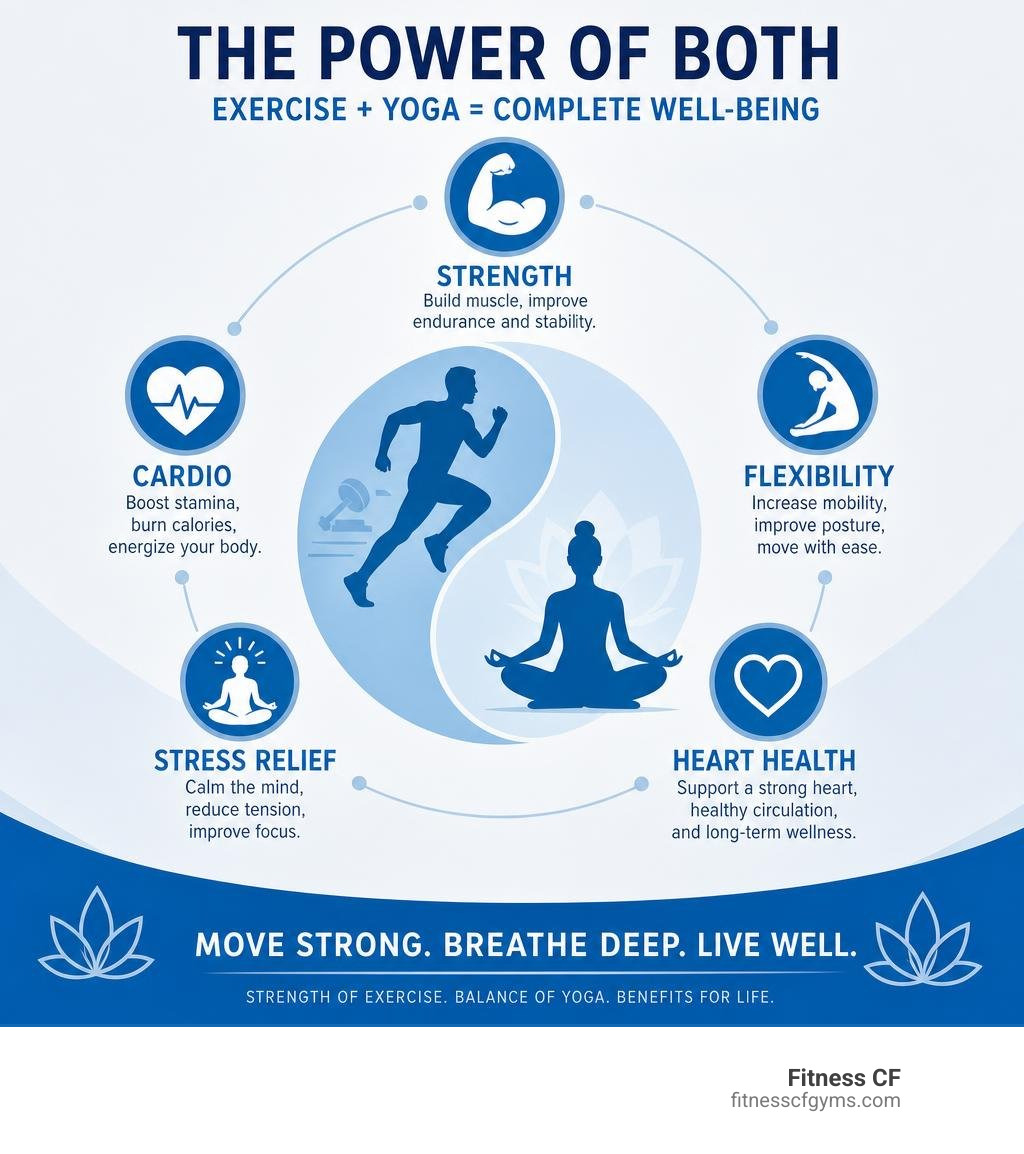
For optimal physical fitness, you do not have to choose between going to the gym and rolling out your yoga mat. In fact, combining them is the ultimate way to build a balanced, resilient body.
A well-rounded fitness routine should include a mix of cardiovascular training, strength training, and mobility work. Yoga serves as the perfect active recovery tool to pair with intense workouts. It helps flush out metabolic waste, elongates tight muscles, and restores joint range of motion after heavy lifting.
If you are recovering from an injury, managing joint pain, or just getting back into physical activity, low-impact workouts are the safest way to build a foundation. You can learn how to structure these routines by reading 4 Common Types of Exercise and exploring Low-Impact Workouts: Perfect for Beginners and Those with Joint Concerns.
Frequently Asked Questions about Exercise and Yoga
Is yoga considered a form of cardiovascular exercise?
While gentle yoga is primarily a low-intensity activity, more dynamic styles can absolutely contribute to your weekly cardiovascular goals. On average, yoga practice provides about 3.3 METs (Metabolic Equivalents), which classifies it as a moderate-intensity workout.
However, dynamic sequences like Surya Namaskar (Sun Salutations) can range from 2.9 to 7.4 METs, reaching the intensity level of a brisk walk or light jog. While it may not replace high-intensity cardio, practicing active flow yoga regularly improves physical fitness, breathing efficiency, and overall aerobic capacity.
How do I safely combine strength training with a yoga practice?
The key to combining strength training with yoga is smart scheduling and recovery. Avoid scheduling intense, deep-stretching yoga classes (like Yin) immediately before a heavy weight-lifting session, as deeply relaxed muscles and joints are more prone to injury under heavy loads.
Instead, use gentle yoga as a post-workout cool-down or as an active recovery workout on your rest days. This helps relieve muscle soreness, maintains joint mobility, and keeps your nervous system balanced. For practical tips on incorporating stretching safely, check out our guide on Stretching Routines to Improve Flexibility and Prevent Injuries.
What are the best yoga poses for beginners to improve flexibility?
If you are new to yoga, starting with simple, foundational poses is the safest way to build flexibility and confidence. Here are three excellent poses to start with:
- Cat-Cow Pose: Moving between arching and rounding your back on all fours. It gently warms up the spine and relieves lower back tension.
- Downward-Facing Dog: Forming an inverted “V” shape with your body. This classic pose stretches the hamstrings, calves, and shoulders while building upper-body strength.
- Tree Pose: Standing on one leg with the opposite foot resting on your calf or inner thigh. This pose is fantastic for building ankle stability, core strength, and balance.
If you are located in Central Florida and want to learn these poses under professional guidance, check out our resources on Yoga for Beginners Orlando to find local classes and step-by-step support.
Conclusion
At the end of the day, exercise and yoga are not competing philosophies—they are two sides of the same coin. Traditional exercise builds the external physical strength, endurance, and power your body needs to thrive. Yoga provides the internal balance, flexibility, joint stability, and mental clarity that keeps you moving pain-free and feeling your best.
By integrating both into your weekly routine, you create a sustainable, lifelong approach to healthy living and overall fitness. Whether your goal is to lower your blood pressure, build physical strength, or simply find a healthy way to manage daily stress, taking that first step is what matters most.
Ready to experience the benefits of a balanced fitness routine for yourself? Start your fitness journey today with a free trial pass at Fitness CF and explore our diverse range of fitness classes, yoga sessions, and supportive community spaces designed for all fitness levels. Let’s unroll the mat and lift the weights together!