
Why a Structured Plan is Your Key to Success
Workout plans are structured schedules that outline your exercises, frequency, and progression. They transform vague intentions like “I want to get in shape” into concrete action steps that fit your lifestyle and goals.
Without a structured approach, it’s easy to wander through workouts aimlessly or quit when results don’t appear fast enough. A well-designed plan removes the guesswork, keeps you accountable, and ensures you’re hitting all the essential components your body needs: cardio for your heart, strength training for your muscles, flexibility for injury prevention, and scheduled rest for recovery.
The truth is simple: consistency beats perfection every time. Research shows that exercise enjoyment is the strongest predictor of whether you’ll stick to your routine. This means the best workout plan is the one you’ll follow consistently, not necessarily the most complicated one.
For general health, adults need at least 150 minutes of moderate-intensity exercise or 75 minutes of vigorous exercise per week, plus strength training at least 2 days per week. These guidelines are backed by research and are key to maintaining health, preventing chronic disease, and building lasting fitness.
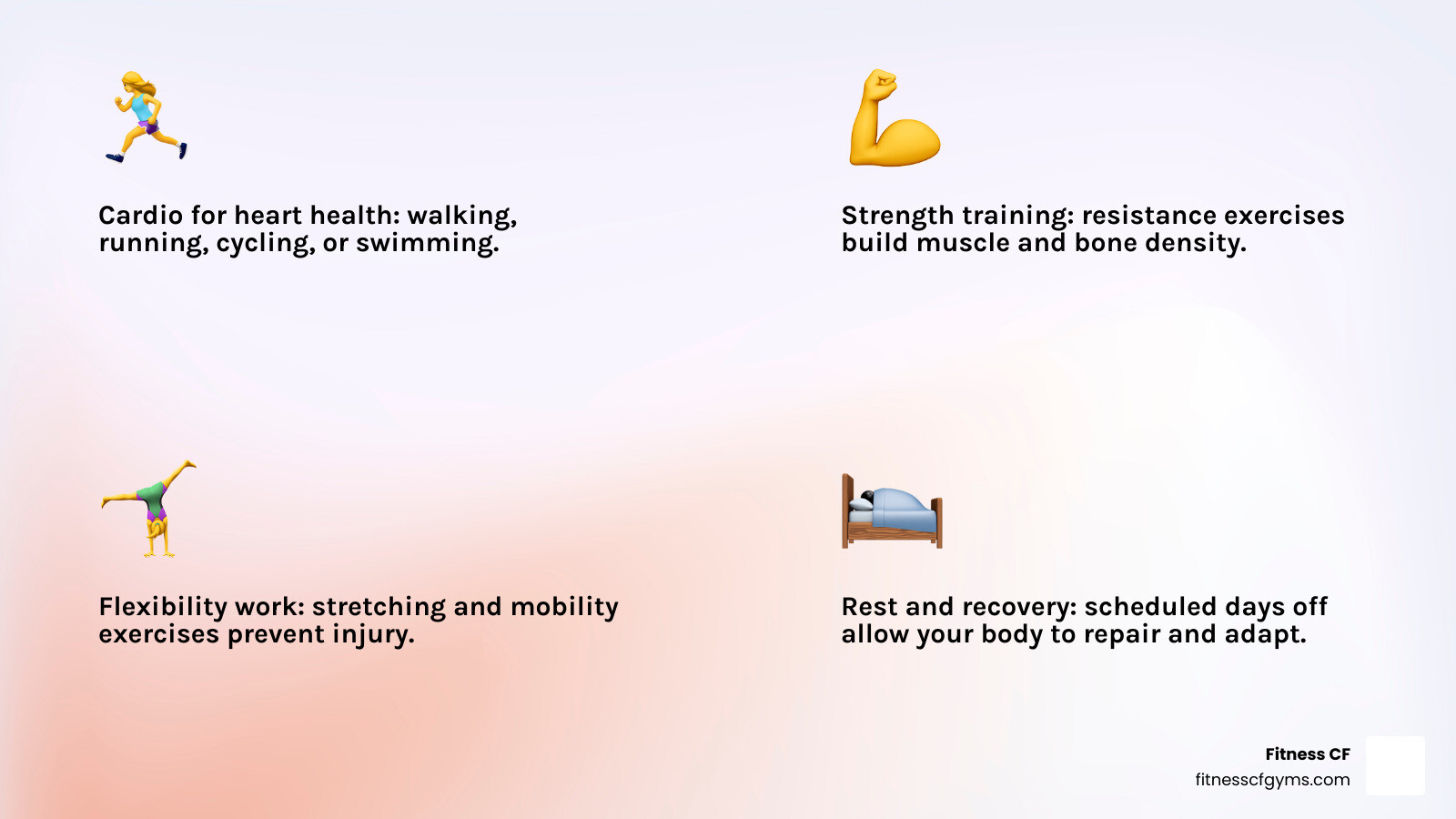
Workout plans word guide:
The Building Blocks of Effective Workout Plans
An effective workout plan requires a solid foundation to ensure your fitness journey is balanced, sustainable, and leads to tangible results. This means considering not just what exercises you do, but also how often and for how long.
A well-rounded plan incorporates three fundamental pillars: cardiovascular exercise, strength training, and flexibility work.
- Cardio (Cardiovascular Exercise): Cardio strengthens your heart and lungs, improves circulation, and boosts stamina. Activities like walking, jogging, cycling, or swimming are crucial for heart health.
- Strength Training (Resistance Training): This builds and maintains muscle mass and bone density, which is vital as we age. Using bodyweight, free weights, or machines boosts metabolism and improves functional strength for daily tasks.
- Flexibility and Mobility: Often overlooked, stretching and mobility drills are critical for preventing injury, improving range of motion, and enhancing posture.
How Often and How Long Should You Exercise?
Your ideal workout frequency and duration depend on your goals and fitness level, but official guidelines provide a great framework. According to the Physical Activity Guidelines for Americans, adults should aim for:
- At least 150 minutes of moderate-intensity cardio or 75 minutes of vigorous-intensity cardio per week. This can be broken into 30-minute sessions five days a week.
- Strength training for all major muscle groups at least two days per week.
A typical workout session lasts 30 to 60 minutes. Beginners can start with 2-4 workouts per week, while more advanced individuals might train 4-5 days. The most important rule is to listen to your body and prioritize consistency over intensity.
The Importance of Warm-Ups and Cool-Downs
Warm-ups and cool-downs are non-negotiable parts of any effective workout plan. A 5-10 minute dynamic warm-up (like light cardio and bodyweight movements) prepares your body for activity by increasing blood flow and mobility, which reduces injury risk.
After your workout, a 5-10 minute cool-down helps your body return to its resting state. This should include light cardio followed by static stretching (holding stretches for 30-45 seconds) to improve flexibility and aid muscle recovery. Proper preparation and recovery are vital for long-term success.
Choosing and Customizing Your Ideal Workout Plan

The journey to a healthier you is personal. The key to finding a workout plan you can stick with is choosing one that fits your fitness level, goals, and lifestyle. A personalized approach is the most effective path to sustainable fitness.
Research shows that exercise enjoyment is the strongest predictor of success for sticking to a routine. If you don’t enjoy it, you’re less likely to do it. So, let’s find what you do enjoy!
Setting SMART Fitness Goals
Before starting, define what you want to achieve with SMART goals:
- Specific: What exactly do you want to accomplish? (e.g., “Run a 5K race.”)
- Measurable: How will you track your progress? (e.g., “Track my running time.”)
- Attainable: Is this goal realistic for you? (e.g., “I will train three times a week.”)
- Relevant: Does this goal align with your overall health objectives?
- Timely: What is your target deadline? (e.g., “Within 6 months.”)
A SMART goal like, “I will run a 5K in under 30 minutes in 6 months by training three times a week,” provides clear direction and motivation for your workout plan.
Matching Workout Plans to Your Experience Level
Choosing a plan that’s too easy or too hard can lead to boredom or injury. It’s best to start conservatively and use progressive overload—gradually increasing the challenge—to keep improving.
| Characteristic | Beginner | Intermediate | Advanced |
|---|---|---|---|
| Frequency | 2-3 days/week (full body) | 3-4 days/week (full body, upper/lower split) | 4-6 days/week (specialized splits) |
| Intensity | Light weights, bodyweight, focus on form | Moderate weights, increasing resistance | Heavy weights, advanced techniques |
| Complexity | Basic compound movements, simple cardio | More varied exercises, some isolation work | Complex lifts, advanced variations |
| Example Exercises | Bodyweight squats, push-ups, walking, planks | Goblet squats, dumbbell rows, lunges, jogging | Barbell back squats, deadlifts, pull-ups, sprints |
How to Create Personalized Workout Plans
Creating your own workout plan doesn’t have to be complicated. The most effective plan is one you can stick to, fits your life, and that you enjoy. The most critical step is giving yourself permission to adjust it as needed.
- Set Your Goals: Use the SMART framework to define your objectives.
- Assess Your Schedule: How many days and how much time can you realistically commit?
- Choose Activities You Enjoy: Experiment with different forms of cardio and strength training to find what motivates you.
- Design a Weekly Template: Map out your week with a balance of strength, cardio, and rest days.
- Select Exercises: Focus on compound movements that work multiple muscle groups (squats, push-ups, rows) and choose cardio you like.
- Determine Sets & Reps: For muscle growth, aim for 3-4 sets of 8-12 reps. For strength, try 3-5 sets of 1-6 reps.
- Track Your Progress: Use a journal or app to log your workouts. Seeing your progress is a powerful motivator.
- Adjust as Needed: Life happens. Don’t be afraid to modify your plan if your schedule, goals, or body changes. Consistency is the ultimate goal.
Maximizing Your Results: Advanced Tactics and Long-Term Success

Once you’ve established a consistent workout plan, you can focus on advanced tactics to maximize results. This includes specialized exercises, age-specific modifications, and the indispensable roles of nutrition and recovery.
The Importance of Deep Core Exercises
Beyond visible abs, the deep core muscles in your midsection, pelvic floor, and diaphragm act as your body’s natural back brace, providing stability for your spine. Strengthening your deep core leads to better posture, balance, and stability, which is vital for injury prevention. As recommended by health experts like the Mayo Clinic, incorporating these exercises 2-3 times a week is a great start.
Excellent deep core exercises include:
- Bird Dog: On all fours, extend one arm and the opposite leg, keeping your core tight.
- Side Plank: Support yourself on one forearm, lifting your hips to form a straight line.
- Dead Bug: Lie on your back and slowly lower one arm and the opposite leg toward the floor without arching your back.
- Plank: Hold a straight line from head to heels, engaging your entire core.
Fitness for Life: Workout Considerations for Ages 40+
As we age, our bodies change, often with a gradual decline in muscle and bone mass. A smart workout plan can counteract this. Research shows resistance training is key to stimulating muscle and bone growth.
Key considerations for those over 40:
- Prioritize Resistance Training: It helps preserve muscle, boost metabolism, and strengthen bones.
- Use Joint-Friendly Modifications: Choose exercises that don’t stress your joints, like goblet squats instead of back squats or triceps pushdowns instead of dips.
- Allow for More Recovery: Your body may need more rest between intense workouts. Studies suggest it’s wise to extend recovery times as you get older.
- Emphasize Balance and Mobility: Incorporate exercises that improve your range of motion to reduce fall risk.
Fueling Your Fitness: The Role of Nutrition and Hydration
Your workout plan is only as effective as the fuel you provide your body. Proper nutrition and hydration support energy, muscle repair, and performance.
- Eat a Balanced Diet: Include complex carbohydrates for energy, lean protein for muscle repair, and healthy fats for hormone production.
- Time Your Nutrients: A carb-rich snack before your workout provides fuel, while a post-workout meal with protein and carbs aids recovery.
- Stay Hydrated: Drink water before, during, and after exercise to regulate body temperature and transport nutrients. Dehydration severely impacts performance.
- Focus on Whole Foods: Prioritize unprocessed foods and aim for sustainable weight loss of 1-2 lbs per week if that is your goal.
Staying Consistent and Avoiding Common Pitfalls
Consistency is the most important factor in long-term success. To maintain it, avoid common mistakes like doing too much too soon, using poor form, or skipping warm-ups and rest days. Schedule your workouts, listen to your body, and don’t get discouraged by setbacks. exercise enjoyment is the strongest predictor of success, so find activities you love.
Frequently Asked Questions about Workout Plans
Here, we address some of the most common inquiries to help you steer your workout plan with greater confidence.
How do I know if my workout plan is working?
Tracking progress is key. Look for signs beyond the scale:
- Strength Gains: Lifting heavier weights or doing more reps.
- Endurance Improvement: Running longer or feeling less winded during cardio.
- Body Composition Changes: Clothes fitting better or increased muscle definition.
- More Energy: Feeling more vibrant throughout the day and sleeping better.
- Easier Daily Activities: Carrying groceries or climbing stairs feels less strenuous.
Keeping a workout journal is a great way to see tangible proof of your progress and know when it’s time to adjust your plan.
Can I build muscle and lose fat at the same time?
Yes, this is called “body recomposition.” It’s most effective for beginners, those returning to exercise, or individuals with higher body fat. The process requires a strategic approach:
- High-Protein Diet: Essential for muscle repair and growth.
- Progressive Strength Training: You must consistently challenge your muscles to stimulate growth.
- Slight Calorie Deficit: Eat slightly fewer calories than you burn to encourage fat loss without hindering muscle building.
- Patience: Body recomposition is a slower process that requires consistency in both your workout plan and nutrition.
What if I miss a workout?
Missing a workout is normal. The most important thing is to avoid an “all-or-nothing” mindset. A single missed session won’t derail your progress.
- Don’t stress: Just get back on track with your next scheduled workout.
- Don’t double up: Trying to cram two workouts into one day can lead to fatigue and injury.
- Adjust if needed: If you’re missing workouts frequently, see if your plan is too ambitious for your current schedule and adjust it to be more realistic. Consistency is what matters most in the long run.
Conclusion: Start Your Fitness Journey Today
Starting on a fitness journey, or reinvigorating an existing one, can feel daunting. Yet, with a well-constructed workout plan, it transforms into an empowering path toward a healthier, more vibrant you. We’ve explored the essential building blocks, from the three pillars of fitness (cardio, strength, flexibility) to the critical roles of warm-ups, cool-downs, and deep core exercises. We’ve also highlighted the importance of tailoring your plan to your experience level, setting SMART goals, and making crucial adjustments for life’s changes, especially as we age.
The core principles remain constant: personalization, balance, and above all, consistency. Your perfect workout plan isn’t a rigid, one-size-fits-all solution, but a dynamic guide that adapts to your life, accepts your enjoyment, and continually challenges you to grow. Proper nutrition and hydration fuel your efforts, and adequate rest ensures your body repairs and strengthens.
Taking the first step is often the hardest, but it’s also the most rewarding. Whether you’re a beginner eager to learn the ropes or an experienced individual looking to optimize your routine, having a structured approach can make all the difference. We believe in empowering you with the knowledge and tools to succeed.
Sometimes, a little expert guidance can go a long way in refining your approach, ensuring proper form, and keeping you motivated. If you’re looking for personalized support to create your ideal workout plan and achieve your unique fitness aspirations, we encourage you to explore personal training options to create your perfect plan. Your journey to a stronger, healthier you starts now.