Why Boxing Cardio Classes Are One of the Best Workouts You Can Do
Boxing cardio classes give you a full-body workout that burns serious calories, builds strength, and relieves stress – all in one session.
Here’s what you get in a typical boxing cardio class:
- Calorie burn – up to 1,000 calories per session, depending on intensity, body size, and effort
- Cardio boost – improved heart health, lung capacity, and endurance
- Strength gains – toned muscles from head to toe through punches, footwork, and bodyweight moves
- Stress relief – rhythmic punching helps clear your head fast
- Better balance and coordination – footwork and movement patterns train your whole body
- No experience needed – classes are beginner-friendly at every fitness level
These classes are not about fighting. They combine boxing techniques – like shadowboxing and heavy bag work – with high-intensity intervals and strength movements. The result is a workout that challenges your body and your mind at the same time.
Whether you are a complete beginner, a busy parent, or someone who has hit a fitness plateau, boxing cardio fits where you are right now. In the sections below, you will learn what to expect, how the workout supports a healthy lifestyle, and how to get started with confidence.
Key boxing cardio classes vocabulary:
The Ultimate Guide to Boxing Cardio Classes
When you think of boxing, you might picture two fighters sweating under bright lights in a ring, trading heavy blows. But fitness-focused boxing is different. Today, boxing cardio classes offer many of the athletic benefits of a fighter’s conditioning routine without physical contact or competitive sparring.
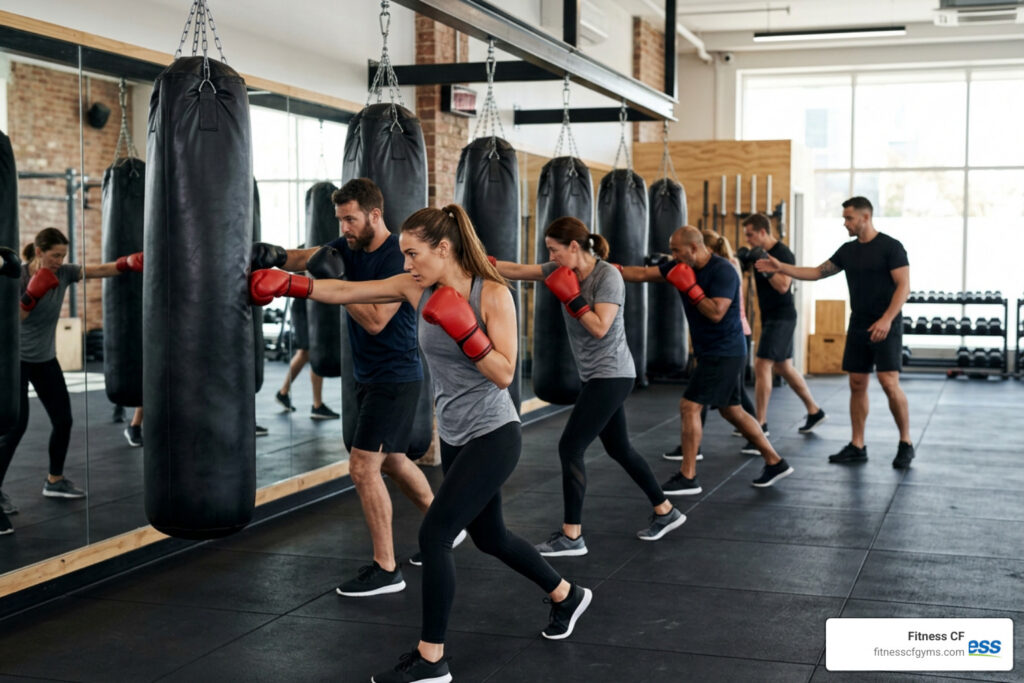
At its core, a boxing cardio class is a high-energy group fitness workout designed to improve cardiovascular health, build lean muscle, and burn fat. Instead of fighting an opponent, you challenge your own limits. By using a mix of shadowboxing, heavy bag work, and bodyweight conditioning exercises, these classes elevate your heart rate and keep your whole body engaged.
The aerobic exercise component of these classes is a major reason the calorie burn is so strong. A single 45-minute session can burn up to 1,000 calories depending on your effort level, body composition, and overall conditioning. This makes it one of the most efficient workouts for people who want cardio, strength, coordination, and stress relief in one routine.
To help you visualize how these classes differ from stepping into a competitive ring, here is a simple comparison:
| Feature | Traditional Boxing Training | Boxing Cardio Classes |
|---|---|---|
| Primary Goal | Self-defense, competition, ring strategy | Calorie burn, weight loss, muscle definition |
| Physical Contact | Yes (sparring, mitt work with contact) | No (non-contact, heavy bags, shadowboxing) |
| Equipment Used | Headgear, mouthguards, sparring gloves | Heavy bags, jump ropes, light weights |
| Experience Required | Intermediate to advanced skills needed | None (completely beginner-friendly) |
| Workout Structure | Sparring rounds, defensive drills, pad work | HIIT intervals, strength training, rhythmic combos |
| Injury Risk | Moderate to high (head and facial impact) | Very low (strictly fitness-related) |
Understanding the Difference: Boxing Fitness vs. Traditional Sparring
The most important distinction is that boxing fitness is non-contact training. You will never be hit, and you will never have to hit another person. Instead, your primary target is either a heavy bag filled with water or sand, or simply the air in front of you during shadowboxing drills.
Heavy bag workouts allow you to release force safely. Hitting a bag provides physical resistance, which forces your muscles to contract and work harder than they would during many forms of steady-state cardio. Shadowboxing focuses on form, speed, and mental visualization. It also teaches you to control your movements using your core, which helps prevent overextending your joints.
If you love the idea of martial arts-inspired movement but want to explore different formats, you can Discover martial arts-based fitness to see how kickboxing and other combat styles compare to pure boxing.
Who Should Join Boxing Cardio Classes?
One of the best things about boxing cardio classes is their accessibility. People with different backgrounds, ages, and fitness goals can modify the same workout to match their current ability.
- Beginners: If you have never worn a pair of boxing gloves, you can still start. Instructors typically break down the basic punches – the jab, cross, hook, and uppercut – so you can follow along safely.
- Active Seniors: Because there is no physical contact, many older adults can enjoy balance, coordination, and bone-supporting benefits while keeping movements controlled and low impact when needed.
- Busy Professionals: If you only have 45 minutes to exercise, these classes deliver a full-body cardio and strength training experience in a single, efficient session.
- All Fitness Levels: You control the speed and power of your punches. If you need to slow down the pace or take a break, you can do so at any time without disrupting the flow of the workout.
The Health and Fitness Benefits of Boxing Workouts

Engaging in regular boxing workouts can support both physical health and mental wellness. It is a holistic workout style that challenges your body while giving your brain a much-needed break from daily stressors.
One of the most overlooked physical benefits of boxing is its impact on bone health. Boxing workouts include weight-bearing movement and resistance from the heavy bag, which can help strengthen muscles around your bones. Combined with a balanced strength routine and proper nutrition, this can support bone density and healthy aging.
Regular physical activity is also strongly connected to long-term wellness. The American Heart Association recommends a mix of moderate-to-vigorous aerobic activity and muscle-strengthening exercise, and boxing cardio can help contribute to both goals.
Cardiovascular Endurance and Heart Health
Your heart is a muscle, and just like any other muscle, it needs to be trained to stay strong. Boxing cardio classes are designed to move you through different heart rate zones, transitioning between high-intensity aerobic capacity work and quick anaerobic recovery periods.
This style of training builds stamina. By consistently challenging your cardiovascular system, you can improve endurance, support healthier blood flow, and make everyday activities feel easier over time. Regular cardio exercise is also associated with a lower risk of heart disease and a better overall quality of life.
If you are trying to decide which style of cardiovascular training is best for your current fitness journey, you can Choose the best cardio for your goals to find the perfect match for your lifestyle.
Full-Body Strength and Muscle Definition
Many people assume boxing is purely an upper-body workout because you throw punches with your arms. In reality, real punching power starts from the ground up.
Every punch you throw begins with your feet pushing against the floor, traveling up through your legs, rotating through your hips and core, and finally releasing through your shoulders and arms. This means you are building lean muscle and developing upper body power while simultaneously working on lower body stability.
The resistance of hitting a heavy bag acts as a form of strength training, toning your shoulders, back, chest, and arms without requiring long sessions of heavy lifting. When paired with squats, lunges, planks, and other bodyweight moves, boxing cardio becomes a true full-body workout.
Inside the Workout: HIIT, Strength, and Technique
A well-structured boxing cardio class is a masterclass in modern physical conditioning. It does not just focus on one aspect of fitness; instead, it blends core stability, balance, and coordination into a single cohesive experience. To see how these elements compare to other popular workouts, you can Explore different conditioning classes to find your perfect rhythm.
The Power of High-Intensity Interval Training
Most modern boxing cardio classes rely heavily on HIIT (High-Intensity Interval Training). Instead of jogging at a steady pace, you perform explosive bursts of punching combinations followed by short, active recovery periods such as jumping jacks, squats, or core work.
This training style spikes your metabolic rate and triggers the EPOC effect (Excess Post-exercise Oxygen Consumption). This means your body continues to burn calories at an elevated rate for hours after your workout is finished, even while you are resting and recovering. To understand the science behind this fat-burning phenomenon, you can Learn about the benefits of HIIT and how it maximizes your workout time.
Core Stability, Balance, and Coordination
Every hook and cross you throw requires rotational power. To rotate safely and quickly, your abdominal muscles, obliques, and lower back must fire in unison. This constant twisting motion builds core stability without requiring you to perform a single traditional sit-up.
Boxing footwork also teaches you to stay light on your feet while shifting your center of gravity. This dynamic movement improves hand-eye coordination and can support better balance. For older adults and people who want to maintain functional fitness, these movement skills can make daily activities feel more stable and controlled.
What to Expect in Your First Session

It is completely normal to feel a little intimidated before walking into your first boxing cardio class. Almost everyone remembers their first time putting on wraps and wondering if they are doing it right. A good class environment should feel supportive, beginner-friendly, and focused on personal progress rather than comparison.
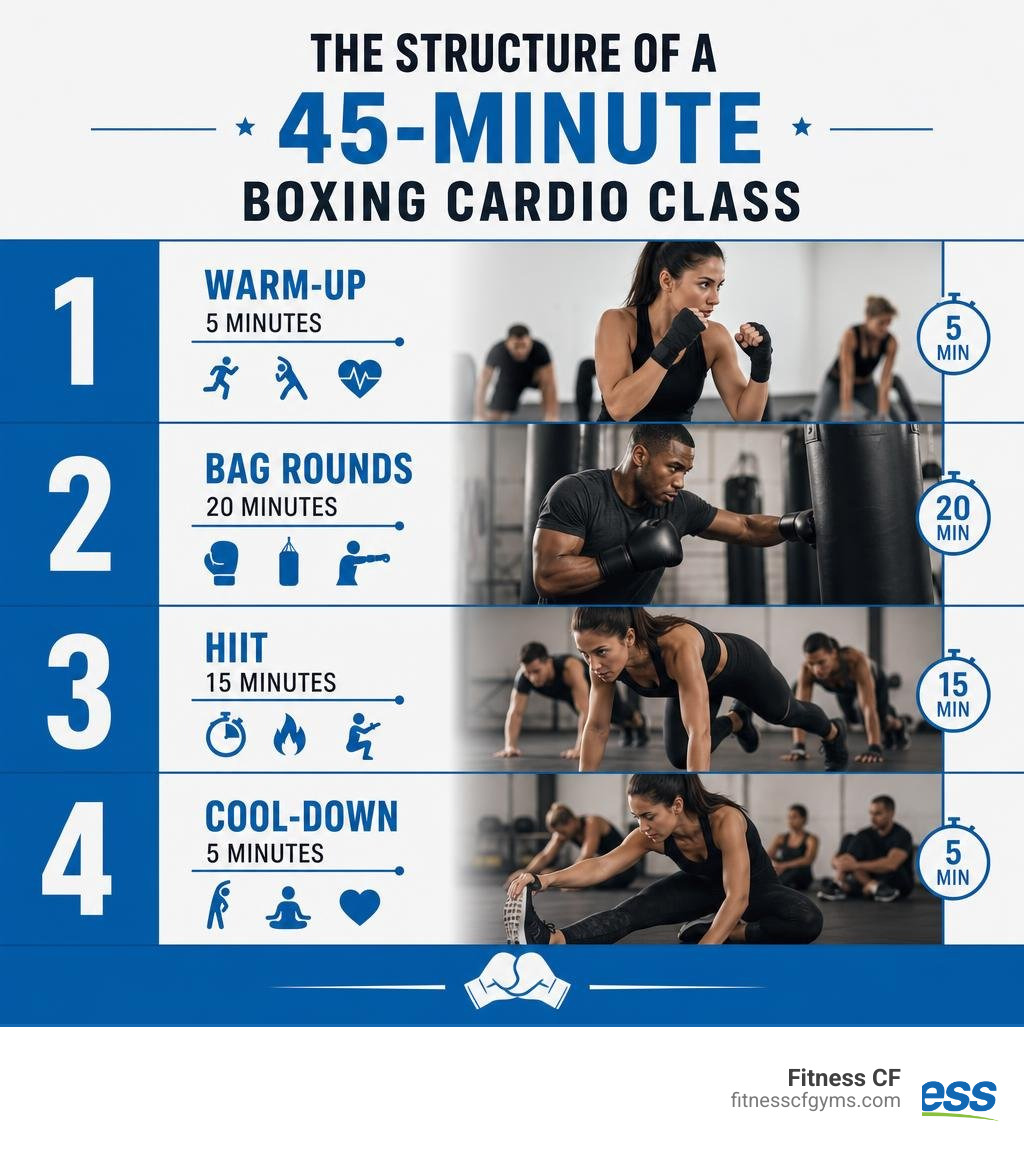
A typical class structure lasts between 45 and 50 minutes and follows a clear progression:
- Warm-up Drills (5-10 mins): Dynamic stretching, jump rope, light shadowboxing, and mobility movements to prep your joints and raise your core temperature.
- Technique & Combinations (25-30 mins): The heart of the class. You will practice specific punch combinations on the heavy bag or in the air, interspersed with bodyweight strength intervals.
- Core Burnout (5 mins): Focused abdominal work to build rotational power and stability.
- Cool-down Stretches (5 mins): Deep static stretches to lower your heart rate and promote muscle recovery.
What to Wear to Boxing Cardio Classes
When dressing for a boxing cardio session, prioritize comfort, breathability, and support:
- Athletic Wear: Opt for moisture-wicking, breathable fabrics. You will sweat a lot, so high-performance workout wear is highly recommended. Avoid loose or baggy shirts that might get caught in your hands while punching.
- Supportive Sneakers: Wear athletic shoes with good lateral support and cushioning. Boxing involves a lot of pivoting and quick footwork, so running shoes with overly thick, soft soles might make you feel unstable.
- Hair and Accessories: Keep long hair tied back securely, and remove any rings, watches, or dangling jewelry before putting on your hand wraps.
Essential Equipment and Gear
To get the most out of your session, you will need a few basic pieces of gear:
- Hand Wraps: These are important for protection. Hand wraps help support the tiny bones in your hands and stabilize your wrists when making contact with the heavy bag. Ask for help with wrapping if you are new.
- Boxing Gloves: Most fitness boxing sessions require a standard pair of boxing gloves, often 12oz to 14oz for general conditioning.
- Heavy Bags: These are commonly used for resistance and impact training. Water-filled heavy bags may feel gentler on your knuckles and wrists than traditional sand-filled bags.
For home practice, start with shadowboxing, footwork drills, and light conditioning before adding bag work. If you do use a heavy bag at home, choose gloves and wraps that fit properly, leave enough space to move safely, and focus on controlled technique instead of maximum power.
Frequently Asked Questions
How many calories do you burn in a boxing cardio class?
Because boxing cardio is a high-intensity, full-body workout, you can burn anywhere from 500 to 1,000 calories per 45-to-60-minute session. The exact number depends on your weight, muscle mass, conditioning level, and how much effort you put into every punch and interval.
Do I need prior boxing experience to join?
No prior experience is necessary. Beginner-friendly classes typically walk through the basic punches and defensive movements at the start of the session, allowing new participants to learn the fundamentals safely while more experienced participants focus on speed, power, and precision.
Is boxing cardio safe for beginners?
Yes, boxing cardio can be safe for beginners when it is done with proper form and smart pacing. Since there is no sparring or physical contact with another person, the risk of contact-related injury is low. You control the impact and intensity of your workout. By focusing on technique, wrapping your hands correctly, and taking breaks when needed, you can enjoy a safe, self-paced, and rewarding workout.
Conclusion
Embracing a healthy lifestyle does not mean you have to spend hours on a boring cardio machine. Boxing cardio classes offer a dynamic, engaging, and fun way to build strength, improve endurance, burn calories, and clear your mind.
The combination of cardio intervals, strength movements, core rotation, and coordination training makes boxing cardio a powerful option for overall fitness. It can support heart health, help build lean muscle, improve balance, and make exercise feel more exciting and sustainable.
Are you ready to experience the physical and mental benefits of boxing cardio? Start your fitness journey with group classes and claim your free trial pass today!