The Best 1 Exercise for Full Body Training (Quick Answer)
If you’re short on time and looking for the 1 exercise for full body results, here it is:
The Pushup to Downward Dog is the single best full-body exercise you can do. It combines a push-up with a yoga-inspired downward dog position to hit nearly every major muscle group in one fluid movement — no equipment needed.
What it targets:
- Chest, shoulders, and triceps (pushing phase)
- Core and back (transition and hold)
- Hamstrings, calves, and posterior chain (downward dog phase)
How to start:
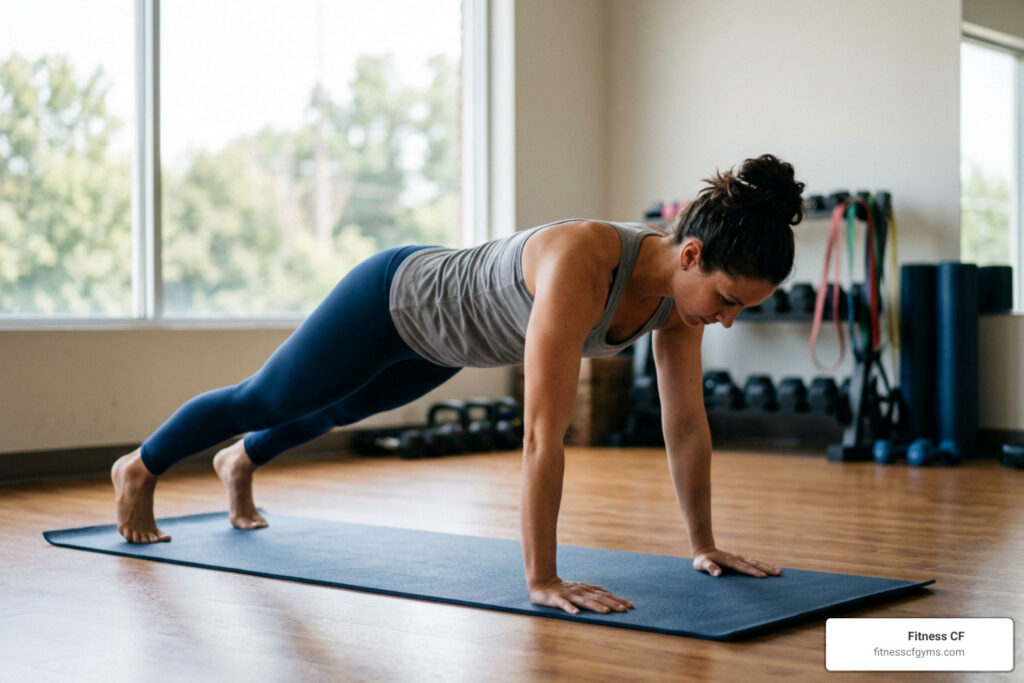
- Get into a high plank position
- Lower into a push-up (stop before your chest touches the floor)
- Push back up and shift your hips up and back into a downward dog
- Return to high plank and repeat
Beginners: 10 reps | Advanced: 20 reps with optional 3-second holds
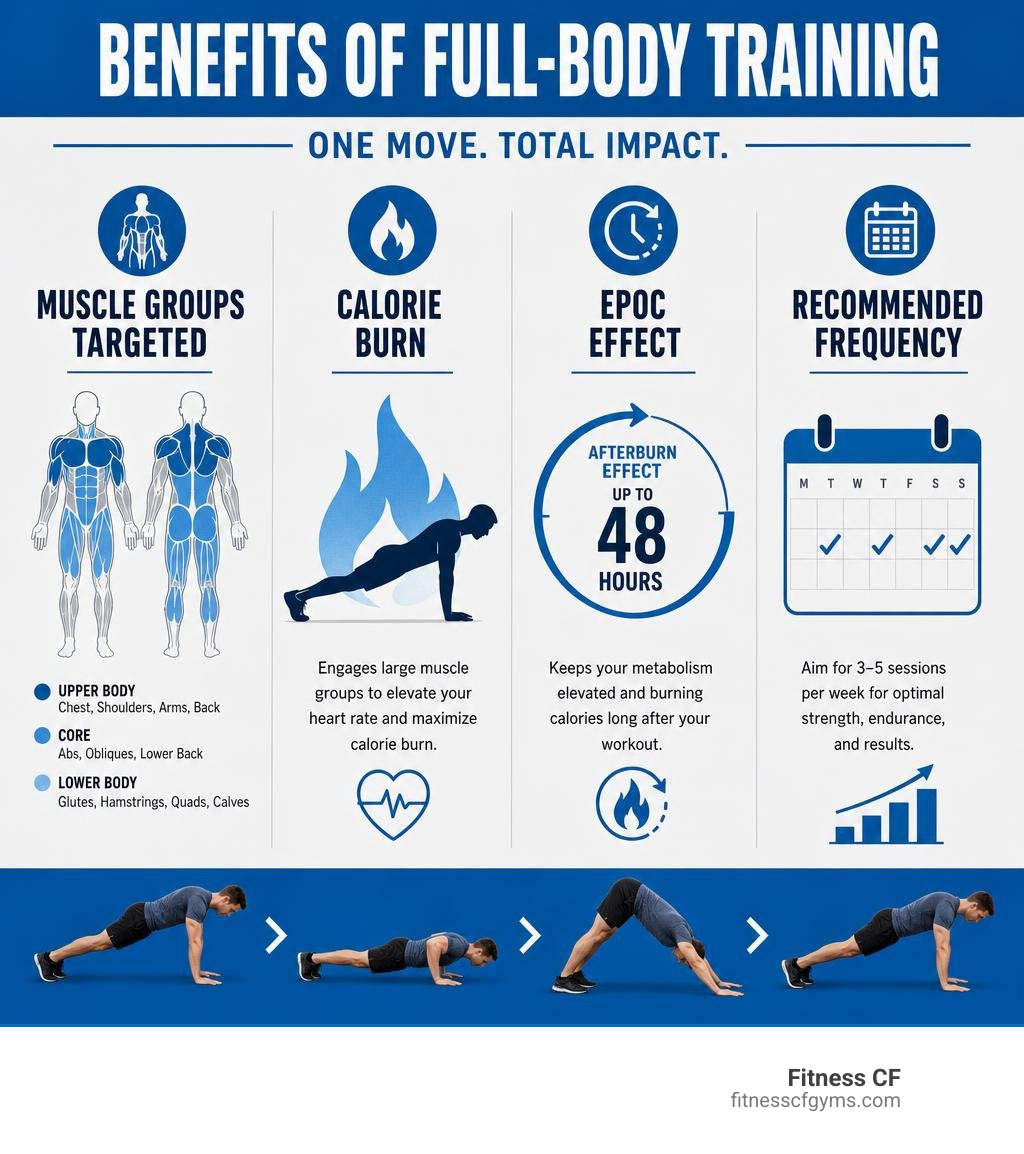
Most people think getting a full-body workout means spending an hour in the gym cycling through a dozen different exercises. But the truth is simpler — and more encouraging — than that. One well-chosen compound movement, performed consistently, can engage your core, upper body, and lower body all at once, elevate your heart rate, and keep your metabolism running higher for up to 48 hours after you finish.
Living a healthy life is built on consistency, and finding efficient ways to exercise makes staying active much easier. I’m Pleasant Lewis, a fitness professional with over 40 years of experience helping people discover the power of functional movement. By combining the muscle-building benefits of strength training with the heart-pumping benefits of cardiovascular exercise, you can transform your physical health and mental well-being. Let’s break down exactly why this move works so well and how to get the most out of it.
Why the Pushup to Downward Dog is the Best 1 Exercise for Full Body Training
When we look for a single movement that can do it all, we have to look past basic isolation exercises. Doing bicep curls all day might give you a nice pump, but it won’t do much for your heart, your core, or your posterior chain. To get the absolute most out of your training time, you need a hybrid movement that challenges both your strength and your flexibility.
The Pushup to Downward Dog is our favorite candidate for the ultimate 1 exercise for full body fitness. It is a beautiful marriage of strength training and yoga. By combining a classic upper-body pushing movement with an active, overhead posterior stretch, you create a continuous loop of work and recovery.
This hybrid exercise does wonders for your cardiovascular health. Because you are constantly shifting your body weight and moving your heart above and below your hips, your cardiovascular system has to work overtime to pump blood to different muscle groups. This elevates your heart rate quickly, turning a simple bodyweight strength move into an efficient cardio session.
Furthermore, this move serves as a fantastic active recovery tool. If you are sore from a heavy lifting session or stiff from sitting at a desk all day, flowing through a few rounds of this exercise lubricates your joints, stretches your tight hamstrings, and wakes up a sleepy core. It fits seamlessly into any daily routine, requiring nothing more than your own body weight and a small patch of floor space. Incorporating both strength and cardio elements into your day is a cornerstone of healthy living, helping to lower blood pressure, improve mood, and boost daily energy levels.
Muscle Groups Targeted by the Hybrid Move
What makes this hybrid exercise so special is that it leaves virtually no muscle untouched. Let’s look at what is actually happening under the hood during each phase of the movement:
- The Upper Body Push: As you lower into the push-up and press yourself back up, you heavily recruit your chest (pectoralis major), your shoulders (anterior deltoids), and the backs of your arms (triceps).
- The Core Stability Center: To keep your body in a straight line from head to heel, your entire core must fire. Your rectus abdominis, obliques, and deep transverse abdominis act as a stabilizing bridge, preventing your hips from sagging toward the floor.
- The Posterior Chain Stretch and Strength: As you transition your hips up and back into the downward dog, the focus shifts. Your upper back and shoulders work statically to support your weight overhead, while your hamstrings, calves, and glutes receive a deep, active stretch.
If you love the feeling of working multiple muscle groups at once but want to add some variety down the road, you can also explore other options like these 10 Simple Dumbbell Exercises for a Full Body Workout to build on this solid foundation.
The Science of Time-Efficient Compound Movements
There is a mountain of exercise science supporting why compound movements like this are so incredibly effective. When you perform multi-joint exercises, you require your nervous system to coordinate several muscle groups simultaneously. This improves overall muscle coordination and balance, making you feel more athletic and capable in your everyday movements.
Additionally, compound movements burn up to 50% more calories per session than isolation exercises because they require a massive amount of oxygen and energy to fuel multiple muscle groups all at once. This massive energy demand triggers what scientists call Excess Post-Exercise Oxygen Consumption (EPOC), or the “afterburn” effect. A high-intensity session utilizing compound movements can keep your metabolic rate elevated for up to 48 hours post-workout, helping you burn calories even while you rest.
Best of all, you don’t need to live in the gym to see results. A landmark 2021 study revealed that full-body workouts performed just 3 days per week produce similar strength and muscle gains to complex split routines, provided the weekly training volume is kept the same. This is great news for busy individuals who want to stay healthy without sacrificing their entire schedule. If you want to dive deeper into how short, intense sessions can transform your fitness, check out The Ultimate 15-Minute Full-Body Workout (That Actually Works) for more science-backed training strategies.
Step-by-Step Guide to the Pushup to Downward Dog
To reap the full physical benefits of this incredible movement, precision is key. Moving mindfully from a high plank into a deep stretch requires a strong mind-muscle connection and a solid understanding of proper alignment.

How to Perform This 1 Exercise for Full Body Strength
Let’s walk through the movement step-by-step to ensure you are performing it with flawless technique:
- The Setup: Start in a strong high plank position on the floor. Place your hands slightly wider than shoulder-width apart, with your fingers spread wide to create a stable base. Keep your feet together or hip-width apart. Squeeze your glutes, pull your belly button toward your spine, and look at the floor slightly ahead of your hands to keep your neck neutral.
- The Descent: Inhale deeply as you slowly bend your elbows, lowering your entire body toward the ground in a controlled, steady motion. Keep your elbows tucked back at a 45-degree angle relative to your torso—avoid letting them flare out directly to the sides. Lower yourself until your chest is just a few inches above the floor.
- The Press: Exhale powerfully as you push through your palms to return to the starting high plank position. Maintain a completely straight line from your head to your heels; do not let your lower back arch or your hips sag.
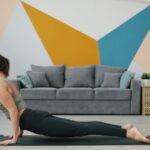
- The Transition: Without pausing at the top of the plank, continue pushing through your hands as you drive your hips up and back toward the ceiling. Let your head relax between your shoulders as you press your chest back toward your thighs.
- The Downward Dog Hold: Focus on lengthening your spine. Drive your heels down toward the floor to feel a deep stretch through your hamstrings and calves. Hold this position for a brief second, breathing deeply.
- The Return: Smoothly shift your weight forward, lowering your hips back to the starting high plank position. Re-engage your core and glutes, and prepare for the next repetition.
For those who are just beginning their fitness journey and want a complete walkthrough of similar bodyweight circuits, 10 Minute Full Body Workout (No Equipment, Beginner Friendly) – The Complete Athlete Guide offers a fantastic, easy-to-follow layout to build your confidence.
Key Form Cues and Common Mistakes to Avoid
Even seasoned athletes can fall into bad habits when fatigue sets in. Keep these essential form cues in mind to protect your joints and maximize muscle engagement:
- Mind the Elbows: Avoid flaring your elbows out to a 90-degree angle during the push-up phase. This puts immense, unnecessary stress on your rotator cuffs. Keep them tucked back at roughly 45 degrees, forming an “arrow” shape with your body rather than a “T.”
- Keep a Neutral Spine: Never let your lower back sag like a hammock during the plank or push-up. If your hips drop, your core stops working, and your lower back takes the brunt of the strain. If you feel your lower back pinching, squeeze your glutes harder or drop to your knees for the push-up portion.
- Pack Your Shoulders: During the downward dog, avoid shrugging your shoulders up to your ears. Keep your shoulders “packed” down your back, creating space for your neck to relax.
- Heel Drive vs. Flat Feet: In the downward dog, it is completely fine if your heels do not touch the floor. Focus on the upward tilt of your pelvis and the lengthening of your spine rather than forcing your heels flat at the expense of a rounded back.
Programming Your Full-Body Routine: Reps, Sets, and Progressions
Consistency and smart programming are the secret ingredients to any successful fitness journey. To keep making progress, you need to understand how to structure your workouts and when to challenge your body with harder variations.
Beginner vs. Advanced Workout Protocols
Your starting point depends entirely on your current fitness level. Because this exercise is highly scalable, you can adjust the volume and intensity to match your capabilities.
- The Beginner Protocol: If you are new to bodyweight training, aim for 10 controlled repetitions per set. Focus entirely on your form rather than speed. Perform 2 to 3 sets, resting for 60 to 90 seconds between sets. Doing this 2 to 3 times a week is plenty to spark noticeable changes in your strength and endurance.
- The Advanced Protocol: If you have solid upper-body strength, aim for 20 repetitions per set. To make it even more challenging, introduce 3-second isometric holds at both the bottom of the push-up and the peak of the downward dog. Perform 4 sets with minimal rest (30 to 45 seconds) between rounds.
To see how you can fit these protocols into a broader weekly routine, check out Your 5-Day Workout Routine to Get Toned and Terrific for a balanced, structured approach to bodyweight and resistance training.
Modifications and Progressions for Every Fitness Level
Don’t let a challenging movement discourage you! There are plenty of ways to modify the Pushup to Downward Dog so that it feels just right for your body:
- The Incline/Wall Variation (Easiest): If a floor push-up is too intense, place your hands on a sturdy wall, counter, or bench. Perform the push-up against the elevated surface, then push your hips back into a modified downward dog stretch.
- The Knee Push-Up Modification (Moderate): Perform the push-up phase with your knees resting on the floor. Once you press back up to the top, lift your knees off the ground and push your hips back into the full downward dog.
- The Single-Leg Challenge (Advanced): Perform the entire movement while keeping one leg lifted slightly off the floor. This adds a massive balance challenge and forces your core to work twice as hard to keep your hips square.
- Tempo Training: Slow down the entire movement. Take 3 seconds to lower into the push-up, 2 seconds to press up, and 3 seconds to transition into the stretch. This increases your muscles’ “time under tension,” which is a fantastic driver for muscle growth.
If you want to build a highly structured, equipment-free routine over a longer period, we highly recommend reading through the 8-Week Full Body Routine: No Equipment, No Gym, Real Progression guide, which shows you exactly how to progress your bodyweight training week by week.
Comparing the Pushup to Downward Dog to Other Compound Movements
To truly understand the value of the Pushup to Downward Dog, it helps to see how it stacks up against other famous full-body compound movements.
| Exercise | Primary Movement Patterns | Impact Level | Equipment Needs | Cardiovascular Demand |
|---|---|---|---|---|
| Pushup to Downward Dog | Horizontal Push, Overhead Press/Hinge | Low | None | Moderate to High |
| Burpees | Squat, Push, Jump | High | None | Extremely High |
| Squats | Lower Body Push (Knee Flexion) | Low to Moderate | None / Dumbbells | Moderate |
| Deadlifts | Lower Body Pull (Hip Hinge) | Low | Barbell / Dumbbells | Moderate to High |
While burpees are fantastic for metabolic conditioning, they are high-impact and can be tough on the wrists, knees, and lower back if performed with poor form. Squats and deadlifts are unparalleled for building raw lower-body strength, but they typically require external weights to remain highly effective over time.
The Pushup to Downward Dog shines because it offers a zero-equipment, low-impact alternative that simultaneously builds upper-body strength, opens up tight joints, and challenges your core stability without putting harsh impact on your skeletal system.
Is Relying on Only 1 Exercise for Full Body Workouts Enough?
While we love the efficiency of having a single go-to exercise, we must be honest about its limitations. Relying on literally only one exercise forever can eventually lead to muscle imbalances.
The human body is designed to perform several fundamental movement patterns: pushing, pulling, hinging, squatting, carrying, and rotating. While the Pushup to Downward Dog covers pushing, hinging, and core stabilization beautifully, it lacks a true “pulling” movement (like a pull-up or row) to target the lats and biceps. It also doesn’t heavily overload the quadriceps the way a deep squat or lunge does.
For true, long-term physical longevity and balanced strength, you should eventually expand your routine to include a variety of movements. If you want to learn how to weave different exercises together into a cohesive, balanced program, take a look at our guide on How to Build a Full Body Workout Plan That Actually Works.
Frequently Asked Questions about Full-Body Training
Can you build muscle with a single bodyweight exercise?
Yes, you absolutely can, especially if you are a beginner or intermediate trainee. Muscle hypertrophy (growth) is triggered by mechanical tension and time under tension. By using variations like tempo training, single-leg holds, and increasing your total training volume, you can continue to challenge your muscles and stimulate growth using nothing but your own body weight.
How many times a week should you do full-body workouts?
For most people, performing full-body workouts 2 to 3 times per week is the sweet spot. This frequency allows you to stimulate muscle protein synthesis regularly while still leaving a generous 48-hour recovery window between sessions. Your muscles don’t grow while you are working out; they grow and repair while you are resting and sleeping!
Is a 10-minute full-body workout actually effective?
Absolutely. A focused, high-intensity 10-minute workout is infinitely better than doing nothing at all. Short workouts are incredible tools for building consistency, lowering the barrier to entry, and establishing healthy daily habits. Over time, these small, consistent efforts compound into massive improvements in your cardiovascular fitness and metabolic health.
Conclusion
At the end of the day, healthy living isn’t about finding a perfect, highly complicated fitness routine that you abandon after two weeks. It’s about finding simple, effective habits that you can maintain for a lifetime. Embracing a balanced lifestyle that combines strength training, active recovery, and mindful movement is the ultimate key to physical longevity.
Prioritizing your physical health through regular exercise offers profound benefits. Strength training helps maintain muscle mass, supports joint health, and boosts metabolic rate, while cardiovascular exercise strengthens the heart, improves lung capacity, and enhances mental clarity. Together, these two pillars of fitness form the foundation of a vibrant, energetic life.
If you are ready to explore a wider variety of movements and build a routine that keeps you feeling energized and strong, check out The Definitive Guide to Full Body Exercises Routine to take your next step toward a healthier, happier you!