What is a Full Body Exercises Routine?
To understand why a full body exercises routine is so incredibly effective, we first need to look at how it differs from traditional split training.
In a traditional split routine, you isolate specific muscle groups on different days of the week. For example, you might have a “Chest and Triceps” day, a “Back and Biceps” day, and a dreaded “Leg Day.” While this approach works well for competitive bodybuilders who need a massive amount of training volume on single muscles, it requires you to be in the gym five to six days a week. If you miss Monday’s chest workout, you might have to wait an entire week to target your chest again.
A full body exercises routine, on the other hand, targets all of your major muscle groups—including your legs, chest, back, shoulders, arms, and core—during a single training session. Instead of blasting one area with endless exercises, you perform a few high-quality, multi-joint movements that stimulate the entire body.

This training style is deeply rooted in the history of physical culture. Before split routines became popular in the modern bodybuilding era, legendary lifters built world-class physiques using simple, full-body programs three days per week.
According to the latest exercise science, training each muscle group 2–3 times per week leads to significantly greater muscle growth and strength development compared to training each muscle only once a week. Because muscle protein synthesis remains elevated for only 24 to 48 hours after a workout, a full-body split allows you to repeatedly trigger the signals for muscle repair and growth throughout the week. To dive deeper into how this works, check out this guide on the science of full body training.
| Feature | Full Body Workout Routine | Traditional Split Training |
|---|---|---|
| Weekly Frequency per Muscle | 2 to 3 times | 1 time |
| Typical Weekly Gym Visits | 2 to 3 days | 4 to 6 days |
| Primary Exercise Type | Compound (multi-joint) | Isolation (single-joint) |
| Calorie Burn per Session | High (300–600 calories/hour) | Moderate |
| Scheduling Flexibility | High (missing a day doesn’t ruin the week) | Low (missing a day disrupts the split) |
| Best Suited For | Beginners, busy people, general fitness | Advanced bodybuilders, specialists |
Who Benefits Most from This Training Style?
While anyone can benefit from a total-body approach, certain groups will find it particularly life-changing:
- Beginners: If you have been lifting for less than a year, your muscles adapt rapidly to any resistance stimulus. A 3-day full-body plan provides the perfect balance of frequent practice (which helps you master exercise form) and plenty of recovery time.
- Busy Professionals: If you struggle to find time for the gym, full-body training is a game-changer. You can achieve incredible results in just two or three 45-to-60-minute sessions per week, leaving you more time for work, family, and life.
- Athletes: Real-world movement requires your entire body to work as a integrated unit. Full-body compound exercises train your muscles to coordinate together, improving athletic performance, functional strength, and balance.
- Anyone Focused on Body Composition: If your goal is shedding fat while revealing lean, toned muscle, the high metabolic demand of full-body training is unmatched. It is a highly efficient path toward achieving a fit toned body.
The Core Benefits of Full Body Strength Training
Choosing a full body exercises routine offers clear physical and metabolic advantages that make your workouts more productive.
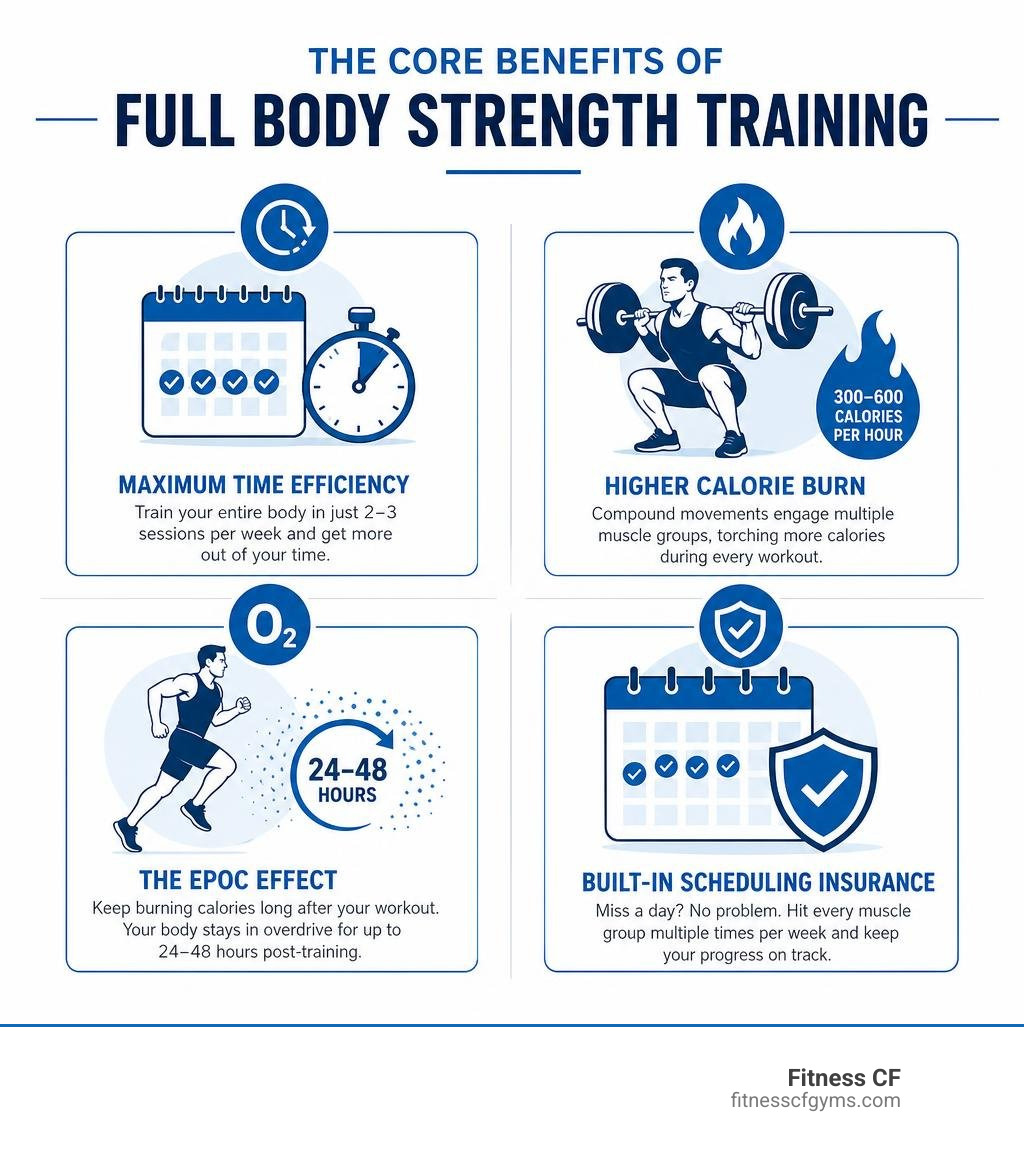
- Maximum Time Efficiency: You do not need to live at the gym to get in the best shape of your life. By condensing your training into three focused sessions per week, you free up hours of personal time while still hitting every muscle group with optimal frequency.
- Higher Calorie Burn: Because compound exercises require multiple large muscle groups to work simultaneously, they demand a massive amount of energy. A typical full-body session can burn between 300 to 600 calories per hour, depending on your weight and training intensity.
- The EPOC Effect: Intense full-body resistance training triggers Excess Post-Exercise Oxygen Consumption (EPOC). This means your body continues to consume oxygen and burn calories at an elevated rate for up to 24 to 48 hours after your workout is over, helping you learn how to lose fat and gain muscle simultaneously.
- Built-in Scheduling Insurance: Life happens. If you are on a 5-day split and miss your leg day, your lower body goes untrained for a week. If you are on a full-body plan and miss a Friday session, you have already trained your legs on Monday and Wednesday. Your progress never stalls due to a busy calendar.
Muscle Protein Synthesis and Frequency
When you lift weights, you trigger a biological process called muscle protein synthesis (MPS), which is the mechanism your body uses to repair and rebuild muscle tissue. In natural lifters, MPS remains elevated for roughly 24 to 48 hours after training before returning to baseline.
By utilizing a 3-day full-body routine, you can hit your chest, back, and legs on Monday, Wednesday, and Friday. This means you are spiking MPS three separate times per week. In contrast, a traditional split routine only spikes MPS once a week per muscle group. By keeping the growth signals active almost continuously, you optimize your body’s natural ability to build lean tissue. To explore the research supporting this frequency, take a look at this detailed breakdown of research on training frequency.
Cardiovascular and Metabolic Advantages
Many people believe you must spend hours on a treadmill to improve your cardiovascular health, but a structured full-body strength routine offers incredible heart-health benefits. Moving directly from a lower-body exercise like a squat to an upper-body exercise like a row forces your heart to pump blood rapidly from one end of your body to the other.
This peripheral heart action keeps your heart rate elevated throughout the session, providing a powerful cardiovascular stimulus alongside your strength gains. Balancing this metabolic demand with proper recovery is the cornerstone of a successful cardio and strength balance.
The Best Compound Exercises for Your Routine
To get the most out of a full body exercises routine, you must build it around compound movements. These are multi-joint exercises that recruit several large muscle groups at once, giving you the absolute best return on your time and effort.

By prioritizing compound movements over isolation exercises (like bicep curls or calf raises), you stimulate more muscle mass, burn more calories, and trigger a stronger natural hormone response. If you are working out at home or prefer lighter weights, you can achieve similar total-body benefits using these 10 simple dumbbell exercises.
Lower Body Foundations: Squats and Hinges
The lower body contains the largest, most powerful muscles in your body, making squats and hinges the absolute foundation of any effective routine.
- The Squat (Quad Dominant): Whether you perform a barbell back squat, a goblet squat, or a bodyweight squat, this movement targets your quadriceps, glutes, hamstrings, and core. Squats build foundational lower-body strength and improve your mobility for daily activities like climbing stairs or standing up from a chair.
- The Hinge (Posterior Chain Dominant): Movements like the conventional deadlift or the Romanian Deadlift (RDL) focus on the “posterior chain”—the muscles along the back of your body, including your hamstrings, glutes, and lower back. Mastering the hip hinge protects your lower back from injury and is essential for developing a strong, toned body gym workout.
Upper Body Essentials: Push and Pull
To build a balanced upper body and protect your joints, you should always pair your pushing movements with an equal amount of pulling exercises.
- Horizontal Push (Chest & Triceps): Exercises like the bench press, dumbbell chest press, or classic push-ups target your chest, shoulders, and triceps.
- Vertical Push (Shoulders & Triceps): The overhead press (barbell or dumbbell) builds strong, stable shoulders and core stability.
- Vertical Pull (Back & Biceps): Pull-ups, chin-ups, or lat pulldowns target the latissimus dorsi (the wide muscles of your back) and your biceps.
- Horizontal Pull (Mid-Back & Biceps): Seated cable rows, bent-over barbell rows, or dumbbell rows build thickness in your upper back, which improves your posture and shoulder health. For a minimalist approach, you can build a highly effective routine around these 6 essential exercises.
Designing Your Weekly Full Body Workout Plan
Creating a successful weekly schedule requires balancing training intensity with adequate rest. Because you are stimulating your entire body in every session, you must allow at least one full day of recovery between workouts.
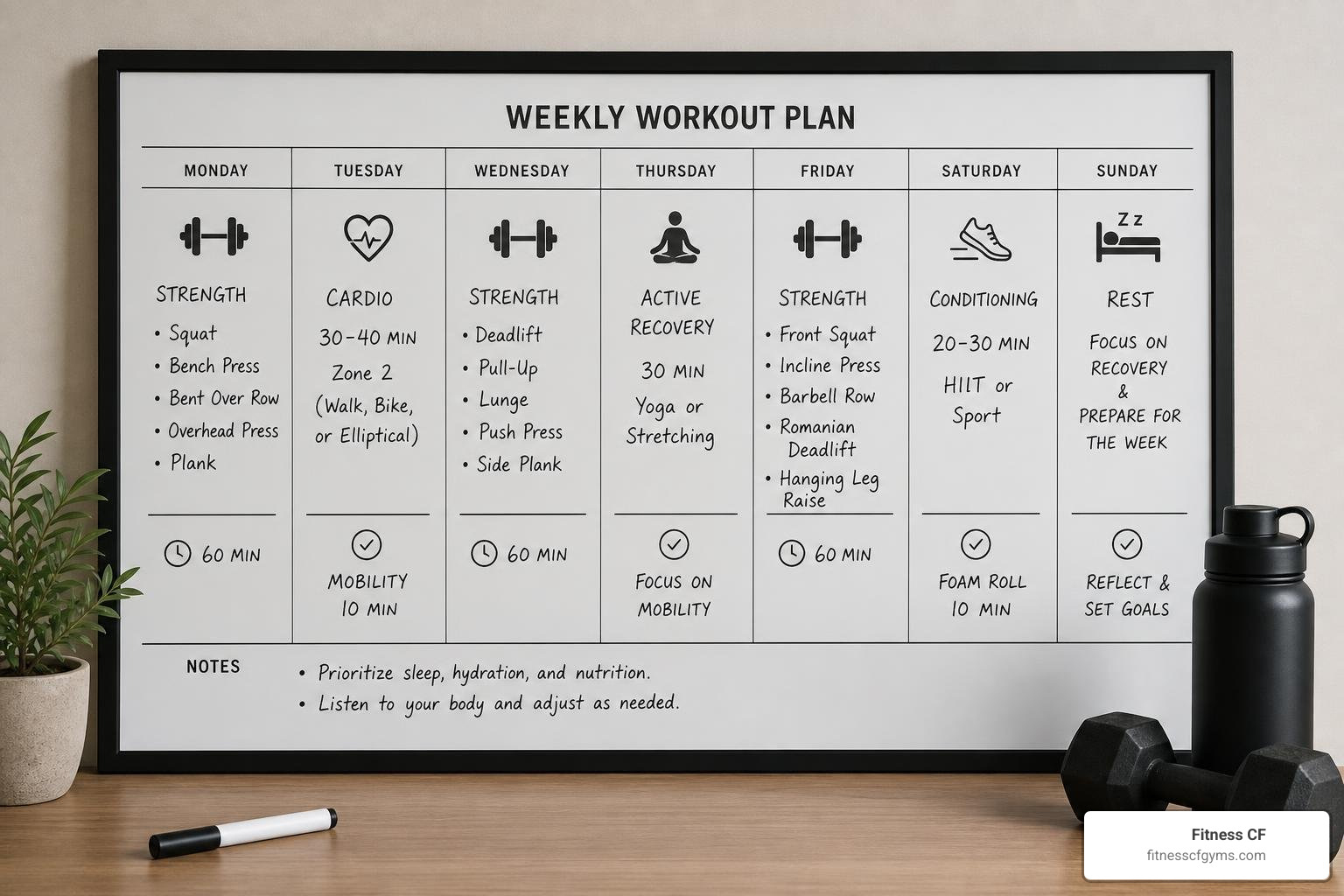
A classic and highly effective weekly structure is a 3-day alternating schedule:
- Monday: Workout A (Squat Focus)
- Tuesday: Rest / Active Recovery (e.g., walking, light stretching)
- Wednesday: Workout B (Hinge Focus)
- Thursday: Rest / Active Recovery
- Friday: Workout A or C (Volume / Balance)
- Saturday & Sunday: Rest
This structure ensures your muscles have a full 48 hours to recover and rebuild before they are called into action again. To see how to expand your training as you gain experience, explore this 5 day workout routine.
Structuring a Beginner Full Body Exercises Routine
If you are new to strength training, keep things simple. Focus on mastering your form, building a mind-muscle connection, and training consistently. Here is a perfect beginner template that you can complete in under an hour:
- Warm-Up: 5–10 minutes of light cardio (walking or cycling) followed by dynamic stretches (arm circles, leg swings, bodyweight squats).
- Goblet Squat: 3 sets of 10–12 reps (Rest 90 seconds between sets)
- Dumbbell Flat Bench Press: 3 sets of 10–12 reps (Rest 90 seconds)
- One-Arm Dumbbell Row: 3 sets of 10–12 reps per side (Rest 90 seconds)
- Romanian Deadlift (Dumbbell or Barbell): 3 sets of 12 reps (Rest 90 seconds)
- Plank Hold: 3 sets of 30–45 seconds (Rest 60 seconds)
- Cool-Down: 5 minutes of static stretching for your hamstrings, chest, and hips.
This simple routine covers all major movement patterns safely and effectively. For more specialized tips tailored to women’s fitness goals, check out our beginner full body guide.
Progressing Your Full Body Exercises Routine to Intermediate and Advanced Levels
As your body adapts to the beginner routine, your progress will eventually slow down. This is a natural part of the fitness journey! To continue building muscle and gaining strength, you must apply the principle of progressive overload. This means gradually increasing the challenge on your muscles over time.
Instead of changing your exercises every week, you can progress by:
- Adding Weight: Adding 2 to 5 pounds to your upper-body lifts or 5 to 10 pounds to your lower-body lifts when you can easily hit your rep targets.
- Increasing Reps: If your target is 8–12 reps, and you can perform 12 clean reps on all sets, increase the weight slightly in your next session.
- Increasing Sets: Moving from 3 sets to 4 sets for your primary exercises to increase your overall training volume.
Intermediate and advanced lifters can also transition to daily undulating periodization, where you have a “Heavy” day (lower reps, heavier weights), a “Volume” day (moderate reps and weights), and an “Accessory” day (focusing on weak points and core). If you are ready to take your gains to the next level, take a look at our structured 30 day muscle gain plan.
Frequently Asked Questions about Full Body Workouts
Starting a new routine often comes with questions. Here are clear, science-backed answers to the most common queries about full-body training.
Can I do a full body workout every day?
No, we do not recommend performing a full-body workout every single day. When you lift weights, you create microscopic tears in your muscle fibers. Your muscles do not actually grow during your workout—they grow while you are resting, sleeping, and recovering.
Training the same muscles daily without a 48-hour recovery window can lead to overtraining, persistent joint pain, chronic fatigue, and stalled progress. If you love staying active daily, focus on light cardio or mobility work on your off days, and read about the muscles you can workout every day safely (such as your calves, abs, and forearms).
How long should a typical full body strength workout last?
A highly effective full-body strength workout should take between 45 to 60 minutes, including a proper warm-up and cool-down. If your workouts are stretching past 75 minutes, you are likely doing too many exercises or resting too long between sets.
Quality and intensity always beat quantity. By focusing on 5 to 6 high-yield compound exercises and keeping your rest periods to 60–90 seconds for accessory moves (and 2–3 minutes for heavy compound lifts), you can stimulate maximum muscle growth in under an hour. For a structured template, check out this 4-week full-body program.
What equipment do I need for an effective full body routine?
You do not need a gym packed with complicated machinery to get an incredible full-body workout. You can build a highly effective routine using:
- Bodyweight Only: Push-ups, pull-ups, squats, lunges, and planks require zero equipment and can be done anywhere.
- Dumbbells & Resistance Bands: These are perfect for home workouts, offering excellent versatility and adjustable resistance.
- Barbells & Plates: Ideal for intermediate and advanced lifters looking to maximize strength gains through heavy compound lifts.
The most important factor is consistency and progressive challenge, not the complexity of your gear. Explore how to build a balanced home or gym setup with this simple weekly plan.
Conclusion
Embarking on a full body exercises routine is one of the smartest, most time-efficient decisions you can make for your health, strength, and overall well-being. By focusing on high-quality compound movements and prioritizing your recovery, you can achieve remarkable physical transformations in just a few hours per week.
At Fitness CF, we believe that fitness should enhance your life, not consume it. Whether you are training in Orlando, Clermont, Mount Dora, or St. Cloud, our goal is to help you build a sustainable, healthy lifestyle that keeps you feeling strong, energized, and confident.
Now is the perfect time to take action. Pick three non-consecutive days this week, commit to a simple full-body routine, and watch your strength soar. If you want a step-by-step blueprint to guide your journey, read our comprehensive guide on How to Build a Full Body Workout Plan That Actually Works. Let’s get moving!