Stop Wasting Time: Here Are the 5 Best Dumbbell Exercises Right Now
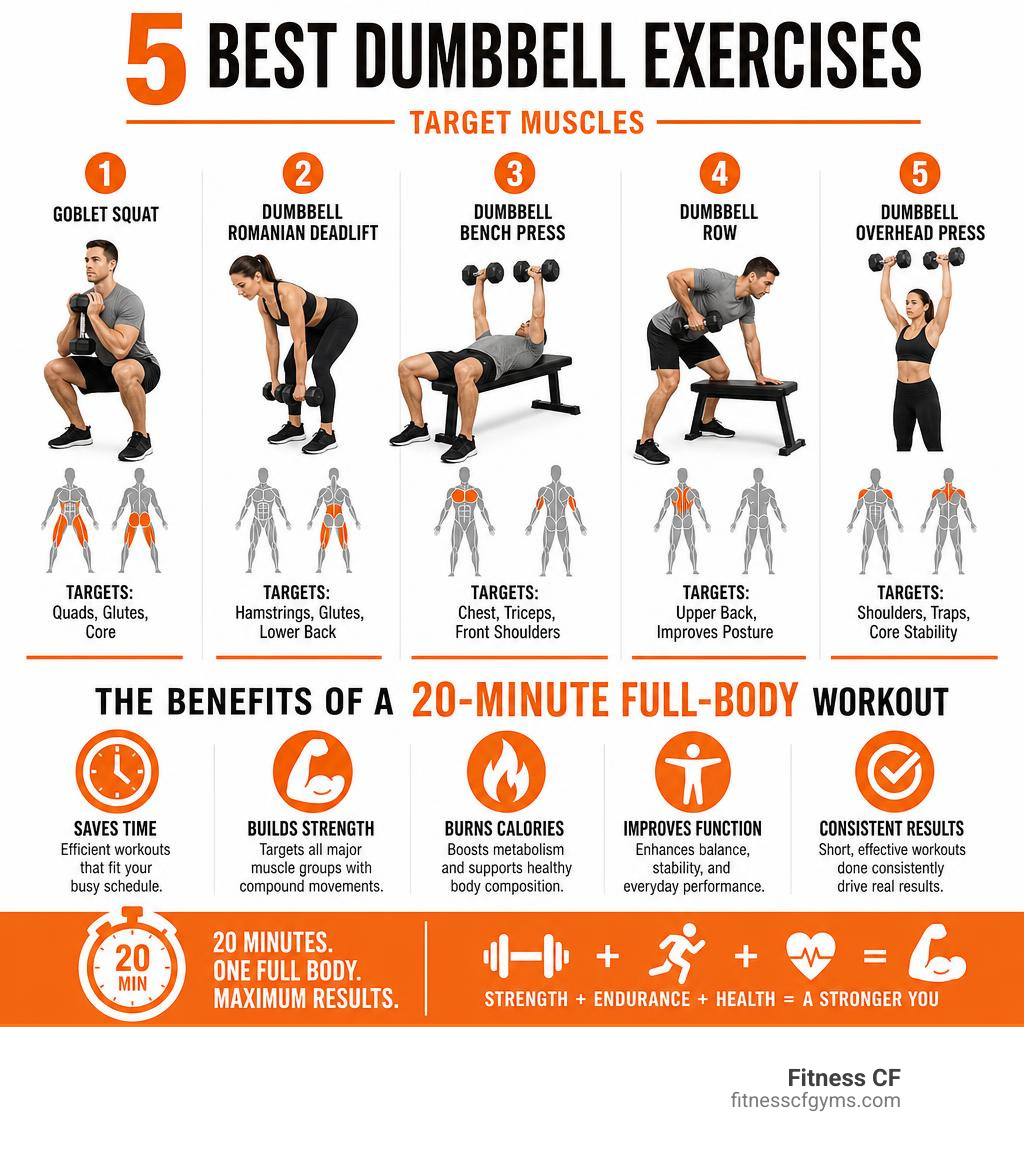
The 5 best dumbbell exercises for a quick, effective full-body workout are:
- Goblet Squat – targets quads, glutes, and core
- Dumbbell Romanian Deadlift – works hamstrings, glutes, and lower back
- Dumbbell Bench Press – builds chest, triceps, and front shoulders
- Dumbbell Row – strengthens upper back and improves posture
- Dumbbell Overhead Press – develops shoulders, traps, and core stability
You are busy, but you still want to get stronger, feel better, and make the most of your training time.
The good news? You do not need hours of exercise or a room full of equipment. A pair of dumbbells and 20 to 30 minutes is enough to train your entire body when you choose the right movements.
Dumbbells are versatile, joint-friendly for many people, and excellent for building practical strength. They train stabilizer muscles, allow each side of your body to work independently, and support better balance and coordination.
I’m Pleasant Lewis, owner and operator of Fitness CF, with over 40 years of experience in the fitness industry helping people build strength and healthy habits through smart, efficient training. Use this guide as a simple framework to get stronger without wasting reps.
Why the 5 Best Dumbbell Exercises Are All You Need for Full-Body Fitness
The best quick workouts are not random. They are built around movement patterns your body uses every day:
- Squat
- Hinge
- Push
- Pull
- Press overhead
That is why these five dumbbell exercises work so well together. They train your legs, glutes, back, chest, shoulders, arms, core, grip, and posture in one efficient routine.
Dumbbells also offer benefits that machines and barbells do not always provide.
First, dumbbells force your stabilizer muscles to work. A machine guides the weight for you. Dumbbells do not. Your shoulders, hips, core, wrists, ankles, and smaller supporting muscles have to help control the movement. That is one reason dumbbell training can improve balance, coordination, and functional fitness.
Second, dumbbells make unilateral training easier. Unilateral simply means training one side at a time. Even when you use two dumbbells, each arm or leg has to control its own weight. This can help you notice and correct strength differences between your right and left sides.
Third, dumbbells can be more joint-friendly for many people. Because each arm moves independently, your shoulders and wrists can follow a more natural path than they might with a fixed barbell. That does not mean dumbbells are automatically safer – form still matters – but they do give your body more freedom to find a comfortable position.
Finally, dumbbells are excellent for muscle hypertrophy, which is the process of building muscle size. The key is using a weight that challenges you while allowing good technique. In simple terms: by the last few reps of a set, the work should feel hard, but your form should not fall apart.
If you want a bigger-picture look at why strength training is worth your time, we recommend reading 7 Compelling Reasons to Strength Train. For an accessible routine focused on strength and mobility, this guide to Dumbbell Exercises: Routine for Everyday Strength and Mobility is also a helpful reference.
Strength training does more than build muscle. It supports posture, helps protect joints, contributes to bone health, and makes everyday tasks easier – carrying groceries, lifting kids, moving furniture, climbing stairs, and getting off the floor without making that mysterious adult sound we all know too well.
The 5 Best Dumbbell Exercises: Step-by-Step Guide

These exercises made our list because they are compound movements. That means they use multiple joints and muscle groups at once. Compound exercises give you more return for your time than isolation moves like curls or triceps kickbacks.
We love curls too. But if you only have 20 minutes, your biceps will have to wait their turn.
The goal is to train with control, use a full range of motion you can manage safely, and gradually progress over time. That progression can come from heavier dumbbells, more reps, slower tempo, shorter rest periods, or better form.
For more dumbbell training ideas, check out our Ultimate Guide to Dumbbell Workouts for Sculpting Your Body Anywhere. You can also explore additional exercise variations in this guide to effective dumbbell exercises for muscle gain.
1. The Goblet Squat
The goblet squat is one of the best lower-body dumbbell exercises because it teaches proper squat mechanics while training your legs, glutes, and core.
Primary muscles worked
- Quadriceps
- Glutes
- Hamstrings
- Core
- Upper back
- Calves
Why it is effective
Holding the dumbbell in front of your chest encourages an upright torso, which can make the squat easier to learn than a barbell back squat. It also challenges your core because your body has to resist folding forward.
This exercise builds strength for everyday movements like standing up from a chair, climbing stairs, and picking something up from the floor.
How to do it
- Stand with your feet about shoulder-width apart.
- Hold one dumbbell vertically at chest height, with both hands under the top end of the dumbbell.
- Brace your core as if someone is about to poke your stomach.
- Push your hips slightly back and bend your knees.
- Lower until your thighs are roughly parallel to the floor, or as low as you can go with control.
- Keep your chest tall and your heels planted.
- Drive through your midfoot and heels to stand back up.
- Squeeze your glutes at the top without leaning backward.
Common mistakes
- Letting the knees collapse inward
- Rounding the lower back
- Lifting the heels off the floor
- Holding the dumbbell too low
- Dropping quickly instead of lowering with control
Beginner modification
Use a lighter dumbbell or perform a box squat by sitting back to a bench or chair. Pause lightly, then stand back up.
Advanced progression
Use a heavier dumbbell, slow the lowering phase to 3 seconds, pause at the bottom, or perform heels-elevated goblet squats for more quad emphasis.
2. The Dumbbell Romanian Deadlift
The dumbbell Romanian deadlift, often called the RDL, is a hip-hinge exercise. It trains the backside of your body, also known as the posterior chain.
Primary muscles worked
- Hamstrings
- Glutes
- Lower back
- Upper back
- Core
- Forearms and grip
Why it is effective
The RDL strengthens the muscles you use to hinge at the hips. That matters because hinging shows up everywhere in real life: picking up a laundry basket, lifting a cooler, grabbing a suitcase, or moving a box.
It is also one of the best dumbbell exercises for building hamstring and glute strength without needing a barbell.
How to do it
- Stand tall with a dumbbell in each hand in front of your thighs.
- Keep your feet about hip-width apart.
- Soften your knees slightly.
- Brace your core and keep your spine neutral.
- Push your hips backward like you are trying to close a car door with your glutes.
- Let the dumbbells travel down the front of your legs.
- Stop when you feel a strong stretch in your hamstrings or when your back wants to round.
- Drive your hips forward to return to standing.
Common mistakes
- Squatting instead of hinging
- Rounding the back
- Looking too far up and straining the neck
- Letting the dumbbells drift away from the legs
- Going lower than your mobility allows
Beginner modification
Start with a shorter range of motion. Lower the dumbbells only to knee level until you can maintain a neutral spine.
Advanced progression
Try single-leg dumbbell RDLs, slower eccentric reps, or heavier dumbbells. Single-leg versions add a serious balance challenge, so do not be surprised if your ankles suddenly develop opinions.
3. The Dumbbell Bench Press
The dumbbell bench press builds upper-body pushing strength and gives your chest, shoulders, and triceps a powerful training stimulus.
Primary muscles worked
- Pectoralis major
- Triceps
- Anterior deltoids
- Serratus anterior
- Core and shoulder stabilizers
Why it is effective
Compared with a barbell, dumbbells allow each arm to move independently. This can help improve symmetry and may allow a more natural shoulder path. Dumbbells can also provide a greater range of motion, which is useful for chest development when performed safely.
No bench? No problem. You can do a dumbbell floor press instead. The floor limits how far your elbows travel, which can be helpful for beginners or anyone who wants a more controlled pressing option.
How to do it
- Lie on a flat bench with one dumbbell in each hand.
- Plant your feet firmly on the floor.
- Start with the dumbbells near your chest, elbows about 45 degrees from your torso.
- Keep your wrists stacked over your elbows.
- Brace your core and press the dumbbells upward.
- At the top, your arms should be extended but not aggressively locked.
- Lower the dumbbells with control until your elbows are slightly below your torso or until you reach a comfortable range.
- Press back up and repeat.
Common mistakes
- Flaring elbows too wide
- Bouncing the weights at the bottom
- Letting wrists bend backward
- Arching the lower back excessively
- Using dumbbells that are too heavy to control
Beginner modification
Perform a dumbbell floor press. Lie on your back with knees bent and feet flat. Lower until your upper arms touch the floor, then press up.
Advanced progression
Use heavier dumbbells, pause at the bottom, slow the lowering phase, or perform alternating dumbbell bench presses to challenge core stability.
4. The Dumbbell Row
The dumbbell row is your posture-saving, back-building, pulling-strength powerhouse.
Primary muscles worked
- Latissimus dorsi
- Rhomboids
- Middle and lower trapezius
- Rear deltoids
- Biceps
- Core
Why it is effective
Many people spend hours sitting, driving, texting, or working at a computer. Over time, the shoulders may drift forward and the upper back can become weak. Rows help strengthen the muscles that pull your shoulder blades back and support better posture.
The dumbbell row also trains each side independently, making it great for identifying strength imbalances.
How to do it
- Place one knee and one hand on a bench, with the opposite foot on the floor.
- Hold a dumbbell in your free hand.
- Keep your back flat and neck neutral.
- Let the dumbbell hang under your shoulder.
- Pull your elbow toward your hip, not straight up toward your shoulder.
- Squeeze your shoulder blade gently at the top.
- Lower with control until your arm is extended.
- Repeat all reps, then switch sides.
Common mistakes
- Twisting the torso
- Shrugging the shoulder toward the ear
- Pulling with momentum
- Rounding the back
- Turning the row into a biceps curl
Beginner modification
Use a lighter dumbbell and support yourself with one hand on a bench, sturdy surface, or your thigh in a staggered stance.
Advanced progression
Try a two-dumbbell bent-over row, a chest-supported row, or a renegade row. That renegade rows are much harder than they look. They are basically planks with attitude.
5. The Dumbbell Overhead Press
The dumbbell overhead press trains vertical pushing strength and challenges your shoulders, triceps, upper back, and core.
Primary muscles worked
- Deltoids
- Triceps
- Upper trapezius
- Upper chest
- Serratus anterior
- Core
Why it is effective
Pressing weight overhead builds strong shoulders and improves your ability to reach, lift, and stabilize objects above you. Because dumbbells move independently, your shoulder stabilizers have to stay active throughout the lift.
This exercise is also a great test of core control. If you have to lean way back to press the weight, the dumbbells are probably too heavy.
How to do it
- Stand tall with feet about hip-width apart.
- Hold one dumbbell in each hand at shoulder height.
- Keep palms facing forward or slightly inward.
- Brace your core and squeeze your glutes lightly.
- Press the dumbbells overhead until your arms are extended.
- Keep your ribs down and avoid leaning backward.
- Lower the dumbbells slowly to shoulder height.
- Repeat with control.
Common mistakes
- Overarching the lower back
- Pressing the dumbbells too far forward
- Shrugging excessively
- Locking the elbows aggressively
- Using leg drive when you are trying to do a strict press
Beginner modification
Perform the exercise seated with back support or use one dumbbell held with both hands.
Advanced progression
Try alternating overhead presses, single-arm presses, half-kneeling presses, or tempo presses. Single-arm variations light up your core because your body has to resist leaning to one side.
How to Perform the 5 Best Dumbbell Exercises with Perfect Form
Perfect form does not mean every rep looks like it belongs in a textbook. It means you are moving with control, using the right muscles, and keeping your joints in safe positions.
Here are our top form rules for all five exercises:
Keep a neutral spine.
Your back should not round during squats, rows, or RDLs. Think “tall chest, ribs down, strong core.”Control the eccentric phase.
The eccentric phase is the lowering part of a lift. Do not just drop into a squat or let dumbbells fall during a press. Lowering with control increases time under tension and helps reduce injury risk.Breathe with purpose.
Inhale before or during the lowering phase. Exhale as you stand, press, or pull. Do not hold your breath for long sets unless you have been coached on bracing techniques.Avoid momentum.
If you have to swing the dumbbells, they are probably too heavy. Your muscles should move the weight, not your ego.Keep joints aligned.
Knees should track in the same direction as your toes. Wrists should stay stacked during presses. Shoulders should stay away from your ears during rows.Stop if pain feels sharp or unusual.
Muscle fatigue is normal. Joint pain, pinching, or sharp discomfort is not something to push through.
If you want to build a broader strength routine, our guide to the Best Strength Training Exercises to Add to Your Routine is a great next step.
How to Structure Your Quick Full-Body Dumbbell Workout

A quick dumbbell workout should be simple enough to repeat and challenging enough to create progress.
For most people, these five exercises work well 2 to 3 times per week with at least 48 hours between full-body sessions.
Option 1: Strength-focused workout
Use this if your goal is strength, muscle tone, and steady progress.
| Exercise | Sets | Reps | Rest |
|---|---|---|---|
| Goblet Squat | 3 | 8-12 | 60-90 seconds |
| Dumbbell Romanian Deadlift | 3 | 8-12 | 60-90 seconds |
| Dumbbell Bench Press | 3 | 8-12 | 60-90 seconds |
| Dumbbell Row | 3 each side | 8-12 | 60-90 seconds |
| Dumbbell Overhead Press | 2-3 | 8-10 | 60-90 seconds |
Option 2: 20-minute conditioning circuit
Use this if you want strength plus a cardio-style challenge.
| Exercise | Work | Rest |
|---|---|---|
| Goblet Squat | 10 reps | Minimal |
| Dumbbell Romanian Deadlift | 10 reps | Minimal |
| Dumbbell Bench Press | 10 reps | Minimal |
| Dumbbell Row | 10 reps each side | Minimal |
| Dumbbell Overhead Press | 10 reps | Rest 90 seconds after round |
Complete 3 rounds.
This circuit can raise your heart rate, improve muscular endurance, and help you fit resistance training into a busy day. For another example, see this guide on how to get stronger with five dumbbell moves.
Strength vs conditioning: which should you choose?
| Goal | Best structure | Weight | Rest | Best for |
|---|---|---|---|---|
| Build strength | Straight sets | Moderate to heavy | 60-120 seconds | Muscle and strength gains |
| Improve endurance | Circuit | Light to moderate | Short | Cardio benefits and stamina |
| Learn technique | Straight sets | Light | 60-90 seconds | Beginners |
| Save time | Circuit | Moderate | Short | Busy schedules |
| Increase muscle tone | Both | Challenging but controlled | 45-90 seconds | Overall fitness |
Warm up for 5 to 10 minutes with light cardio and mobility, such as brisk walking, cycling, arm circles, bodyweight squats, hip hinges, and light rows. After training, cool down with easy walking and gentle stretching.
Modifying the 5 Best Dumbbell Exercises for Beginners and Advanced Lifters
The same five exercises can work for nearly every fitness level. The difference is how you load, modify, and progress them.
For beginners
Start with a weight you can lift for 10 to 12 controlled reps while feeling like you could do about 2 more reps if needed. This is called leaving “reps in reserve.”
Some beginners may start around 5 kg to 10 kg depending on the exercise, current strength, and comfort level. Go lighter if form breaks down.
Beginner tips:
- Use 2 sets per exercise for the first 2 weeks.
- Focus on form before adding weight.
- Rest 60 to 90 seconds between sets.
- Add reps before adding weight.
- Increase weight in small jumps.
You can also review our list of 10 Simple Dumbbell Exercises for a Full Body Workout for more beginner-friendly options. For additional beginner guidance, this beginner dumbbell workout resource may also help.
For advanced lifters
If you already train consistently, make these five exercises harder without sacrificing control.
Advanced progressions:
- Use heavier dumbbells.
- Slow the lowering phase to 3 to 5 seconds.
- Add pauses at the hardest point of each rep.
- Use unilateral variations like single-arm presses or single-leg RDLs.
- Increase total weekly sets.
- Use supersets, such as goblet squats paired with rows.
- Reduce rest times for conditioning.
- Track your lifts in a workout log.
Advanced training should still be controlled, intentional, and progressive.
Frequently Asked Questions about Dumbbell Training
Dumbbell training is simple, but simple does not always mean obvious. Here are the questions we hear often.
Can you build muscle and tone your body using only dumbbells?
Yes. Dumbbells can build strength, muscle, and visible muscle tone when you train consistently and use progressive overload.
Progressive overload can mean:
- Lifting heavier dumbbells
- Doing more reps
- Adding another set
- Slowing the tempo
- Improving range of motion
- Reducing rest periods
- Training more consistently
To build muscle, the final reps of your set should feel challenging. If you finish 15 reps and feel like you could do 15 more, the weight is probably too light.
Dumbbells can also support fat loss indirectly by helping build lean muscle, supporting a healthy metabolic rate, and pairing well with cardio, nutrition, sleep, and daily movement.
If your goal is muscle growth, read How to Build Muscle Mass Simply and Guaranteed.
What weight dumbbells should beginners start with?
Start with the weight that lets you perform every rep with good control.
A practical test:
- Pick a light-to-moderate dumbbell.
- Perform 10 reps of the exercise.
- Ask yourself: “Could I do 2 more reps with good form?”
- If yes, that is a solid starting weight.
- If you could do 10 more, go heavier.
- If your form breaks before rep 10, go lighter.
Lower-body moves like goblet squats and RDLs often use heavier dumbbells than shoulder presses. Some people may start around 5 kg to 10 kg, while others need less or more.
If you are setting up at home, this at-home dumbbell workout guide includes practical beginner considerations. For upper-body beginners, this simple upper-body dumbbell guide can provide additional context.
How many times a week should I do a full-body dumbbell workout?
Most beginners should start with 2 to 3 full-body dumbbell workouts per week.
A simple schedule:
- Monday: Full-body dumbbell workout
- Tuesday: Light cardio or mobility
- Wednesday: Rest or active recovery
- Thursday: Full-body dumbbell workout
- Friday: Cardio, yoga, or walking
- Saturday: Optional full-body workout
- Sunday: Rest
Try to allow about 48 hours between full-body strength sessions. Muscles grow and repair during recovery, not during the workout itself.
What safety tips should I follow with dumbbells?
Use these rules every time:
- Warm up for 5 to 10 minutes.
- Choose weights you can control.
- Keep your core engaged.
- Move through a pain-free range of motion.
- Do not hold your breath for long sets.
- Keep dumbbells close to your body when picking them up.
- Avoid twisting while lifting from the floor.
- Wear supportive shoes.
- Stop if you feel sharp pain.
- Ask for coaching if you are unsure about form.
What common dumbbell mistakes should I avoid?
The biggest mistakes are:
- Going too heavy too soon
- Swinging the dumbbells
- Skipping warm-ups
- Rushing reps
- Ignoring the lowering phase
- Training the same sore muscles hard every day
- Only doing upper-body exercises
- Forgetting to progress over time
- Using poor posture during rows and RDLs
Good training is not just about working hard. It is about working hard in the right direction.
Are dumbbells better than machines or barbells?
Not always better – just different.
Dumbbells are excellent because they:
- Train stabilizer muscles
- Allow natural joint movement
- Help correct side-to-side imbalances
- Require less space
- Work well at home or in a supervised training setting
- Fit many fitness levels
- Support both strength and conditioning
Machines can help beginners, rehab-style training, or targeted muscle work. Barbells are useful for heavy strength work. But if your goal is a quick, effective, full-body workout, dumbbells are hard to beat.
Conclusion
The 5 best dumbbell exercises – goblet squat, dumbbell Romanian deadlift, dumbbell bench press, dumbbell row, and dumbbell overhead press – give you a complete full-body workout without wasting time.
Together, they train your legs, glutes, chest, back, shoulders, arms, core, grip, balance, and posture. They build practical strength, support muscle tone, improve coordination, and help you stay active for the long run.
Start light. Move well. Progress gradually. Stay consistent.
Ready to make your next workout simple and effective? Start your fitness journey today and grab a free trial pass at Fitness CF.