Why Every Woman Should Know These Muscle Building Tips
Muscle building tips for women are not one-size-fits-all — and that’s exactly why so many women feel stuck, confused, or discouraged when they start lifting weights.
Here’s a quick answer to get you started:
Top Muscle Building Tips for Women at a Glance:
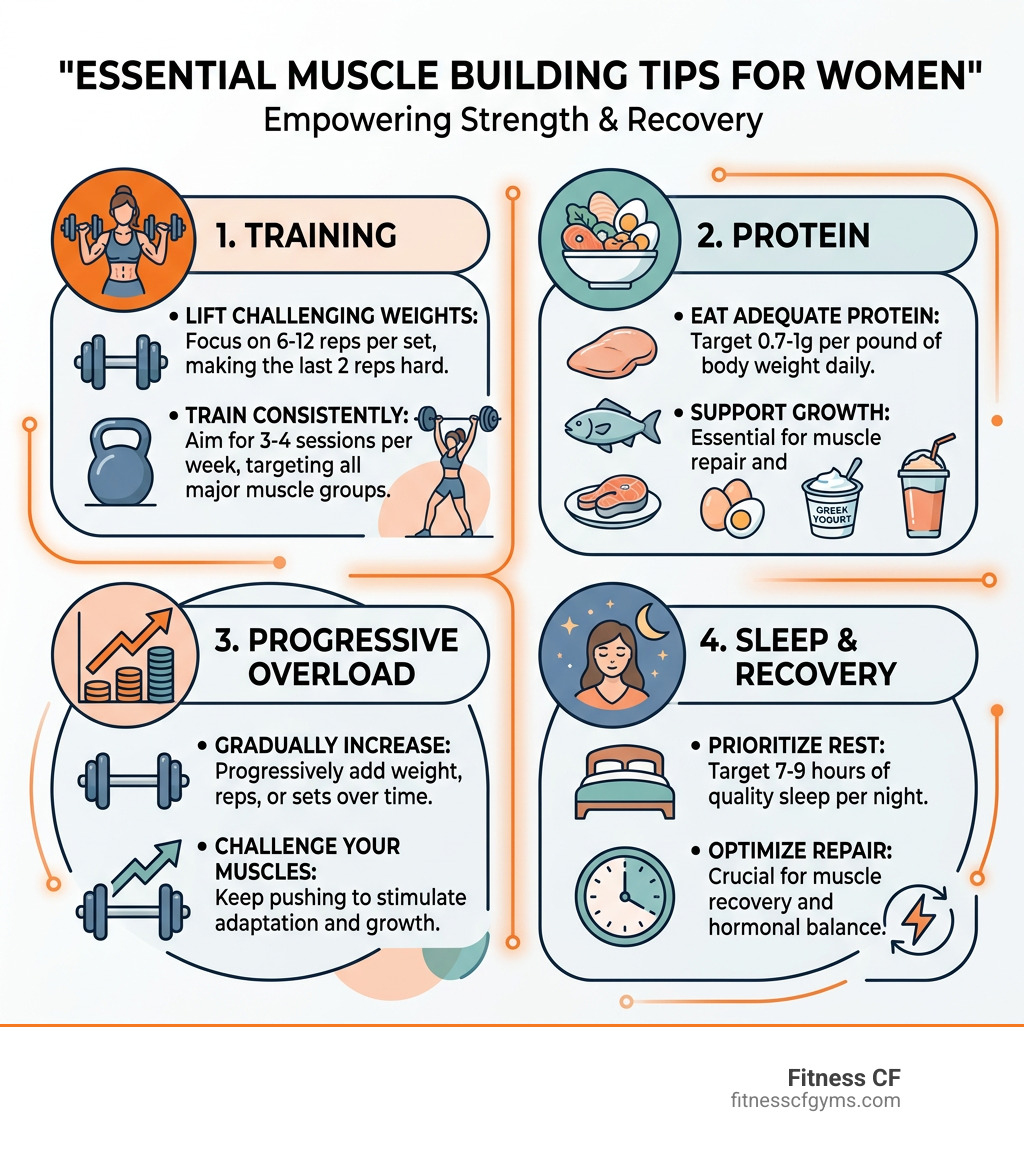
- Lift challenging weights – Aim for 6-12 reps per set, with the last 2 reps feeling hard
- Eat enough protein – Target 0.7-1g per pound of body weight daily
- Train consistently – 3-4 sessions per week hitting all major muscle groups
- Prioritize recovery – 7-9 hours of sleep per night is non-negotiable
- Use progressive overload – Gradually increase weight, reps, or sets over time
- Eat enough calories – A small surplus of 200-300 calories supports muscle growth
- Stay consistent – Noticeable changes typically appear within 8-12 weeks
The truth is, more women are strength training than ever before. In 2004, only 17.5% of U.S. women trained with weights twice or more per week. By 2020, that number had grown to 26.9%. And for good reason — building muscle is one of the most powerful things a woman can do for her long-term health, confidence, and energy.
Yet despite the growing interest, a lot of harmful myths still hold women back. Fear of getting “bulky.” Confusion about what to eat. Not knowing where to start. Sound familiar?
This guide cuts through the noise. Whether you’re picking up a dumbbell for the first time or looking to push past a plateau, you’ll find practical, science-backed strategies here that actually work for the female body.
I’m Pleasant Lewis, owner and operator of Fitness CF and Results Fitness, with over 40 years of experience in the fitness industry helping people of all ages and backgrounds build strength and live healthier lives — including countless women looking for reliable muscle building tips for women that fit their real lives. Let’s get into what the science and experience actually show.
Easy muscle building tips for women word list:
The Science of Female Hypertrophy: Why You Won’t Get “Bulky”
One of the most persistent hurdles we see in Central Florida gyms is the fear that picking up a heavy barbell will suddenly turn a woman into a professional bodybuilder overnight. We want to set the record straight: physiologically, it is incredibly difficult for women to get “bulky” by accident.
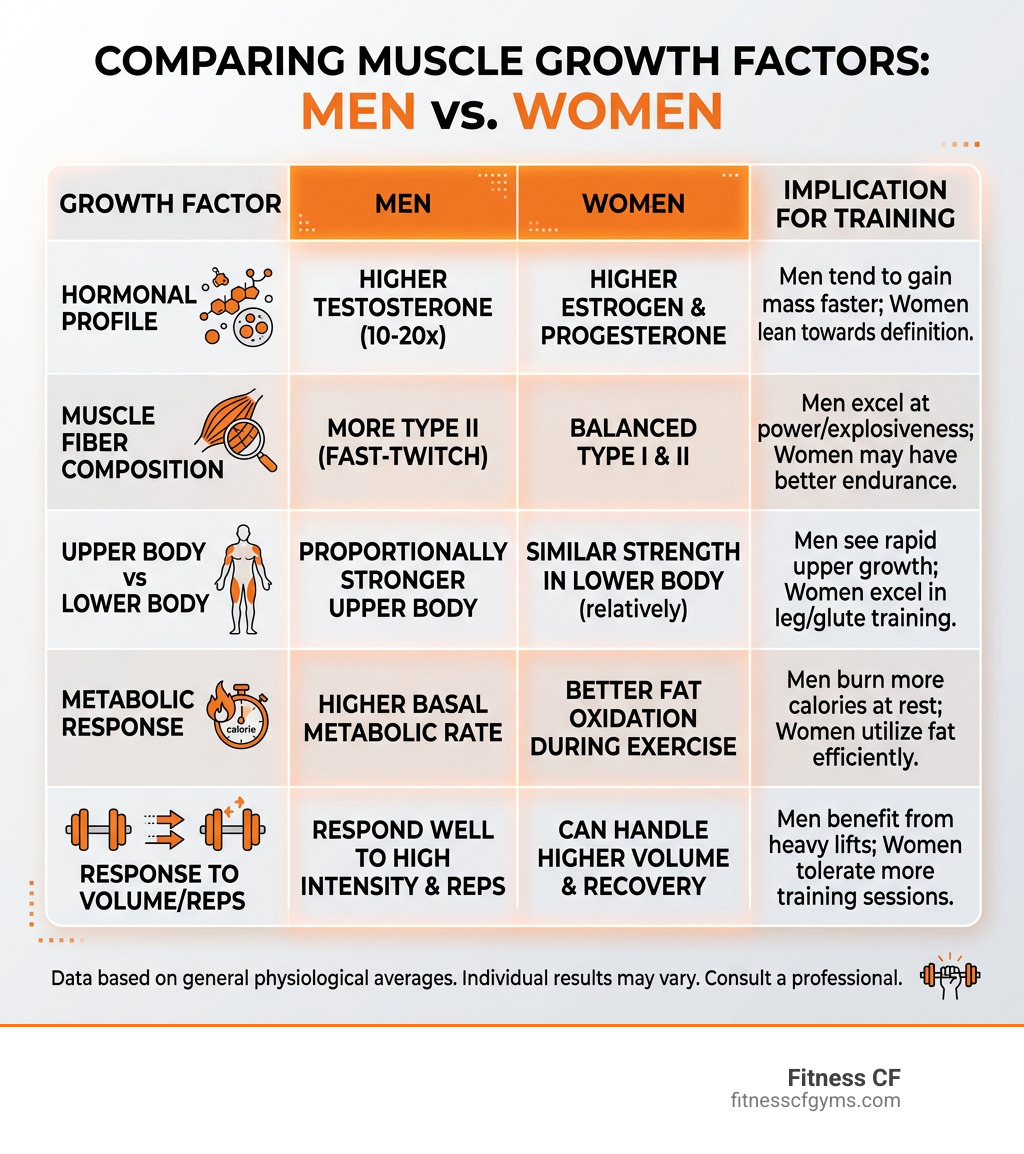
The primary reason comes down to hormones. Women naturally have about one-tenth to one-twentieth the amount of testosterone that men do. Testosterone is a major driver of muscle size. While we can certainly build impressive strength and definition, our bodies are designed to create lean, dense muscle rather than massive volume. When you see women who have reached extreme levels of muscularity, it is usually the result of years of hyper-specific training, a very strict caloric surplus, and sometimes performance-enhancing substances.
Research from the CDC shows that strength training is essential for health, yet many women still shy away from it due to this myth. In reality, building muscle actually helps you look “toned”—a word many women use to describe having muscle visibility and low enough body fat to see it. You can’t “tone” a muscle that isn’t there! For more on this, check out our deep dive into why women don’t actually get bulky from lifting weights.
Debunking Common Weightlifting Myths
Let’s look at the facts. Men and women have different hormonal profiles that dictate how we respond to resistance. While men might see rapid increases in shoulder width and arm circumference, women tend to see improvements in bone density, metabolic rate, and functional strength first.
Another common myth is that “light weights and high reps” are for women, while “heavy weights” are for men. This is simply not true. To stimulate muscle growth (hypertrophy), you must challenge the muscle. If you can breeze through 20 reps without breaking a sweat, your body has no reason to grow stronger.
By focusing on muscle density rather than just “size,” women can achieve a powerful, athletic physique that supports joint health and a high metabolism. Muscle is metabolically active tissue, meaning it burns more calories at rest than fat does. So, the more muscle you have, the easier it is to maintain a healthy weight.
Essential Muscle Building Tips for Women: Training for Results
If you want to see real changes in your physique, your training needs to be intentional. We recommend following a few core principles that apply to everyone from Orlando to Mount Dora.
First, prioritize progressive overload. This is the “secret sauce” of muscle building. It means you must gradually increase the stress placed upon your body during exercise. You can do this by adding more weight to the bar, performing more repetitions, or shortening your rest periods. If you lift the same 10-pound dumbbells for the next two years, your muscles will stay exactly the same size because they’ve already adapted to that load.
Second, focus on compound movements. These are exercises that work multiple joints and muscle groups at once, such as squats, deadlifts, lunges, and overhead presses. These moves give you the most “bang for your buck” and trigger a better hormonal response for growth. The WHO guidelines suggest that adults should do muscle-strengthening activities at least two days a week, but for optimal results, we suggest three to four sessions. For more detailed advice, read our tips for building lean muscle mass.
Beginner Muscle Building Tips for Women
If you’re just starting your journey in Clermont or St. Cloud, your number one priority is form. Don’t worry about how much weight is on the bar yet. Focus on moving through a full range of motion safely. Watching a demo video of proper squat form can be a great way to visualize the movement before you try it.
We often suggest that beginners start with weight machines. They provide a fixed path of motion, which helps you build a baseline of strength while minimizing the risk of injury. As you get more comfortable, you can transition to free weights (dumbbells and barbells), which engage more stabilizing muscles.
Consistency is key. It’s better to work out for 30 minutes three times a week than to do one three-hour marathon session once a month. Aim for a rep range of 8-12 per set. This range is widely considered the “sweet spot” for hypertrophy. If you want to learn more about starting from scratch, check out our beginner guide for home arm workouts.
Advanced Muscle Building Tips for Women
For those who have been lifting for a while and hit a plateau, it might be time to switch up your training splits. Instead of full-body workouts every time, you might try an “Upper/Lower” split or a “Push/Pull/Legs” routine. This allows you to hit each muscle group with more volume while still allowing for recovery.
Research on high-frequency training suggests that training a muscle group 2-3 times per week is superior to the traditional “body part split” where you only hit legs once a week. You should also focus on time under tension—slowing down the eccentric (lowering) phase of your lifts to create more micro-tears in the muscle fibers, which then grow back stronger.
Don’t underestimate the mind-muscle connection. Instead of just moving the weight from point A to point B, focus on squeezing the specific muscle you are trying to work. This intentionality can make a massive difference in your results. For more advanced strategies, explore our plan to build muscle and lose fat.
Nutrition and Fueling: The Role of Protein and Calories
You can lift all the weights in the world, but if you aren’t eating to support that growth, you won’t see the results you want. To build muscle, your body generally needs to be in a caloric surplus—meaning you eat slightly more calories than you burn. We’re not talking about a “dirty bulk” with fast food; a modest surplus of 200-300 calories from whole foods is usually enough.
The most important macronutrient for us is protein. When we lift weights, we create tiny micro-tears in our muscles. Protein provides the amino acids (the building blocks) needed to repair those tears and build the muscle back larger. Research on protein intake highlights that for those looking to maximize hypertrophy, a higher protein diet is non-negotiable.
Specifically, look for foods high in leucine, an amino acid that acts as a “trigger” for muscle protein synthesis. You’ll find this in animal products like chicken and eggs, as well as plant-based sources like soy. For a complete breakdown of what to eat, see our nutrition tips for building muscle.
Optimizing Protein and Supplements
How much protein do you actually need? A good rule of thumb is 0.7 to 1 gram of protein per pound of body weight. So, if you weigh 150 pounds, you should aim for roughly 105 to 150 grams of protein per day.
While we always advocate for “food first,” supplements can help bridge the gap:
- Whey Protein: A fast-digesting protein perfect for post-workout recovery.
- Creatine: One of the most researched supplements in the world. Creatine for women has been shown to improve strength, boost exercise performance, and even support bone health.
- BCAAs: Branched-chain amino acids can help with recovery, though they are often unnecessary if your total protein intake is high enough.
For more ideas on how to stock your pantry, check out our guide to lean muscle-building foods.
Muscle Building After 40: Navigating Menopause and Hormonal Changes
Many women ask us if it’s too late to start building muscle once they hit 40 or enter menopause. The answer is a resounding no. In fact, this is the time when strength training becomes most critical.
As we age, we naturally begin to lose muscle mass—a process called sarcopenia. This is accelerated during menopause due to the decline in estrogen, a hormone that actually helps protect and build muscle cells. Without intervention, this loss of muscle can lead to a slower metabolism, weight gain, and increased frailty.
The good news is that resistance training can significantly slow or even reverse this process. Research on bone density shows that lifting weights is one of the best ways to combat the osteoporosis risk that comes with aging. If you’re wondering about the timeline, read more on how long it takes for muscles to grow.
Combating Sarcopenia and Bone Loss
Strength training isn’t just about aesthetics for women over 40; it’s about functional longevity. By building muscle, you improve your joint stability, which reduces the risk of falls and injuries. It also helps manage the hormonal imbalances that can lead to insulin resistance and cardiovascular issues.
Research on strength training for osteoporosis indicates that high-intensity resistance training is safe and effective for increasing bone mineral density in postmenopausal women. We recommend focusing on movements that challenge your balance and coordination alongside your strength. It’s never too late to start; your future self will thank you for the work you do today.
Recovery and Lifestyle: The Secret to Long-Term Growth
We often say that you don’t grow in the gym; you grow while you sleep. When you lift weights, you are essentially breaking your body down. The growth happens during the recovery phase.
Sleep quality is the most underrated tool in your fitness arsenal. Sleep deprivation can reduce muscle protein synthesis by up to 18% after just one bad night. Aim for 7-9 hours of quality shut-eye to allow your hormones to reset and your tissues to repair.
Managing cortisol (the stress hormone) is also vital. Chronic stress keeps cortisol levels high, which can lead to muscle breakdown and fat storage around the midsection. This is where active recovery comes in. On your days off, don’t just sit on the couch. Go for a walk in one of our beautiful Central Florida parks, try a gentle yoga class, or use a foam roller. These activities promote blood flow to the muscles without adding extra stress. You can learn more about balancing cardio and weights for recovery here.
Finally, those micro-tears need time to heal. Avoid training the same muscle group two days in a row. If you hit legs hard on Monday, give them until Wednesday or Thursday before you go again.
Frequently Asked Questions about Muscle Building for Women
How long does it take for women to see noticeable muscle growth?
Consistency is the most important factor. While you might feel “tighter” or stronger within the first two weeks, true hypertrophy takes time. Most women can expect to see noticeable muscle growth within 8 to 12 weeks of consistent training and proper nutrition. Factors like genetics, age, and your starting fitness level will play a role, but if you stick with it, the results will come.
Can women build muscle while losing fat?
Yes, this is known as body recomposition. It is most common in beginners or those returning to the gym after a long break. To achieve this, you need to eat at or slightly below your maintenance calories while keeping your protein intake very high. This gives your body the fuel to build muscle while forced to burn stored fat for energy. For a deeper look at this process, check out how to lose fat and gain muscle.
Is cardio necessary when trying to build muscle?
Cardio is not strictly “necessary” for muscle growth, but it is essential for heart health and overall endurance. We recommend “Zone 2” cardio—low-intensity steady-state exercise like walking or light cycling. This improves your aerobic capacity, which actually helps you recover faster between sets of heavy lifts. The key is to avoid excessive high-intensity cardio that might interfere with your strength gains. Learn how to balance cardio and weights effectively.
Conclusion
At Fitness CF, we believe that every woman deserves to feel strong, capable, and confident. Building muscle is about so much more than what you see in the mirror; it’s about metabolic health, bone density, and the empowerment that comes from knowing what your body can achieve.
Whether you are in Orlando, Clermont, Mount Dora, or St. Cloud, our community is here to support your journey toward a healthier lifestyle. From our diverse classes to our expert personal trainers, we provide the tools you need to succeed.
Ready to see what you’re capable of? Start your journey with our 30-day muscle gain plan and take the first step toward the strongest version of yourself today!