Lower Back Pain Is Incredibly Common — But Exercise Can Help
If you’re looking for exercises to ease lower back pain, here are the most effective options to start with today:
- Pelvic tilts – Gently mobilize the lower spine
- Knee-to-chest stretch – Release tight lower back muscles
- Cat-cow stretch – Improve spinal mobility and reduce stiffness
- Bridge exercise – Strengthen glutes and support the lower back
- Bird dog – Build core stability and spinal control
- Child’s pose – Decompress and stretch the lower back
- Hamstring stretch – Relieve tension pulling on the lower spine
- Abdominal bracing/planks – Build deep core support for the spine
Most of these can be done in 15 minutes, once or twice a day. Start with 2-3 repetitions and build gradually.
Back pain has a way of turning simple tasks — standing at the sink, picking something up off the floor, getting out of a chair — into a real challenge.
You’re far from alone. Research shows that roughly 8 in 10 Americans will experience back pain at some point in their lives, and more than 25% of American adults are dealing with it right now. The lower spine is the most commonly affected area.
The good news? Movement is medicine. Gentle, consistent exercise is one of the most effective tools for both relieving lower back pain and preventing it from coming back. Rest might feel like the right instinct, but staying still often makes things worse by allowing muscles to tighten up further.
I’m Pleasant Lewis, owner and operator of Fitness CF and Results Fitness, with over 40 years of experience in the fitness industry helping people find exercises to ease lower back pain and build healthier, more active lives. In that time, I’ve seen how the right movement routine can transform how people feel day to day. Read on for everything you need to build a safe, effective routine that works for you.
Before You Start: Safety Rules for Exercising With Lower Back Pain
Lower back exercises should feel gentle, controlled, and helpful. They should not feel like a wrestling match with your spine. If your back is already irritated, the goal is not to “push through.” The goal is to move well, reduce stiffness, and rebuild support gradually.
A simple pain scale can help:
- 0-3 out of 10: Mild discomfort is usually acceptable.
- 4-5 out of 10: Use caution. Slow down, reduce range of motion, or choose an easier version.
- 6-10 out of 10: Stop. That is too much.
Also stop if pain gets sharper, spreads down the leg, causes tingling, or feels worse after the session or the next morning. For more general safety tips, we recommend reading our guide on how to exercise safely while recovering.
Seek medical guidance before self-managing if you have:
- Pain after a fall, accident, or trauma
- New numbness, weakness, or tingling
- Pain traveling below the knee
- Loss of bowel or bladder control
- Fever, unexplained weight loss, or feeling very unwell
- Severe pain that does not change with position
- Pain that wakes you at night or limits normal daily activity
- Back pain that lasts more than a few weeks despite gentle care
Exercise can help many cases of lower back pain, but it is not a replacement for medical evaluation when red flags are present.
What Precautions Should You Take Before Starting?
Before doing exercises to ease lower back pain, set yourself up for success:
- Warm up for 2-3 minutes. Walk around, march in place, or do gentle shoulder rolls.
- Breathe normally. Holding your breath increases tension.
- Move slowly. Smooth reps beat fast reps every time.
- Stay in a comfortable range. A gentle stretch is fine; sharp pain is not.
- Keep a neutral spine when strengthening. Avoid over-arching or rounding aggressively.
- Use support. A pillow under the knees, a towel under the head, or a chair modification can make exercises easier.
- Avoid bouncing. Stretches should be steady and relaxed.
- Hydrate. Muscles and connective tissue work better when you are not running on iced coffee and optimism alone.
A good warm-up and cool-down can reduce stiffness and help your body transition into and out of movement. Here is more on why warm-ups and cool-downs matter.
When Exercise Is Not Enough
If pain is severe, spreading, or not improving, it is time to get help. A healthcare professional or physical therapist can evaluate whether your symptoms are more consistent with muscle strain, disc irritation, nerve involvement, arthritis, stenosis, or another cause.
You should also get professional advice if:
- Pain lasts more than 2-6 weeks
- You cannot work, sleep, walk, or do normal tasks
- You feel progressive weakness
- You have tingling, burning, or numbness
- Exercises consistently make symptoms worse
- Pain began after a fall or heavy lift
A personalized plan is especially helpful for chronic lower back pain because the “right” exercise often depends on what movements your back tolerates best.
The Best Exercises to Ease Lower Back Pain for Gentle Relief

The best routine combines three things:
- Mobility to reduce stiffness
- Stretching to release tight hips, hamstrings, glutes, and lower back muscles
- Strengthening to support the spine long term
Medical resources such as back exercise routine guidance and stretching and strengthening guidance often emphasize the same core idea: start gently, stay consistent, and build gradually.
Core Exercises to Ease Lower Back Pain
Your core is more than your six-pack area. It includes deep abdominal muscles, obliques, spinal stabilizers, glutes, and hip muscles. When these muscles work well, your lower back does not have to do all the heavy lifting.
Try these:
1. Abdominal bracing
- Lie on your back with knees bent.
- Gently tighten your stomach as if preparing for a cough.
- Keep breathing.
- Hold for 10 seconds.
- Repeat 5-10 times.
This teaches your deep core to support the spine during everyday movements like standing, bending, and lifting.
2. Bridge
- Lie on your back, knees bent, feet flat.
- Tighten your glutes and lift your hips.
- Keep ribs down and avoid arching your lower back.
- Hold for 3-10 seconds.
- Do 8-12 reps.
Bridges strengthen the glutes, which help stabilize the pelvis and reduce stress on the lower back.
3. Bird dog
- Start on hands and knees.
- Brace your core.
- Extend one arm and the opposite leg.
- Keep hips level.
- Hold 5-10 seconds.
- Repeat 6-10 reps per side.
This builds balance, spinal control, and core endurance.
4. Dead bug
- Lie on your back with knees bent at 90 degrees.
- Brace your core.
- Slowly lower one heel or extend one leg while keeping your lower back steady.
- Return and switch sides.
- Do 6-10 reps per side.
5. Beginner plank or side plank
- Start with short holds of 10-20 seconds.
- Keep your body aligned.
- Stop if your back sags or pain increases.
- Repeat 2-4 times.
Planks are helpful, but only when done with good form. A sloppy plank is just a dramatic way to irritate your back.
Stretching Exercises to Ease Lower Back Pain
Stretching helps when tight muscles are pulling on the pelvis and lower spine. Hold most stretches for 15-30 seconds, repeat 2-4 rounds, and never force the position.
1. Single knee-to-chest stretch
- Lie on your back.
- Pull one knee toward your chest.
- Keep the other foot flat or leg relaxed.
- Hold, then switch sides.
2. Double knee-to-chest stretch
- Pull both knees toward your chest.
- Relax your shoulders and breathe.
- Hold 20-30 seconds.
This can feel soothing for stiffness, especially when sitting or standing has made your back feel compressed.
3. Lower back rotation
- Lie on your back with knees bent.
- Let both knees gently roll to one side.
- Keep shoulders relaxed.
- Hold 5-10 seconds, then switch.
4. Hamstring stretch
- Lie on your back and raise one leg.
- Use a towel or strap behind the thigh if needed.
- Straighten the knee only until you feel a gentle stretch.
- Hold 15-30 seconds.
Tight hamstrings can tug on the pelvis and increase lower back strain.
5. Figure-four or piriformis stretch
- Lie on your back.
- Cross one ankle over the opposite knee.
- Pull the uncrossed leg toward your chest.
- Hold, then switch.
This targets the glutes and piriformis, which can contribute to sciatica-like discomfort when tight.
6. Hip flexor stretch
- Kneel with one foot forward, or lie near the edge of a bed with one leg relaxed down.
- Gently shift until you feel the front of the hip stretch.
- Keep ribs down and glutes lightly engaged.
7. Child’s pose
- Start on hands and knees.
- Sit hips back toward heels.
- Reach arms forward.
- Breathe slowly for 20-30 seconds.
If your knees do not love this one, use pillows or skip it. We are helping your back, not negotiating with angry kneecaps.
How Exercises Target Different Causes of Lower Back Pain
Different pain patterns often respond to different movements. This is why one person loves cobra stretch while another person says, “Absolutely not.” Use the table below as a general guide, not a diagnosis.
| Pain pattern or trigger | What may be involved | Helpful movements | Use caution with |
|---|---|---|---|
| Sore after lifting or twisting | Muscle strain | Pelvic tilts, walking, knee-to-chest, gentle rotations | Heavy lifting, fast twisting |
| Tight after sitting | Hip flexor tightness, weak glutes, stiff spine | Hip flexor stretch, bridges, walking, cat-cow | Long sitting without breaks |
| Pulling behind legs | Tight hamstrings | Hamstring stretch, nerve glides if advised, gentle walking | Forced toe touches |
| Weak or unstable feeling | Weak core or glutes | Bird dog, bridge, bracing, dead bug | Heavy loaded exercises too soon |
| Pain eased by standing or lying | Possible flexion sensitivity or disc irritation | Extension-based moves may help, such as gentle press-ups or standing lumbar extension | Aggressive forward bending |
| Pain eased by sitting | Possible extension sensitivity or stenosis-type pattern | Knee-to-chest, child’s pose, flexion-based stretches | Deep backbends |
| Leg tingling or sciatica-like symptoms | Nerve irritation | Professional evaluation, gentle nerve glides if appropriate | Any move that increases leg symptoms |
For more detail on matching movements to symptoms, see this condition-specific exercise guidance.
A Simple 15-Minute Routine You Can Do Most Days

You do not need a complicated routine. In fact, complicated routines often become “things we meant to do.” A short, repeatable plan works better.
A 15-minute routine can be done once daily, or twice daily if your body responds well. Some guidance suggests doing back exercises morning and evening when possible, while other routines recommend 4-6 days per week. The best plan is the one you can do consistently without flaring symptoms.
You can also review this 15-minute lower back relief routine for another example of how gentle mobility and strengthening can fit into a short session.
How Often Should You Do Exercises to Ease Lower Back Pain?
Here is a simple frequency plan:
- Gentle mobility: Daily, especially during flare-ups
- Stretching: 2-3 times per day if it feels good, holding 15-30 seconds
- Strengthening: At least 2 days per week; 4-6 days can work if intensity is low
- Walking or low-impact cardio: Most days
- Movement breaks: Every 30-60 minutes if you sit for long periods
Start with 2-3 repetitions per movement. Add 1-2 reps every few days if symptoms stay calm. Early on, keep most strengthening exercises to 1-2 sets. More is not always better. Better is better.
For general health, adults are often encouraged to aim for around 150 minutes of moderate-intensity cardio weekly, such as brisk walking, cycling, swimming, or elliptical training.
Step-by-Step Routine Order
Try this 15-minute flow:
Warm-up walk or march in place – 2 minutes
- Keep it easy.
- Let your arms swing naturally.
Pelvic tilts – 1 minute
- Lie on your back with knees bent.
- Gently flatten your lower back, then release.
- Do 8-12 slow reps.
Cat-cow – 2 minutes
- On hands and knees, round and arch gently.
- Move with your breath.
- Do 8-10 reps.
Knee-to-chest stretch – 2 minutes
- Hold each side 15-30 seconds.
- Repeat 2 rounds.
Bridge – 2 minutes
- Lift hips using glutes.
- Hold 3-5 seconds.
- Do 8-12 reps.
Bird dog – 2 minutes
- Extend opposite arm and leg.
- Keep hips steady.
- Do 6-8 reps per side.
Hamstring stretch – 2 minutes
- Hold each side 20-30 seconds.
- Keep the stretch gentle.
Child’s pose or breathing reset – 2 minutes
- Settle into a comfortable position.
- Breathe slowly through the ribs and belly.
If any exercise increases pain, swap it for walking, breathing, or a smaller range of motion.
How Long Until You Feel Better?
Some people feel looser after the first session. Others need a few days. A realistic timeline looks like this:
- Same day: Less stiffness, easier movement
- 3-5 days: Noticeable relief for some mild cases
- 2-3 weeks: Better flexibility and confidence with daily activity
- 6+ weeks: More meaningful strength and endurance changes
If you feel mild soreness from using muscles that have been “on vacation,” that is normal. Sharp pain, worsening pain, or symptoms traveling down the leg are not. If soreness shows up, use the tips in our post-workout soreness recovery guide.
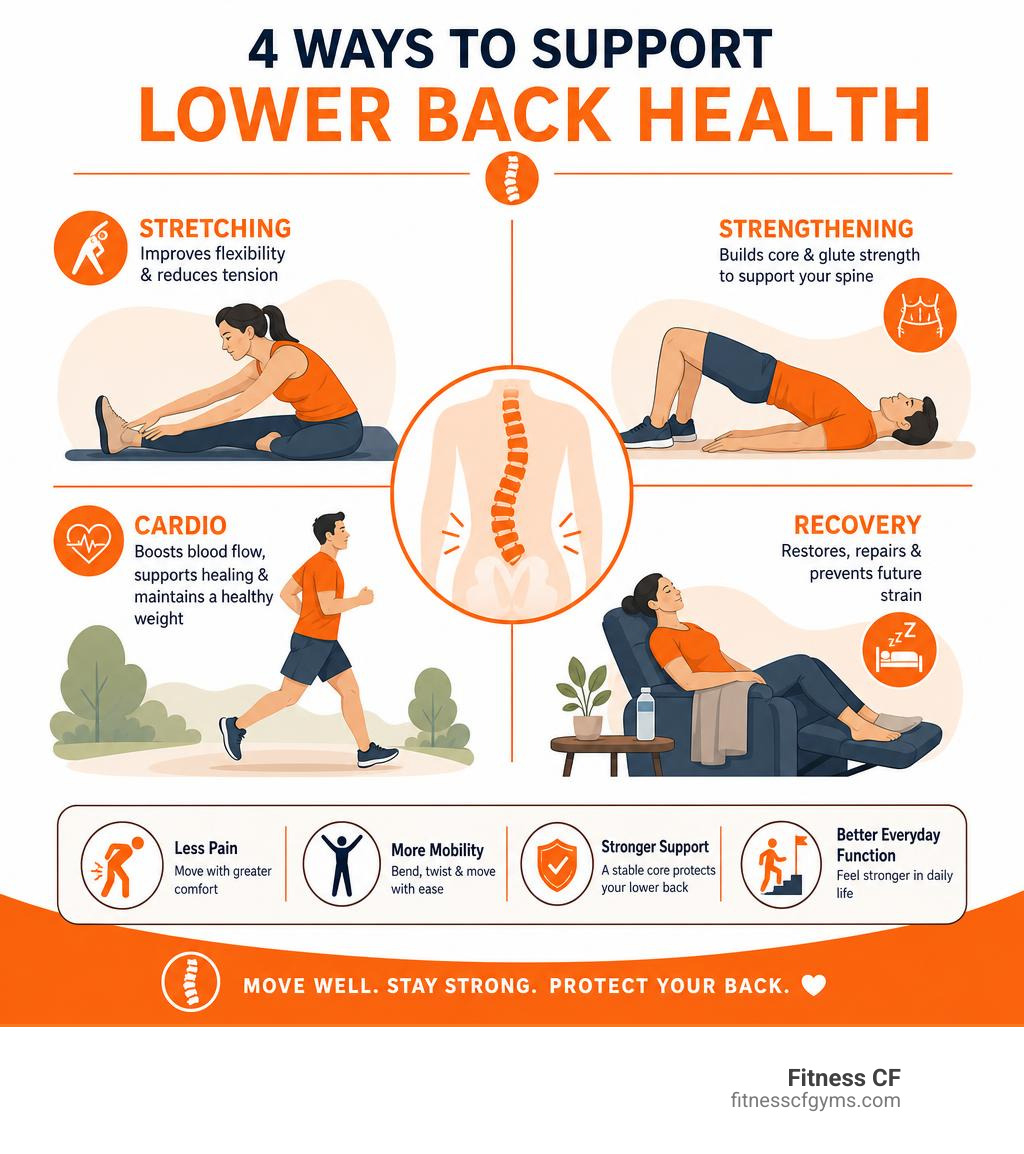
Preventing Future Back Pain Through Strength, Cardio, and Healthy Living
Relief is great. Prevention is better. The long-term goal is to build a body that is stronger, more mobile, and less likely to flare up every time you lift groceries or sit too long.
Back-friendly healthy living includes:
- Strength training
- Low-impact cardio
- Daily walking
- Flexibility work
- Better lifting mechanics
- Healthy weight management
- Quality sleep
- Stress management
- Regular movement breaks
- Adequate calcium and vitamin D for bone health
- Avoiding smoking, which is linked with more frequent back pain episodes
For more ideas, see our guide to flexibility and injury-prevention routines.
Stretches That Help Prevent Future Back Pain
The best prevention stretches usually target the areas connected to the pelvis and lower spine:
- Hamstrings
- Hip flexors
- Glutes
- Piriformis
- Lower back rotation
- Thoracic spine mobility
- Seated mobility for work breaks
If you sit often, take short breaks every 30-60 minutes. Stand up, walk, stretch your hips, and reset posture. Your back was not designed to be folded into a chair for half the day like a lawn chair in storage.
Why Strength Training Helps Protect Your Lower Back
Strength training helps your lower back by improving:
- Core endurance: Your trunk can support you longer without fatigue.
- Glute activation: Strong glutes reduce stress on the lumbar spine.
- Hip stability: Better hip control means less compensation from the back.
- Posture: Stronger muscles help you hold better positions.
- Bone density: Resistance training supports stronger bones.
- Lifting mechanics: A stronger body handles daily tasks better.
Start with bodyweight movements such as bridges, bird dogs, squats to a chair, and planks. Then progress to bands, machines, or weights when your form is solid. Our prevent muscle pain guide can help you build smarter training habits.
Why Cardio and Daily Movement Matter
Cardio is not just for heart health. It also helps your back by increasing blood flow, reducing stiffness, supporting weight management, improving sleep, and calming the nervous system.
Back-friendly cardio options include:
- Walking
- Swimming
- Cycling
- Elliptical training
- Low-impact dance or step movements
- Gentle yoga, Pilates, or tai chi
Walking is one of the simplest tools for lower back pain. Start with 5-10 minutes and build gradually. If walking increases pain, stop and get guidance.
Frequently Asked Questions About Exercises for Lower Back Pain
What Are the Most Effective Exercises for Relieving Lower Back Pain?
The most effective options for many people include:
- Pelvic tilts
- Knee-to-chest stretch
- Cat-cow
- Bridges
- Bird dog
- Child’s pose
- Hamstring stretch
- Piriformis stretch
- Abdominal bracing
- Beginner planks
- Walking
The best choice depends on the cause of your pain. Muscle tightness, weak core muscles, irritated discs, and posture-related stiffness may all need slightly different approaches.
What Exercises Should You Avoid With Lower Back Pain?
Avoid exercises that increase pain or cause symptoms down the leg. Common moves to be careful with include:
- Sit-ups
- Aggressive crunches
- Heavy lifting during a flare-up
- High-impact jumping
- Fast twisting
- Deep backbends
- Forced toe touches
- Loaded spinal flexion
- Any movement that causes numbness, tingling, or sharp pain
Some people with disc irritation feel worse with forward bending. Some people with stenosis-type symptoms feel worse with back extension. This is why paying attention to your pain pattern matters.
Should You Rest or Keep Moving When Your Back Hurts?
In most non-emergency cases, gentle movement is better than complete rest. Too much bed rest can increase stiffness and make returning to activity harder.
Good options include:
- Short walks
- Gentle stretching
- Pelvic tilts
- Cat-cow
- Breathing drills
- Easy mobility breaks
That said, “keep moving” does not mean “ignore pain.” Use pain as feedback. Move gently, stop when symptoms worsen, and progress gradually.
Conclusion
Lower back pain is common, but it does not have to run the show. A simple routine of mobility, stretching, core strengthening, walking, and healthy recovery habits can make a major difference.
Start small. Move slowly. Breathe. Build consistency before intensity. And remember: the goal is not to punish your back into feeling better. The goal is to support it.
At Fitness CF, we believe better movement should feel approachable for every fitness level. Whether you are rebuilding confidence after a flare-up or working to prevent future aches, the right routine can help you feel stronger, steadier, and more active.
Ready for your next step? Start with this lower back pain workout guide.