When Your Lower Back Hurts, Movement Is Usually the Answer
Lower back pain fitness is one of the most searched health topics in the world — and for good reason. About 8 in 10 Americans will experience back pain at some point in their lives, making it the leading cause of disability worldwide.
If your back is flaring up right now, here are the safest exercises to start with:
- Walking – 10 to 15 minutes at a comfortable pace
- Pelvic tilts – lying on your back, knees bent
- Bird-dog – on hands and knees, extend opposite arm and leg
- Glute bridges – lie on your back and raise your hips
- Cat-camel stretch – gentle spinal movement on hands and knees
- Knee-to-chest stretch – hold 20 to 30 seconds each side
Start with 2 to 3 reps of each. Stop if pain goes above a 5 out of 10.
Here is the part that surprises most people: resting is often the wrong answer.
Research consistently shows that staying active — even gently — leads to better outcomes than bed rest. Yet when back pain strikes, the instinct is to stop moving entirely. That instinct can make things worse.
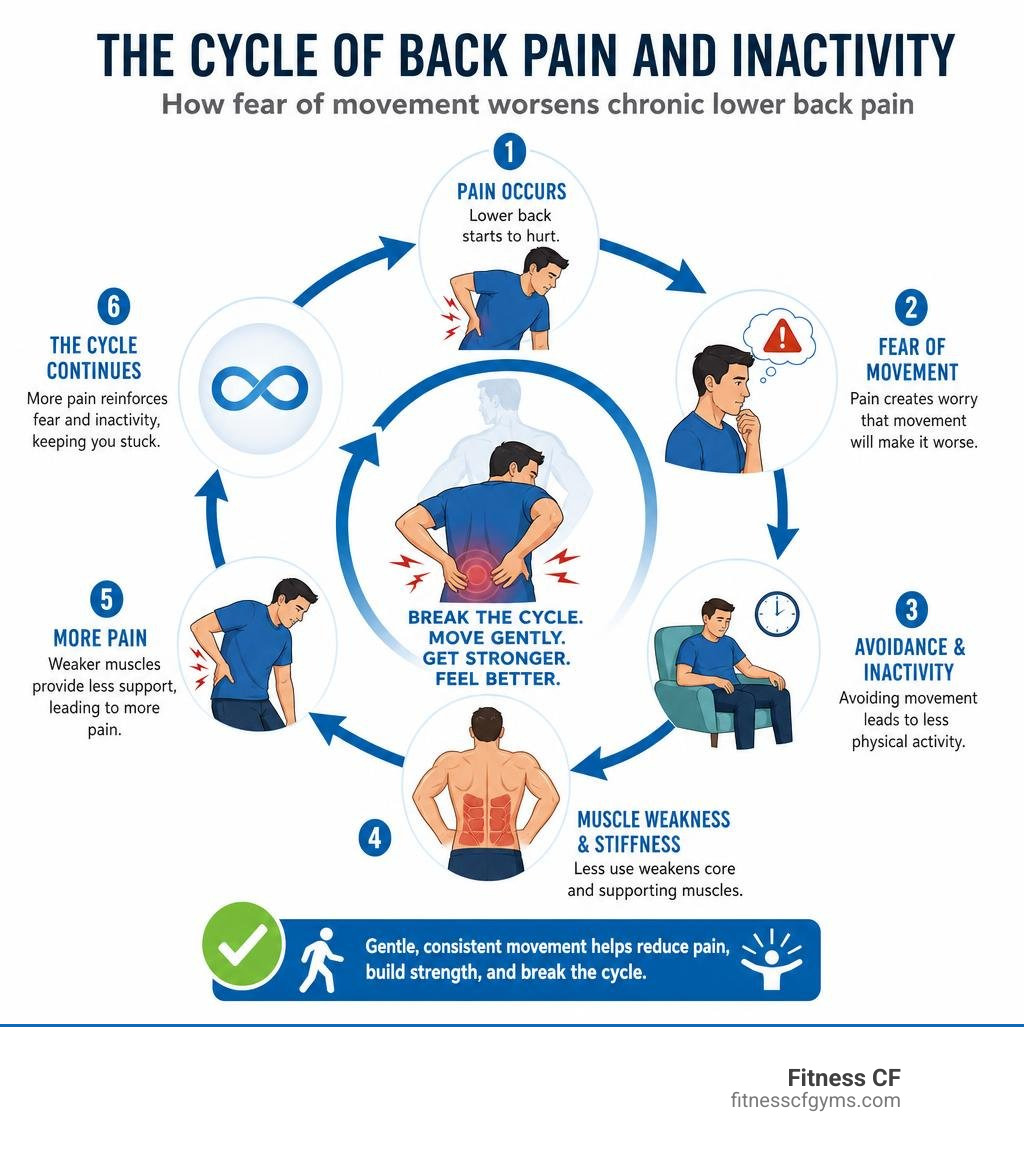
The fear-avoidance cycle explains why. Pain leads to fear of movement. Fear leads to inactivity. Inactivity weakens the muscles that support your spine. Weaker muscles mean more pain. And the cycle continues.
Breaking that cycle starts with understanding what kinds of movement help — and which ones to skip for now.
Studies covering more than 25,000 people with chronic low back pain found that exercise therapy is by far the most researched treatment for this condition, outperforming passive treatments like massage or ultrasound alone. On average, people who followed a structured exercise program improved their pain scores by 15 points on a 100-point scale — while those who did nothing barely improved at all.
The goal of this guide is simple: help you move smarter, not harder.
I’m Pleasant Lewis, owner and operator of Fitness CF and Results Fitness, with over 40 years of experience in the fitness industry helping people improve their health through safe, effective movement — including those managing lower back pain fitness challenges. In that time, I’ve seen how the right approach to exercise can transform not just someone’s back health, but their entire quality of life.
Designing a Lower Back Pain Fitness Routine: Modalities Compared
When you are dealing with non-specific chronic lower back pain, choosing the right workout modality can feel like navigating a minefield. You might wonder: should you sign up for a Pilates class, start lifting weights, or stick to a daily walking routine?
Fortunately, we have incredible data to guide us. A landmark network meta-analysis published in the British Journal of Sports Medicine evaluated 89 studies involving over 5,500 patients to determine which exercise modalities are most effective for chronic low back pain.
The results were eye-opening. Different types of exercise excel at solving different pieces of the chronic pain puzzle. To understand why your body reacts to these movements the way it does, it helps to understand The Science of Fitness: How Exercise Impacts Your Body, which explains how movement stimulates tissue recovery, increases blood flow, and alters pain perception in the brain.
To help you decide where to focus your energy, we have compiled a comparison of the primary exercise modalities based on the latest sports medicine data:
| Exercise Modality | Primary Benefit | Best For | SUCRA Ranking / Effectiveness |
|---|---|---|---|
| Pilates | Pain Reduction & Core Control | Relieving severe, persistent discomfort | Ranked #1 (100%) for pain reduction |
| Resistance Training | Functional Strength & Mental Health | Improving daily physical function and mood | Ranked highest (80%) for physical function & mental health |
| Stabilization/Motor Control | Deep Core Coordination | Protecting the spine during daily movements | Ranked highest (80%) for physical function |
| Aerobic Exercise | Cardiovascular Health & Circulation | Boosting mood and systemic recovery | Ranked highest (80%) for mental health |
| Stretching & McKenzie | Targeted Flexibility | Temporary relief of acute stiffness | Effective for specific mechanical issues; less effective as a standalone chronic cure |
Pilates, Yoga, and Aerobic Exercise for Spine Health
If your primary goal is to turn down the volume on your back pain, Pilates is an absolute powerhouse. By focusing on the deep core stabilizers—specifically the transverse abdominis, obliques, and pelvic floor—Pilates creates a natural “girdle” around your lumbar spine. This muscular support reduces the sheer load placed directly on your intervertebral discs.
Yoga also offers exceptional benefits for spine health, but it requires a mindful approach. While gentle yoga poses improve flexibility and reduce stress (which is crucial, since stress alters pain processing), you must avoid extreme spinal flexion or aggressive twisting. The goal is to find a comfortable range of motion, not to force yourself into a pretzel.
For those who are highly deconditioned or in the midst of a painful flare-up, aerobic exercise is the perfect place to start. A simple walking program—aiming for 30 to 60 minutes every two days—promotes healing by delivering oxygen-rich blood to the spinal tissues. Walking is a fantastic Low Impact Workout for Seniors and beginners alike, providing cardiovascular benefits without putting excessive compression forces on your joints.
Strength Training vs. Passive Therapy
For decades, the standard medical response to a bad back was passive therapy: hot packs, ultrasound, massage, and complete bed rest. While a heating pad feels great in the moment, modern sports science has proven that passive treatments do very little to solve the root cause of chronic pain.
Strength training is now considered the gold standard for long-term back pain management. When you progressively load your muscles, you build a resilient, supportive structural system around your spine.
According to a comprehensive guide on Lower Back Strength Training: Training Myths, Best Exercises, and How to Build a Bulletproof Spine – Muscle & Fitness, the biggest training myth holding people back is that the lower back is fragile and must be protected from all stress. In reality, your spine is a remarkably robust structure designed to bend, lift, and carry load. By avoiding movement entirely, you allow the supporting muscles to atrophy, leaving your spine even more vulnerable. The key is not to avoid spinal loading, but to manage the dosage through smart, progressive exercise selection.
The 12-Week Progressive Protocol: From Pain to Strength
Rebuilding your back is not a weekend project. It requires a structured, phased approach that respects the timeline of tissue healing and utilizes progressive overload.
A highly effective framework is the Chronic Lower Back Pain: The 12-Week Exercise-Based… | PhysioNear protocol. This progressive program is broken into three distinct blocks, each designed to take you from a state of protective muscle guarding to confident, functional strength.
Phase 1: Foundation and Lower Back Pain Fitness Basics (Weeks 1–4)
In the first four weeks, our primary objective is to show your nervous system that movement is safe. We do this by focusing on isometric stability and gentle mobility, avoiding movements that put the spine under heavy flexion or shear forces.
The foundation of this phase is Dr. Stuart McGill’s famous “McGill Big Three.” These exercises are designed to maximize core muscle endurance while placing minimal load on the spine:
- The Modified Curl-Up: Lie on your back with one knee bent and the other leg straight. Place your hands under your lower back to maintain your natural arch. Gently lift your head and shoulders just slightly off the floor, holding for 10 seconds. Do not let your lower back flatten into the ground.
- The Side Plank: Lie on your side, supporting your weight on your elbow and knees (or feet, if advanced). Keep your body in a perfectly straight line from head to knees. Hold for 10 to 20 seconds, and repeat on the other side.
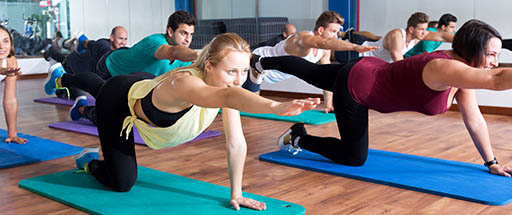
- The Bird-Dog: On hands and knees, slowly extend your right arm forward and left leg backward until they are parallel to the floor. Keep your hips level and avoid arching your lower back. Hold for 10 seconds, return to center, and switch sides.
Alongside these, we incorporate gentle pelvic tilts and knee-to-chest stretches. To ensure your body is fully prepared for these movements, read through our detailed guides on Say Goodbye to Aches: The Best Exercises for Lower Back Pain and learn how to properly prepare your joints with The Importance of Warm Up and Cool Down Exercises: A Comprehensive Guide.
Phase 2 & 3: Building Load and Functional Strength (Weeks 5–12)
Once you can complete the foundation phase with minimal to no pain, it is time to build functional strength. This is where we transition from floor exercises to standing, loaded movements that prepare your body for real-world tasks. This transition is the essence of What is Functional Fitness—training your muscles to work together to handle daily physical demands safely.
During Weeks 5 through 8 (the Strength Phase), we introduce exercises like:
- The Glute Bridge: Lie on your back, knees bent, feet flat on the floor. Drive through your heels to lift your hips, squeezing your glutes at the top. This strengthens the posterior chain without loading the spine.
- Goblet Squats: Holding a light dumbbell or kettlebell close to your chest, sit back into a squat while keeping your torso upright. This front-loaded position naturally encourages a neutral spine.
In Weeks 9 through 12 (the Load Phase), we can begin introducing highly effective lifting patterns. One of the best investments you can make for your spinal longevity is learning to use a trap bar (hex bar).
As highlighted in the Home Gym for Back Pain: Safe Training Guide | GarageGymBuilders | GarageGymBuilders, the trap bar deadlift is vastly superior to the conventional barbell deadlift for back pain sufferers. Because you stand inside the frame of the trap bar, the weight is kept directly in line with your center of gravity. This reduces the peak lumbar moment (the leverage force trying to bend your spine) by 8% to 10%, allowing you to train your hips and legs with a fraction of the lower back strain.
Listening to Your Body: Pain Monitoring and Exercises to Avoid
The golden rule of lower back pain fitness is simple: push for progression, but never push through sharp, structural pain.
To manage this safely, use a simple 0-to-10 pain scale during your workouts:
- 0 to 3 (Green Light): Mild discomfort or muscle awareness. This is completely safe.
- 4 to 5 (Yellow Light): Acceptable discomfort. You can continue, but monitor closely. The pain should ease quickly after you finish the set and should not feel worse the next morning.
- 6 to 10 (Red Light): Excessive, sharp, stabbing, or radiating pain. Stop immediately.
It is normal to experience some mild muscle soreness 24 to 48 hours after a new workout. However, if your joints feel inflamed or your back pain is significantly worse the day after training, it is a sign that you either used too much weight or chose an exercise your body isn’t ready for yet.
Safe Movement Patterns for Lower Back Pain Fitness
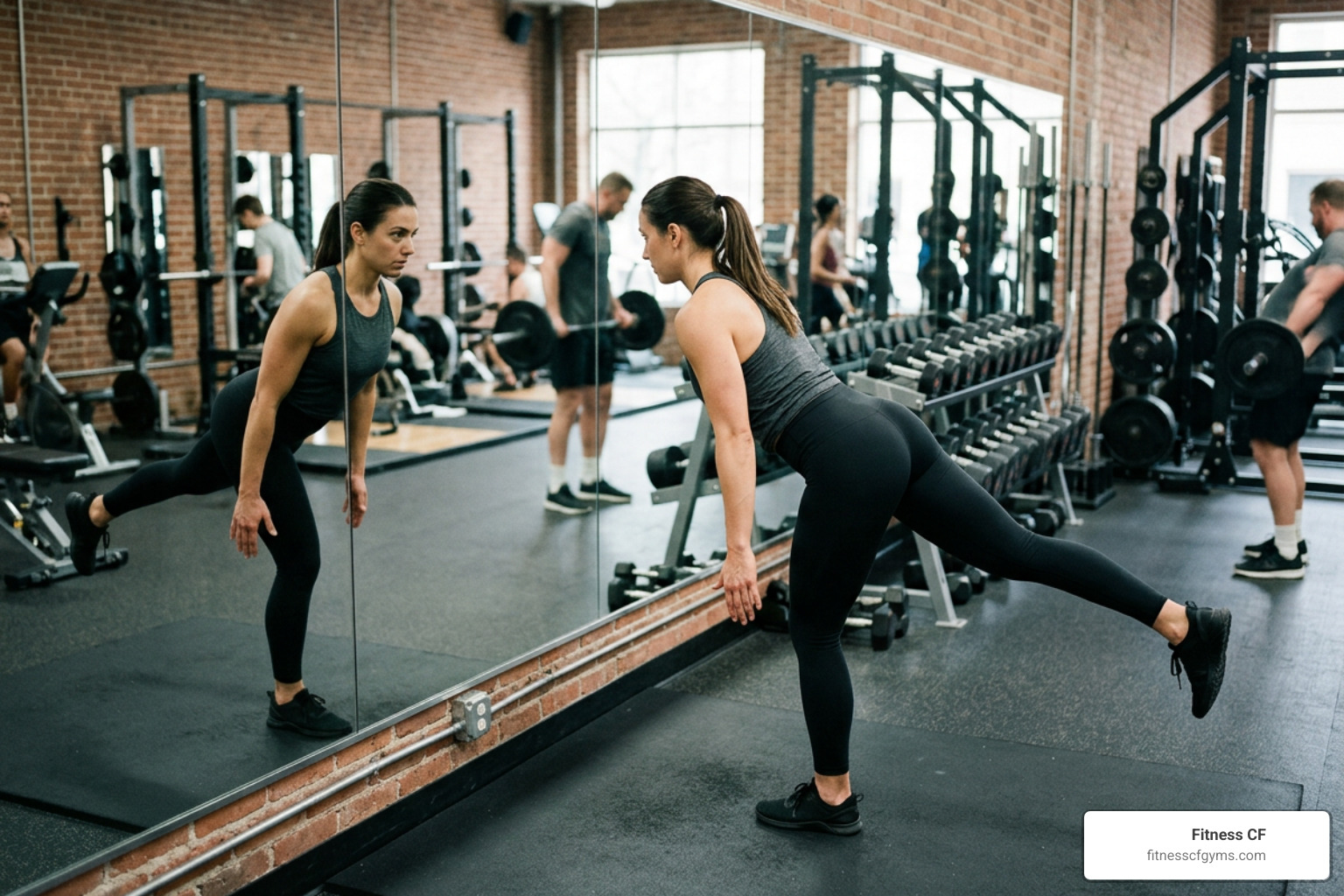
Maintaining a neutral spine—where your back retains its natural, gentle curves without rounding or arching excessively—is your ultimate shield against injury.
When you have a history of back issues, there are several exercises you should temporarily avoid or permanently modify. To learn how to navigate these adjustments in detail, check out our comprehensive breakdown on How to Work Out with Lower Back Pain.
As a general rule, we recommend avoiding:
- Conventional Barbell Deadlifts: Pulling a straight bar from the floor puts a massive rotational load on the lower back if your form slips even a millimeter.
- Heavy Barbell Back Squats: Placing a heavy barbell across your shoulders compresses the spine and requires incredible hip mobility to avoid “butt wink” (rounding the lower back at the bottom of the squat).
- Traditional Sit-Ups and Crunches: These exercises repeatedly force your lumbar spine into deep flexion under tension, which can irritate spinal discs.
- Standing Overhead Presses: If your thoracic spine or shoulders are tight, you will naturally arch your lower back to push the weight overhead, heavily compressing your lumbar facets.
Instead, focus on keeping your spine neutral and using unilateral (single-leg or single-arm) exercises, which allow you to train your muscles with much lighter weights.
Red Flags: When to See a Professional
While self-managing your back pain with exercise is highly effective for most people, you must know when to step away from the gym and consult a medical professional.
Seek immediate medical attention if you experience any of the following “red flag” symptoms:
- Pain that radiates down one or both legs past your knee (sciatica)
- Numbness, tingling, or weakness in your legs or feet
- Loss of bowel or bladder control
- Unexplained weight loss, fever, or night pain that wakes you from a deep sleep
- Severe pain that does not change or improve regardless of your position or activity
If you live in Central Florida and are experiencing persistent, complex back issues, it is wise to consult a specialist. For expert medical evaluation, consider reaching out to a board-certified spine surgeon like Low Back Pain Treatment Orlando, FL – Dr Sheyan J Armaghani to ensure you have a clear diagnosis before starting a new exercise regimen.
Frequently Asked Questions about Back Pain and Exercise
How long does it take to see improvements in back pain from exercise?
If you are consistent, you can expect to see noticeable improvements within 4 to 12 weeks. Clinical data published in an Original Article on exercise-based protocols shows that an 8-week structured, low-intensity resistance training program can yield up to a 71.6% reduction in functional disability and a 79.6% reduction in pain scores.
The key is patient consistency. Your muscles, tendons, and ligaments adapt to exercise slower than your cardiovascular system. Give your body time to heal and rebuild.
Can I still lift weights if my lower back is sore?
Yes, but you must modify your routine. If your lower back is experiencing general muscular soreness or mild fatigue, it is actually beneficial to keep moving.
Often, lower back fatigue occurs because the muscles lack isometric endurance rather than peak strength. This concept is measured by physical therapists using the Biering-Sørensen test, which evaluates how long your spinal erectors can hold a neutral, unsupported position. If your back muscles fatigue quickly, your body will transfer the physical load to your passive spinal structures (like your discs and ligaments), causing pain.
If you are sore, lower the weight, focus on high-rep endurance sets, or switch to exercises that support your torso, such as chest-supported rows or incline dumbbell presses.
What are the best daily habits to prevent back pain recurrence?
While a 15-minute daily exercise routine is fantastic, how you move during the other 23 hours of the day matters just as much. To keep your back healthy for life:
- Avoid Prolonged Sitting: Stand up, stretch, or walk for 2 minutes every 30 to 45 minutes to relieve static pressure on your spinal discs.
- Optimize Your Ergonomics: Ensure your computer screen is at eye level and your chair supports the natural curve of your lower back.
- Prioritize Daily Mobility: Incorporate gentle stretching to keep your hips and hamstrings loose. Tight hamstrings pull down on your pelvis, which flattens the lumbar curve and increases strain on your back.
To build a safe, effective daily mobility habit, explore our guides on Stretching Routines to Improve Flexibility and Prevent Injuries and try these Better Flexibility: 8 Fantastic Exercises to Increase Range of Motion.
Conclusion
Living a vibrant, active life means building a body that can withstand the demands of the real world. Embracing a healthy lifestyle centered around regular movement is the single best defense against chronic pain.
The benefits of strength training extend far beyond a resilient spine—it boosts bone density, improves metabolic health, and preserves joint function as we age. Likewise, the cardiovascular benefits of cardio help reduce systemic inflammation, keep your blood vessels healthy, and elevate your daily energy levels.
At Fitness CF, we believe that fitness should be accessible, safe, and empowering for every body—no matter where you are starting from. If you are ready to take the next step in your movement journey, we invite you to learn more about How to Work Out with Lower Back Pain and discover how our community can support your goals. Let’s work together to build a strong, pain-free foundation for your future!