You Don’t Need a Gym to Build a Strong Upper Body
An abs chest and arms workout at home without equipment is one of the most effective ways to build real strength, improve posture, and get visible muscle definition — no gym membership required.
Here’s a quick overview of what this workout covers:
| Muscle Group | Key Exercises |
|---|---|
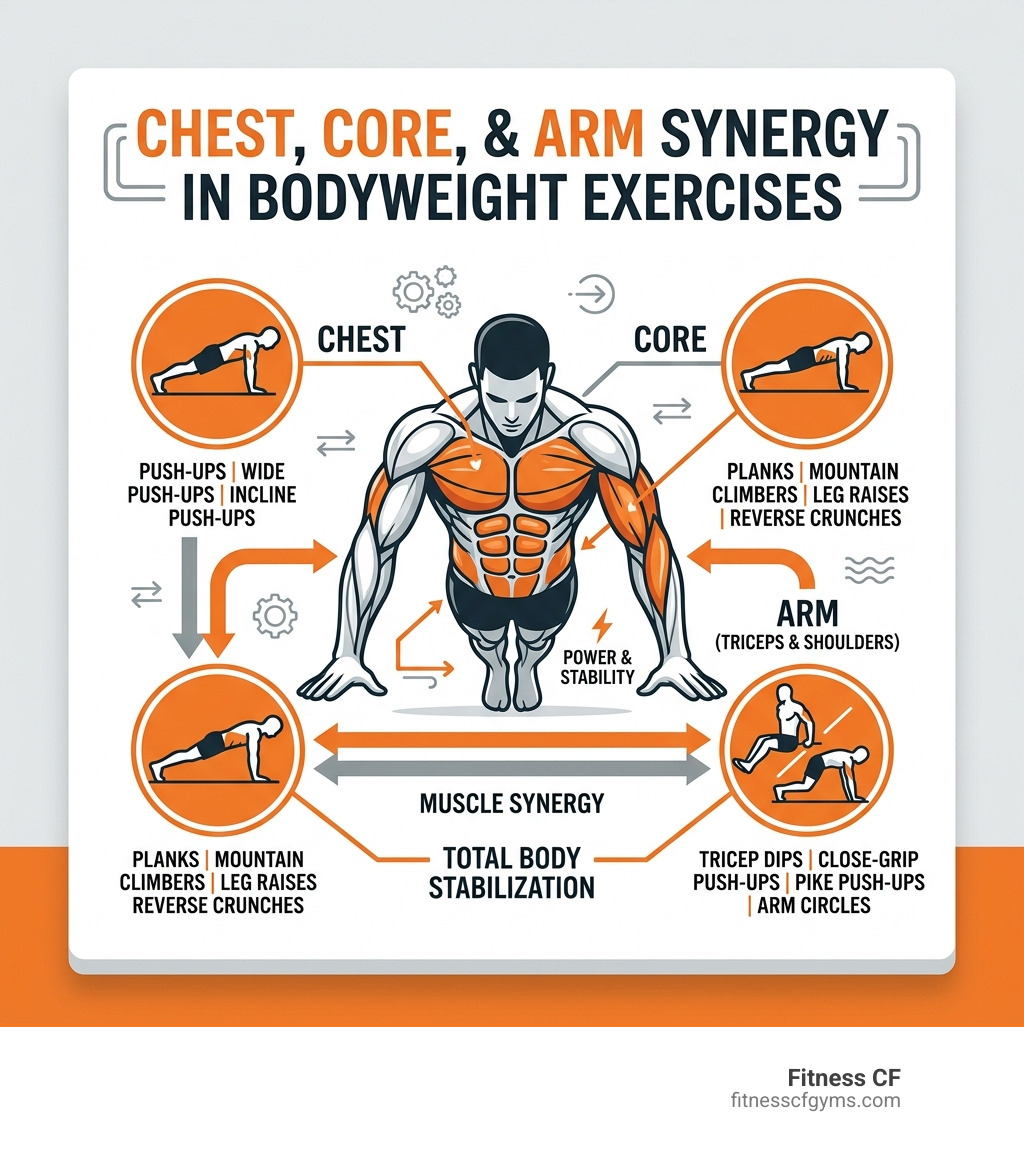
| Chest | Push-ups, wide push-ups, incline push-ups, diamond push-ups |
| Abs | Planks, mountain climbers, leg raises, reverse crunches |
| Arms (triceps) | Tricep dips, close-grip push-ups, pike push-ups |
| Arms (shoulders) | Pike push-ups, arm circles, isometric holds |
The short answer: Do 3-4 rounds of push-up variations, plank holds, and bodyweight arm exercises, 3 times per week. Focus on form, rest 60-90 seconds between rounds, and add reps as you get stronger.
Your chest, arms, and core all work together in nearly every pushing movement. Training them in one session saves time and increases intensity — a classic win for busy schedules.
I’m Pleasant Lewis, owner and operator of Fitness CF, with over 40 years in the fitness industry helping everyday people get stronger and healthier. In that time, I’ve seen how a well-structured abs chest and arms workout at home without equipment can deliver real, lasting results when done consistently. Let’s walk through exactly how to do it.
Abs chest and arms workout at home without equipment definitions:
The Benefits of an Abs Chest and Arms Workout at Home Without Equipment
When we think about building a powerful physique, we often imagine heavy bench presses and cable machines. However, as we move through April 2026, the trend toward bodyweight mastery has never been stronger. Training your chest, abs, and arms together creates a “compound activation” effect. This means your muscles aren’t working in isolation; they are learning to function as a single, powerful unit.
One of the biggest advantages of an abs chest and arms workout at home without equipment is the improvement in your posture. A strong chest provides the foundation for your upper body, while a solid core supports your spine and keeps you upright. When these two areas are balanced, you naturally stand taller and move with more confidence. This is especially important for those of us in Central Florida who spend a lot of time commuting or sitting at desks.
Furthermore, this type of training builds functional strength. Functional strength is the kind of power you use in the real world—lifting groceries, pushing a heavy door, or playing with your kids at a park in Orlando or Clermont. Because you are moving your own body weight through space, you develop better balance and coordination than you might on a fixed weight machine.
From a time-efficiency standpoint, pairing these muscle groups is a game-changer. While your chest muscles are resting between sets of push-ups, you can jump straight into a plank. This keeps your heart rate elevated, turning your strength session into a calorie-burning powerhouse. Understanding why arm strength is important for overall fitness helps you see that these workouts aren’t just about looking good in a t-shirt—they are about longevity and physical independence.
Essential Bodyweight Exercises for Upper Body Definition
To see results, we need to target the muscles from different angles. Your chest (pectorals), arms (triceps and shoulders), and core (rectus abdominis and obliques) all require specific movements to grow.
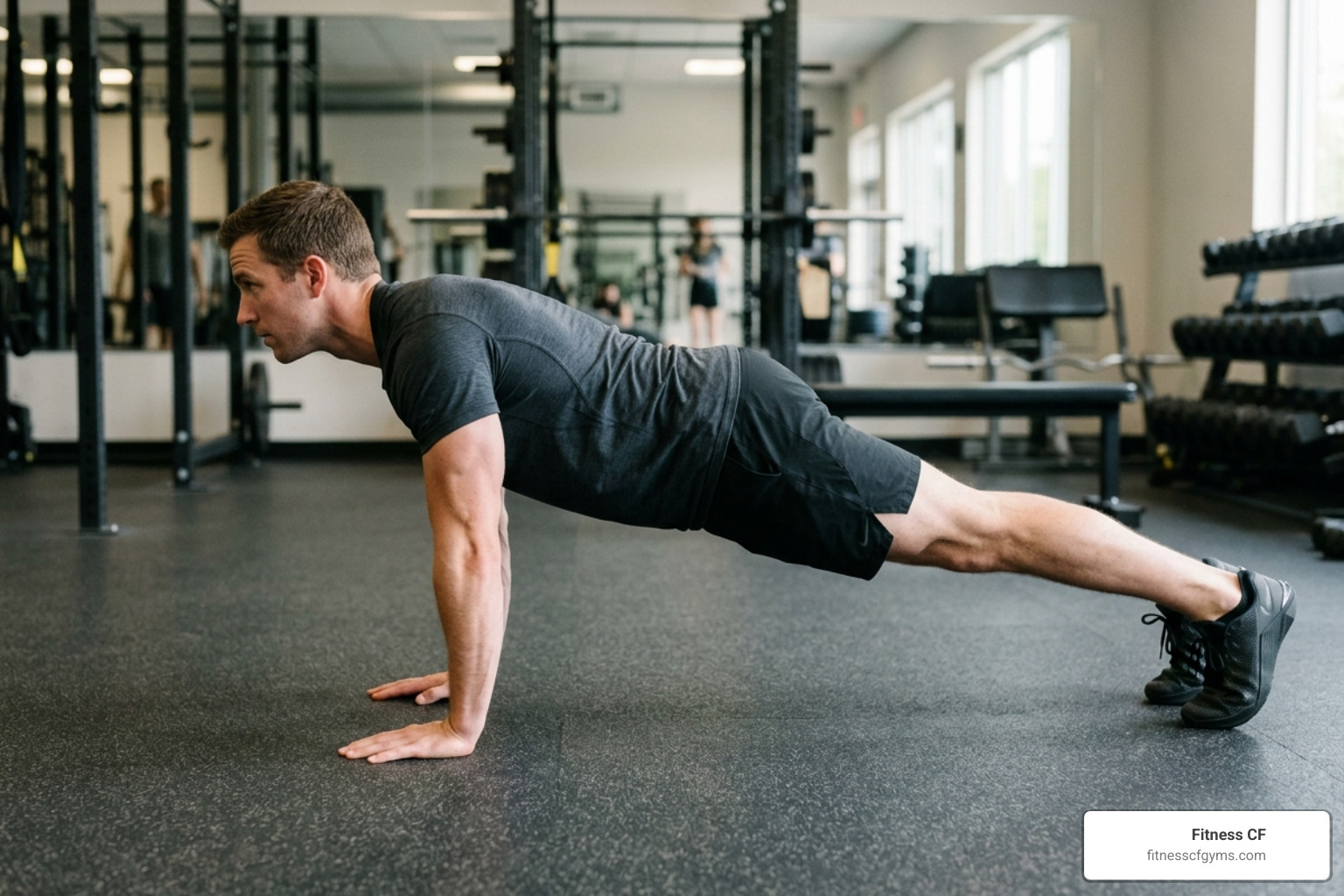
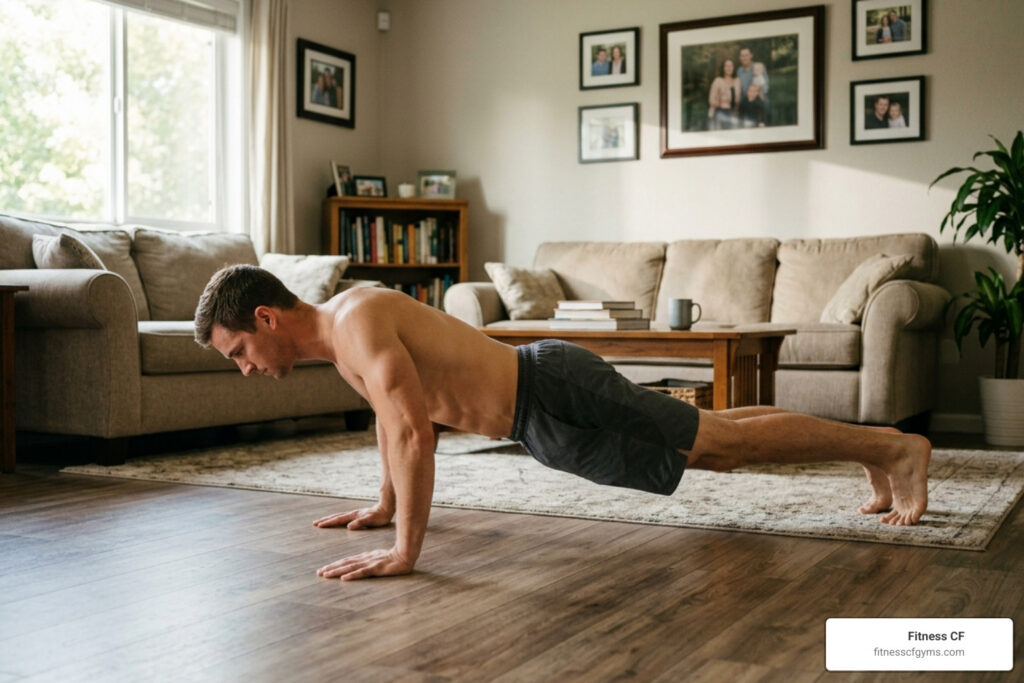
- Standard Push-ups: The king of bodyweight exercises. These target your middle chest, shoulders, and triceps. To do them right, keep your hands slightly wider than shoulder-width and your body in a straight line from head to heels.
- Diamond Push-ups: By placing your hands together so your index fingers and thumbs form a diamond shape, you shift the focus to your triceps and the inner part of your chest. These are challenging but incredibly effective for building “horseshoe” triceps.
- Wide-grip Push-ups: Moving your hands further out targets the outer chest and puts more emphasis on the pectoral muscles while reducing the work done by the arms.
- Tricep Dips: You don’t need a dip station; you can use the floor or a sturdy chair. Keep your hips close to your hands to protect your shoulders and focus the burn on the back of your arms.
For a visual guide on how to flow through these movements, checking out a 15 MIN UPPER BODY WORKOUT (CHEST, BACK, ABS … – YouTube can help you master the rhythm and tempo needed for home training.
Core Stabilizers for an Abs Chest and Arms Workout at Home Without Equipment
Your core is the bridge between your upper and lower body. In an abs chest and arms workout at home without equipment, the core often acts as a stabilizer during push-ups, but we also want to target it directly.
- Plank Variations: The forearm plank is a staple, but adding shoulder taps (touching your opposite shoulder while holding a high plank) forces your obliques to work overtime to prevent your hips from rocking.
- Mountain Climbers: These provide a cardiovascular boost while torching the lower abs. Keep your movements slow and controlled to maximize muscle engagement, or speed them up for a “metabolic burn.”
- Leg Raises: Lie on your back and lift your legs to a 90-degree angle. This targets the lower abdominal region, which is often the hardest area to define.
Incorporating the 6 Best Core Exercises For Abs into your routine ensures that you aren’t just working the “mirror muscles” on the surface, but building deep, structural strength.
Targeted Arm Sculpting Without Weights
People often ask us, “How do I work my arms without dumbbells?” The answer lies in leverage and isometric tension.
- Pike Push-ups: Get into a downward dog position with your hips high in the air. Lower your head toward the floor between your hands. This is essentially a bodyweight overhead press, targeting the deltoids (shoulders).
- Floor Dips: Sit on the floor with your knees bent, hands behind you. Lift your hips and pulse up and down using only your triceps.
- Isometric Holds: At the bottom of a push-up or the middle of a plank, hold the position for 5-10 seconds. This creates “time under tension,” which is a primary driver for muscle growth.
- Arm Circles: They might seem simple, but doing large and small circles for 60 seconds straight will exhaust the small stabilizing muscles in your shoulders.
For those looking for a quick, guided session, the 10-Minute Arms and Abs With Denise Austin – AARP video offers great modifications for various fitness levels.
Your Step-by-Step Home Training Guide
Structuring your workout is just as important as the exercises themselves. We recommend a circuit-style format. This means you perform one exercise after another with minimal rest, then take a longer break after you’ve completed the whole “round.”
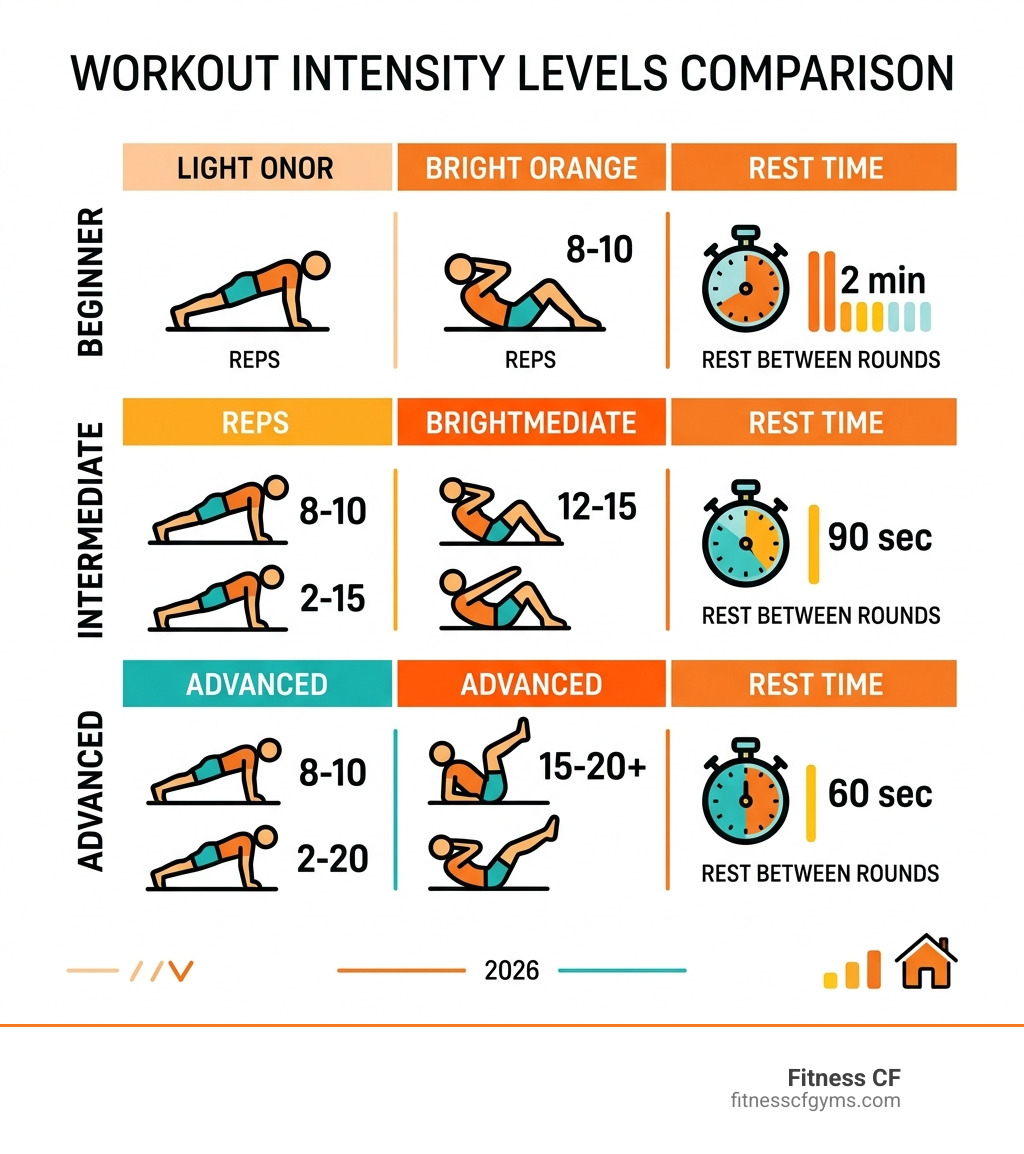
| Level | Reps/Seconds | Rest Between Moves | Rest Between Rounds |
|---|---|---|---|
| Beginner | 8-10 Reps / 30s | 20 Seconds | 2 Minutes |
| Intermediate | 12-15 Reps / 45s | 15 Seconds | 90 Seconds |
| Advanced | 15-20+ Reps / 60s | 10 Seconds | 60 Seconds |
The Routine:
- Warm-up: 5 minutes of arm circles, torso twists, and jumping jacks.
- Circuit:
- Standard Push-ups
- Plank with Shoulder Taps
- Wide-grip Push-ups
- Leg Raises
- Tricep Dips
- Mountain Climbers
- Repeat: Complete 3-4 rounds.
- Cool-down: 5 minutes of stretching.
Before you start, consult our Arm Exercises Ultimate Guide to ensure you understand the mechanics of each movement.
The Beginner-Friendly Abs Chest and Arms Workout at Home Without Equipment
If you’re just starting your fitness journey in St. Cloud or Mount Dora, don’t feel pressured to do 50 perfect push-ups on day one. Everyone starts somewhere.
- Incline Push-ups: Place your hands on a kitchen counter or a sturdy sofa. This reduces the amount of body weight you have to lift, making the movement easier while still building chest strength.
- Knee Push-ups: If a full plank push-up is too much, drop to your knees. Focus on keeping your hips tucked in so your body still forms a straight line from your head to your knees.
- Crunches: Unlike full sit-ups, crunches isolate the upper abs and are easier on the lower back for beginners.
- Forearm Planks: Start with 20-30 second holds and gradually increase the time as your core gets stronger.
This approach is particularly effective for a Full Body Workout Women focus, as it builds lean muscle and functional tone without requiring heavy equipment.
Mastering Form and Progressive Overload
The secret to building a “heroic” chest and abs isn’t doing the same thing every day—it’s getting slightly better every time you train. This is called progressive overload.

How do you progress without adding weight?
- Tempo Control: Instead of rushing through reps, take 3 seconds to lower yourself in a push-up and 1 second to explode back up. This increases “time under tension.”
- Reduce Rest: If you usually rest for 90 seconds, try resting for 75 seconds next week.
- Increase Reps: Aim for just one more rep per set than you did last time.
- Mind-Muscle Connection: Focus on the muscle you are working. When doing a push-up, squeeze your chest at the top. When planking, pull your belly button toward your spine.
Safety Tips to Remember:
- Avoid Sagging Hips: In planks and push-ups, a sagging lower back puts dangerous pressure on your spine. If you can’t keep your hips up, it’s time to rest.
- Prevent Wrist Strain: If your wrists hurt during push-ups, try doing them on your knuckles or using “push-up handles” (or even two sturdy, flat-bottomed mugs) to keep your wrists in a neutral position.
- Breathing: Never hold your breath. Exhale on the “effort” (pushing up or crunching) and inhale on the way down.
Healthy Living: Nutrition, Cardio, and Recovery
We often say at Fitness CF that “abs are made in the kitchen, but revealed in the gym (or living room).” You can have the strongest abdominal muscles in Florida, but if they are hidden under a layer of excess body fat, you won’t see the definition you’re working for.
Nutrition Essentials:
- Protein Intake: Protein is the building block of muscle. Aim for a source of lean protein (like chicken, fish, beans, or Greek yogurt) with every meal to help your chest and arms recover.
- Hydration: Most people are chronically dehydrated. Water is essential for muscle contraction and energy levels. Drink a glass of water before you start your workout.
The Role of Cardio and Recovery: Strength training is vital, but adding 20-30 minutes of brisk walking or light jogging through your local Central Florida neighborhood helps improve heart health and burn extra calories. Cardio also improves blood flow, which can actually speed up muscle recovery.
Don’t forget the power of sleep. Your muscles don’t grow while you are working out; they grow while you are sleeping. Aim for 7-9 hours of quality rest. If you are feeling particularly sore, take an “active recovery” day—this could be a light yoga session or a gentle walk to keep the blood moving without overtaxing your nervous system. Consistency beats perfection every single time.
Frequently Asked Questions about Home Upper Body Training
How often should I perform this workout for results?
For the best results, we recommend performing this abs chest and arms workout at home without equipment 3 times per week. Your muscles need about 48 hours to recover between sessions. For example, you could train on Monday, Wednesday, and Friday. On your “off” days, focus on cardio or flexibility.
Can I build muscle without using any weights?
Absolutely. Your muscles don’t know the difference between a 20lb dumbbell and the weight of your own torso. As long as you are providing enough resistance (through high reps, slow tempo, or difficult variations like diamond push-ups), your muscles will adapt by getting stronger and larger. Many gymnasts have incredible physiques using almost exclusively bodyweight exercises.
What are the most common mistakes in home push-ups and planks?
The most common mistakes are flared elbows and a “piked” or “sagging” butt. In a push-up, your elbows should be at about a 45-degree angle to your body, not sticking straight out like the letter “T.” In a plank, your body should be a straight line. If you feel a pinch in your lower back, your hips are likely sagging, which means your core has stopped engaging.
Conclusion
Building a strong, defined upper body is a journey that starts with a single step—or in this case, a single push-up. At Fitness CF, we believe that fitness should be accessible to everyone, whether you’re training in one of our Central Florida gyms or in your own living room.
By focusing on a consistent abs chest and arms workout at home without equipment, you are investing in your long-term health, posture, and confidence. You don’t need fancy gear to become the strongest version of yourself; you just need a little space, a lot of determination, and the willingness to show up for yourself every day.
Ready to take your fitness to the next level? Whether you want to master the basics at home or join a community of like-minded fitness enthusiasts, we’re here to support you. Start your fitness journey today and let’s build something heroic together.