Why Women Fitness Is Worth Investing In Right Now
Women fitness is one of the fastest-growing areas in health, and for good reason — the right program can transform your energy, strength, confidence, and long-term health all at once. According to the World Health Organization, regular physical activity is fundamental to overall well-being.
If you’re looking for the best women’s fitness solutions, here’s a quick summary of what actually works:
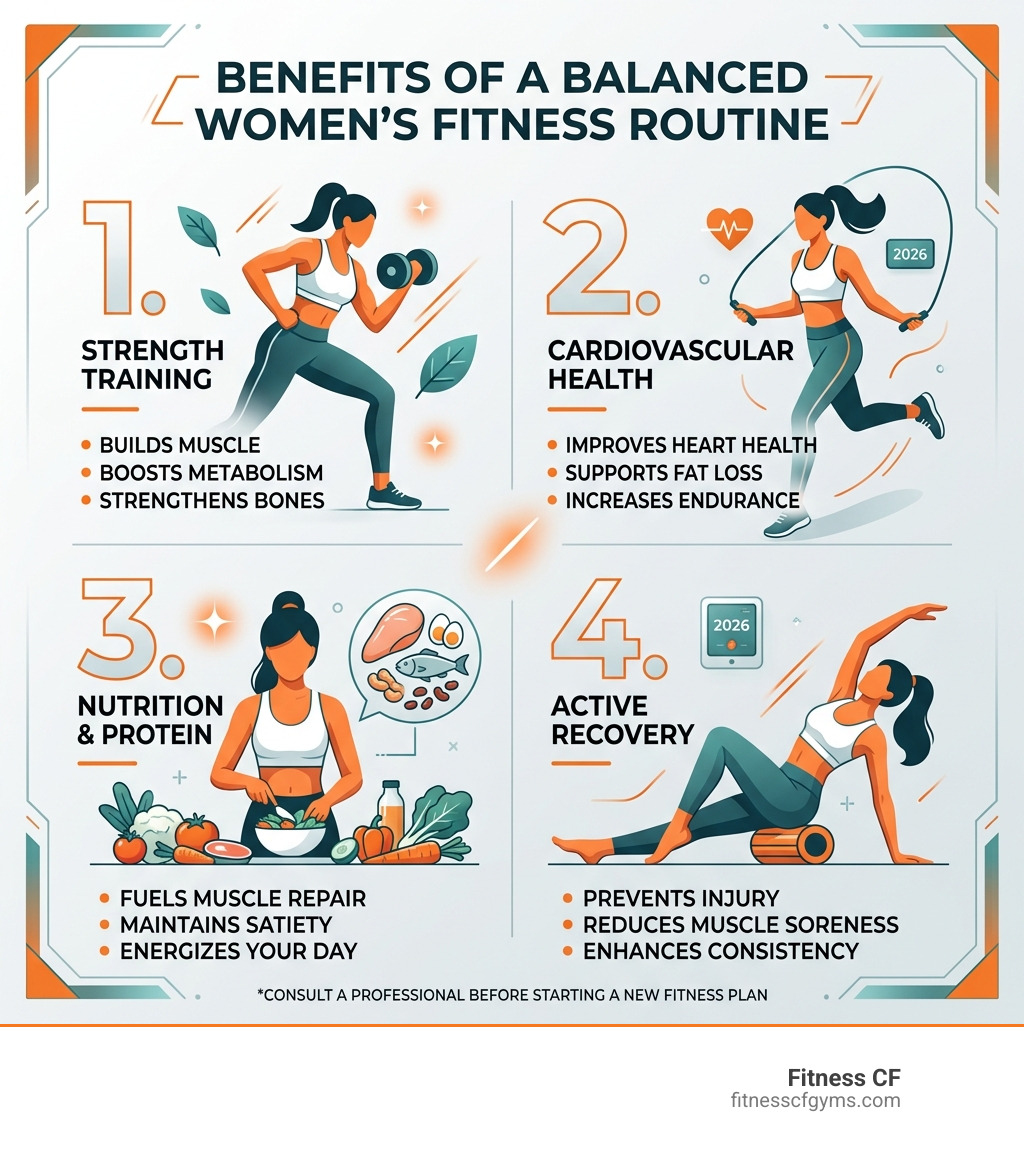
- Strength training 2-3x per week – builds muscle, boosts metabolism, and strengthens bones
- 150 minutes of moderate cardio per week – supports heart health and fat loss
- 0.7-1.0g of protein per pound of bodyweight daily – fuels muscle repair and keeps you feeling full
- Active recovery and mobility work – prevents injury and keeps you consistent long-term
- A structured weekly plan – removes guesswork and builds lasting habits
Most women don’t need more motivation. They need a clear plan that fits their real life. Whether you’re just starting out, pushing past a plateau, or navigating a major life change like postpartum recovery or menopause, the right fitness approach makes all the difference. In this guide, we will walk through the strategies that actually move the needle.
Quick look at women fitness:
The Power of Strength Training for Women Fitness

For decades, the mainstream narrative suggested that women should stick to light weights. We now know that resistance training is perhaps the single most effective tool for changing body composition and improving long-term health.
When we talk about women fitness, strength training is the engine. It utilizes progressive overload—the gradual increase of stress placed upon the body during exercise—to stimulate muscle growth and neurological adaptations. This doesn’t just make you “stronger”; it changes your physiology.
By increasing your lean muscle mass, you effectively raise your resting metabolic rate. Muscle tissue is more metabolically active than fat tissue, meaning you burn more calories even while resting. Furthermore, for women, weight-bearing exercise is a non-negotiable for bone density. Research shows that bone density begins to decline after age 30, and strength training creates the necessary mechanical tension to keep bones dense and resilient.
If you are worried about looking “masculine,” it is important to understand the myth of women getting bulky from weight lifting. Women naturally have lower testosterone levels than men, making it physiologically difficult to build massive muscles without years of hyper-specific training. Instead, lifting weights provides the defined look most women desire—which is simply muscle definition revealed by a lower body fat percentage.
Essential Exercises for a Women Fitness Routine
To get the most out of your time, we recommend focusing on compound movements. These are exercises that work multiple muscle groups and joints at once, providing the biggest “bang for your buck.”
- Squats: The king of lower-body exercises, targeting the quads, hamstrings, and glutes.
- Deadlifts: Essential for the posterior chain (back, glutes, and hamstrings) and functional strength.
- Hip Thrusts: Widely considered the best move for isolated glute development.
- Overhead Presses and Rows: Crucial for posture and building strong, toned arms for women.
Debunking Common Fitness Myths
One of the biggest hurdles in women fitness is the amount of misinformation available. Let’s set the record straight:
- The “Toning” Myth: You cannot “tone” a muscle. You can only build it or lose the fat covering it. High reps with tiny weights won’t give you definition if there is no muscle underneath.
- Cardio is the Only Way to Lose Weight: While cardio is great for heart health, excessive cardio can sometimes lead to muscle loss. Strength training preserves your muscle, ensuring that the weight you lose comes primarily from fat stores.
- Spot Reduction: You cannot choose where your body burns fat. Doing a thousand crunches won’t melt belly fat; it will just strengthen the muscles underneath. Total body fat loss through nutrition and full-body movement is the only way to see definition in specific areas.
If these myths have held you back, working with a professional can help. You can empower your workout with a women’s only personal trainer to ensure your form is correct and your plan is based on science.
Designing a Sustainable Weekly Workout Schedule
Consistency is the secret sauce of women fitness. A perfect workout done once a month is useless compared to a “good enough” workout done three times a week. The CDC recommends that adults get at least 150 minutes of moderate aerobic activity per week, paired with muscle-strengthening activities on two or more days.
A balanced weekly schedule should include:
- Strength Training: 2–3 days of full-body or split routines.
- HIIT (High-Intensity Interval Training): 1 day of short, intense bursts to improve cardiovascular power and metabolic flexibility.
- LISS (Low-Intensity Steady State): 2–3 days of walking, swimming, or light cycling for recovery and heart health.
- Mobility/Rest: At least one full day of rest or restorative movement like yoga.
For those looking for a complete roadmap, we recommend a full body workout for women that hits every major muscle group in a single session, allowing for maximum recovery time between lifting days.
Beginner-Friendly Women Fitness Solutions
If you’re just starting, don’t feel pressured to spend hours exercising. Many effective smart fitness solutions for the modern woman involve short, 20-minute sessions that can be done with minimal equipment.
Resistance bands are an incredible tool for beginners. They provide “variable resistance,” meaning the exercise gets harder as the band stretches, which is excellent for muscle activation without excessive joint stress. Even 7 to 10 minutes of daily movement can jumpstart your metabolism and build the habit of showing up for yourself.
Intermediate Progression and Plateaus
After about six months of consistent training, many women hit a plateau. This is where the body has adapted to the current stress and no longer feels the need to change. To break through, you must embrace movement variety and advanced progressive overload.
This might mean:
- Increasing the resistance or weight.
- Decreasing rest times between sets.
- Adding “unilateral” movements (one leg or one arm at a time) to fix muscle imbalances.
- Changing the tempo (slowing down the “negative” portion of a lift).
Transitioning to an intermediate plan ensures you continue to see results in lean muscle gain and fat loss rather than just spinning your wheels.
Nutrition and Recovery: The Foundation of Results
You cannot out-train a poor diet. Nutrition provides the raw materials for muscle repair and the fuel for your sessions. In the context of women fitness, we often see two extremes: overeating processed foods or undereating in a way that impacts the metabolism.
The goal is to find a middle ground. For fat loss, a modest calorie deficit is effective. For muscle building, a slight surplus or eating at maintenance is ideal. Regardless of the goal, protein is the most important macronutrient.
Fueling for Muscle and Fat Loss
To support muscle protein synthesis, active women should aim for approximately 1.6 grams of protein per kilogram of body weight (or about 0.7–1.0g per pound). This keeps you satiated and prevents the body from breaking down muscle tissue for energy.
Our female muscle fat loss workout guide emphasizes that “eating clean” isn’t just about calories; it’s about hormonal balance. Prioritizing whole foods—lean proteins, complex carbs, and healthy fats—helps regulate insulin and cortisol, which are key players in how your body stores fat.
| Protein Source | Protein Content (approx.) | Best For |
|---|---|---|
| Chicken Breast (4oz) | 31g | Lean muscle repair |
| Greek Yogurt (1 cup) | 20g | Satiety and probiotics |
| Tofu (half cup) | 10g | Plant-based recovery |
| Eggs (2 large) | 12g | Healthy fats and choline |
| Whey/Plant Protein (1 scoop) | 20-25g | Post-workout convenience |
Recovery, Mobility, and Injury Prevention
Recovery is when the actual “fitness” happens. When you lift weights, you create microscopic tears in your muscles; they grow back stronger only when you rest.
We encourage “active recovery,” which involves low-impact movement like walking or light stretching to increase blood flow to sore muscles. Techniques such as foam rolling, heat therapy, and dedicated mobility work are essential. Understanding the benefits of women-only fitness can also play a role here, as these environments often prioritize holistic health and restorative practices alongside high-intensity training.
Navigating Fitness Through Every Life Stage
A woman’s body goes through significant hormonal shifts throughout her life, and her fitness routine should adapt accordingly. Understanding these phases is key to longevity.
Training During Pregnancy and Postpartum
During pregnancy, the goal shifts from “performance” to “maintenance and preparation.” Focus on pelvic floor health and core stability to support the extra weight and prepare for labor.
Safe Prenatal Exercises include:
- Modified squats (using a chair for balance).
- Pelvic tilts to relieve lower back pain.
- Walking and swimming for low-impact cardio.
- Prenatal yoga for flexibility and breath control.
Postpartum training should be restorative. It is crucial to check for Diastasis Recti (abdominal separation) before returning to heavy lifting or high-impact moves. Start with deep diaphragmatic breathing and gentle walking before progressing to more intense women’s health Orlando wellness approaches.
Active Aging and Bone Health
As women enter menopause, estrogen levels drop, which can lead to a decrease in muscle mass and bone density. This is the time to increase resistance training, not shy away from it. Strength training, combined with balance work (like yoga or single-leg exercises), is the best defense against falls and fractures in later years. Fitness is not just about looking good in your 20s; it’s about being able to carry your own groceries and play with your grandkids in your 70s.
Frequently Asked Questions about Women Fitness
Will lifting heavy weights make me look bulky?
No. As discussed, women lack the high levels of testosterone required to build massive muscle mass easily. Lifting heavy weights will help you achieve a lean, “toned” appearance by building muscle and increasing your metabolic rate, which helps burn the fat that covers the muscle.
How much protein do active women actually need?
Most research suggests that active women need between 0.7 and 1.0 grams of protein per pound of body weight. For a 150-pound woman, this is roughly 105 to 150 grams of protein per day. This supports muscle repair and helps manage hunger levels.
Can I achieve fitness goals with 20-minute home workouts?
Absolutely. Consistency and intensity matter more than duration. A focused 20-minute HIIT or strength circuit can be more effective than an hour of distracted, low-effort exercise. The key is to use challenging weights or movements and minimize rest time.
Conclusion
We believe that every woman deserves a fitness solution that makes her feel powerful, healthy, and confident. A commitment to a healthy lifestyle transforms lives.
Whether you’re looking for the community of a group class or the personalized attention of a coach, the most important step is the first one. Don’t wait for the “perfect” time—start where you are, use what you have, and do what you can. Your future self will thank you for the investment you make in your health today.
Ready to take the next step? Start your journey at our women’s gym and join a community dedicated to crushing goals and building strength together.