Why Strength Training Trumps Cardio for Fat Loss
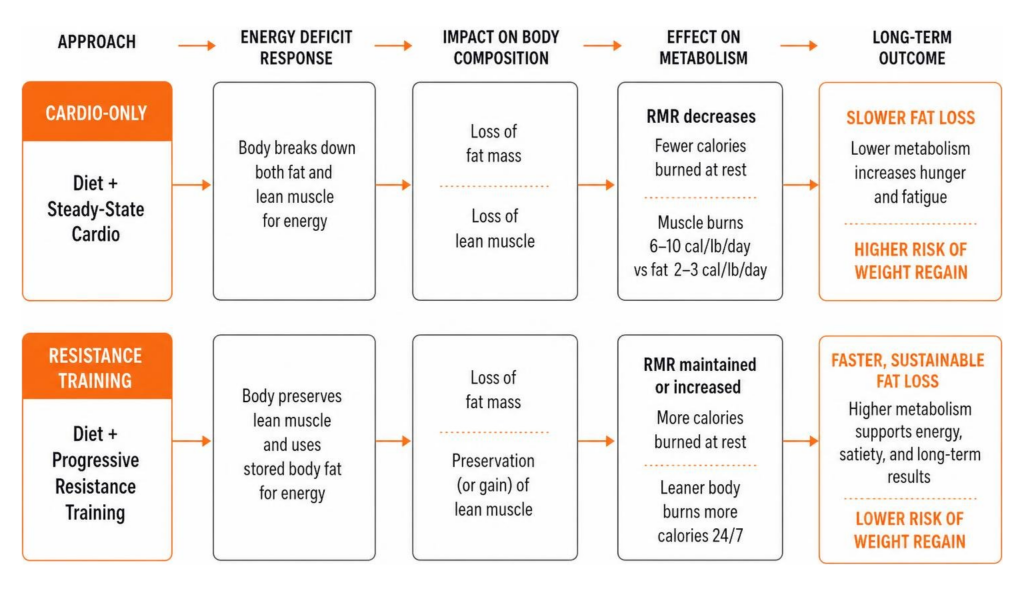
When starting a body transformation journey, many people instinctively head straight for steady-state cardio. While running or cycling burns energy during the session itself, relying exclusively on aerobic exercise creates a common physiological trap. When you consume fewer calories than you burn, your body breaks down both adipose fat tissue and lean skeletal muscle to fill the energy gap. In fact, standard weight loss through diet alone or diet plus steady cardio can result in up to 25% (and in some older populations, up to 81%) of total weight loss coming from lean muscle mass.
When you lose muscle, your Resting Metabolic Rate (RMR)—the total calories your body burns just staying alive—drops significantly. Muscle tissue is far more metabolically active than fat tissue, burning approximately 6 to 10 calories per pound daily at rest compared to just 2 to 3 calories per pound of fat. Losing muscle slows your furnace down, making long-term fat loss increasingly difficult and weight regain almost inevitable.
This is where progressive weight lifting changes the game. Resistance training sends a powerful signal to the central nervous system and muscular systems: lean tissue is actively needed. When comparing Strength Training vs Cardio: Which is Better for Weight Loss?, scientific evidence overwhelmingly supports lifting. According to scientific research on resistance training and body fat reduction, combining resistance training with caloric restriction yielded a 3.8% reduction in total body fat percentage and a 5.3 kg fat mass reduction compared to controls. Resistance training acts as an insurance policy, instructing your physiology to burn stored body fat for fuel while shielding vital lean muscle.
Furthermore, lifting weights profoundly improves metabolic health markers. Skeletal muscle is the largest insulin-sensitive tissue in the human body, serving as the primary site for blood glucose disposal. Heavy muscular contraction stimulates glucose transporter 4 (GLUT4) translocation independent of insulin, lowering blood sugar levels and reversing insulin resistance. Beyond immediate fuel consumption, intense resistance sessions trigger Excess Post-exercise Oxygen Consumption (EPOC)—often called the “afterburn effect.” While EPOC itself provides a modest acute caloric burn (typically 27 to 40 additional calories over 24 to 38 hours), the long-term metabolic cascade of maintaining high-quality muscle completely outperforms cardio-only strategies.
The Science of Body Recomposition and Metabolism
Body recomposition refers to the simultaneous reduction of body fat mass and increase (or preservation) of fat-free mass (FFM). Traditional diet culture suggests you must choose between building muscle in a calorie surplus or losing weight in a calorie deficit. Modern exercise physiology proves otherwise.
In a comprehensive clinical trial studying adults in a moderate 500-calorie daily deficit, participants who performed structured resistance training gained an average of 0.8 kg to 0.9 kg of fat-free mass while losing up to 8.9 kg of fat mass over five months. Conversely, groups performing aerobic exercise alone lost 1.1 kg of muscle mass alongside their fat loss. In fact, the fat mass to weight loss ratio in the strength group was 1.1, meaning for every kilogram of total body weight lost, they shed more than a full kilogram of pure fat because they added dense muscle mass underneath.
When you Unlock the Power of Strength Training, you actively elevate your resting energy expenditure. Muscle tissue functions as an active endocrine organ, secreting signaling proteins called myokines during contraction. Myokines stimulate fat oxidation, improve systemic tissue health, and support sustained metabolic rate even while operating in a caloric deficit.
How Strength Training Targets Visceral Belly Fat
Not all body fat carries equal health risks. Subcutaneous fat sits directly under the skin, whereas visceral adipose tissue surrounds internal abdominal organs and drives chronic metabolic inflammation, heart disease risk, and type 2 diabetes.
While spot-reduction of fat is a biological impossibility, total-body strength training preferentially Mobilizes visceral fat. An 18-month clinical trial examining high-intensity resistance training in older adults revealed a impressive 7.7% reduction in visceral adipose tissue volume with no change in non-training control groups. Furthermore, DXA-backed trial data showed resistance training reduced abdominal waist circumference by an average of 7.5 cm to 9.0 cm.
Exploring 7 Compelling Reasons to Strength Train highlights how multi-joint strength routines mobilize deep visceral fat reserves by elevating growth hormone and catecholamine secretion, delivering dramatic waistline reshaping that bathroom scales fail to measure.
Reviewing the Best Strength Training for Weight Loss Program Frameworks

When evaluating the best strength training for weight loss routines, clarity and structure are essential. Programs generally fall into three primary split models, each offering distinct advantages depending on weekly availability, recovery capability, and training experience.
| Program Split Framework | Weekly Frequency | Ideal Target Audience | Fat Loss & Metabolic Advantages |
|---|---|---|---|
| Full-Body Routine | 3 days per week (e.g., Mon/Wed/Fri) | Beginners to Intermediates; busy schedules | High exercise frequency per muscle group; maximizes calorie expenditure each session via compound movements; optimal rest recovery. |
| Upper / Lower Split | 4 days per week (e.g., Mon/Tue/Thu/Fri) | Intermediate lifters; higher workout capacity | Allows higher localized volume per session while giving muscle groups 72 hours of recovery; great balance for strength maintenance on a cut. |
| Push / Pull / Legs (PPL) | 3 to 6 days per week | Advanced lifters; high frequency preference | High exercise selection variety; maximizes muscle hypertrophy stimulus; requires strict recovery and nutrition management during energy deficits. |
The core engine driving all successful fat loss frameworks is progressive overload. Whether your goal is muscle retention or structural body recomposition, your muscles require an increasing stimulus over time to adapt. In a calorie deficit, progressive overload does not always mean adding heavy weight every single week; it can mean executing reps with better form, decreasing rest intervals, or utilizing double progression (building reps from 8 up to 12 before increasing the weight).
Core Compound Lifts in the Best Strength Training for Weight Loss Routines
To maximize time efficiency and metabolic energy output, the best strength training for weight loss revolves around multi-joint compound lifts. Compound movements recruit major muscle groups simultaneously, demanding significant cardiovascular work, burning elevated calories, and spurring systemic anabolic hormone signals.
Key foundational movements include:
- Squat Variations (Goblet, Front, or Barbell Back Squats): Targets the quadriceps, glutes, and core, demanding immense energy expenditure.
- Hinge Mechanics (Romanian Deadlifts, Trap Bar Deadlifts): Strengthens the posterior chain (hamstrings, glutes, lower back) while teaching proper hip mechanics and burning significant fuel.
- Pushing Patterns (Push-Ups, Dumbbell Bench Press, Overhead Press): Recruits the chest, shoulders, and triceps to build upper body shape and posture support.
- Pulling Patterns (Bent-Over Rows, Lat Pulldowns, Inverted Rows): Builds upper back density, counteracting sedentary computer posture and balancing anterior shoulder strength.
Mastering The Best Strength Training Exercises for Weight Loss and Toning Up ensures every minute in your routine yields maximum body recomposition dividends. As documented in research on strength exercises for weight loss, large multi-joint movements elevate workout heart rates naturally while stimulating deep muscle fibers that single-joint isolation exercises (like bicep curls) simply cannot reach.
Debunking the Female Bulking Myth with the Best Strength Training for Weight Loss
One of the most persistent misconceptions surrounding fitness is that heavy lifting causes women to become accidentally “bulky.” From an endocrinological perspective, this concern is biologically unfounded.
Adult females possess roughly 10 to 20 times less circulating testosterone than males. Developing significant skeletal muscle hypertrophy requires years of systematic, dedicated heavy training paired with a deliberate caloric surplus. In a calorie deficit or at weight maintenance, resistance training creates a lean, tight, and defined physique by building structural muscle density while stripping away overlaying body fat.
A 2024 clinical study published in postmenopausal women evaluated a 12-week progressive strength program. Results demonstrated an average fat mass loss of 2.4 kg alongside a 1.2 kg gain in lean skeletal muscle mass. The women did not get bulkier—they decreased overall body measurements, dropped clothing sizes, and significantly improved functional strength. Understanding What is Strength Training and What Are Its Benefits? empowers women to lift with confidence, knowing that heavy resistance is the ultimate key to achieving a toned appearance.
How to Structure Your Weekly Weight Loss Blueprint

Creating an effective training plan requires balancing stimulus and recovery. The human body does not rebuild muscle during the workout itself; repair and fat oxidation happen during sleep and active rest.
A proven 4-week starter split for beginners and intermediates combines 3 full-body strength workouts with low-impact daily movement:
- Monday: Full-Body Strength Session A + 15 mins steady mobility
- Tuesday: Low-Intensity Steady-State Cardio (30–45 min walk or light cycle)
- Wednesday: Full-Body Strength Session B
- Thursday: Active Recovery (Light walking, stretching, NEAT elevation)
- Friday: Full-Body Strength Session C
- Saturday: Optional Interval Conditioning or outdoor recreational movement
- Sunday: Complete Rest and Recovery
Reviewing Best Training for Weight Loss: Your Weekly Workout Blueprint provides a structured roadmap that fits effortlessly into busy family and professional schedules.
Integrating Cardio and Resistance Work Safely
Cardiovascular conditioning remains a valuable tool for heart health, respiratory capacity, and extra calorie expenditure. However, executing hours of high-intensity cardio immediately prior to lifting exhausts your central nervous system, depleting muscular glycogen reserves and compromising your ability to lift heavy weights with proper form.
To optimize results, always prioritize resistance training first in your session when energy stores are fresh. If performing same-day cardio, schedule low-to-moderate intensity aerobic work after your lifts, or separate sessions by several hours.
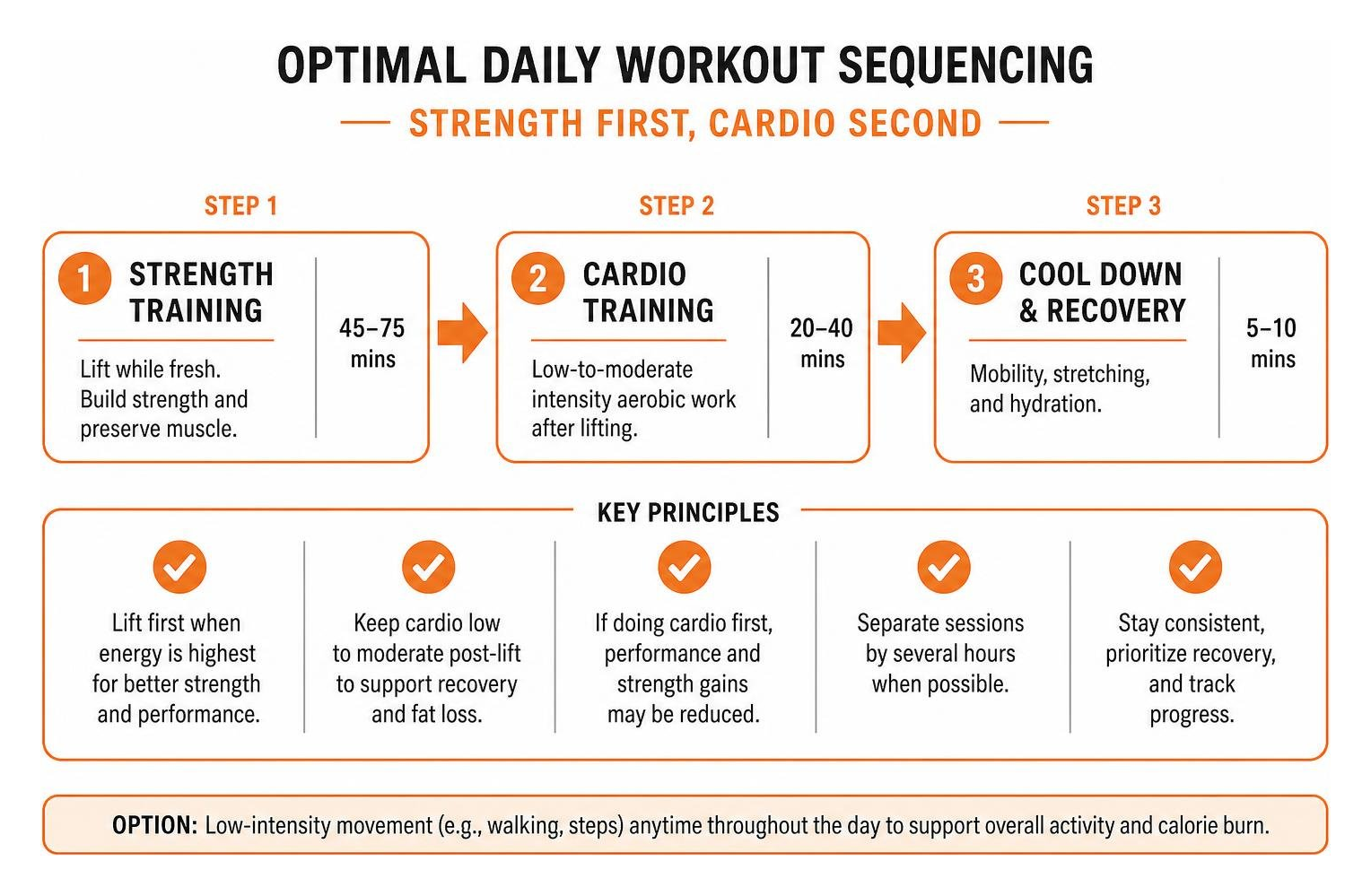
Another powerful tool for fat loss is elevating Non-Exercise Activity Thermogenesis (NEAT)—the calories burned through daily non-workout movement like taking stairs, standing, and walking. Aiming for 7,000 to 10,000 daily steps burns substantial energy without creating central nervous fatigue, preventing the severe appetite spikes often caused by intense cardio sessions. Reading Finding Balance: Combining Strength Training and Cardiovascular Exercise offers step-by-step guidance on blending aerobic health with strength gains.
Beginner Progression and 4-Week Goal Setting
When embarking on a new training plan, setting realistic, evidence-based goals prevents frustration and promotes long-term adherence.
A healthy rate of fat loss is approximately 0.5 to 1.0 pound (0.25 to 0.5 kg) per week, which corresponds to a gentle, sustainable daily deficit of roughly 300 to 500 calories. Meta-analyses reveal that aggressive energy deficits exceeding 500 calories per day impair muscle protein synthesis and prevent lean mass retention during strength training programs.
During your first 4 weeks:
- Weeks 1–2 (Foundation Phase): Focus on mastering technique across 3 sets of 10 to 12 repetitions per exercise, leaving 2 to 3 Reps in Reserve (RIR) to allow connective tissue adaptation.
- Weeks 3–4 (Strength & Load Phase): Progress load slightly while shifting rep targets to 3 sets of 8 to 10 reps, applying linear weight increases when form remains pristine.
Exploring Strength Training 101: Building a Solid Foundation helps set structural baselines that prevent early burnout while establishing solid lifting habits.
Essential Nutrition and Recovery Guidelines for Weight Loss
No strength program can outperform a completely unmanaged diet. To build lean tissue while forcing your body to burn fat, nutritional precision is critical.
- Protein Intake: Protein provides the amino acid building blocks required to repair muscle tissue under caloric restriction. Target between 1.6 and 2.2 grams of protein per kilogram of total body weight daily (roughly 0.7 to 1.0 gram per pound). High-protein diets also carry a high Thermic Effect of Food (TEF), burning roughly 20-30% of consumed protein calories through digestion alone.
- Carbohydrate & Fat Distribution: Carbohydrates fuel intense muscular workouts and preserve intramuscular glycogen. Center primary carbohydrate intakes around your training window. Ensure essential dietary fats support hormonal production by maintaining intake around 20-30% of total daily calories.
- Sleep Quality: Inadequate sleep (under 7 hours nightly) elevates cortisol, impairs glucose sensitivity, increases hunger hormones (ghrelin), and accelerates muscle loss during energy deficits.
- Comprehensive Tracking: Look beyond daily scale numbers. Take monthly progress photos, track waist circumference with a tape measure, and monitor workout logbooks to track performance improvements.
Integrating principles from Vitality Through Strength Training alongside curated lists of Best Strength Training Exercises to Add to Your Routine ensures your training, recovery, and nutrition operate as a unified system. For structured frameworks, review detailed resources like the 8-Week Barbell Fat Loss Program, explore the 12-Week Beginner Plan, or review evidence-based guides on how to Build Your Strength Training Weight Loss Program and Strength Training for Weight Loss Research.
Frequently Asked Questions About Strength Training for Weight Loss
How many days a week should a beginner lift weights for weight loss?
A beginner should start with 2 to 3 non-consecutive days of full-body strength training per week (such as Monday, Wednesday, and Friday). This frequency provides sufficient muscular stimulus to encourage retention and metabolic adaptation while granting 48 hours of recovery between sessions for joint and central nervous system repair.
Will lifting weights slow down total scale weight loss initially?
Yes, scale weight loss may temporarily slow down or plateau during the first 2 to 4 weeks of starting a strength training routine. Muscle tissue holds water and glycogen as it repairs and builds. Furthermore, gaining dense muscle mass offsets fat weight on a standard bathroom scale. However, your body composition is rapidly improving—your waist circumference, garment fit, and body fat percentage will decrease even if the scale stays flat.
Can strength training prevent muscle loss while on a weight loss program?
Yes. Progressive strength training combined with adequate daily protein intake (1.6 to 2.2 g/kg) is the single most effective way to prevent muscle loss during a calorie deficit. While dieting without exercise causes up to 25% of weight loss to come from muscle tissue, research shows resistance training preserves virtually all lean mass and can even foster muscle growth while shedding body fat.
Conclusion
Losing weight successfully is not simply about getting smaller—it is about improving your body composition, boosting your metabolic health, and building physical vitality that lasts. Relying solely on drastic calorie cuts or hours of repetitive cardio often leads to lost muscle mass, a sluggish resting metabolic rate, and disappointing long-term results.
By prioritizing progressive strength training built around full-body compound movements, you protect your hard-earned lean muscle, burn stubborn body fat, and create a strong, resilient foundation for daily life. Paired with a moderate calorie deficit, adequate protein, and quality rest, resistance training provides the most efficient blueprint for sustainable health. Focus on consistency over perfection, track your strength improvements, and celebrate the lasting benefits of a healthier, stronger body. You can also explore specialized weight loss programs to help guide your fitness transformation.