What Power Flow Yoga Actually Is (And Why It’s Worth Your Time)
Power flow yoga is a dynamic, breath-driven style of yoga that builds real strength, flexibility, and mental focus — all in a single class.
Here’s a quick snapshot before we dive deeper:
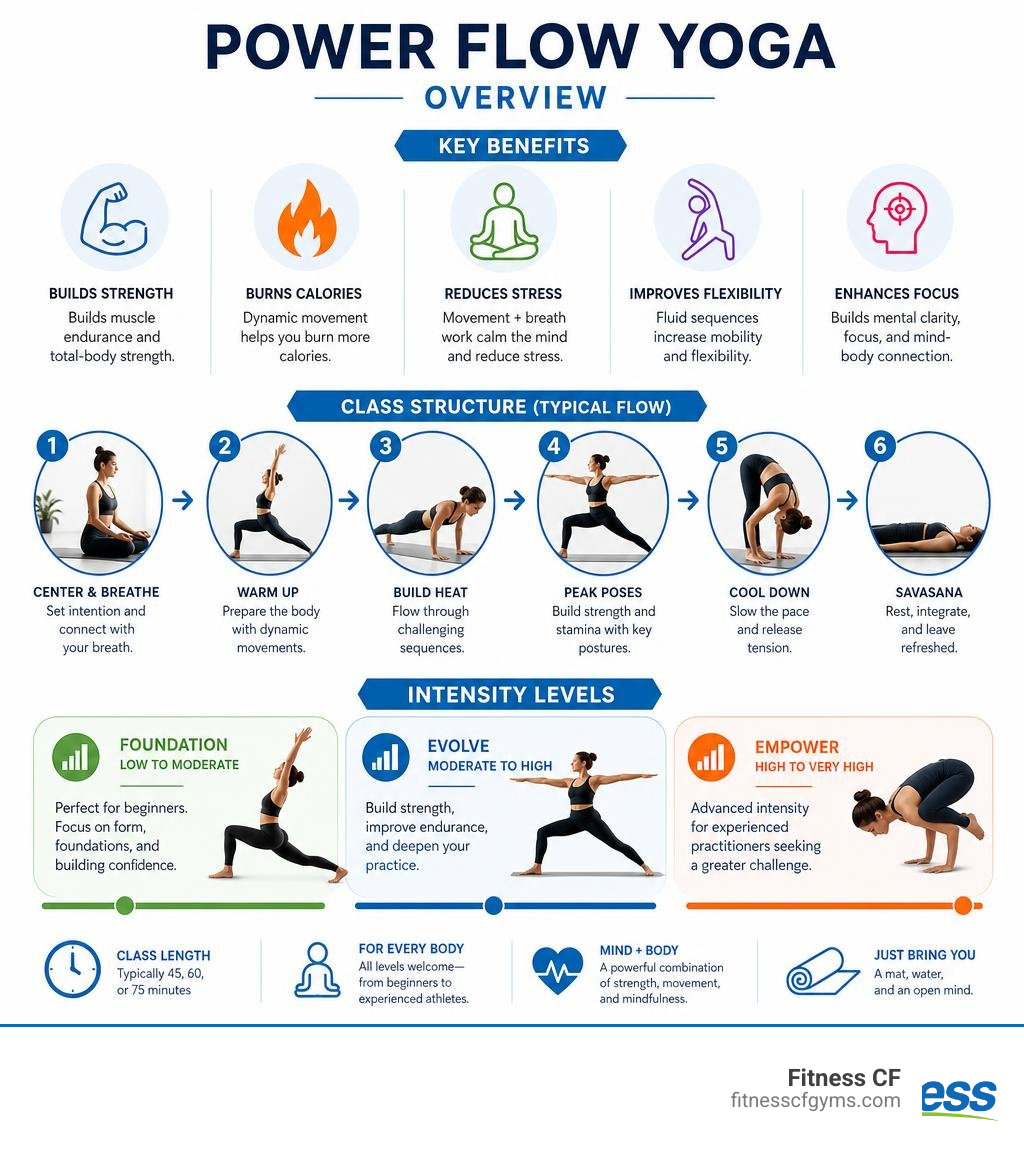
- What it is: A vigorous, athletic yoga practice that links poses together through continuous movement and breath
- Origin: Developed in the early 1990s as an American adaptation of Ashtanga yoga
- Who it’s for: Anyone from motivated beginners to experienced athletes looking for a challenging full-body workout
- Key benefits: Builds muscle endurance, burns 350–500 calories per 60-minute session, reduces stress, and improves flexibility
- Class length: Typically 45, 60, or 75 minutes
- Heated room? Optional — but common in many studios
Most people assume yoga is slow, gentle, or only for flexibility. Power flow yoga flips that idea completely.
It combines the mindfulness of traditional yoga with the intensity of an athletic workout. You move constantly, guided by your breath, building heat and strength from the inside out. It’s challenging — but also deeply rewarding.
For busy people juggling family, work, and health goals, that combination matters. You get cardio, strength training, and stress relief in one practice.
I’m Pleasant Lewis, owner and operator of Fitness CF, with over 40 years in the fitness industry — and I’ve seen how power flow yoga transforms not just bodies, but energy levels and daily mindset. In the sections ahead, I’ll break down everything you need to know to start or deepen your practice with confidence.
What is Power Flow Yoga?
To understand power flow yoga, it helps to look at where it sits in the broader landscape of yoga practices. If you have ever researched What Are the Different Types of Yoga?, you know that styles range from the deeply restorative to the physical. Power flow sits firmly on the physical, athletic end of the spectrum.
At its core, power flow is a vigorous, fitness-based approach to vinyasa yoga. Instead of holding static poses for long periods or focusing solely on meditation, this style prioritizes building physical strength, stamina, and flexibility through continuous, creative movement. We often describe it as a moving meditation because the physical effort required is so intense that your mind has no choice but to focus entirely on the present moment.
The Origins and Evolution of Power Flow Yoga
The roots of modern power yoga trace back to the early 1990s. At the time, yoga in the West was widely perceived as a gentle, slow-paced stretching routine. Seeking to challenge this perception, pioneering teachers like Bryan Kest in Los Angeles and Baron Baptiste on the East Coast began teaching what they had learned in Mysore, India, but with a distinct, Western twist.
They stripped away the rigid, fixed sequences and the traditional Sanskrit counts of classical Ashtanga yoga. Instead, they introduced dynamic sequencing, a faster pace, and an athletic focus designed to appeal to fitness enthusiasts and gym-goers. This evolution made the practice highly accessible to the modern practitioner, blending ancient breathwork with contemporary athletic training.
How It Differs from Ashtanga and Traditional Vinyasa
While power flow is a direct descendant of Ashtanga and shares many similarities with traditional vinyasa, there are key differences that set it apart:
- No Fixed Sequences: In Ashtanga, practitioners follow a strict, unchanging order of postures (the Primary Series). In power flow, teachers have the creative freedom to design unique sequences for every single class. You might focus on hip opening one day and arm balances the next.
- Athletic Pacing and Holds: While traditional vinyasa focuses on a smooth, steady transition between poses, power flow often incorporates longer holds in strength-building postures (like holding Warrior II for 8 to 10 breaths instead of the standard 5) and includes explicit core-strengthening blocks.
- Fitness Integration: Power flow frequently incorporates modern functional fitness movements, such as plank pulses, push-up variations (chaturangas), and intense balancing sequences. It is designed to feel like a complete workout.
If you are new to the terminology, reading up on All About Yoga Exercise Basics can help you feel more comfortable with these foundational concepts before stepping onto the mat.
The Structure and Anatomy of a Power Flow Class
A well-designed power flow yoga class is not just a random collection of hard poses thrown together. It is a carefully engineered physical and energetic journey. Every movement is placed with purpose to build internal heat, prepare the joints and muscles for deeper shapes, and safely bring the body back down to a state of deep rest.
Most classes run for 45, 60, or 75 minutes. Regardless of the duration, a high-quality class follows a specific, intelligent blueprint. For example, a complete, structured sequence might contain up to 48 postures, guiding the body through a balanced wave of exertion and recovery. To understand how these classes are systematically built from start to finish, you can read more about How Power Flow Is Structured: Asana, Breath & Intelligent Sequencing .
The Role of Breath and Intention in Power Flow Yoga
In power flow, the breath is the engine. We use a specific breathing technique known as Ujjayi pranayama (often called “ocean breath” or “victorious breath”). This involves inhaling and exhaling deeply through the nose while slightly constricting the back of the throat, creating a soft, audible whispering sound.
This breath serves several vital functions:
- Heat Generation: It warms the body from the inside out, preparing muscles and joints for deep stretching.
- Nervous System Regulation: Even when the physical poses are highly challenging, steady Ujjayi breathing signals to your brain that you are safe, keeping you out of a panicked “fight-or-flight” state.
- Mental Anchor: The sound and rhythm of your breath give your mind a focal point, preventing your thoughts from drifting to your to-do list.
The Triple-Peak Sequencing Method
Many advanced power flow classes utilize a “triple-peak” structure. Rather than building to a single, exhausting high point, the class rises and falls in waves of intensity. This approach mirrors natural human energy cycles and allows for sustainable, high-intensity effort.
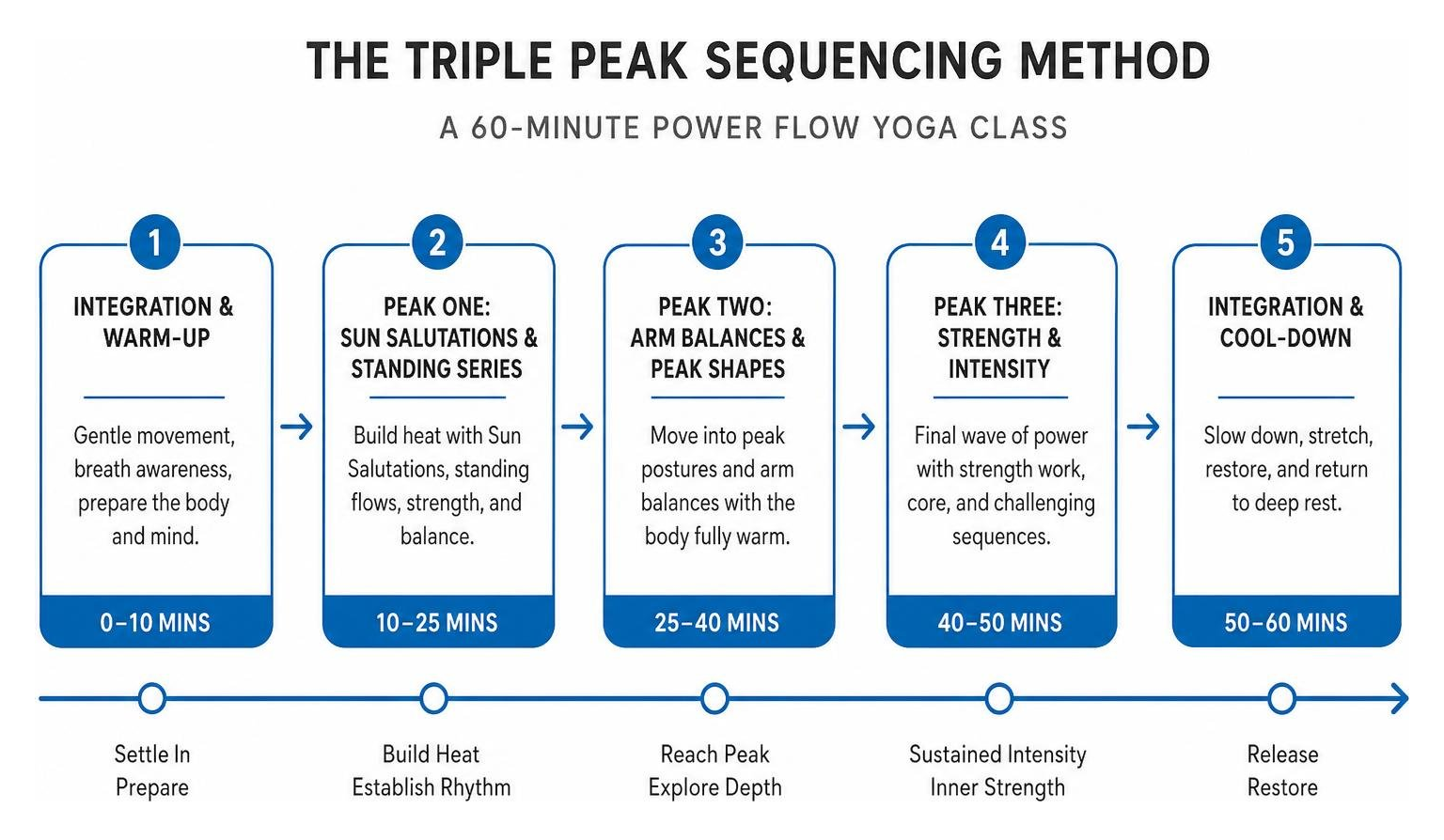
Here is how a typical 60-minute triple-peak class unfolds:
- Integration and Warm-Up (0–10 mins): We begin with gentle movements, child’s pose, cat-cows, and initial breath awareness to land on the mat.
- Peak One: Sun Salutations & Standing Series (10–25 mins): We build heat rapidly with Sun Salutations (Sun A and Sun B), followed by strong, standing flow sequences, including long-held Warrior poses and balancing postures.
- Peak Two: Arm Balances & Peak Shapes (25–40 mins): With the body fully warm, we transition to more complex postures. This is where you might try arm balances like Crow Pose, or deep backbends.
- Peak Three: Core Finisher (40–45 mins): A dedicated core block featuring boat pose variations, side planks, and abdominal pulses to solidify full-body stability.
- The Descent & Release (45–55 mins): We cool the body down with deep floor stretches, hip openers (like Pigeon Pose), and gentle twists.
- Final Rest / Savasana (55–60 mins): At least 5 full minutes of complete stillness to allow the nervous system to integrate the physical work.
For a detailed look at how these elements come together in a real-world setting, check out this sample Power Yoga Sequence: 60-Minute Strength Class with Cues | FLOW Yoga Sequence Builder .
Physical and Mental Benefits of Power Flow
The beauty of power flow yoga is that it bridges the gap between traditional fitness workouts and mindful mental health practices. It is a holistic approach to healthy living that supports both your physical body and your state of mind.
| Physical Benefits | Mental & Emotional Benefits |
|---|---|
| Builds lean muscle strength and endurance | Promotes deep stress relief and relaxation |
| Enhances joint mobility and overall flexibility | Improves mental focus and cognitive clarity |
| Increases cardiovascular fitness and stamina | Builds emotional resilience and confidence |
| Boosts metabolic rate and supports healthy weight | Encourages self-love and body positivity |
If you want to explore the broader picture of how a regular practice affects your body, take a look at our guide on What Are the Health Benefits of Yoga?.
Strength Training and Cardiovascular Health
Many people wonder if yoga can truly count as a “real” workout. The answer with power flow is a resounding yes. Because you are constantly supporting, lifting, and balancing your own body weight, it acts as an exceptional form of resistance training. It targets major muscle groups — including your core, shoulders, glutes, and back — while also engaging smaller stabilizing muscles that are often missed in traditional gym machines.
Additionally, the continuous, flowing transitions keep your heart rate elevated. This sustained effort provides a solid cardiovascular workout, helping to improve heart health and lung capacity. To understand why incorporating this practice can supercharge your overall exercise routine, read Exploring the Power of Yoga: Why You Should Add It to Your Fitness Routine.
Mental Resilience and Stress Reduction
While the physical challenge is undeniable, the mental benefits of power flow yoga are often what keep people coming back to the mat. In a world full of constant screens, notifications, and high stress, a power flow class acts as a sanctuary.
When you are holding a challenging pose or navigating a complex balance, you cannot think about your emails. You have to be entirely present. This deep, moving mindfulness helps to lower cortisol (stress hormone) levels, relieve accumulated physical tension, and clear mental clutter. Many practitioners leave class feeling a sense of deep emotional release and quiet confidence that carries over into how they handle daily life challenges.
How to Safely Practice and Modify Challenging Poses
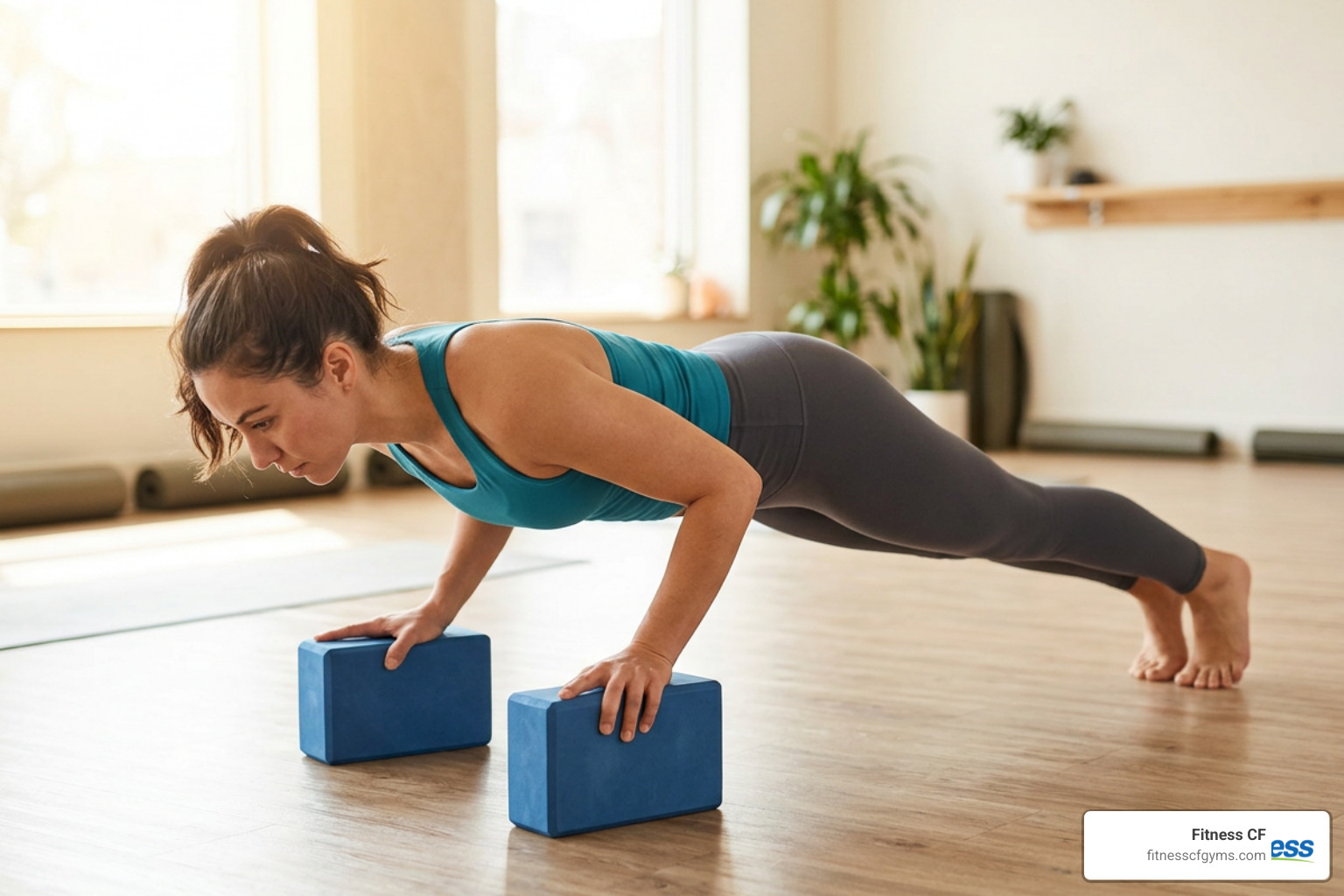
Because power flow is an intense, athletic practice, safety and proper alignment are paramount. It is easy to get swept up in the energy of a class, but listening to your body and using modifications is the key to a sustainable, lifelong practice.
If you are looking for a balanced way to build up your physical capacity safely, we highly recommend trying a structured 45-minute yoga for strength and flexibility routine to establish a solid foundation.
Essential Gear and Environmental Factors
To set yourself up for success, having the right gear is essential:
- A High-Quality Mat: Because you will sweat, you need a non-slip mat with excellent grip to prevent sliding during Downward Facing Dog.
- Yoga Blocks and Straps: Blocks are not just for beginners; they bring the floor closer to you, allowing you to maintain perfect alignment in poses like Half Moon or Triangle.
- Comfortable, Breathable Clothing: Wear athletic wear that moves with you and wicks away sweat. Avoid overly baggy clothes that might get in your way during inversions.
- Hydration: Bring a water bottle and a hand towel. If you are practicing in a heated room (which typically ranges from 80°F to 95°F), proper hydration before, during, and after class is non-negotiable.
Modifications for Arm Balances and Core Work
One of the most common places practitioners risk injury is in the transition known as Chaturanga Dandasana (the low push-up). Doing dozens of repeated, misaligned chaturangas can strain the shoulders over time.
Here is how you can safely modify and progress through key power flow challenges:
- Modify Chaturanga: Always drop your knees to the mat. Keep your elbows hugging tightly in against your ribs and ensure your shoulders never dip lower than your elbows.
- Prep for Crow Pose (Bakasana): Instead of jumping straight into balancing on your hands, keep your toes on the mat or place a block under your feet to practice shifting your weight forward into your hands safely.
- Scale Boat Pose (Navasana): If your lower back rounds or aches in Boat Pose, bend your knees and keep your shins parallel to the floor, or bring your hands to the backs of your thighs for support.
The goal of yoga is not to force your body into a specific shape, but to use the shape to learn more about your body.
Frequently Asked Questions about Power Flow
Is power flow yoga suitable for beginners?
Yes, absolutely! While it is a step up in intensity from a gentle or restorative class, motivated beginners can absolutely participate. The key is to choose a class or platform where the instructor offers clear modifications. Never hesitate to take Child’s Pose whenever you need a break — it is a sign of an advanced, self-aware practitioner, not a weakness.
If you want to practice at home first to build your confidence, online resources like the Shakti Power Flow | Yoga With Adriene video offer a wonderful, encouraging introduction to moving with intention.
How many calories does a typical class burn?
On average, a 60-minute power flow class burns between 350 and 500 calories for a 150-pound individual. This number can increase if the class is held in a heated room or features a particularly high-tempo sequence. However, we always remind our members that calorie burn is just a small piece of the puzzle; the true value lies in the muscle endurance, cardiovascular health, and mental peace you build.
For those short on time but looking for a high-efficiency burn, dynamic short-session classes like the 15 min Power Flow are fantastic options to keep your metabolism active.
How often should I practice power yoga per week?
For experienced practitioners, practicing power flow yoga up to five days a week is a reasonable and healthy routine, with six days being the absolute upper limit. Because of the repetitive nature of weight-bearing movements on the hands and wrists (like plank and chaturanga), your body requires rest to repair muscle tissue and prevent shoulder overuse. If you want to practice daily, we recommend alternating high-intensity power days with gentle, restorative, or yin yoga sessions.
Conclusion
Embarking on a power flow yoga journey is one of the most rewarding commitments you can make to your physical health and mental well-being. By blending the strength-building benefits of functional fitness with the deep, restorative power of mindful breathwork, it offers a truly complete approach to healthy living.
Whether you are looking to tone your body, build cardiovascular stamina, or find a peaceful escape from the daily grind, there is a space on the mat waiting for you.
If you are located in Central Florida, we would love to welcome you into our community. We offer a diverse range of classes designed for all fitness levels at our various local hubs. You can explore local opportunities near you with our guides to Mount Dora Yoga: Your Ultimate Guide to Local Studios and Unroll Your Mat: A Comprehensive Guide to Yoga Classes Across Central Florida.
Ready to take the first step toward a stronger, more balanced version of yourself? Find your rhythm, discover Yoga Classes Near Me, or learn more about our dedicated Hatha Yoga Orlando and power options.
We invite you to join us on the mat and experience the transformation firsthand. Start Your Journey at Our Yoga Studio Orlando today!