Why a Home Fitness Trainer Could Be the Healthiest Decision You Make This Year
A home fitness trainer is one of the fastest-growing ways to stay fit, build strength, and hit your health goals — all without leaving the house.
Here’s a quick breakdown of what you need to know:
| Question | Quick Answer |
|---|---|
| What is it? | A coaching system or device that guides your workouts at home |
| Main types | AI-powered machines, virtual coaching apps, cable/functional trainers, all-in-one systems |
| Who is it for? | Beginners, busy parents, advanced lifters, rehab patients — almost anyone |
| Key benefits | Convenience, privacy, personalization, cost savings over time |
| Typical cost | Free apps to $4,000+ machines; subscriptions from ~$6/day |
| Space needed | Some systems fold down to under 3 sq ft |
Whether your schedule is packed, your motivation is low, or you simply prefer the privacy of your own space, home-based fitness has a solution that fits.
Gone are the days when “working out at home” meant a dusty treadmill in the corner. Today’s options range from AI coaches that correct your form in real time to certified virtual trainers who meet you over video — and everything in between. The results people are getting are real. Research shows that users of virtual coaching platforms report strong long-term consistency, with some platforms seeing over 80% of users still training consistently after six months.
I’m Pleasant Lewis, owner and operator of Fitness CF and Results Fitness, with over 40 years of experience in the fitness industry — and I’ve watched the rise of the home fitness trainer reshape how people approach their health. In this guide, I’ll help you cut through the noise and find what actually works.
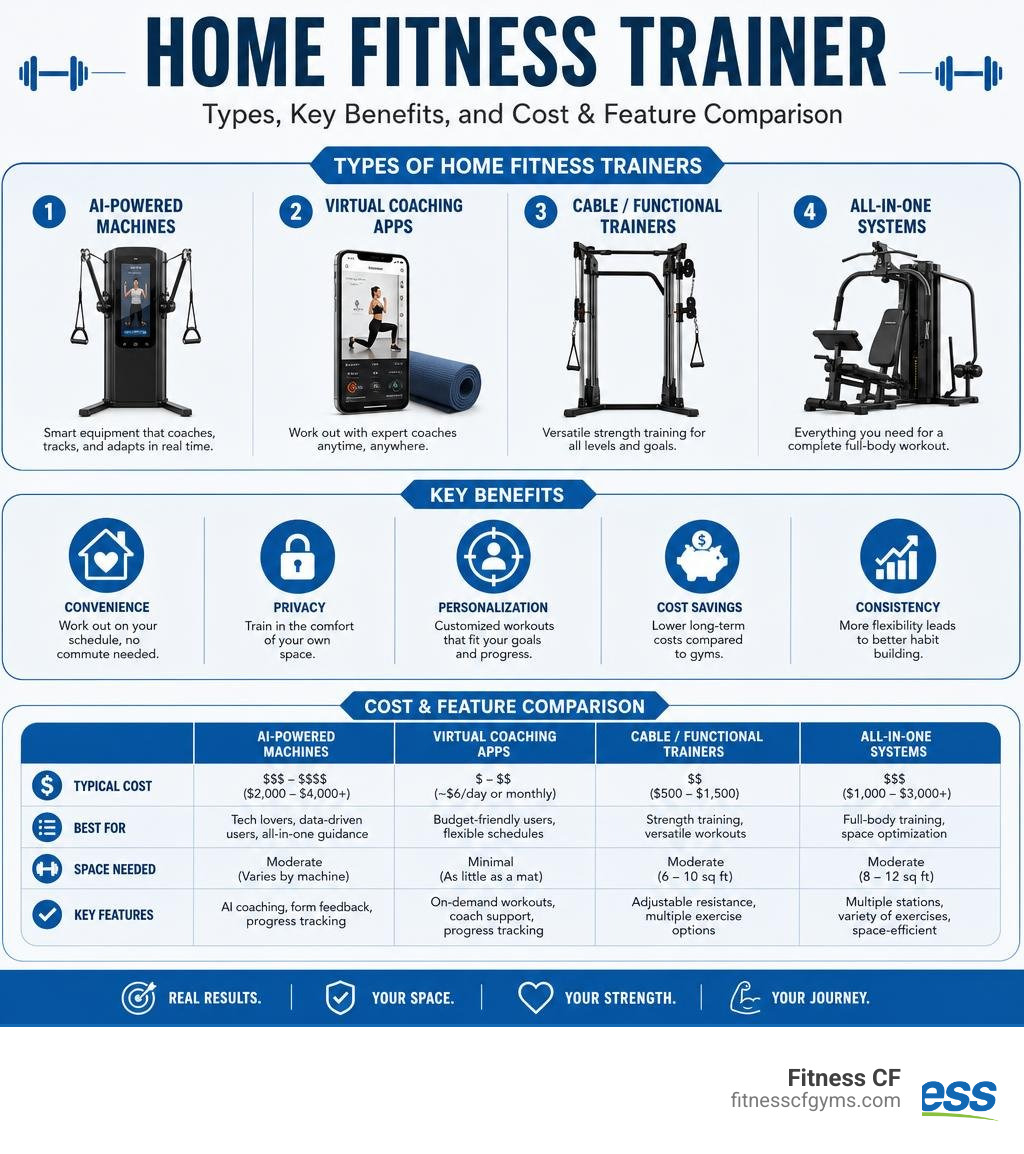
Home fitness trainer vocab explained:
Understanding Home Fitness Training Modalities

What is a Home Fitness Trainer?
When we talk about a home fitness trainer, we are referring to a broad category of modern solutions designed to bring professional-grade fitness instruction, feedback, and structure directly into your living room. Historically, working out at home meant self-guided routines, following along with pre-recorded workout DVDs, or attempting to navigate complex equipment without guidance.
Today, a home fitness trainer acts as a bridge. It replaces the traditional gym setting with interactive technology, remote human coaching, or smart hardware. This can range from a live virtual coach observing your form over a video call to an AI-powered smart mirror that maps your body’s movements.
The primary difference lies in the level of personalization and feedback. Traditional home workouts are passive; you watch a screen and hope your form is correct. A modern home training system is active; it tracks your reps, measures your velocity, adjusts your resistance, and holds you accountable. If you have ever wondered, Personal Training: How Do I Know If It’s Right for Me?, exploring these home-based modalities is an excellent, low-pressure way to experience structured coaching.
Types of Home Training Systems
To find the right setup for your home, it helps to understand the five primary types of systems available in 2026:
- Virtual Coaching Apps: These platforms connect you with real, certified human coaches. You receive custom-built training plans, and depending on the service, you either record videos of your movements for feedback or stream live, 1-on-1 sessions. Premium platforms are highly selective, with some accepting fewer than 3% of trainer applicants to ensure top-tier guidance.
- AI-Powered Strength Machines: These are wall-mounted or freestanding digital weight systems. They use electromagnetic resistance rather than physical iron plates. Systems like the Tonal 2 | The Ultimate Smart Gym for a Complete Home Workout pack up to 250 pounds of digital resistance into a compact frame and use built-in cameras to analyze your movement patterns in real time.
- All-in-One Digital Gyms: These are freestanding, highly portable units that require zero wall mounting. Devices like the Gym Monster Affordable AI-Powered All-in-One Home Gym Workout Machine – Speediance and its successor, the Gym Monster 2 | Advanced Smart Home Gym & Digital Weight Machine – Speediance , utilize dual direct-drive motors to provide smooth, adjustable magnetic tension. They offer multiple training modes (such as eccentric, chain, and constant) to mimic free weights.
- Smart Mobility and Strength Pods: Sleek, floor-based systems such as the AEKE K1 Smart Home Gym | AI-Powered Strength & Mobility focus heavily on integrating strength training with mobility and flexibility. Using a 4K touchscreen and a 6D body assessment, these systems map your movement blueprint to keep your joints healthy and balanced.
- Targeted Functional Trainers: If you want to focus on specific muscle groups without massive electrical setups, compact mechanical units like the Multifunction Core & Glute Trainer | Sunny Health & Fitness | Sunny Health & Fitness offer a physical, space-saving alternative. These systems use heavy-duty steel frames and joint-friendly resistance bands to target the posterior chain and core safely.
Choosing the Right Home Fitness Trainer for Your Goals

Key Features to Look For
With so many high-tech options on the market, it is easy to get overwhelmed by flashy screens and marketing promises. When evaluating a home fitness trainer, we recommend focusing on these core features:
- Customizable and Adaptive Resistance: Look for systems that allow micro-adjustments. Digital weight systems that adjust in 1-pound increments make progressive overload incredibly safe and manageable.
- Real-Time Form Feedback: This is crucial for preventing injuries. Whether it is a live coach watching you over a Zoom call or an AI system tracking your joint angles on a 4K display, you need immediate feedback when your back rounds or your knees cave.
- Multi-User Profiles: If multiple household members plan to use the system, look for equipment that supports individual profiles. This allows the machine to remember everyone’s specific strength levels, seat adjustments, and workout history.
- Space and Installation Requirements: Some systems require professional white-glove installation and structural wall studs, while others are ready to use right out of the box and fold down to take up less than 3 square feet of floor space.
Suitability for Different Fitness Levels
One of the greatest achievements of modern home fitness technology is its ability to meet you exactly where you are.
For beginners, walking into a crowded gym can feel incredibly intimidating. A home fitness trainer provides a private, judgment-free environment to learn the basics of movement. Features like adaptive weight reduction—where an AI coach automatically lowers the digital weight if it senses you struggling mid-rep—build confidence without the risk of dropping a heavy barbell.
For advanced lifters, systems that offer specialized loading modes, such as eccentric overload (adding weight during the lowering phase of a lift) or chain mode (mimicking the progressive weight of heavy steel chains), provide the high-intensity stimuli needed to break through stubborn training plateaus.
If you are recovering from an injury, certain smart trainers offer highly controlled rehabilitation settings. For example, using the AI Smart Home Gym | 43-inch 4K, 220lb Resistance – AEKE , you can utilize “elastic mode” to mimic the joint-friendly, progressive tension of physical therapy bands. If you are still unsure how to structure your routine, consulting The Definitive Guide to Finding a Personal Trainer can help you decide if a hybrid approach of home and in-person coaching is right for your recovery.
The Benefits of Strength Training and Cardio at Home
Building Strength and Lean Muscle
We cannot overstate the importance of strength training for long-term health and vitality. As we age, we naturally lose muscle mass and bone density. Engaging in consistent resistance training is the single best way to combat this decline, boost your resting metabolism, and protect your joints from daily wear and tear.
Using a home fitness trainer allows you to perform compound movements—such as squats, deadlifts, chest presses, and overhead presses—safely in your own space. By utilizing digital weight or adjustable cable systems, you can achieve the necessary mechanical tension required for muscle hypertrophy without needing a room full of heavy iron plates.
Furthermore, having a structured home program ensures you are targeting all major muscle groups evenly, preventing the muscular imbalances that often lead to chronic lower back or shoulder pain. If you want to understand how structured guidance can accelerate these physical changes, check out these 13 Incredible Benefits of a Personal Trainer.
Boosting Cardiovascular Health and Endurance
While strength training builds the frame, cardiovascular exercise keeps the engine running smoothly. Regular cardio improves your aerobic capacity, lowers your resting heart rate, regulates blood sugar levels, and releases a powerful flood of mood-boosting endorphins.
Many modern home fitness systems seamlessly integrate cardiovascular work into their programming. From high-intensity interval training (HIIT) classes to simulated rowing and skiing motions, you can elevate your heart rate and burn calories without needing a massive commercial cardio machine.
This combination of strength and cardio at home makes it easier than ever to maintain an active, healthy lifestyle, even on days when your schedule feels entirely unmanageable.
Comparing Home Workouts to In-Person Coaching
| Feature | Home Fitness Trainer (AI / Digital) | In-Person Personal Trainer |
|---|---|---|
| Convenience | Outstanding; zero commute, available 24/7 | Requires travel; bound to trainer’s schedule |
| Privacy | Complete privacy in your own home | Working out on a public gym floor |
| Upfront Cost | Moderate to High (for premium smart hardware) | Low (no equipment to purchase) |
| Ongoing Cost | Low to Moderate (monthly app subscription) | High (per-session fees add up quickly) |
| Form Feedback | Camera-assisted AI or remote video analysis | Direct, hands-on physical adjustments |
| Accountability | High (via app reminders and digital tracking) | Maximum (a human is physically waiting for you) |
The Cost of a Home Fitness Trainer vs. Traditional Options
When evaluating the financial side of fitness, it is important to look at the long-term value. Premium smart home gyms represent a significant upfront investment, often ranging from $2,000 to over $4,000. Many of these hardware systems also require an ongoing monthly subscription (typically around $39 to $59) to unlock live classes, AI coaching features, and detailed data tracking.
However, when compared to the ongoing cost of hiring a 1-on-1 personal trainer at a physical facility—which can easily range from $60 to over $150 per hour—a home system often pays for itself within the first year. For households where multiple family members will use the machine, the savings multiply rapidly.
If you prefer a human touch but want to save money, virtual personal training services offer a middle ground, often costing around $6 a day for unlimited access to a dedicated coach. This is a fraction of the cost of traditional in-person sessions.
Accountability, Form Correction, and Motivation
The biggest hurdle to any fitness routine is not a lack of knowledge; it is a lack of consistency. This is where a home fitness trainer shines.
Data shows that while only about 7% of people who download a standard, non-interactive fitness app stick with it long-term, virtual coaching platforms that offer real human accountability boast a 6-month consistency rate of over 83%. Knowing that a remote coach is checking your workout logs—or that your smart machine is tracking your weekly streaks—provides a powerful psychological push to keep moving.
Additionally, real-time form correction has evolved dramatically. Modern camera systems and wearable motion trackers analyze your pacing, range of motion, and symmetry. If you are lifting too quickly or failing to hit the proper depth on a squat, the system alerts you instantly.
This immediate feedback loop dramatically reduces the risk of injury, ensuring that your home workouts are just as safe and effective as working with a trainer in person. To learn more about how professional guidance can transform your physical habits, explore the 6 Incredible Benefits of Personal Training.
Frequently Asked Questions About Home Fitness
Do I need a lot of space for a home fitness setup?
Not at all. While some older home gyms required an entire dedicated spare room, modern systems are incredibly space-efficient. Many of the leading all-in-one digital weight machines feature foldable designs that can be set up in under a minute and rolled into a closet or placed under a bed when not in use. Some wall-mounted units take up zero floor space when the arms are folded flat against the wall, requiring only a clear 7′ x 7′ area of floor space when you are actively working out.
Can a virtual trainer really correct my form?
Yes! Through a combination of high-definition video streaming, smart camera accessories, and wearable motion-tracking technology (such as an Apple Watch or Android smartwatch), virtual trainers can observe your joint angles, posture, and lifting tempo in real time. They can provide immediate verbal cues to help you adjust your alignment, ensuring you perform every exercise safely and effectively.
Is home training suitable for beginners?
Absolutely. In fact, many beginners find home training far more comfortable than a traditional gym environment because it eliminates “gym anxiety.” Smart home systems are designed to guide you through the basics step-by-step, starting with comprehensive body assessments to establish your baseline strength and mobility. The equipment automatically selects the appropriate resistance, allowing you to focus entirely on mastering your movement patterns in a private, supportive space.
Conclusion
Investing in a home fitness trainer is more than just buying a piece of exercise equipment; it is a commitment to building a sustainable, lifelong habit of healthy living. By removing the barriers of travel time, weather, and crowded gym floors, home-based training systems make it easier than ever to remain consistent with your strength and cardiovascular workouts.
At Fitness CF, we believe that the best workout routine is the one you actually look forward to doing. Whether you choose to train in the comfort of your living room with a state-of-the-art digital system or prefer the high-energy atmosphere of a local facility, the ultimate goal is to keep your body moving, strong, and pain-free.
If you are ready to take the next step in your health journey and want to explore all of your coaching options, dive into our comprehensive Fitness CF Personal Training Guide to find the perfect fit for your lifestyle.