Why a Bootcamp Exercise Class Might Be the Most Efficient Workout You’ll Ever Try
A bootcamp exercise class is a fast-paced, full-body group workout that combines strength training, cardio, and functional movement — all in one session, typically lasting 45 minutes.
Here’s what you need to know at a glance:
- What it is: A group fitness class modeled loosely on military training, using circuits of bodyweight and equipment-based exercises
- How long it takes: Most sessions run 45 minutes, though some programs offer 30- or 60-minute formats
- Who it’s for: All fitness levels — beginners through advanced athletes — with modifications available throughout
- Key benefits: Burns calories, builds strength, improves cardiovascular fitness, and keeps you accountable
- What to expect: A warm-up, several timed working rounds, a cooldown, and a coach guiding every step
Staying consistent with fitness is hard. Life gets busy. Motivation fades. Solo workouts can feel repetitive and easy to skip.
That’s exactly where bootcamp shines.
The group energy, the coaching, the structure — they all work together to push you further than you’d go on your own. Whether you’re trying to lose weight, build strength, improve heart health, or simply feel better day-to-day, bootcamp delivers results without demanding hours of your time.
I’m Pleasant Lewis, a fitness professional with over 40 years in the fitness industry. I’ve seen how a well-run bootcamp exercise class can transform not just someone’s body, but their entire relationship with healthy living. In the sections below, I’ll walk you through everything you need to know to decide if bootcamp is right for you.
Bootcamp exercise class word roundup:
What is a Bootcamp Exercise Class?
To truly appreciate a modern bootcamp exercise class, it helps to understand where the concept started. The term “boot camp” originally dates back to the Spanish-American War, where U.S. Navy and Marine recruits wore leggings known as “boots.” Over time, the term came to represent the intense, structured, and highly disciplined military recruit training designed to turn civilians into robust, physically prepared service members.
In the late 1990s and early 2000s, fitness pioneers in the United States, Australia, the United Kingdom, and Canada independently realized that the core principles of military physical training—discipline, camaraderie, varied functional movements, and high efficiency—could be adapted for mainstream fitness. Thus, the commercial fitness bootcamp was born.
But what exactly makes it different from other popular training styles?
While a traditional strength training session focuses primarily on lifting heavy weights with long rest periods, and a dedicated cardio class (like spin or running) focuses almost exclusively on aerobic endurance, a bootcamp workout bridges the gap. It is a holistic, full-body conditioning experience.
Unlike pure High-Intensity Interval Training (HIIT), which relies on strict, mathematically structured work-to-rest ratios (such as the 20-seconds-on, 10-seconds-off Tabata protocol) performed at near-maximum heart rate, bootcamp classes are more fluid. They incorporate a broader variety of movements, including strength work, agility drills, and active recovery periods. While you might perform a HIIT block during a bootcamp, the entire class is not bound to that singular formulaic rhythm.
Furthermore, compared to one-on-one personal training, bootcamp offers the motivating dynamic of a group setting. You get the watchful eye of a certified coach to correct your form, but you also benefit from the shared energy of your peers. For many, this collective drive is what makes group fitness classes transform workout routines from boring chores into the highlight of their day.
| Feature | Bootcamp Class | HIIT Class | Personal Training |
|---|---|---|---|
| Primary Focus | Full-body strength + cardio conditioning | High-effort cardiovascular intervals | Customized individual goals |
| Structure | Varied circuits, AMRAPs, and partners | Strict work-to-rest intervals (e.g., 1:1, 1:2) | Variable based on daily plan |
| Typical Group Size | 15 to 40 participants | 10 to 30 participants | 1-on-1 or small group (2-3) |
| Equipment Used | Dumbbells, kettlebells, ropes, bodyweight | Often bodyweight or light equipment | Full equipment access |
| Atmosphere | Team-oriented, high-energy, community-driven | Intense, solo-focused within a group | Private, focused, educational |
The Anatomy of a Bootcamp Workout
No two bootcamp workouts are ever exactly the same, which is one of the primary reasons participants stay engaged and avoid performance plateaus. However, a high-quality session always follows a logical, science-backed structure to keep you safe and maximize your physical output.
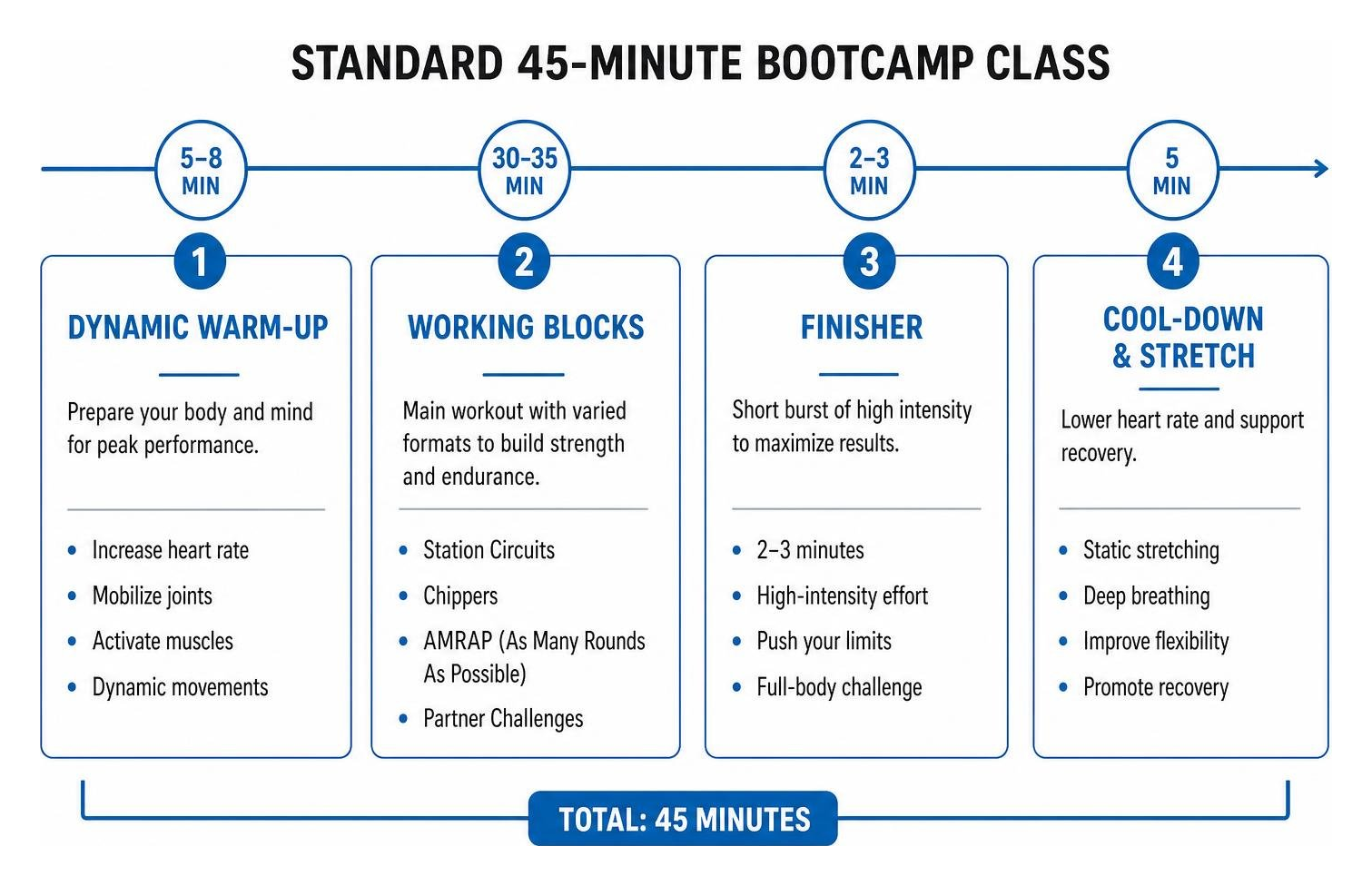
A standard 45-minute class is typically broken down into four distinct phases:
1. The Dynamic Warm-Up (5–8 minutes)
Before you lift a single weight or perform a jump, your body needs to prepare. A proper warm-up increases your core temperature, lubricates your joints, and activates your nervous system. Rather than static stretching (which can temporarily reduce muscle power), bootcamp warm-ups utilize dynamic movements. You can expect exercises like light jogging, jumping jacks, arm circles, bodyweight squats, and inchworms.
2. The Working Blocks (30–35 minutes)
This is the heart of the workout. Instructors organize this section using various formats to keep your muscles guessing. Common templates include:
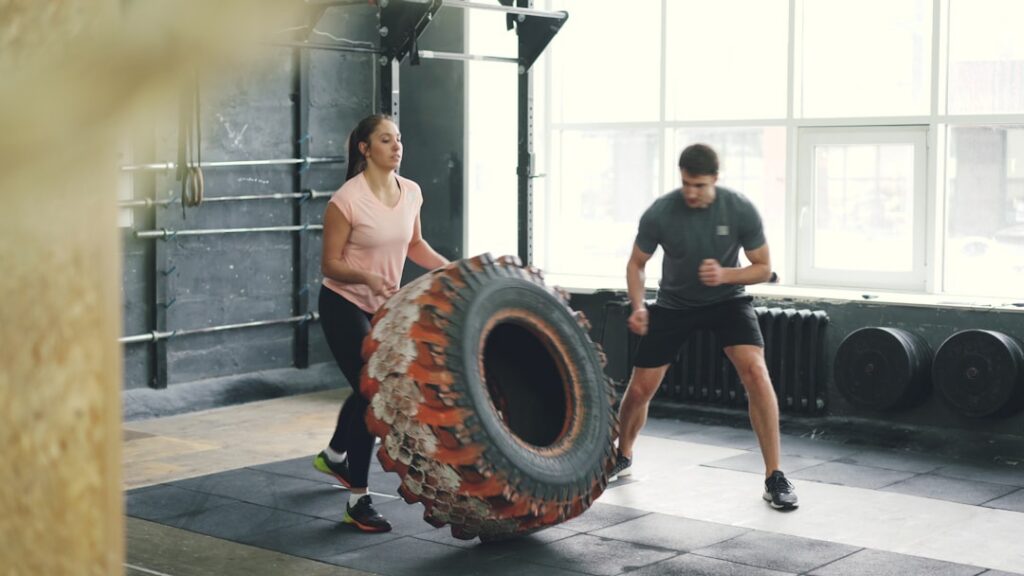
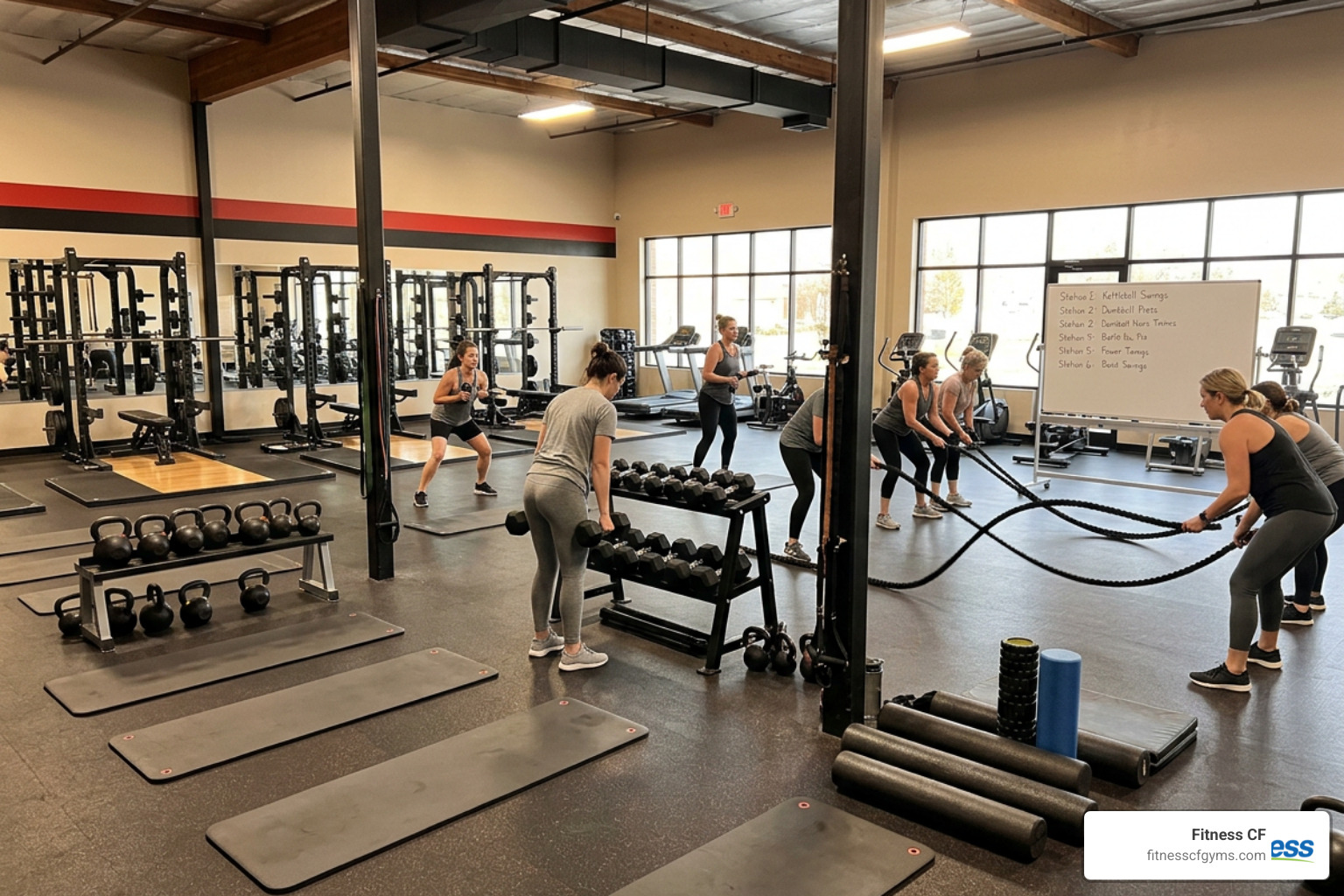
- Station Circuits: The room is set up with multiple stations (e.g., station one is kettlebell swings, station two is push-ups, station three is battle ropes). You perform the exercise at your station for a set time (usually 30 to 60 seconds) before rotating to the next.
- Chippers: A list of exercises with high repetition targets (e.g., 50 squats, 40 mountain climbers, 30 kettlebell cleans). The goal is to “chip away” at the reps at your own pace until the list is complete.
- AMRAP (As Many Rounds As Possible): You are given a short circuit of 3 to 4 exercises and a time limit (such as 8 minutes) to complete as many rounds of that circuit as you can.
- Partner Challenges: Working with a classmate where one person performs a strength exercise while the other completes a cardio task, switching back and forth to foster community support.
3. The Finisher (2–3 minutes)
Just when you think you are done, the coach may throw in a brief, high-intensity “finisher” to fully exhaust your energy systems. This could be a 2-minute plank challenge, a rapid burpee pyramid, or a team sprint.
4. The Cool-Down and Stretch (5 minutes)
To bring your heart rate back down safely and promote recovery, the class finishes with static stretching, deep breathing, and sometimes yoga-inspired movements.
To get the most out of these structures, it helps to understand how different formats challenge your body. You can learn about the best group fitness classes and how their unique layouts target different energy systems.
Equipment and Scalability in Bootcamp Training
One of the greatest myths about bootcamp training is that you need to be an elite athlete who can lift heavy barbells to participate. In reality, a great bootcamp is incredibly scalable, utilizing a mix of simple tools and your own body weight.
Common equipment you will encounter includes:
- Dumbbells and Kettlebells: For building functional, multi-planar strength.
- Medicine Balls and Slam Balls: Excellent for developing explosive power and core strength.
- Suspension Trainers (TRX): Using your body weight against gravity to build joint stability.
- Battle Ropes and Jump Ropes: For high-intensity cardiovascular conditioning without the joint impact of constant running.
- Resistance Bands: Perfect for targeted muscle activation and joint-friendly resistance.
However, a bootcamp can be incredibly effective with absolutely no equipment at all. Bodyweight exercises—such as push-ups, squats, lunges, planks, and burpees—allow you to move through natural patterns, improving your relative strength and mobility.
This simplicity and focus on natural movement make bootcamp highly adaptable. If you have joint concerns, you can easily swap high-impact jumping movements for low-impact alternatives. For example, a jump squat can be scaled down to a rapid air squat with a calf raise, and a burpee can be modified by stepping back rather than jumping.
To learn more about how to protect your joints while still getting an incredible workout, read our guide on low-impact workouts. Additionally, sports science research highlights how structured group formats allow participants to safely progress at their own pace; you can check out some of these insights through this scientific research on bootcamp training.
The Health and Fitness Benefits of Bootcamp
Why do millions of people worldwide walk into a bootcamp exercise class every single week? Because it delivers a comprehensive suite of health benefits that are difficult to replicate in a solo workout session.
1. Balanced Strength Training
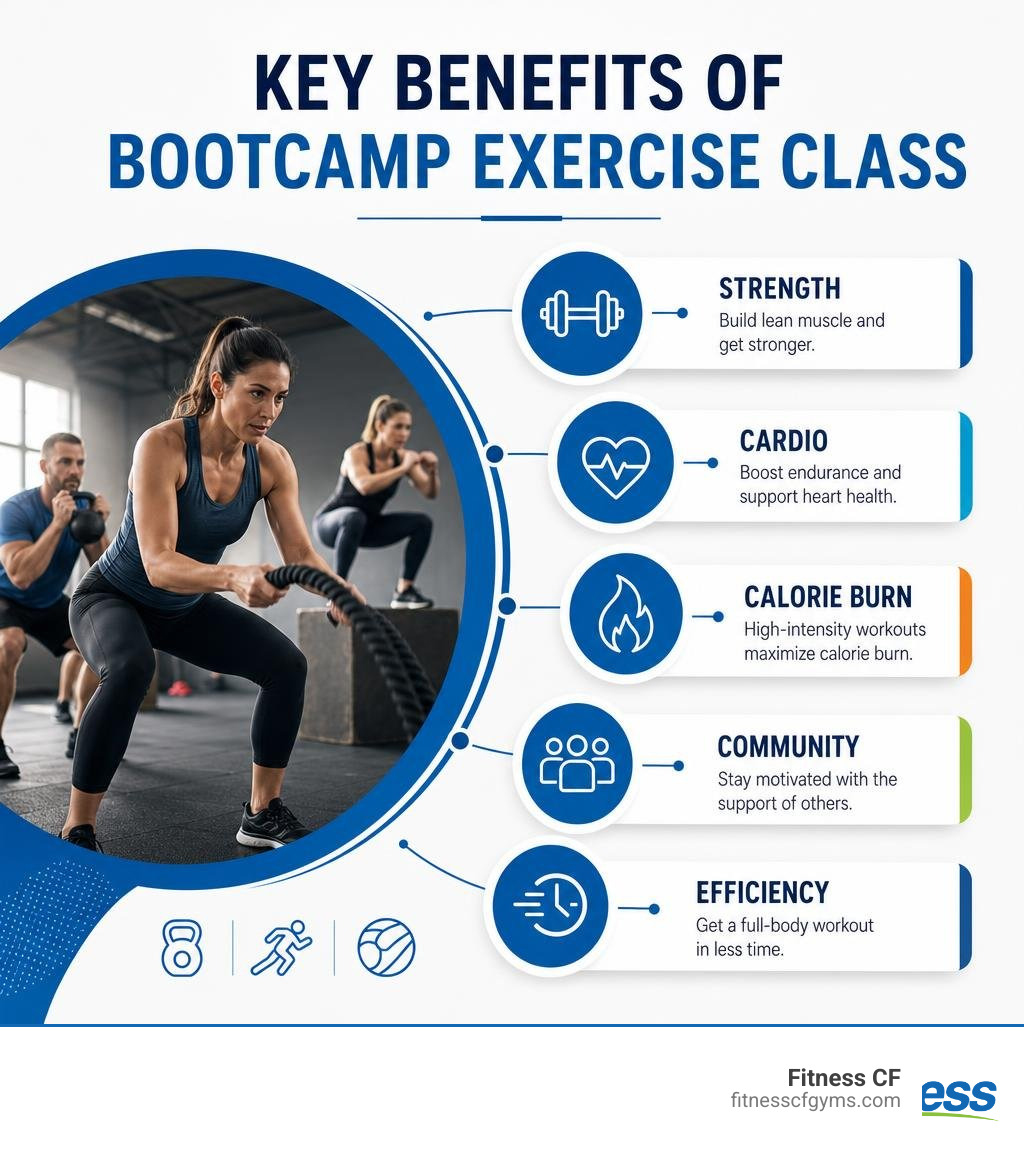
Many traditional cardio routines can lead to muscle loss over time if not paired with resistance work. Bootcamp classes solve this by integrating functional strength training into every session. By lifting weights and performing resistance movements, you stimulate muscle hypertrophy and increase bone density, protecting your skeletal system as you age.
2. Enhanced Cardiovascular Health
Because rest periods are kept short and active, your heart rate remains elevated throughout the session. This constant demand strengthens your cardiac muscle, lowers resting blood pressure, and improves your VO2 max (the maximum amount of oxygen your body can utilize during exercise).
3. Maximum Calorie Burn & The “Afterburn” Effect
A single 45-minute bootcamp class can burn a significant number of calories, but the magic really happens after the class ends. High-intensity circuit training triggers Excess Post-Exercise Oxygen Consumption (EPOC), commonly known as the “afterburn effect.” Your body must expend extra energy (calories) for up to 24 to 36 hours post-workout simply to repair muscle tissue, replenish oxygen stores, and return your metabolism to its baseline state.
4. Mental Motivation and Consistency
Working out alone requires immense mental discipline. In a bootcamp class, the coach plans the workout, keeps track of the time, and provides constant encouragement. This takes the cognitive load off your shoulders. Furthermore, the shared struggle of a group environment builds a sense of community. You are far less likely to press the snooze button when you know your classmates and coach are expecting you to show up.
If you are looking to accelerate your health journey, the power of a group environment cannot be overstated. We encourage you to discover the benefits of group training to see how a supportive community can completely redefine your consistency.
Who Should Join a Bootcamp Class?
Because of its highly adjustable nature, bootcamp is suited for a remarkably wide demographic:
- Busy Professionals: If you only have 45 minutes to spare during a lunch break or before heading to the office, bootcamp maximizes every single minute. You get strength, cardio, and core work checked off your list in one efficient block.
- Beginners Looking for Direction: If starting a workout routine leaves you feeling overwhelmed and unsure of where to begin, bootcamp provides a structured, safe environment where every movement is demonstrated and coached.
- Experienced Athletes Breaking a Plateau: If your current routine has stopped yielding results, the varied, high-intensity nature of bootcamp can shock your system and kickstart new progress.
- Active Seniors: With proper coaching and low-impact modifications, seniors can use bootcamp to maintain functional mobility, balance, and muscle mass.
However, bootcamp is not for everyone. If you are recovering from an acute joint injury, have severe cardiovascular limitations, or have been advised by a medical professional to avoid high-intensity physical exertion, you should consult your physician before signing up.
If you are just starting your fitness journey and want to ensure you choose a format that matches your current capabilities, check out the best classes for beginners for a gentle but effective entry point.
Preparing for Your First Session
Walking into your very first bootcamp exercise class can feel a bit intimidating. You might worry that you won’t be able to keep up, or that you’ll feel out of place.
Let us reassure you: everyone in that room had a “day one.”

The atmosphere of a modern bootcamp is built on encouragement, not intimidation. Instructors do not play the role of a screaming military drill sergeant; instead, they act as supportive coaches who want to see you succeed safely.
To make your first class a success:
- Arrive 15 minutes early: This gives you time to meet the instructor, get a quick tour of the space, and let them know about any past injuries or physical limitations you have.
- Wear supportive footwear: Choose cross-training shoes that offer lateral support, as you will be moving in multiple directions, not just running forward.
- Bring water and a towel: You will sweat, so staying hydrated is key.
- Leave your ego at the door: Focus on your own screen, your own station, and your own movement quality. It is always better to perform 10 perfect, slow repetitions than 20 sloppy, rushed ones.
Before making the leap, it is wise to do a little homework. We recommend you explore factors to consider before joining a class to ensure the format, schedule, and environment align perfectly with your personal preferences.
Navigating Your First Bootcamp Exercise Class
During the class, the instructor will demonstrate every exercise before the timer starts, showing both the standard movement and several modifications. If a movement feels too intense, or if a weight is too heavy, simply wave the coach over. They are trained to quickly scale the movement down so you can keep moving safely.
To help you map out your fitness journey and understand what to expect as the months progress, take a look at our comprehensive read our group fitness guide 2025 to get a bird’s-eye view of your path to success.
Safety and Modifications in a Bootcamp Exercise Class
Your safety is always the number one priority. If you are pregnant, recovering from childbirth, or managing a chronic issue like lower back pain or knee discomfort, you can still absolutely participate in bootcamp.
Our coaches specialize in offering smart, joint-friendly adjustments. For example, we can elevate your hands on a bench for push-ups to reduce shoulder strain, or swap out high-impact jumping jacks for low-impact step-outs.
For a deeper dive into adjusting your routine for maximum joint comfort, explore low-impact exercises. For further reading on how structured exercise programs keep you safe, you can review this scientific research on circuit training safety.
Frequently Asked Questions about Bootcamp Workouts
How often should I do bootcamp workouts, and when will I see results?
For the best results, we recommend participating in bootcamp classes 3 to 4 times per week.
If you are a complete beginner, starting with 2 sessions per week is a fantastic way to let your muscles and joints adapt without overtraining. Because of the high-intensity nature of these workouts, your body needs time to repair. It is crucial to allow at least 24 to 48 hours of recovery between highly intense sessions, or to alternate bootcamp days with lower-intensity activities like yoga, walking, or mobility work.
Most participants begin to notice positive changes—such as increased energy, better sleep, and improved muscular endurance—within 2 to 4 weeks of consistent training. More significant physical changes, such as fat loss and increased muscle definition, typically become visible within 6 to 8 weeks, especially when paired with a balanced nutrition plan.
To understand how high-intensity intervals contribute to these rapid adaptations, you can learn about the benefits of HIIT and how they fast-track your conditioning.
Are bootcamp workouts effective for weight loss and muscle building?
Yes, they are incredibly effective for both.
For weight loss, bootcamp is a powerhouse because it combines high calorie expenditure during the workout with the prolonged post-workout calorie burn of the afterburn effect. Because you are building lean muscle tissue simultaneously, your resting metabolic rate increases—meaning you burn more calories even when you are sitting at your desk or sleeping.
When it comes to muscle building, bootcamp utilizes compound, multi-joint movements (like squats, deadlifts, overhead presses, and rows) that recruit large muscle groups. While it may not build the extreme muscle bulk of a dedicated bodybuilding program, it is highly effective for building a lean, athletic, and functional physique.
If you are looking for targeted workouts to complement your bootcamp routine, check out these 7 booty workouts that’ll boost your glutes for excellent lower-body strengthening ideas.
How do different bootcamp formats and durations compare?
Bootcamp classes generally fall into three duration categories, each with its own unique focus:
- The 30-Minute Format: These ultra-efficient sessions combine rapid HIIT intervals with active recovery. There is almost no downtime, making them perfect for maximizing fat loss and cardiovascular output when you are short on time.
- The 45-Minute Format: This is the industry sweet spot. It allows ample time for a thorough warm-up, diverse working blocks that balance heavy strength work with cardiovascular conditioning, and a dedicated cool-down.
- The 55- to 60-Minute Format: These longer sessions often allow for more specialized training. Some formats focus heavily on high-repetition barbell work, such as BODYPUMP | Strength Training Workout Class | Les Mills, which delivers over 1,000 repetitions in a single hour to build incredible muscular endurance. Other hour-long styles split the class between treadmill running intervals and floor strength training.
No matter which format you choose, finding a structured program that fits your schedule and lifestyle is key to maintaining consistency. Many communities offer diverse options, allowing you to select the duration and intensity that best align with your personal fitness goals.
Conclusion
At the end of the day, the best workout is the one you actually look forward to and stay consistent with.
A bootcamp exercise class isn’t just about sweating through a challenging circuit; it is about embracing a healthy lifestyle, setting personal goals, and building strength, stamina, confidence, and daily energy through consistent movement.
Strength training helps preserve lean muscle, support bone health, and make everyday activities feel easier. Cardio improves heart health, endurance, calorie burn, and overall vitality. Bootcamp brings both together in a time-efficient format that keeps workouts fresh, challenging, and motivating.
If you are ready to experience the energy, the fun, and the results of a true group workout, explore group fitness and take that first step toward your goals.