Is a Freelance Personal Trainer Right for You?
A freelance personal trainer is a self-employed fitness professional who works independently — outside of a single gym or employer — to coach clients one-on-one. Here’s a quick snapshot to help you decide if hiring one fits your needs:
| Question | Quick Answer |
|---|---|
| What is a freelance personal trainer? | A self-employed coach who sets their own schedule, rates, and training locations |
| Where do they train clients? | At home, outdoors, rented studio space, or online |
| How much do they cost? | Varies; often per session, monthly package, or subscription |
| What certifications should they have? | NASM, ACE, NCSF, or equivalent — plus CPR/AED |
| Who is it best for? | People who want flexibility, personalized programs, and direct access to their coach |
If you’re a busy person juggling family, work, and health goals, the idea of flexible, personalized fitness support sounds appealing — and for good reason. The freelance personal training market is growing fast, with a projected annual growth rate of 8.5% through 2030. More than 60% of trainers now offer virtual or online sessions, making it easier than ever to get coached on your schedule, not theirs.
But flexibility alone doesn’t make a trainer the right fit. Before you hire someone, it’s worth understanding exactly what freelance training involves, how it compares to working with gym staff, and what to look for in a qualified coach.
I’m Pleasant Lewis, owner and operator of Fitness CF, with over 40 years of experience in the fitness industry. I’ve seen how the right freelance personal trainer — or the wrong one — can shape a client’s long-term results. In this guide, I’ll break down everything you need to know to make a confident, informed choice.
What is a Freelance Personal Trainer?

Unlike a traditional gym employee, a freelance personal trainer operates as an independent business owner. They are entirely self-employed, meaning they manage their own branding, client acquisition, scheduling, and program design. Because they aren’t bound to the physical walls of a single commercial fitness facility, they have the ultimate autonomy to train you wherever makes the most sense for your lifestyle.
This high level of independence allows independent coaches to design highly customized programming. They aren’t forced to push specific gym-branded products, nor are they restricted to using only the equipment available on a single commercial floor. Instead, they can focus entirely on holistic healthy living, adapting your workouts to your immediate environment.
Whether you want to train in your living room, a local park in Clermont, or through a screen while traveling, a freelance coach adapts to you. If you are wondering if this personalized approach aligns with your current fitness level and budget, it helps to ask yourself: Is Fitness Personal Training Right for You?
Many successful independent coaches build unique, highly specialized brands. For example, some trainers focus entirely on virtual women’s coaching, while others specialize in post-rehab strength training, focusing on highly individualized, functional coaching that goes far beyond standard gym routines.
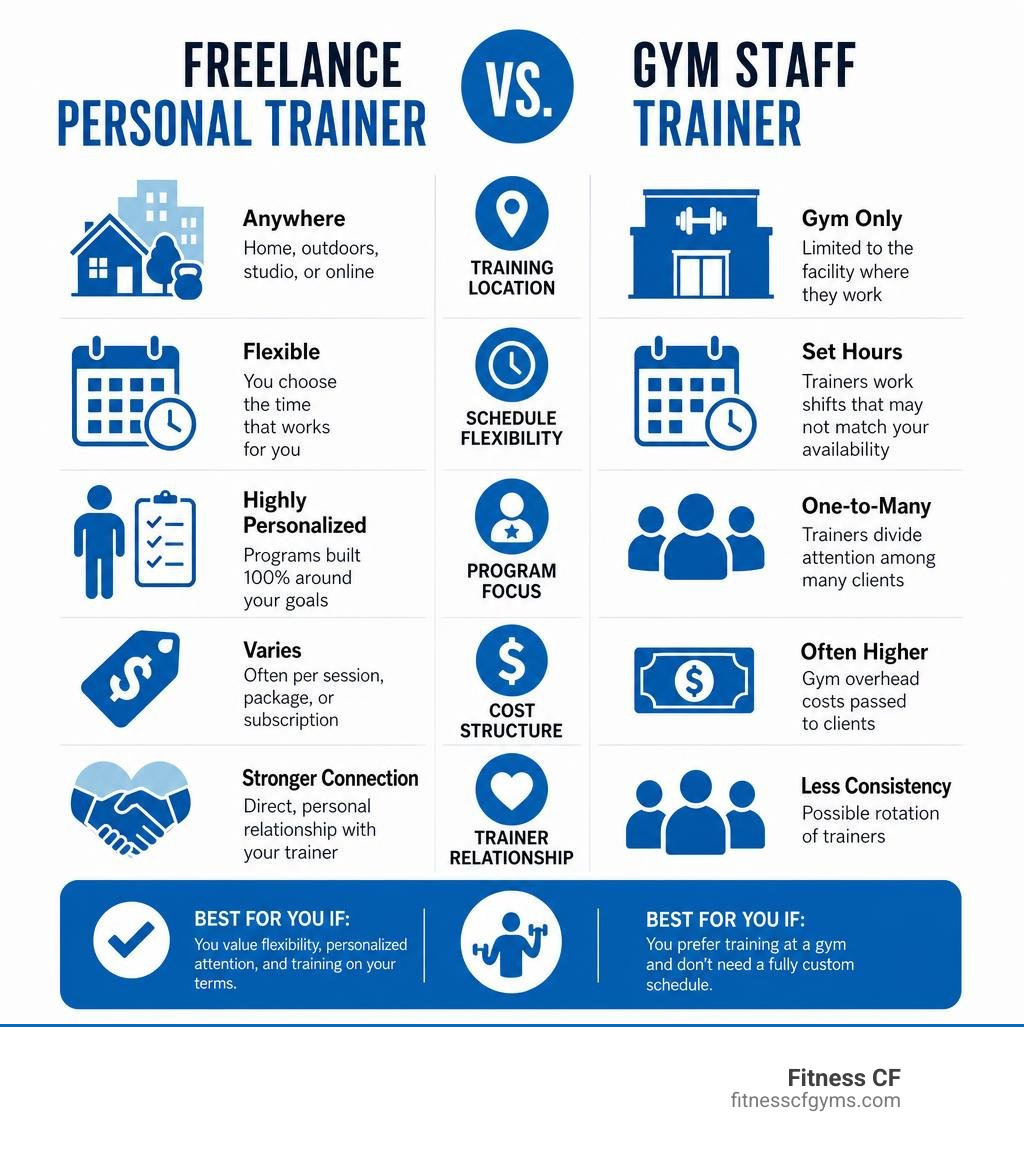
Freelance Personal Trainer vs. Gym Staff: Key Differences
When deciding how to invest your hard-earned money and time, it’s essential to look at how freelance trainers stack up against traditional, gym-employed personal training staff. Both options have distinct advantages, but they serve very different styles of commitment.
Here is a detailed breakdown of how they compare across key areas:
| Feature | Freelance Personal Trainer | Gym-Employed Personal Trainer |
|---|---|---|
| Primary Location | In-home, public parks, private studios, or online | Inside a specific commercial gym facility |
| Cost Structure | Varies widely; paid directly to the trainer (no middleman) | Standardized packages purchased through the gym |
| Accountability | High, direct communication via text, email, or specialized apps | High during sessions, but bounded by gym operating hours |
| Equipment Access | Dependent on location; often uses portable gear or home gym setups | Full access to premium commercial machines, free weights, and turf |
| Scheduling Flexibility | Highly flexible; agreed upon directly between you and the coach | Subject to gym shift hours and facility availability |
| Holistic Focus | Often includes lifestyle, habit, and customized nutrition coaching | Frequently focused primarily on the physical workout session |
While an independent trainer offers unmatched geographic freedom, gym-based staff trainers have immediate access to top-tier, heavy-duty commercial equipment. For a complete look at how in-club coaching operates, check out our Gym Personal Trainers Complete Guide.
The Benefits of Working with an Independent Fitness Coach

Choosing to work with an independent fitness coach can be a game-changer for your physical and mental well-being. Because these professionals run their own businesses, their survival depends on your success and satisfaction. This dynamic translates into several key benefits for you:
1. Highly Tailored Strength Training and Cardio
A freelance coach has the freedom to build a program centered entirely around your biomechanics and personal goals. They don’t use cookie-cutter templates.
- Benefits of Strength Training: Your coach can implement progressive overload safely, helping you build lean muscle mass, increase bone density, and boost your metabolic rate. This personalized attention ensures your form is perfect, preventing injury.
- Benefits of Cardio: Rather than just telling you to run on a treadmill, an independent trainer can design dynamic cardiovascular routines that improve your aerobic capacity, support heart health, and build physical endurance in ways you actually enjoy.
For general public-health guidance, the CDC recommends that adults combine regular aerobic activity with muscle-strengthening activities to support long-term health and overall fitness.
To dive deeper into how these elements transform your body, read about the 13 Incredible Benefits of a Personal Trainer.
2. Holistic Nutrition and Lifestyle Integration
Many freelance coaches hold dual certifications in fitness and nutrition. Because they aren’t rushed to get to the next gym member on a packed shift, they can spend time analyzing your daily habits. They can help you structure a customized nutrition plan that fuels your workouts, supports recovery, and fits your family’s cooking style. This comprehensive approach is central to The Benefits of Personal Training: Tailoring Your Fitness Journey.
3. Diverse and Inspiring Training Environments
If you find traditional commercial gym environments intimidating or monotonous, a freelance trainer solves this problem. You can train in the comfort of your backyard, a quiet local park, or a private rental studio. For instance, some trainers bring the entire gym to you, utilizing portable resistance bands, kettlebells, and suspension trainers.
This is highly effective for people with busy schedules or physical limitations. Working in these personalized environments is incredibly effective for Achieving Fitness Goals with Personal Training.
How to Choose the Right Trainer for Your Fitness Journey
Finding the perfect coach is a highly personal process. The most brilliant programmer in the world won’t help you if their coaching style clashes with your personality or if their scheduling doesn’t align with your chaotic work week.
When you begin your search, keep these three pillars in mind:
- Coaching Style: Do you thrive under high-energy, “drill-sergeant” motivation, or do you prefer a calm, educational, and supportive teaching style?
- Compatibility: You will be spending hours with this person. Trust, mutual respect, and open communication are non-negotiable.
- Scheduling and Location: Ensure their availability matches your routine. If you live in St. Cloud or Mount Dora, hiring a trainer who primarily operates on the far side of Orlando might lead to skipped sessions due to traffic.
For a step-by-step breakdown of how to navigate this selection process, read our guide on How to Pick a Personal Trainer: Everything You Need to Know.
If you are still on the fence about what type of coaching structure you need, it can be helpful to review Personal Training: How Do I Know If It’s Right for Me? and learn What to Expect: A Guide to Understanding Exactly How Personal Training Works.
What to Look for in a Freelance Personal Trainer
Because the fitness industry is largely self-regulated, anyone can call themselves a “personal trainer” on social media. It is up to you to verify their credentials to protect your health and your wallet.
Here are the essential qualifications you should look for:
- Accredited Certifications: A qualified freelance personal trainer should hold a certification from a nationally recognized, accredited organization. Look for credentials such as:
- NASM (National Academy of Sports Medicine)
- ACE (American Council on Exercise)
- NCSF (National Council on Strength & Fitness)
- ISSA (International Sports Sciences Association)
- First Aid & CPR/AED: This is non-negotiable. A professional trainer must hold a valid, up-to-date CPR (Cardiopulmonary Resuscitation) and AED (Automated External Defibrillator) certification to ensure your safety in the event of an emergency.
- Specialization and Niche Experience: If you have specific goals — like prenatal/postpartum fitness, athletic performance, or corrective exercise after an injury — look for a coach with dedicated certifications in those areas. For women seeking highly specialized coaching environments, you might want to look into working with a specialized female coach. Learn more about this by reading Empower Your Workout with a Women’s Only Personal Trainer and exploring how to Stop Guessing and Start Pressing with Top Female Coaches.
- Professional Liability Insurance: A legitimate freelance business owner will always carry active liability insurance to protect both themselves and their clients during training sessions.
To make sure you don’t miss any red flags during your search, review the 6 Key Qualities to Look for When Hiring a Personal Trainer.
Questions to Ask a Freelance Personal Trainer Before Hiring
Before you sign a contract or send a payment, schedule an initial consultation. This is your opportunity to interview the trainer and ensure they are the right fit for your budget and lifestyle.
We highly recommend asking these targeted questions:
- What is your pricing structure? Do you offer package discounts, monthly subscriptions, or a pay-per-session rate?
- What is your cancellation policy? (Most professional freelancers require a 24-hour notice to avoid charging for a missed session).
- How do you handle scheduling and communication? Do you use a specific app for booking, or do we coordinate via text?
- Do you offer online, hybrid, or in-person sessions? If we do virtual training, what platforms do we use?
- What tools do you use to track my progress? Will we be tracking body composition, strength milestones, or nutritional habits?
- What are your credentials and areas of specialization? Can you provide proof of your active certifications and liability insurance?
For a comprehensive checklist of questions to bring to your consultation, check out our guide on 9 Questions to Ask Before Hiring a Personal Trainer.
Frequently Asked Questions about Independent Training
How do freelance personal trainers structure their pricing?
Freelance trainers have complete control over their business models, meaning their pricing structures can vary. The most common setups include:
- Pay-Per-Session: You pay a flat rate for each individual session. This is highly flexible but usually the most expensive option per hour.
- Session Packages: You purchase a block of sessions upfront (e.g., 10, 20, or 30 sessions) at a discounted rate. This encourages commitment and helps you stay on track over several weeks.
- Monthly Subscriptions: A flat monthly fee that covers a set number of in-person or virtual sessions, along with continuous text support, habit tracking, and customized nutrition guidance. This is excellent for long-term budget planning.
Can a freelance trainer help with both strength training and cardio?
Absolutely! In fact, the best independent coaches design balanced, holistic programs that combine both modalities to maximize your physical endurance and overall fitness.
Your trainer will use progressive overload during strength sessions to build functional lean muscle, protect your joints, and increase metabolic health. They will then pair this with tailored cardiovascular work to enhance your heart health, improve circulation, and build your aerobic capacity. This dual approach ensures you don’t just look fit — you feel strong, energized, and capable in your everyday life.
What tools do independent coaches use to track progress?
To deliver high-quality, professional service, modern freelance trainers utilize a variety of digital tools and communication platforms:
- Client Management Apps: Many trainers use specialized software like PT Distinction or Trainerize to deliver workout plans, track weight lifting milestones, upload exercise demonstration videos, and monitor nutritional habits.
- Video Communication: For remote coaching and virtual check-ins, independent trainers rely on high-quality video platforms like Zoom, Skype, or FaceTime to monitor your form in real-time and provide instant feedback.
Conclusion
Choosing between a freelance personal trainer and a gym-employed staff trainer ultimately comes down to your personal budget, lifestyle, and where you feel most comfortable working out. If you crave ultimate geographic flexibility, highly personalized lifestyle coaching, and direct, unmediated access to your coach, an independent trainer is an incredible investment in your long-term wellness.
On the other hand, if you love the energy of a premium fitness facility, want immediate access to cutting-edge commercial strength and cardio equipment, and prefer the security of a vetted, in-house coaching team, working with gym staff personal trainers is an exceptional pathway.
At Fitness CF, we believe that the best workout program is the one you actually stick to. We are dedicated to supporting your healthy lifestyle, whether you choose to train independently or with our highly qualified, certified in-house personal training teams.
If you live in Central Florida, we invite you to visit one of our local clubs to experience our community firsthand. You can explore our regional guides to find the perfect setup near you:
- Read our comprehensive Gym Personal Trainers Complete Guide to see how our in-house coaching programs operate.
- If you are in the metro area, check out Get Personalized: Top Personal Training Studios in Orlando.
- If you are located in Lake County, explore our Clermont Personal Trainer Guide.
- If you are in Osceola County, take a look at our St. Cloud Personal Trainer Guide.
No matter which path you choose, consistency, progressive effort, and a supportive environment are the true keys to achieving your dream body and optimal health. Let’s take that first step together!