The Science of Light Resistance: Why 5 lb Dumbbells Work
Lifting heavy iron isn’t the only route to upper-body results. Light resistance training with 5-pound dumbbells triggers real structural adaptations in your muscles when applied with the right variables. To understand why a 5 lb weights workout can leave your arms shaking, it helps to examine the underlying exercise physiology.
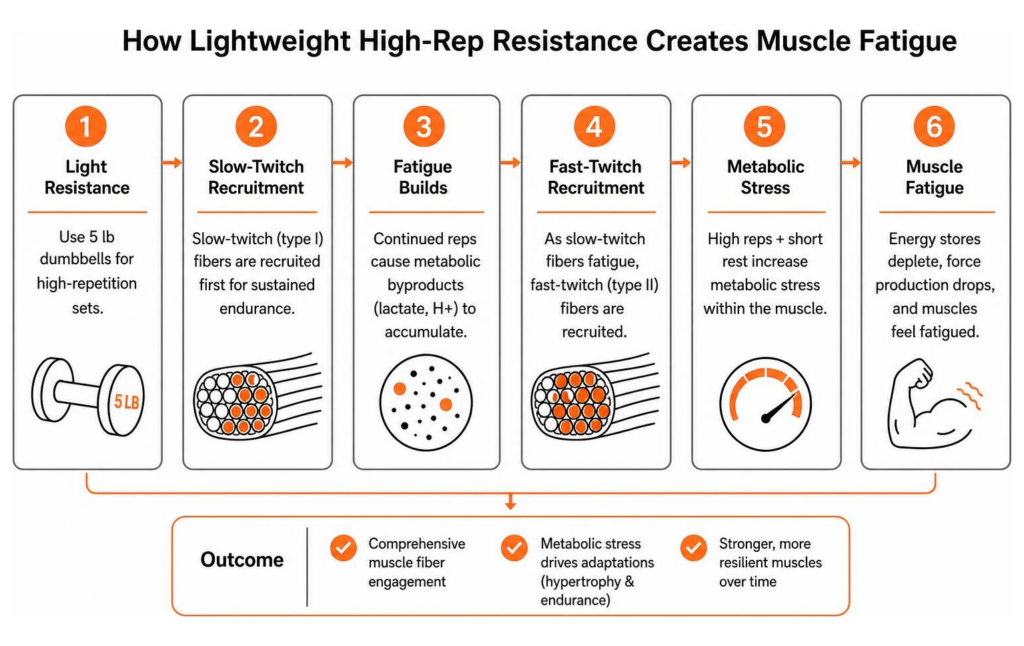
Muscle fibers fall into two main categories: type I (slow-twitch) and type II (fast-twitch). Slow-twitch fibers feature high resistance to fatigue and are rich in mitochondria, making them ideal for sustained endurance activities. When you perform high-repetition sets using a 5-pound dumbbell, you recruit these slow-twitch fibers over an extended duration. As these fibers exhaust, your body recruits fast-twitch muscle fibers to keep moving, ensuring comprehensive muscle engagement.
Muscle growth, or hypertrophy, depends on three key drivers: mechanical tension, muscle damage, and metabolic stress. While heavy lifting relies heavily on mechanical tension, lightweight training relies on metabolic stress. By performing high repetitions with short rest breaks, you create an accumulation of metabolic byproducts (like hydrogen ions and lactate) inside the muscle tissue. This creates a physiological environment that stimulates localized muscle growth and endurance.
Light resistance is also exceptional for activating smaller stabilizer muscles. Major compound lifts can cause larger prime movers (like your pectorals or lats) to overpower smaller rotators, joint stabilizers, and posture-supporting muscles. Using 5 lb weights allows you to isolate and strengthen shoulder rotators and forearm flexors without overwhelming the joints. Research suggests that forearm exercises like wrist curls can help improve strength and motor control, which could help improve function and prevent common wrist injuries.
If you are looking to take your routine further, you can check out this article on building muscle with 5 lb weights or discover tactics for strong and toned arms.
Who Benefits Most From a 5 lb Weights Workout?
A 5 lb weights workout offers broad utility across various fitness backgrounds:
- Fitness Beginners: New lifters can master foundational movement patterns, build initial neuromuscular coordination, and improve joint resilience without high physical risk.
- Injury Rehabilitation and Joint Health: Individuals recovering from shoulder, elbow, or wrist strain can rebuild localized strength safely. Lower resistance reduces strain and tear risks on delicate connective tissues.
- Active Recovery: On days between intense training sessions, light dumbbell circuits increase local blood flow, delivering nutrients to tissues without causing excessive central nervous system fatigue.
- Home Fitness Enthusiasts: Lightweight dumbbells take up minimal space and provide a quick option for home routines, barre workouts, or Pilates-inspired sessions.
Key Maximizing Techniques: Tempo, Tension, and Volume
To make a 5-pound dumbbell feel significantly heavier, you must adjust how you move the weight. Manipulating tempo and volume changes muscle loading dramatically.
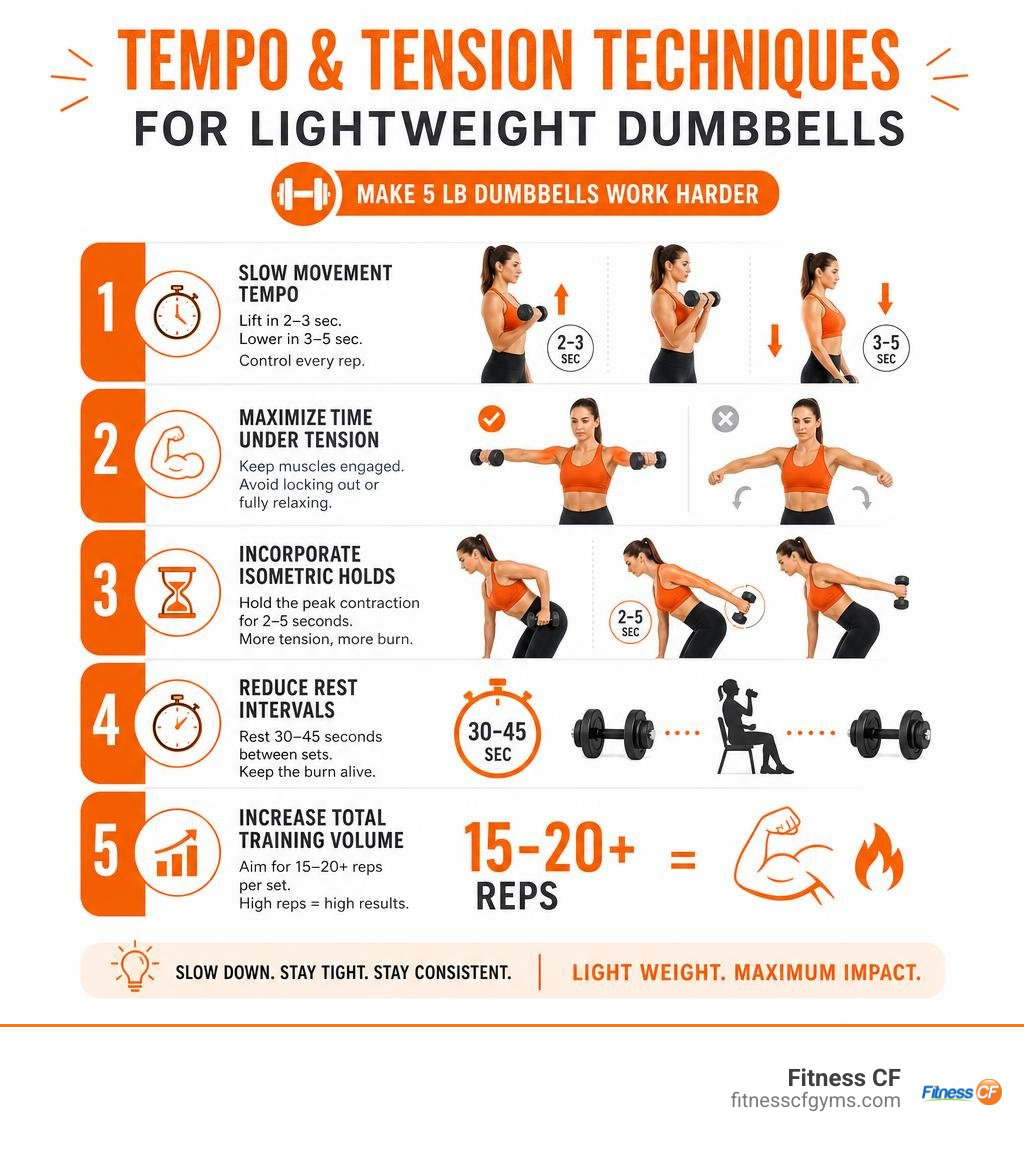
- Slow Movement Tempo: Avoid relying on momentum. Take 2 to 3 seconds to lift the weight (concentric phase) and 3 to 5 seconds to lower it (eccentric phase). Extending the lowering phase increases mechanical load across muscle fibers.
- Maximize Time Under Tension (TUT): Keep constant tension on the targeted muscle. Avoid locking out your elbows at the top of a bicep curl or relaxing at the bottom of a lateral raise.
- Incorporate Isometric Holds: Pause for 2 to 5 seconds at the peak contraction point of a movement (such as the top of a tricep kickback). This intensifies fatigue without needing extra weight.
- Reduce Rest Intervals: Shorten rest times between sets to 30–45 seconds. Shorter rest periods limit metabolic clearance, increasing metabolic stress and boosting stamina.
- Increase Total Training Volume: Aim for high-repetition sets ranging from 15 to 20+ repetitions. High rep volume forces target muscles close to momentary muscular fatigue.
The Ultimate 5 lb Weights Workout for Toned Arms
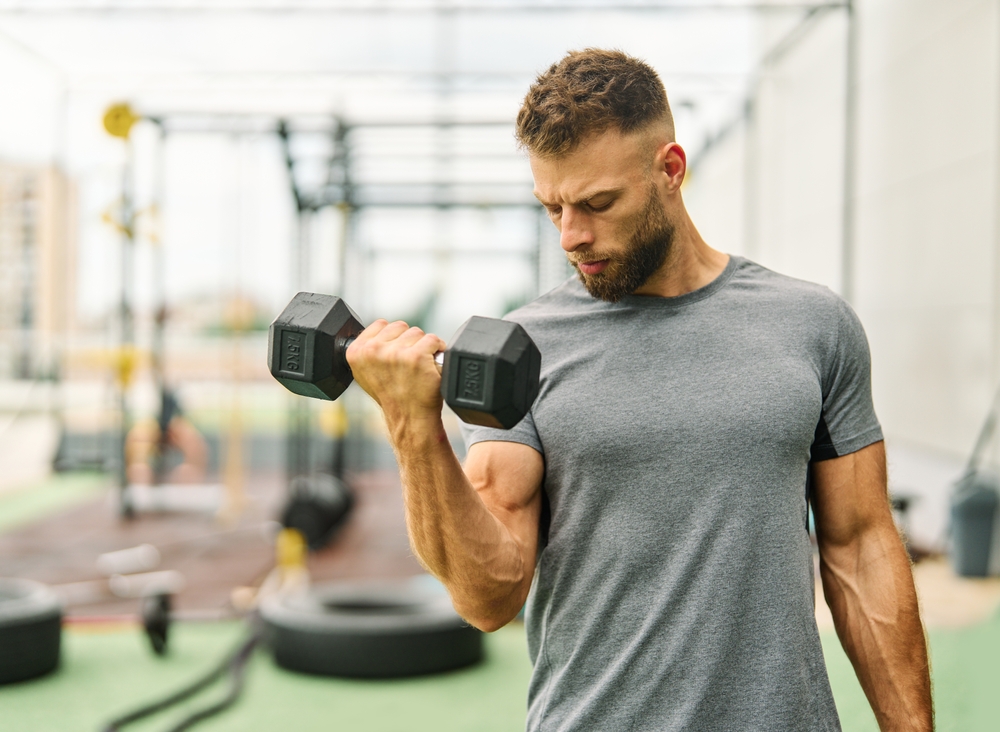
This target upper-body routine isolates your biceps, triceps, shoulders, and forearms. If you want to explore additional arm exercises, read our ultimate guide to arm exercises.
Top Arm and Upper-Body Exercises
Concentration Curls: Sit on a bench or chair, resting the back of your upper arm against your inner thigh. Keeping your torso still, curl the weight up toward your shoulder, squeeze your bicep at the top, and slowly lower over 3 seconds. A 2014 study by the American Council on Exercise found that the concentration curl is the most effective exercise for isolating and strengthening the biceps.
Bicep Curls & Hammer Curls: Stand upright with your shoulders back and core engaged. For standard curls, start with palms facing forward and curl upward. For hammer curls, keep your palms facing each other throughout the rep to target the brachialis and forearm muscles. Avoid swinging your hips for momentum.
Triceps Kickbacks: Hinge forward at the hips with a flat back. Bring your upper arm parallel to the floor, keep your elbow fixed in place, and extend your arm straight back until fully straightened. Pause for a second to feel the tricep contract before returning to the start position.
Lateral Raises: Stand tall holding a dumbbell in each hand at your sides. Maintain a slight bend in your elbows and lift your arms out to the sides until shoulder height. Lower them slowly under control. This exercise isolates the lateral head of the deltoid to widen shoulder shape.
Military Presses (Dumbbell Overhead Press): Hold dumbbells at shoulder height with your palms facing forward. Press overhead until your arms are fully extended without arching your lower back. Lower back to ear level over a 3-second count.
Wrist Curls (Palms-Up & Palms-Down): Rest your forearms on your thighs while seated, letting your wrists hang past your knees. Curl your wrists upward with palms facing up to target forearm flexors, then switch to palms-down to hit forearm extensors.
Structuring Your 5 lb Weights Workout Routine
To build muscle endurance and tone, structure your weekly schedule consistently. A 2015 meta-analysis by Schoenfeld et al. in the Journal of Strength and Conditioning Research found that training each muscle group at least twice per week produced superior hypertrophy compared to once per week.
Here is an effective weekly training breakdown:
| Variable | Recommended Parameter |
|---|---|
| Weekly Frequency | 2 to 3 non-consecutive days per week |
| Sets Per Exercise | 3 to 4 working sets |
| Repetition Range | 15 to 20+ reps (or until 1-2 reps short of failure) |
| Tempo | 2 seconds up, 1-second pause, 3 seconds down |
| Rest Between Sets | 30 to 45 seconds |
Research published in the Journal of Strength and Conditioning Research confirms that multiple-set protocols produce significantly greater strength gains than single-set training at comparable intensities. Combine exercises into supersets (e.g., pairing a bicep curl with a tricep kickback back-to-back) to maintain elevated heart rates and maximize time efficiency. If you are interested in broader strength concepts, check out this study on training session structures.
Limitations and How to Progress Beyond 5 lb Dumbbells
While a 5 lb weights workout is an effective entry point for arm conditioning, light resistance has physiological boundaries.
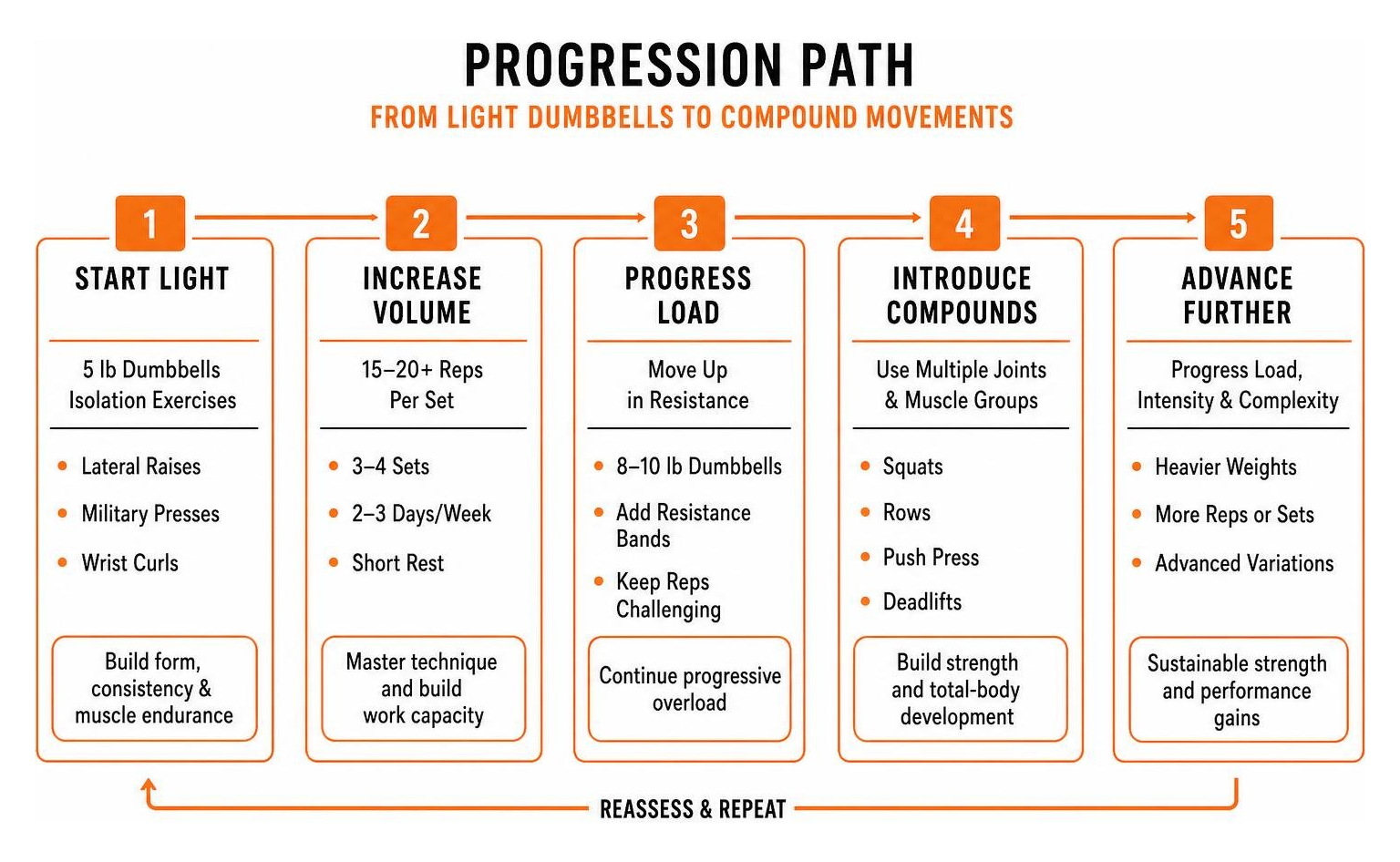
Understanding progressive overload is key to long-term strength. Your muscular system adapts to stress over time. Once your arms adapt to performing 20 repetitions with 5 pounds easily, muscle stimulus plateaus.
- Large Muscle Group Limitations: Glutes, hamstrings, quads, and pectorals require higher mechanical loads to stimulate deep muscle hypertrophy. 5 lb dumbbells are generally too light to fully challenge large lower-body muscle groups.
- Hypertrophy Limits for Advanced Lifters: Lifters with several years of training experience will find 5 pounds insufficient to stimulate fast-twitch motor units for maximum strength gains.
- Transitioning to Heavier Loads: When 20 repetitions feel easy, move up to 8-pound or 10-pound dumbbells. Alternatively, introduce exercise bands or compound barbell movements.
If you are curious about expanding your home resistance training options, you can learn how to burn fat with 5 lb dumbbells or explore our guides on using exercise bands for arms and performing 8 arm exercises for strength and definition.
Frequently Asked Questions About Light Weight Arm Training
Can you effectively build muscle using only 5 lb weights?
Yes, you can build muscle definition and endurance with 5 lb weights by taking your sets close to muscular failure using higher repetition ranges (15-20+ reps), controlled movement tempos, and short rest intervals. While heavier weights are faster for maximum size, light weights create enough metabolic stress to build tone and lean muscle tissue.
How often should you do a 5 lb dumbbell workout to see results?
Aim to perform a light weight dumbbell routine 2 to 3 times per week on non-consecutive days. Leaving 48 hours of recovery between targeted sessions allows muscle tissue to repair and adapt, leading to better definition and movement control over time.
Are 5 lb weights better for toning or building bulk?
Light weights are ideal for building muscular endurance and defined tone without bulk. Bulking requires heavy mechanical loads and high caloric intake, whereas higher reps with 5 lb dumbbells develop lean muscle definition and improve fatigue resistance.
Conclusion
Training with 5-pound dumbbells proves that you do not need heavy equipment to build defined upper-body strength. By emphasizing slower tempos, high volume, and proper technique, a 5 lb weights workout builds endurance, strengthens stabilizer muscles, and provides an accessible option for home routines.
Beyond visible tone, regular resistance training offers notable lifestyle benefits. For instance, 2022 research found that those who regularly completed resistance training slept better and longer than those who solely focused on cardio workouts. Combine your light-weight sessions with balanced recovery to establish a healthy workout routine.
Ready to expand your fitness options? Explore full body dumbbell workout routines to keep your training fresh, or check out our detailed guides on home arm workouts for beginners and building full-body routines that work.