Why Unilateral Pressing Outperforms Bilateral Training for Stability
When we train both arms at the same time using a barbell or pair of dumbbells (bilateral training), our body naturally finds the path of least resistance. If your dominant side is slightly stronger, it will quietly take on a bit more of the workload. Unilateral training—pressing with just one arm—eliminates that safety net.
Training one arm at a time demands significant neuromuscular drive. Your central nervous system has to work harder to coordinate stability across your entire chain while generating force on just one side. When you execute a single-arm press, your body isn’t just focusing on pushing the weight up; it is actively fighting to maintain structural equilibrium. If you want to dive deeper into upper-body routines, check out our Arm Exercises Ultimate Guide.
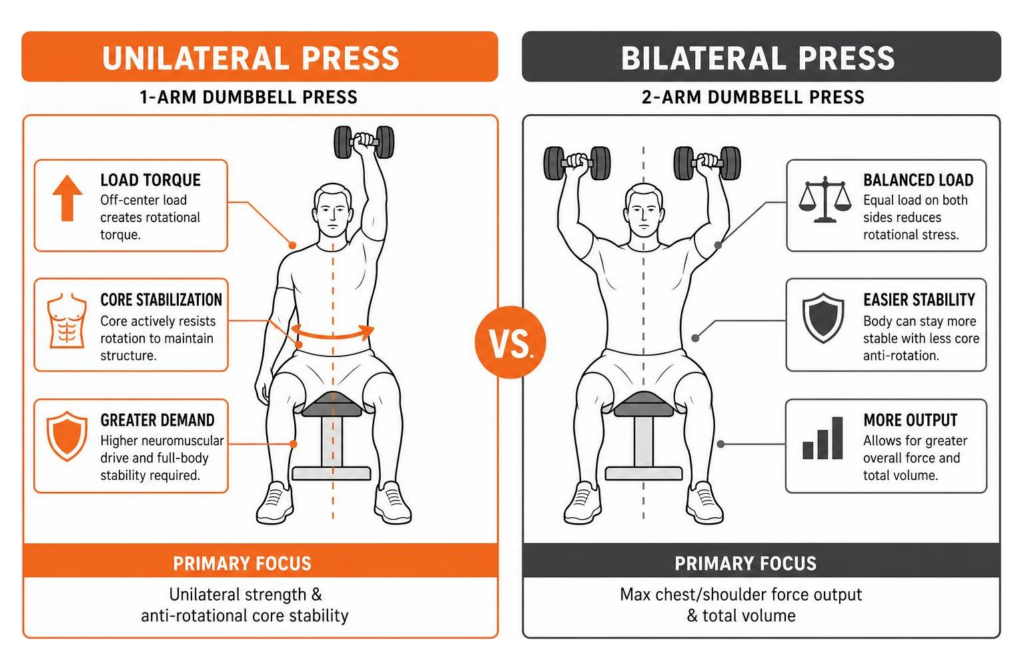
Here is a quick look at how the unilateral press compares to a traditional bilateral dumbbell press:
| Feature | Single-Arm Dumbbell Press | Bilateral Dumbbell Press |
|---|---|---|
| Primary Focus | Unilateral strength & anti-rotational core stability | Max chest/shoulder force output & total volume |
| Core Activation | Extremely high (obliques & deep abdominal wall brace against rotation) | Moderate (symmetrical bracing against extension) |
| Imbalance Correction | Directly isolates left and right side discrepancies | May allow dominant side to mask weaknesses |
| Relative Load | 40%–60% of total combined bilateral weight | 100% of standard training load |
| Joint Mobility | Allows full free movement of scapula and ribcage | Fixed track can limit natural scapular rhythm |
Addressing Muscular Imbalances and Asymmetry
It is completely normal to have a stronger or more dominant arm. However, when left-right strength discrepancies become too severe, they alter your movement patterns and lead to joint compensation.
Unilateral pressing forces each limb to pull its own weight. By isolating one arm, you remove all opportunity for compensation. To build a balanced upper body, we recommend starting your sets with your weaker arm. Whatever reps your weaker side completes with pristine form becomes the strict limit for your stronger side. Over time, this method levels the playing field, as explained in our guide on How to Build Arm Muscle.
Core Activation and Anti-Rotation Dynamics
The moment you lift a dumbbell on just one side of your body, gravity creates offset torque. That load wants to rotate your spine, twist your torso, and tip you right off the bench or floor.
To stay flat and stable, your core has to brace aggressively. Your obliques, deep abdominal wall, and glutes fire asynchronously to create anti-rotation strength. Instead of doing hundreds of traditional crunches, performing offset pressing exercises forces your entire midline to function as a rigid brace under dynamic loading.
Muscles Worked and Core Anti-Rotation Mechanics
While the 1 arm dumbbell press looks like a basic chest or shoulder movement, it is truly a full-body stabilization event.
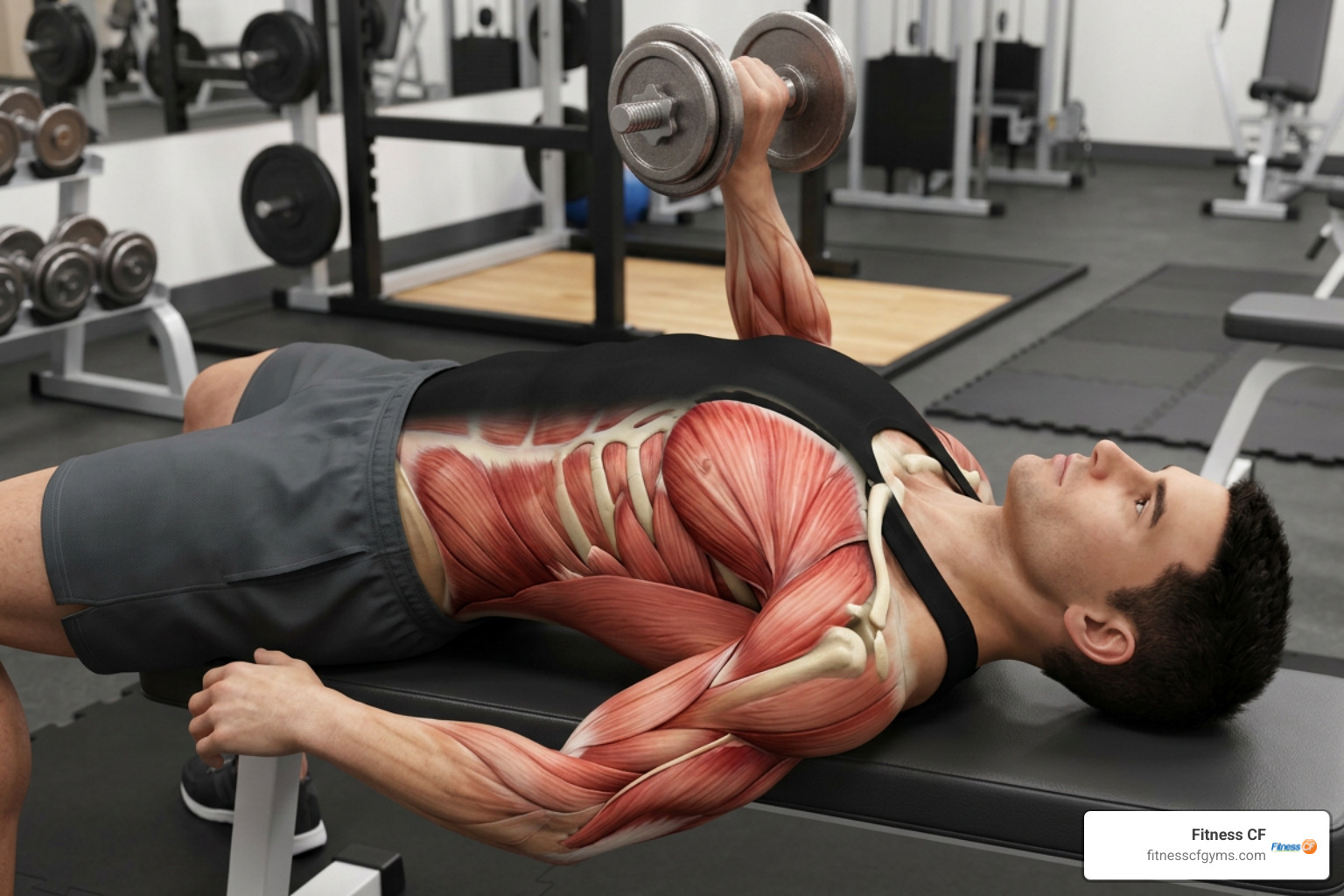
Here is a breakdown of the primary upper body movers and stabilizer muscle contributions:
- Pectoralis Major (~40% in chest press variations): Drives horizontal adduction, bringing the upper arm across the body.
- Anterior Deltoid (~40% in shoulder press variations): Drives shoulder flexion and overhead extension.
- Triceps Brachii (~20%): Extends the elbow joint to complete the lockout at the top of the movement.
- Obliques and Core Stabilizers (~25%): Resists rotational torque, maintaining pelvic and spinal integrity.
- Trapezius & Lateral Deltoid (~15%): Stabilizes the scapula and upper back during the pressing path.
- Serratus Anterior: Anchors the shoulder blade flat against the rib cage to allow smooth scapular rotation.
Primary Upper Body Movers
During horizontal pressing on a bench or floor, your chest adducts the arm while the triceps extend the elbow. During vertical pressing (overhead), the anterior and lateral deltoids take over as the primary drivers. Because you are holding a single weight, your scapula on the working side can move far more naturally than it does when pinned during heavy barbell training.
Deep Core and Oblique Activation
To keep your torso level during asymmetrical loading, the transverse abdominis acts like a tight corset around your waist. Meanwhile, the internal and external obliques on the non-working side contract forcefully to pull your rib cage down and resist the rotational pull of the dumbbell.
Step-by-Step Guide: How to Perform the 1 Arm Dumbbell Press
Mastering proper form ensures that you build strength while keeping your joints safe. Whether you are lying on a flat bench or executing a standing press, follow these foundational steps.
For additional training protocols, explore The Ultimate Guide to Dumbbell Workouts.

Setup, Grip, and Stance Basics
- Establish a Tripod Stance: If lying on a bench, plant both feet firmly on the floor wider than shoulder-width apart. Squeeze your glutes into the pad. If standing, set your feet hip-to-shoulder-width apart with a slight bend in your knees.
- Stack the Wrist and Elbow: Grip the handle firmly near its center. Keep your wrist straight and stacked directly over your elbow throughout the lift.
- Set the Elbow Angle: Position your working elbow at roughly a 30 to 45-degree angle relative to your torso. Avoid flaring your elbow straight out at a 90-degree angle, which places harsh stress on the shoulder capsule.
- Depress the Shoulder: Pull your shoulder blade back and down into your back pocket before initiating the movement.
Core Stabilization Errors in the 1 Arm Dumbbell Press
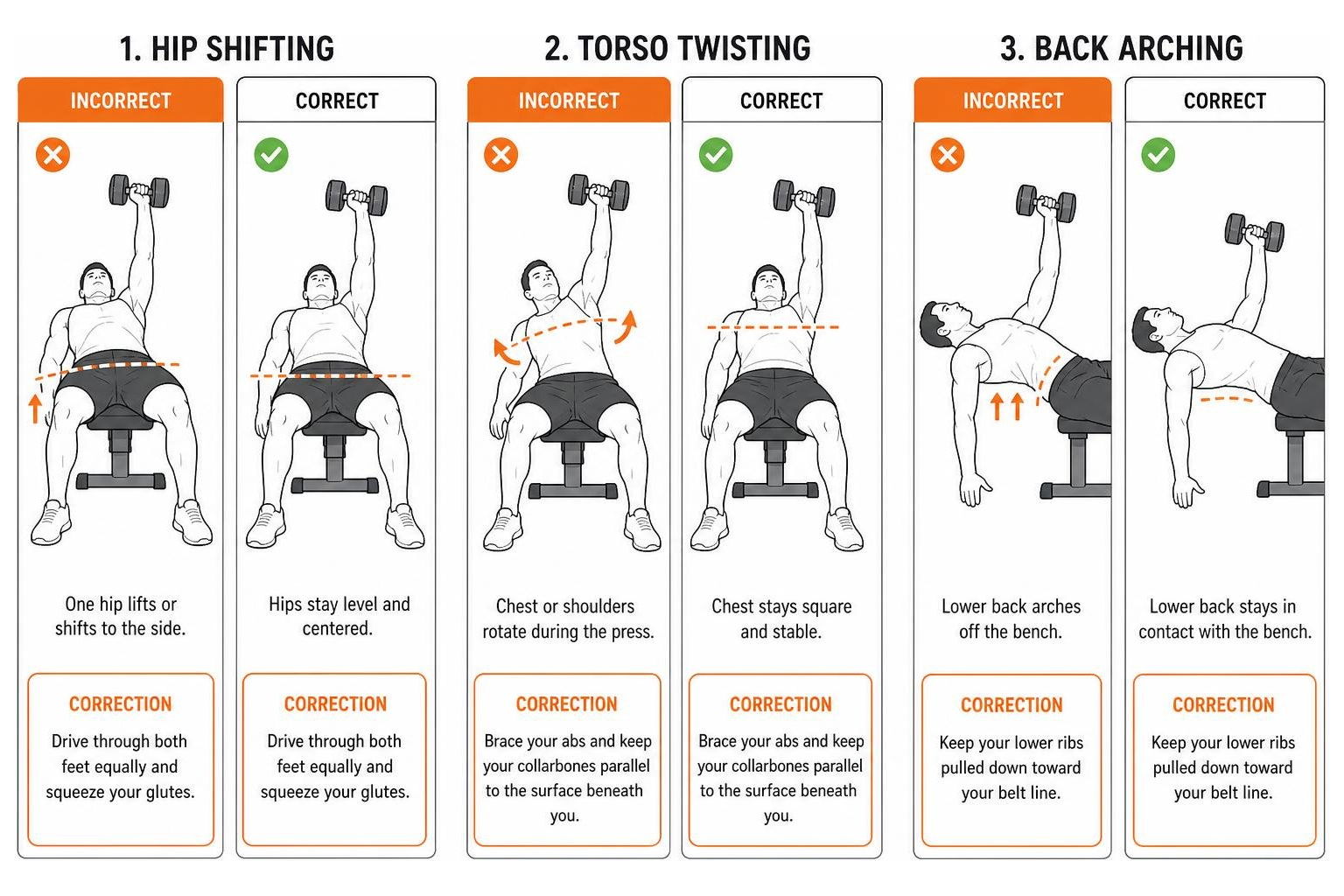
When the load gets heavy, your body will try to cheat stability. Watch out for these four common mistakes:
- Torso Twisting: Rotating your chest or shoulders toward or away from the weight during the press. Correction: Brace your abs as if preparing for a punch, keeping your collarbones parallel to the surface beneath you.
- Hip Shifting: Lifting one side of your glutes off the bench or sliding your hips sideways while standing. Correction: Drive through both feet equally and squeeze your glutes hard.
- Lower Back Arching: Over-extending your lumbar spine to hoist the weight overhead or off your chest. Correction: Keep your lower ribs pulled down toward your belt line throughout the press.
- Momentum Swinging: Bouncing out of the bottom position or using leg drive during strict presses. Correction: Lower the dumbbell under control with a 2-second eccentric count and pause briefly at the bottom.
Effective Variations and Weight Selection Guidelines
Different variations of the single-arm press allow you to target specific performance goals, protect sensitive joints, or train around existing physical limitations.
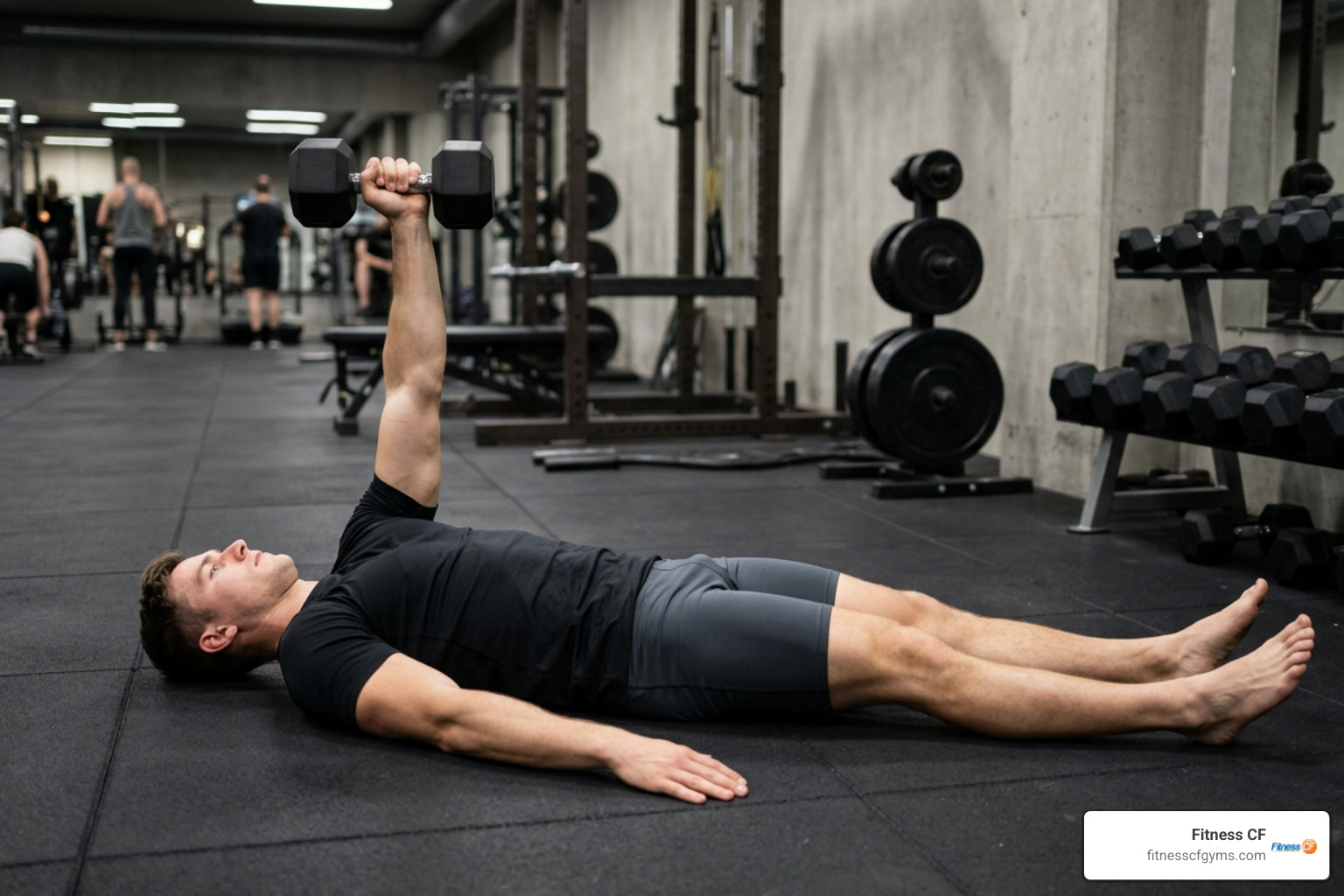
Here are the top variations to include in your training routine:
- The Single-Arm Floor Press: Lying flat on the floor limits your elbow’s depth. This reduced range of motion protects the front of the shoulder capsule, making it ideal for anyone managing shoulder impingement. Performing this with extended legs removes foot drive entirely, turning the movement into an intense anti-rotation challenge.
- The One-Arm Dumbbell Z-Press: Sitting flat on the floor with legs outstretched requires exceptional mobility and posture. Without a bench backrest or foot support, your trunk stabilizers must work continuously to keep you upright as you press overhead.
- The Incline Single-Arm Press: Adjusting a bench to a 30-degree incline shifts focus toward the upper pecs and anterior deltoids while maintaining high core engagement.
Check out our list of 8 Arm Exercises for Strength and Definition for more exercise options.
Chest vs. Overhead: Selecting Your 1 Arm Dumbbell Press Variation
Choosing between a horizontal chest press and a vertical overhead press depends on your main goals:
- Single-Arm Chest Press: Focuses on horizontal adduction. Excellent for chest hypertrophy, shoulder stability, and heavy anti-rotation abdominal strength.
- Single-Arm Overhead Press: Focuses on vertical pushing. Excellent for building shoulder strength, triceps power, upper trap stability, and lateral core anti-flexion strength.
If you are short on time, rotating these lifts within your program ensures total upper-body coverage, as noted in our guide to the 5 Best Dumbbell Exercises.
Determining Optimal Weight and Programming Schemes
Because a single-arm press forces your core to stabilize asymmetric torque, you cannot simply divide your regular two-dumbbell weight in half.
A good rule of thumb is to start with 40% to 60% of the weight you normally use for bilateral pressing. For example, if you usually press a pair of 50-pound dumbbells for chest press reps, start your single-arm presses with a 25 to 30-pound dumbbell.
Match your sets, reps, and rest intervals to your training goal:
- For Strength & Power: 4 to 6 sets × 3 to 6 reps per side (Rest 2–3 minutes between sets).
- For Hypertrophy (Muscle Building): 3 to 5 sets × 8 to 12 reps per side (Rest 60–90 seconds between sets).
- For Core Stability & Endurance: 2 to 4 sets × 12 to 15 reps per side (Rest 45–60 seconds between sets).
Frequently Asked Questions about Single-Arm Pressing
Why is single-arm pressing significantly more challenging than bilateral pressing?
Single-arm pressing creates asymmetrical loading, generating a high amount of rotational torque across your spine. When you use two dumbbells, the opposing forces cancel each other out, allowing your body to stay balanced with minimal effort. With a single dumbbell, your core muscles have to actively pull against the load to keep you upright and aligned.
What weight should I use for a 1 arm dumbbell press compared to regular presses?
We recommend starting at roughly 40% to 60% of your total bilateral dumbbell weight. For floor presses or strict overhead variations, starting around 50% to 60% allows your stabilizer muscles time to adapt without breaking form. As your anti-rotational core strength improves, you can gradually increase the load.
How does the single-arm floor press protect the shoulder joint?
The floor acts as a physical barrier that prevents your elbow from dropping below your torso. This floor-stop mechanic restricts hyper-extension at the bottom of the movement, which significantly reduces anterior shear forces on the shoulder joint. It allows you to build chest, shoulder, and triceps strength with minimal risk of joint pinching or shoulder impingement.
Conclusion
Mastering the 1 arm dumbbell press is one of the most effective ways to build functional strength, eliminate muscular imbalances, and bulletproof your core against rotation. By stepping away from momentum and focusing on deliberate, stable control, you give your body the tools to perform better across every lift.
Start light, focus on locking down your form, and give your stabilizing muscles time to catch up. For a complete workout routine you can follow anywhere, check out our guide on 10 Simple Dumbbell Exercises for a Full Body Workout.