Why Back DB Exercises Belong in Every Strength Routine
Back DB exercises are one of the most effective ways to build a stronger, healthier body — whether you’re training at home or in a full gym.
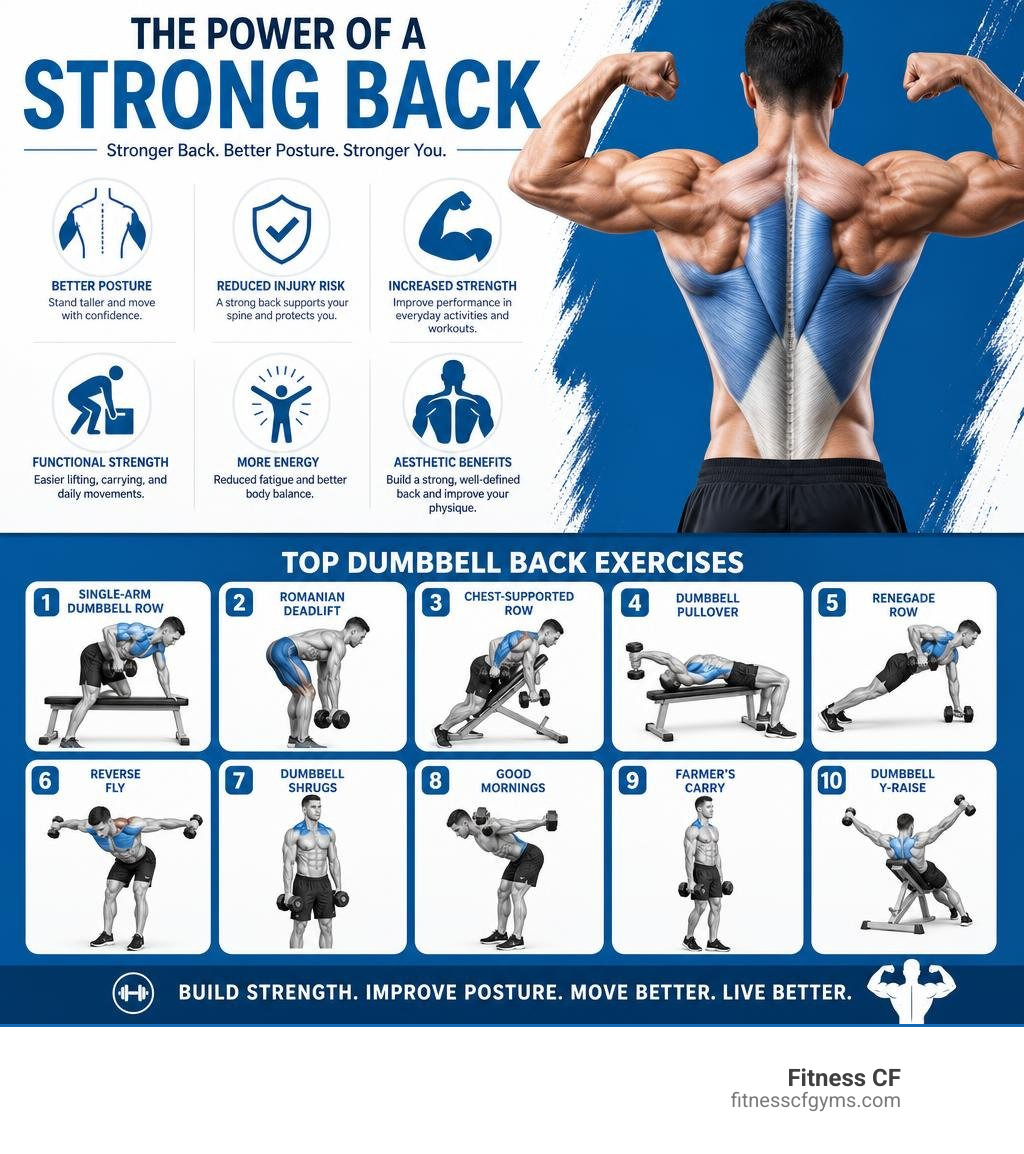
Here’s a quick look at the best dumbbell back exercises to get you started:
| Exercise | Primary Muscle | Best For |
|---|---|---|
| Single-Arm Dumbbell Row | Lats | Unilateral strength |
| Romanian Deadlift | Erector Spinae, Hamstrings | Hip hinge, lower back |
| Chest-Supported Row | Rhomboids, Mid-Traps | Pure back isolation |
| Dumbbell Pullover | Lats | Stretch and width |
| Renegade Row | Full Back, Core | Stability and strength |
| Reverse Fly | Rear Delts | Posture correction |
| Dumbbell Shrugs | Trapezius | Upper back and neck support |
| Good Mornings | Lower Back | Posterior chain |
| Farmer’s Carry | Upper Traps, Core | Grip and stability |
| Dumbbell Y-Raise | Lower Traps | Shoulder health |
Your back is one of the largest muscle groups in your body — and one of the most neglected. Think about it: most people spend hours hunched over a desk, a steering wheel, or a phone screen. Over time, that posture takes a toll. According to the Bureau of Labor Statistics, more than a million workers injure their back every year — accounting for one in five workplace injuries.
The good news? A consistent dumbbell back routine can fight back against all of that. It improves your posture, reduces your injury risk, and builds the kind of functional strength that makes everyday life easier — from picking up your kids to carrying groceries.
I’m Pleasant Lewis, owner and operator of Fitness CF, with over 40 years in the fitness industry helping people build stronger, healthier bodies through smart training. My experience with back DB exercises has shown me that dumbbells are often the most practical and effective tool for building real, lasting back strength at any fitness level. In this guide, I’ll walk you through everything you need to know.
Back db exercises terms you need:
The Anatomy of a Strong Back: Muscles Targeted by Dumbbells
To get the most out of your back db exercises, it helps to understand what is actually going on behind you. The back is a complex network of muscles that work together to support your spine, pull things toward you, and keep you standing tall.
When we design a balanced routine, we target five primary muscle groups:
- Latissimus Dorsi (Lats): These are the wing-shaped muscles on the sides of your back. They are responsible for the coveted “V-taper” look. Their primary job is pulling your arms down and back.
- Trapezius (Traps): A large, kite-shaped muscle spanning your upper neck, shoulders, and mid-back. The upper traps shrug your shoulders, while the mid-and-lower traps pull your shoulder blades together.
- Rhomboids: Sitting right between your shoulder blades, these muscles retract your scapulae. Think of them as the posture anchors that pull your shoulders back when you slouch.
- Erector Spinae: These run vertically along your spine. They keep you upright and are highly active during hip-hinge movements.
- Rear Deltoids: While technically part of the shoulder, the rear delts work closely with the upper back to pull the arms backward and stabilize the shoulder joint.
By choosing exercises that hit these muscles from different angles, you ensure balanced development. For a deeper look at targeting specific muscle groups, check out The Ultimate Guide to Dumbbell Workouts for Sculpting Your Body Anywhere. If you are looking for medically backed insights on how back strengthening prevents spinal issues, you can read Harvard Health’s guide on back strengthening.
Why Back DB Exercises Are Superior to Barbells and Machines
Many lifters assume they need a heavy barbell or a massive cable machine to build a strong back. While those tools have their place, training with dumbbells offers unique advantages that barbells simply cannot match.

1. Unilateral Training and Symmetry
When you use a barbell, your stronger side will naturally compensate for your weaker side. This can lead to subtle muscle imbalances over time. Dumbbells force each side of your body to pull its own weight independently. This unilateral work is highly effective for identifying and correcting left-to-right strength discrepancies.
2. Greater Range of Motion
A barbell stops when it hits your chest or abdomen during a row. Dumbbells allow you to pull the weight past your torso, resulting in a deeper contraction at the top of the movement and a better stretch at the bottom. Research shows that training a muscle through its full range of motion under tension is a primary driver of muscle growth.
3. Increased Stabilizer Activation
Dumbbells are inherently unstable. To keep them moving along a clean path, your body must recruit up to 20% to 30% more stabilizer muscles than it would on a machine. This builds functional, real-world strength that translates directly into better joint safety and athletic performance.
For a deeper breakdown of how dumbbells compare to other training modalities, take a look at ATHLEAN-X’s analysis of dumbbell back movements.
The 10 Best Dumbbell Back Exercises for Strength and Size
Let’s explore the absolute best back db exercises to build size, strength, and structural integrity.
1. Single-Arm Dumbbell Row
The single-arm row is the king of unilateral back training. By supporting your body with one hand on a bench or your knee, you take the pressure off your lower back, allowing you to focus entirely on pulling with your lats.
- How to Do It: Place your left knee and left hand flat on a bench. Keep your right foot on the ground. Hold a dumbbell in your right hand with a neutral grip, letting it hang straight down. Pull the dumbbell up by driving your elbow toward your hip, squeezing your lat at the top. Lower with control.
- Form Cue: Pull from your elbow, not your hand. Imagine your hand is just a hook, and your elbow is doing all the work. Keep your hips and shoulders square to the ground to prevent rotation.
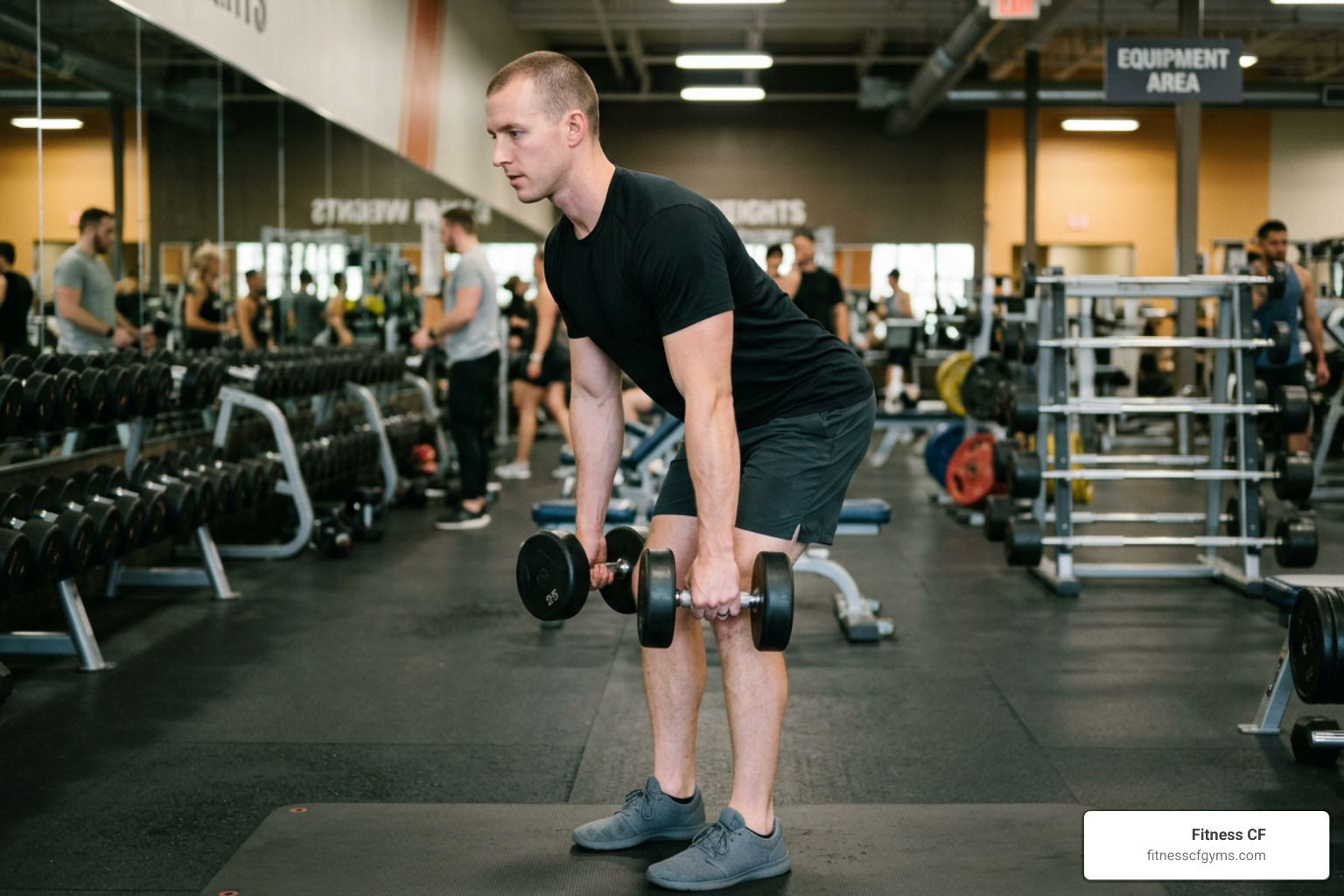
2. Dumbbell Romanian Deadlift (RDL)
The RDL is a premier posterior chain builder. Unlike a standard deadlift from the floor, the RDL emphasizes the hip hinge, heavily loading the erector spinae, glutes, and hamstrings.
- How to Do It: Stand tall with feet hip-width apart, holding dumbbells in front of your thighs. Keep a slight bend in your knees. Push your hips back as if trying to touch a wall behind you, lowering the weights along the front of your legs. Stop when you feel a deep stretch in your hamstrings, then drive through your heels to return to standing.
- Form Cue: Keep your back perfectly flat and the dumbbells close to your shins. Do not let your lower back round at the bottom of the movement.
3. Chest-Supported Dumbbell Row
If you struggle with lower back fatigue or tend to use too much momentum on bent-over rows, this is your solution. The incline bench completely eliminates momentum, forcing your upper back muscles to do 100% of the work.
- How to Do It: Set an incline bench to roughly 45 degrees. Lie chest-down on the bench, holding a dumbbell in each hand. Let your arms hang straight down. Row the dumbbells upward, flaring your elbows slightly out to 30–45 degrees to target the rhomboids and mid-traps. Squeeze your shoulder blades together at the top.
- Form Cue: Keep your chest firmly pressed against the pad throughout the entire set. If your chest peels off the bench, the weight is too heavy.
4. Dumbbell Pullover
The dumbbell pullover is one of the few single-joint exercises that can isolate the lats. It provides an incredible loaded stretch in the fully lengthened position, which is fantastic for building back width.
- How to Do It: Lie flat on your back on a bench, holding one dumbbell with both hands directly over your chest. Slowly lower the dumbbell back over your head in a slight arc, keeping a very soft bend in your elbows. Once you feel a deep stretch in your lats, pull the dumbbell back to the starting position.
- Form Cue: Keep your ribs pressed down and your core braced. Do not let your lower back arch off the bench as you lower the weight, as this shifts the focus to your chest and shoulders.
5. Renegade Row
The renegade row is a brutal combination of upper-body pulling and intense core stabilization. It forces your core to work statically to prevent your hips from rotating as you row.
- How to Do It: Start in a high plank position with your hands gripping hexagon dumbbells on the floor. Set your feet wider than shoulder-width apart for stability. Brace your core, then row one dumbbell up to your hip while balancing on the other hand and your feet. Lower it slowly and repeat on the other side.
- Form Cue: Imagine a glass of water sitting on your lower back. Do not let your hips tilt or sag as you lift the weight.
6. Dumbbell Reverse Fly
To counteract the “desk hunch,” you need to strengthen your rear delts and mid-back. The reverse fly is perfect for isolating these smaller, posture-correcting muscles.
- How to Do It: Stand with feet shoulder-width apart. Hinge at your hips until your torso is almost parallel to the floor, letting the dumbbells hang down with a slight bend in your elbows. Raise your arms out to the sides, leading with your elbows, until they are parallel to the floor. Squeeze your upper back, then lower slowly.
- Form Cue: Use light weights. This is an isolation movement, and using too much weight will cause your traps and lower back to take over.
7. Dumbbell Shrugs
Your traps are built to carry heavy loads. Dumbbell shrugs target the upper portion of the trapezius, helping to support your neck and improve shoulder stability.
- How to Do It: Stand tall with a heavy dumbbell in each hand at your sides. Keep your arms straight. Shrug your shoulders straight up toward your ears as high as possible. Hold for a brief second at the top, then lower under control.
- Form Cue: Do not roll your shoulders in circles. Move them straight up and straight down to prevent unnecessary wear and tear on the shoulder joints.
8. Dumbbell Good Mornings
Like the RDL, the good morning is a hip-hinge variation. However, by placing the load higher up on your body, it increases the leverage demand on your lower back and core.
- How to Do It: Stand with feet shoulder-width apart. Hold a single dumbbell horizontally across your upper back/shoulders (or hold two dumbbells securely against your chest). Keep your knees soft, brace your core, and hinge at your hips to lower your torso until it is nearly parallel to the floor. Drive your hips forward to stand.
- Form Cue: Move slowly and keep your spine completely neutral. This exercise is highly effective but demands strict control.
9. Farmer’s Carry
Carrying heavy weights is one of the most functional exercises you can perform. It builds incredible grip strength, upper trap size, and core stability through isometric holding.
- How to Do It: Pick up a pair of heavy dumbbells. Stand tall with your shoulders pulled back and down. Walk forward with short, deliberate steps, keeping your core braced and your posture perfect.
- Form Cue: Walk as if you have a book balancing on your head. Do not let the weights pull your shoulders forward or cause you to slouch.
10. Dumbbell Y-Raise
This movement targets the lower traps, which are crucial for healthy shoulder blade movement and overall shoulder health.
- How to Do It: Lie chest-down on an incline bench set to a low angle (around 30 degrees). Hold light dumbbells with a neutral grip. Raise your arms up and out at a 45-degree angle, forming a “Y” shape with your body. Pause at the top, then lower with control.
- Form Cue: Keep your thumbs pointing toward the ceiling throughout the movement to maximize lower trap activation.
How to Structure Your Dumbbell Back Workouts
To see real progress, you can’t just pick random exercises each time you walk into the gym. You need a structured plan that utilizes progressive overload — gradually increasing the weight, reps, or control over time.
For a comprehensive guide on building muscle effectively, take a look at our expert guide on How to Structure Lean Muscle Workouts.
How to Program Back DB Exercises for Your Fitness Level
Beginner Routine (2x per week)
Focus on learning the movement patterns and building a solid foundation of mind-muscle connection.
- Chest-Supported Dumbbell Row: 3 sets of 10–12 reps (Rest 60s)
- Dumbbell Romanian Deadlift: 3 sets of 8–10 reps (Rest 90s)
- Dumbbell Reverse Fly: 3 sets of 12–15 reps (Rest 60s)
Intermediate Routine (2–3x per week)
Introduce unilateral movements and higher volume to stimulate muscle growth.
- Single-Arm Dumbbell Row: 3 sets of 8–10 reps per side (Rest 60s)
- Dumbbell Pullover: 3 sets of 10–12 reps (Rest 60s)
- Renegade Row: 3 sets of 10–12 reps per side (Rest 90s)
- Farmer’s Carry: 3 sets of 30-second carries (Rest 60s)
Advanced Routine (3x per week)
Incorporate heavier compounds, drop sets, and advanced variations to push past plateaus.
- Dumbbell Good Mornings: 4 sets of 8 reps (Rest 90s)
- Chest-Supported Row (with a 2-second pause at the top): 4 sets of 8–10 reps (Rest 60s)
- Dumbbell Y-Raise: 3 sets of 12–15 reps (Rest 60s)
- Single-Arm Row (Drop Sets): 3 sets of 8 heavy reps, immediately dropping the weight by 30% for another 8 reps (Rest 90s)
To complement your back training, you can also explore how to build balanced arm strength in our guides on how to build arm muscle and 8 arm exercises for strength and definition.
Essential Safety Tips for Back DB Exercises
- Prioritize a Warm-Up: A proper warm-up can increase your physical performance by up to 79%. Before touching heavy weights, spend 5–10 minutes doing light cardio and dynamic movements like cat-cows, arm circles, and bird-dogs.
- Maintain a Neutral Spine: Whether you are hinging for an RDL or bent over for a row, never let your spine round. Keep your head aligned with your neck and your back flat.
- Brace Your Core: Imagine you are about to get punched in the stomach before every rep. Bracing your core stabilizes your pelvis and protects your lower back from taking on shear force.
- Control the Eccentric Phase: Don’t let gravity pull the weights down. Take 2 to 3 seconds to lower the dumbbells on every single rep to maximize muscle fiber recruitment and keep your joints safe.
Frequently Asked Questions about Dumbbell Back Training
Can you build a wide back with only dumbbells?
Absolutely. While vertical pulling movements like pull-ups and lat pulldowns are excellent, you can build incredible width using only dumbbells. The key is incorporating exercises like the single-arm row (drawing your elbow down and back toward your hip) and the dumbbell pullover, which provide a deep, loaded stretch on the lats.
Why does my lower back hurt during dumbbell rows?
Lower back pain during rows is usually caused by poor core bracing, rounding the spine, or holding a bent-over position with weights that are too heavy. If you experience discomfort, switch to the chest-supported row on an incline bench. This variation supports your body weight and allows you to train your back muscles to failure without straining your lower back.
How often should I train my back with dumbbells?
For optimal muscle growth and recovery, we recommend training your back 2 to 3 times per week. Ensure you have at least 48 hours of rest between intense back sessions to allow the muscle fibers to repair and grow.
Conclusion
Building a strong, healthy back is one of the best investments you can make in your long-term fitness, posture, and quality of life. Whether you are aiming to prevent everyday aches, improve your athletic performance, or sculpt a balanced physique, back db exercises give you all the tools you need to succeed.
Fitness is a holistic journey. Combining your strength training with consistent cardiovascular work, healthy eating, and mobility training is the key to feeling your best every day. If you want to expand your routine beyond back training, check out our guide on 10 simple dumbbell exercises for a full body workout or read the definitive guide to full body exercises routine to build a complete program.
At Fitness CF, we are dedicated to helping our Central Florida community live healthier, stronger lives. We would love to support you on your fitness journey. If you are ready to take your training to the next level, stop by one of our locations or sign up for a free trial pass today!
For more expert training tips and strategies, don’t miss our guide on how to stop wasting time in the gym with these pro bodybuilding tips.