Why Cardio Core and Balance Training Belongs in Your Fitness Routine
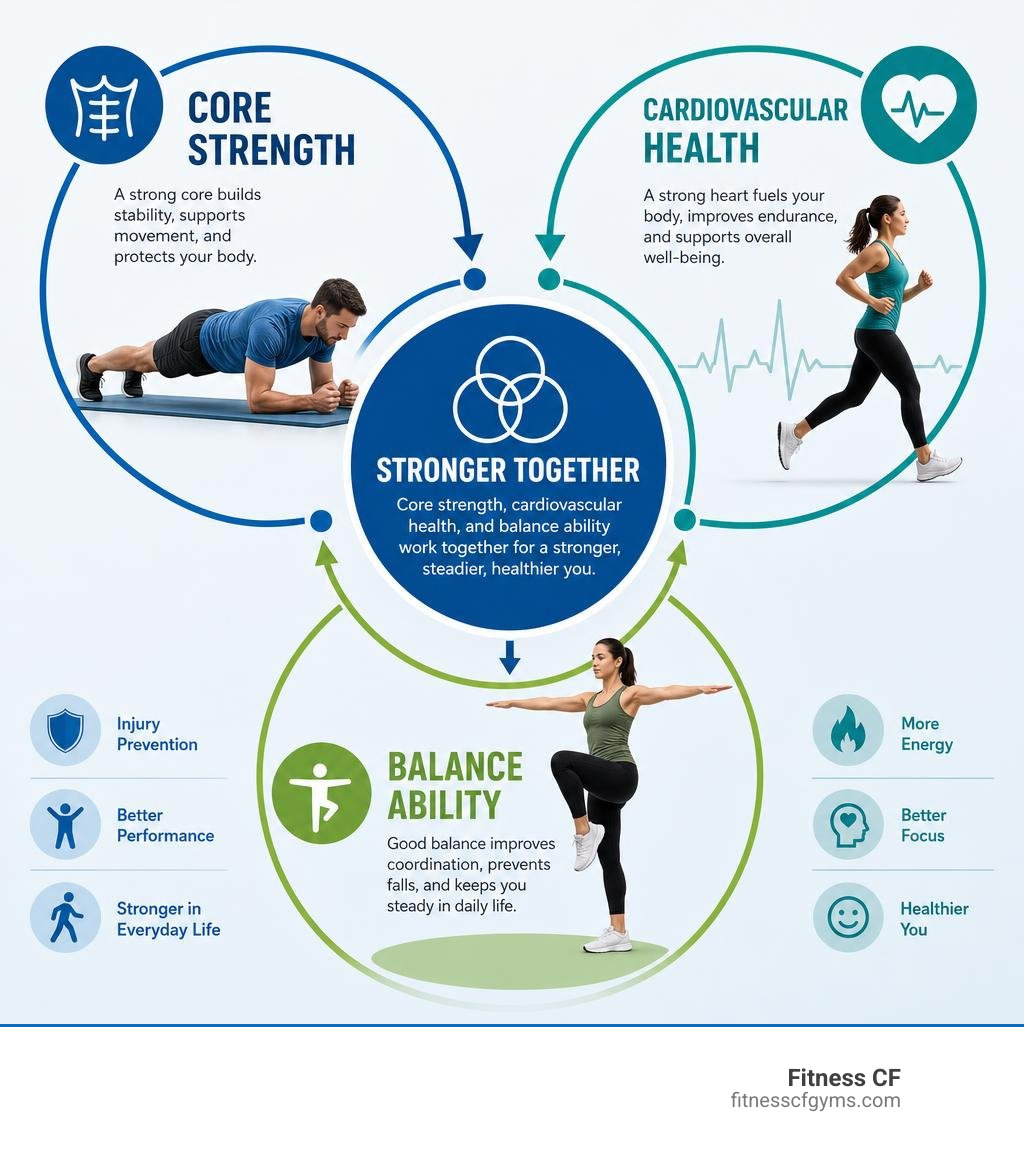
Cardio, core, and balance training combines cardiovascular conditioning, core strengthening, and stability work into one focused routine. Here is a quick overview of what it delivers:
- Improved stability — stronger core muscles support better posture and movement control
- Better balance — research shows 10 weeks of core balance training significantly improves both static and dynamic balance
- Calorie burn — a typical session burns around 300–400 calories
- Injury prevention — increased muscle stiffness in key lower leg muscles reduces fall and injury risk
- Functional fitness — movements carry over directly into everyday activities like walking, lifting, and bending
Most adults are not moving enough. The World Health Organization sets clear physical activity guidelines, and the majority of people fall short of them. The result? Reduced strength, poor balance, and greater vulnerability to injury as the years go on.
Integrating this training is a cornerstone of healthy living. A well-rounded fitness routine that blends the cardiovascular benefits of cardio with the structural benefits of strength training ensures your body remains resilient, energetic, and highly functional. The good news is that you do not need hours in the gym or complicated equipment to fix it. A focused cardio core and balance routine — even one that runs under 40 minutes — can produce real, measurable improvements in how your body moves and feels.
That is exactly what this guide covers.
With decades of experience in the fitness industry helping people build stronger, more balanced bodies through smart, sustainable training, I have seen firsthand how cardio core and balance training transforms not just how people look, but how confidently they move through daily life. Let’s walk through everything you need to know to stop wobbling and start working.
Related content about cardio core and balance:
What is the Core Cardio & Balance Workout?
At its core, a cardio core and balance workout is a hybrid training system designed to elevate your heart rate while simultaneously challenging your stabilizing muscles. Many fitness enthusiasts first encounter this specific style of training through structured home fitness programs—most notably as the “Core Cardio & Balance” recovery routine found in the famous Insanity program.
In that context, the workout serves as a critical bridge. It is typically introduced during “recovery week” (week five of the program) to give your joints and muscles a break from high-impact maximum-intensity intervals, while still keeping your body moving, sweating, and burning calories.

A standard session of this nature runs for approximately 37 to 40 minutes. Unlike high-intensity workouts that push you to your absolute physical limit, a cardio-core-balance routine dials back the explosive impact and focuses on controlled, deliberate movements. However, do not let the word “recovery” fool you. Slower, highly controlled movements increase your muscles’ time under tension, which can make holding a pose or completing a slow repetition feel just as challenging as a rapid-fire cardio circuit.
Using this style of workout strategically ensures that you are giving your body the space to rebuild without slipping into sedentary habits. To understand why this balance is so crucial, you can read more about The Importance of Rest and Recovery and how it prevents burnout.
The Role of Cardio Core and Balance in High-Intensity Programs
When you are deep in a rigorous training cycle, your body accumulates microscopic muscle tears and central nervous system fatigue. If you push at 100% intensity day after day, your performance will eventually plateau, and your risk of injury will skyrocket. This is where active recovery comes into play.
A structured cardio core and balance session keeps blood flowing to damaged muscle tissues, which accelerates the removal of metabolic waste products. At the same time, it targets your aerobic system. By keeping your heart rate in a moderate, steady zone, you continue Improving Cardiovascular Endurance without overtaxing your joints or adrenal glands. It is the ultimate way to maintain your hard-earned stamina while actively preparing your body for the next intense training block.
Workout Structure and Equipment Requirements
One of the greatest advantages of a cardio core and balance routine is its accessibility. It is primarily a bodyweight-focused workout, meaning you do not need an expensive home gym setup or heavy weights to reap the rewards.
Typically, a 37-minute session is structured into three distinct phases:
- The Warm-Up (approx. 4 minutes): A series of continuous, low-to-moderate intensity movements designed to raise core temperature and lubricate the joints.
- The Main Work Phase (approx. 25–30 minutes): A combination of standing core exercises, balance holds, and agility drills performed in timed intervals.
- The Cool-Down and Stretch (approx. 3–5 minutes): Focused static stretching to restore muscle length and bring the heart rate back to baseline.
Because the program relies heavily on your own body weight to create resistance, it is highly adaptable. If you have sensitive joints or are recovering from an injury, you can easily swap out high-impact jumps for grounded, fluid movements. This makes it one of the premier Low-Impact Exercise Options for individuals of all ages and fitness levels.
The Science Behind Cardio Core and Balance Training
While these workouts feel great, their benefits go far deeper than just a good sweat. There is a robust body of scientific literature explaining exactly how combining cardiovascular movement with stability training alters your physical biology for the better.

A landmark study published in the International Journal of Environmental Research and Public Health evaluated the specific physical impacts of core stability and balance protocols. You can read the full MDPI Study on Core Balance Training to dive into the data, but the core findings reveal incredible benefits for muscle function, joint stability, and fall prevention.
Impact on Muscle Tone, Elasticity, and Stiffness
When researchers analyzed the physical changes in adults who participated in a 10-week core balance training program, they discovered something fascinating about muscle characteristics. The study specifically measured muscle tone, elasticity, and stiffness in the lower extremities—focusing on the gastrocnemius (the prominent calf muscle) and the tibialis anterior (the muscle running along the front of your shin).
The results showed that while muscle elasticity (the ability of a muscle to bounce back to its original shape) did not show a statistically significant change, muscle stiffness increased significantly in both the gastrocnemius and tibialis anterior.
In the fitness world, “stiffness” is actually a highly positive trait. It refers to the muscle’s ability to resist external forces and maintain structural integrity. Higher muscle stiffness in the lower legs means your ankle joints are better supported, your body can absorb impact more efficiently, and your overall physical strength and joint protection are greatly enhanced. This biological adaptation directly translates to a reduced risk of ankle sprains, shin splints, and knee strain.
Enhancing Body Composition and Functional Fitness
Beyond structural joint support, integrating cardio core and balance into your weekly routine has a profound impact on your body composition and functional movement.
As we age, key athletic attributes like agility, speed, and reaction time naturally begin to decline—often starting as early as age 30. Furthermore, balance degradation is a primary health concern for older adults, with falls representing the leading cause of injury for individuals over the age of 65.
By engaging in dynamic balance drills, you train your brain and muscles to communicate faster and more efficiently (improving neuromuscular control). This training directly prevents falls and keeps you agile. Additionally, because the workout keeps your heart rate elevated, you burn an impressive number of calories while simultaneously building lean muscle. This dual benefit is the cornerstone of Combining Strength and Cardio to achieve a lean, powerful, and highly functional physique.
Step-by-Step Guide to the Core Cardio & Balance Routine
Ready to try it yourself? Let’s break down exactly how to execute a complete cardio core and balance session. To get the most out of these movements, you must keep your mind focused on your core. Every time you lift a leg, jump, or hold a plank, think about drawing your belly button toward your spine to stabilize your lower back.
Before you begin, make sure you are wearing supportive athletic shoes to grip the floor and protect your ankles during lateral movements. If you want to build a solid foundation before diving into the full routine, consider reviewing these Essential Core Stability Exercises to master the art of proper pelvic alignment and spinal protection.
The Warm-Up and Cool-Down Protocols
Never skip the bookends of your workout. The warm-up prepares your nervous system for movement, and the cool-down jumpstarts your recovery.
The Warm-Up (4 Minutes – Perform each move for 30 seconds, continuously)
- Jog in Place: Start with a light, easy jog to get the blood flowing.
- Switch Heel Kicks: Alternatingly kick your heels forward, tapping them on the floor while pumping your arms.
- Mummy Kicks: Extend your arms straight out in front of you, crossing your wrists over one another while kicking your legs straight out with a quick, low tempo.
- Football Shuffle: Drop into a shallow squat and quickly pitter-patter your feet as fast as possible.
- Over-the-Log Jumps: Imagine a small log on the floor next to you. Hop laterally over it, landing softly on both feet, then hop back.
- High Knees: Bring your knees up toward your chest while jogging in place.
- Power Jacks: A jumping jack, but you drop into a wide squat as your feet land outward.
- Fast Feet: Finish with a final burst of rapid-fire footwork.
The Cool-Down (3 Minutes)
Once the main work is done, transition to deep, belly breathing. Use a slow breathing pattern: inhale for 4 counts, hold for 2 counts, and exhale slowly for 6 counts. Hold static stretches for the shoulders, hip flexors, and calves for at least 15 to 20 seconds each to release built-up muscle tension.
Key Exercises in the Cardio Core and Balance Circuit
The meat of the workout consists of 10 key exercises performed back-to-back. For a true recovery-style challenge, perform each move for 1 minute at a controlled, steady pace. Focus on form over speed!
- Moving Ski Hops: Keep your feet and knees pressed tightly together. Hop side to side while mimicking a downhill skier’s arm motions. This fires up the obliques and lateral stabilizers.
- Hit the Floor: Stand with a wide stance. Hop side to side, reaching down to touch the floor with alternating hands while keeping your chest lifted and spine straight.
- Level 1 Drills: Drop down into a plank, perform 4 push-ups, run your knees in for 8 mountain climbers, jump your feet in, and stand up. Repeat.
- Heismans: A classic agility move. Hop laterally to the right, driving your left knee up toward your chest while bringing your right elbow down to meet it. Pause for a split second to test your balance, then hop to the left.
- Switch Kicks: Lean back slightly, engage your lower abs, and kick your legs out in front of you, alternating rapidly while staying light on the balls of your feet.
- Hop Squats: Drop into a deep squat, explode upward into a small jump, land softly back in the squat position, and repeat. Keep your weight in your heels.
- High Jumps: Bend your knees, swing your arms back, and explode straight up into the air, reaching your hands as high as possible. Land softly with bent knees.
- Moving Plank Walk: Get into a high plank position. Take two steps to the right using your hands and feet simultaneously, then two steps back to the left. Do not let your hips sag or swing.
- Hip Flexor Burners: Stand on one leg. Lift the opposite knee to a 90-degree angle and hold it there. Pulse the leg up and down, then extend it straight out and hold. This will set your hips and lower abs on fire!
- Shoulder Burners in Plie: Hold a wide plie squat. While holding this lower-body isometric pose, extend your arms straight out to the sides and perform small circles, pulses, and overhead presses to fatigue the deltoids.
If you are looking to round out your abdominal training with floor-based movements, check out these Best Core Exercises for Abs to build a rock-solid midsection.
Modifications and Tips for Beginners
If you are just starting your fitness journey or struggle with balance, this workout can feel intimidating. Standing on one leg while your muscles are burning is no easy feat!
The most important rule of thumb is to prioritize form over speed. It is far better to complete five slow, perfectly balanced repetitions than twenty rushed repetitions where you are wobbling and flailing your arms.
Here are a few actionable modifications you can use to make the workout safer and more accessible:
- Use Wall or Chair Support: During the Hip Flexor Burners or single-leg balance holds, place one hand lightly on a wall or the back of a sturdy chair. As your stability improves week by week, try lifting your hand off the support for 5 seconds at a time.
- Reduce the Range of Motion: During Hop Squats or Hit the Floor, you do not have to squat all the way down to the ground. Go only as deep as your joints comfortably allow.
- Remove the Jumps: Turn any jumping movement into a low-impact step. For example, instead of explosive Moving Ski Hops, take wide, rapid steps side-to-side while keeping your core tightly braced.
- Check Your Form in a Mirror: If possible, perform these exercises in front of a mirror. This visual feedback helps you immediately identify if your shoulders are slouching or if your knees are collapsing inward during squats.
You do not need to perform dozens of crunches to build a strong midsection. For those who prefer to keep their workouts upright or low-impact, check out this guide on Full Body Core Workouts Without Crunches for highly effective alternatives.
Frequently Asked Questions about Cardio, Core, and Balance
How many calories does a typical core cardio and balance session burn?
Most adults can expect to burn between 300 and 400 calories during a 37-minute session (with an average burn of approximately 364 calories). The exact number depends on your body weight, muscle mass, and the level of effort you put into the workout. Because this routine combines cardiovascular intervals with isometric holds, it keeps your metabolic rate elevated long after the workout is complete.
Can I skip the recovery week and go straight to high-intensity training?
We strongly advise against skipping your recovery weeks. Your muscles do not actually grow stronger during your workouts; they grow stronger between workouts when they are repairing. Skipping recovery phases leads to overtraining syndrome, chronic fatigue, and joint wear-and-tear. Taking a week to focus on core, cardio, and balance allows your body to heal so you can return to high-intensity programs with maximum power. To understand the relationship between high intensity and recovery, read about The Benefits of HIIT.
What should I do if I cannot hold the balance poses?
Do not worry—this is completely normal! Balance is a skill that must be trained just like strength or endurance. If you cannot hold a pose, simply tap your toe down to the floor for a split second to reset your center of gravity, then lift it back up. Using a wall for light support, focusing your eyes on a single, non-moving point on the floor in front of you, and keeping your core actively braced will all help build joint stability over time.
Conclusion
Building a healthy, resilient body requires more than just lifting heavy weights or running miles on a treadmill. It requires a balanced approach that nurtures your cardiovascular health, strengthens your core, and sharpens your stability. Embracing a healthy lifestyle means understanding the unique benefits of cardio—such as improved heart health and stamina—alongside the benefits of strength training, which builds bone density and lean muscle mass. By incorporating a dedicated cardio core and balance routine into your weekly schedule, you can protect your joints, boost your coordination, and ensure your body moves pain-free for years to come.
Ultimately, overall fitness is about consistency and finding joy in movement. Whether you prefer home workouts, outdoor activities, or structured group sessions, prioritizing your physical well-being is the best investment you can make for your long-term health.
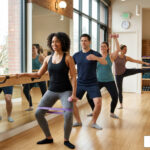
Ready to experience the power of structured, fun, and engaging workouts? Explore new ways to stay active and Join a Group Fitness Class today to take your functional fitness to the next level!