Why More People Are Turning to At Home Workouts for Their Full Body
At home workouts for your full body are one of the most practical ways to build strength, burn fat, and stay healthy — no commute, no waiting for equipment, and no rigid schedule.
Here’s a quick look at what an effective at-home full-body workout involves:
| Element | What to Know |
|---|---|
| Duration | 20-30 minutes per session is effective |
| Frequency | 2-3 times per week with rest days between |
| Equipment | Dumbbells (8-25 lbs) or bodyweight only |
| Workout Format | Circuits with timed intervals (e.g., 40 sec work / 20 sec rest) |
| Key Exercises | Squats, lunges, push-ups, rows, glute bridges, planks |
| Weekly Goal | 150 min moderate-intensity or 75 min high-intensity exercise (per Physical Activity Guidelines for Americans) |
Home fitness is growing fast. Today, 52% of people who exercise work out at home, and gym workouts have dropped by 10% since 2019. The appeal is simple: you can get a complete, effective workout from your living room with minimal gear.
The best part? You don’t need perfect conditions to start — just a plan and a small patch of floor.
I’m Pleasant Lewis, owner and operator of Fitness CF, with over 40 years of experience in the fitness industry helping people build sustainable healthy habits. I’ve seen how well-structured at home workouts for the full body can transform fitness levels when done consistently. In this guide, I’ll walk you through everything you need to get started and keep going.
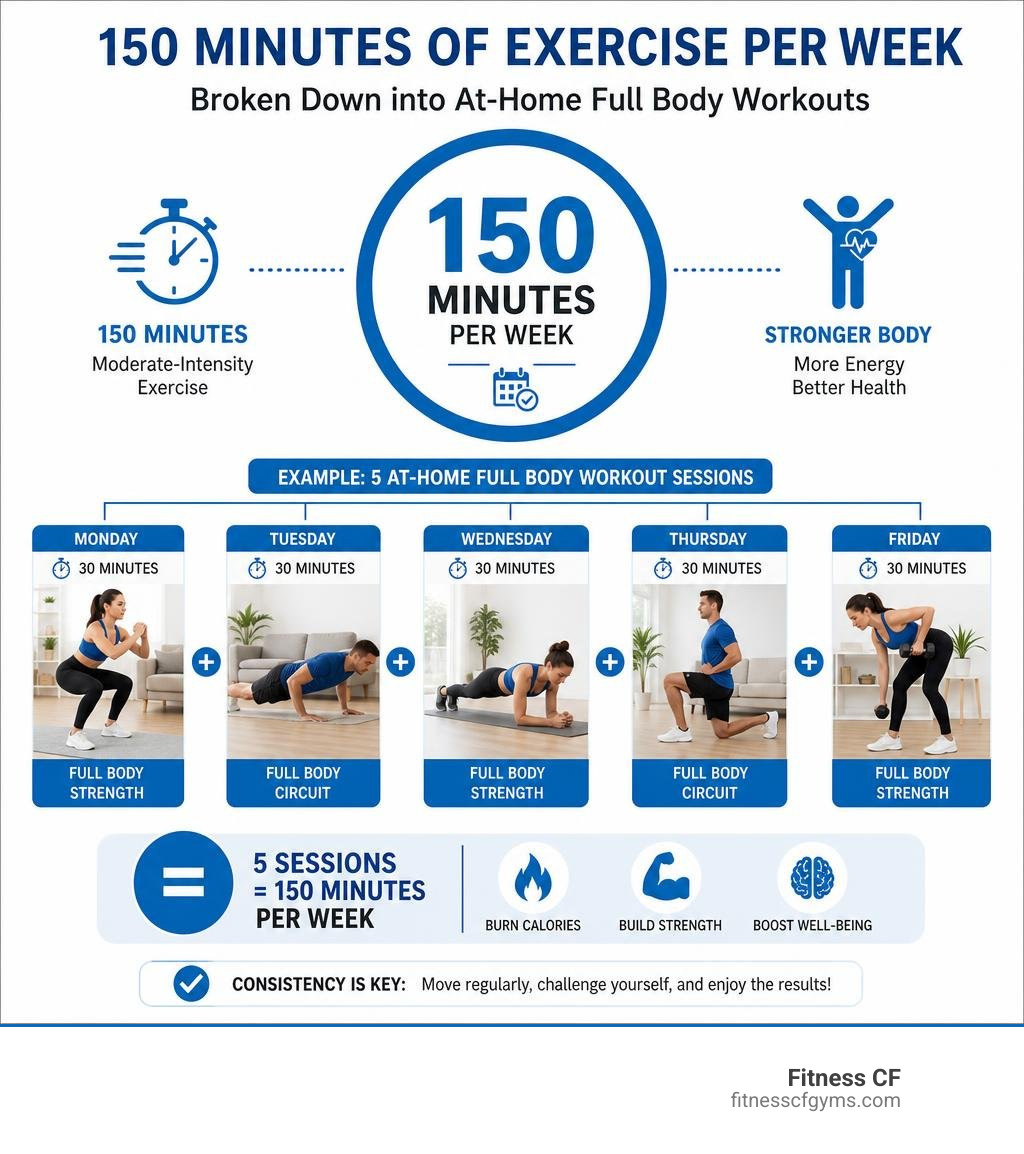
Quick look at at home workouts full body:
Why At Home Workouts Full Body Routines are Highly Effective
When it comes to functional fitness, targeting all your major muscle groups in a single session is incredibly efficient. Instead of focusing on just one body part at a time, at home workouts full body routines challenge your entire system. This approach builds functional strength and muscular endurance simultaneously, mimicking the way your body moves in everyday life.
One of the greatest benefits of full-body training is optimized muscle recovery. When you space out your full-body sessions throughout the week, your muscles get dedicated, 48-hour windows to repair and rebuild. This strategic rest is what allows your muscle fibers to grow stronger without the risk of overtraining.
Additionally, full-body routines trigger a powerful physiological response known as Excess Post-Exercise Oxygen Consumption (EPOC). After an intense, multi-joint workout, your body has to work overtime to restore its oxygen levels, balance hormones, and repair cellular tissue. This process creates a “metabolic boost,” meaning you continue to burn calories at an elevated rate for hours after your workout is finished. For a deep dive into how these routines are structured, explore The Definitive Guide to Full Body Exercises Routine.
The Power of Compound Movements
At the heart of any successful full-body routine are compound movements. These are multi-joint exercises that recruit several major muscle groups at the exact same time. Think of a squat, which engages your quads, hamstrings, glutes, and core, compared to a leg extension machine, which isolates only your quads.
Compound exercises are the ultimate time-savers for home workouts. By engaging more muscle mass, they skyrocket your calorie burn during the session and build functional strength that directly translates to daily activities—like carrying groceries, walking up stairs, or lifting heavy boxes. If you want maximum results in minimal time, prioritizing compound movements is non-negotiable.
Full-Body Workouts vs. Split Routines
Many fitness enthusiasts wonder whether they should choose a full-body routine, a split routine (like upper/lower body split days), or a bodyweight-only program. The right choice depends on your schedule, equipment access, and fitness goals.
For most people training in their living rooms, full-body workouts provide the best balance of muscle building, fat loss, and time efficiency. Let’s compare how these three approaches stack up:
| Feature | Full-Body Workouts | Split Routines | Bodyweight-Only Workouts |
|---|---|---|---|
| Primary Focus | Balanced strength, endurance, and high calorie burn | Targeted muscle hypertrophy and isolation | Functional mobility, endurance, and convenience |
| Equipment Needed | Minimal (Dumbbells or resistance bands) | Moderate to High (Barbells, benches, machines) | None (Uses your own body weight) |
| Weekly Time Commitment | Low (2-3 days per week) | High (4-6 days per week) | Low to Moderate (3-5 days per week) |
| Calorie Burn Per Session | High (due to multi-joint compound moves) | Moderate (fewer muscle groups active at once) | Moderate |
| Muscle Recovery Time | Excellent (full rest days between sessions) | Good (alternates muscle groups daily) | Excellent (low joint impact) |
Whether your goal is fat loss or building lean mass, full-body workouts are incredibly effective because they recruit the maximum amount of muscle tissue per minute of exercise.
How to Structure Your At-Home Workout Program
To get the most out of your training and avoid injury, you need a clear, structured plan. You can’t just jump into lifting heavy weights without preparing your joints, nor should you collapse onto the couch the second your last rep is finished.
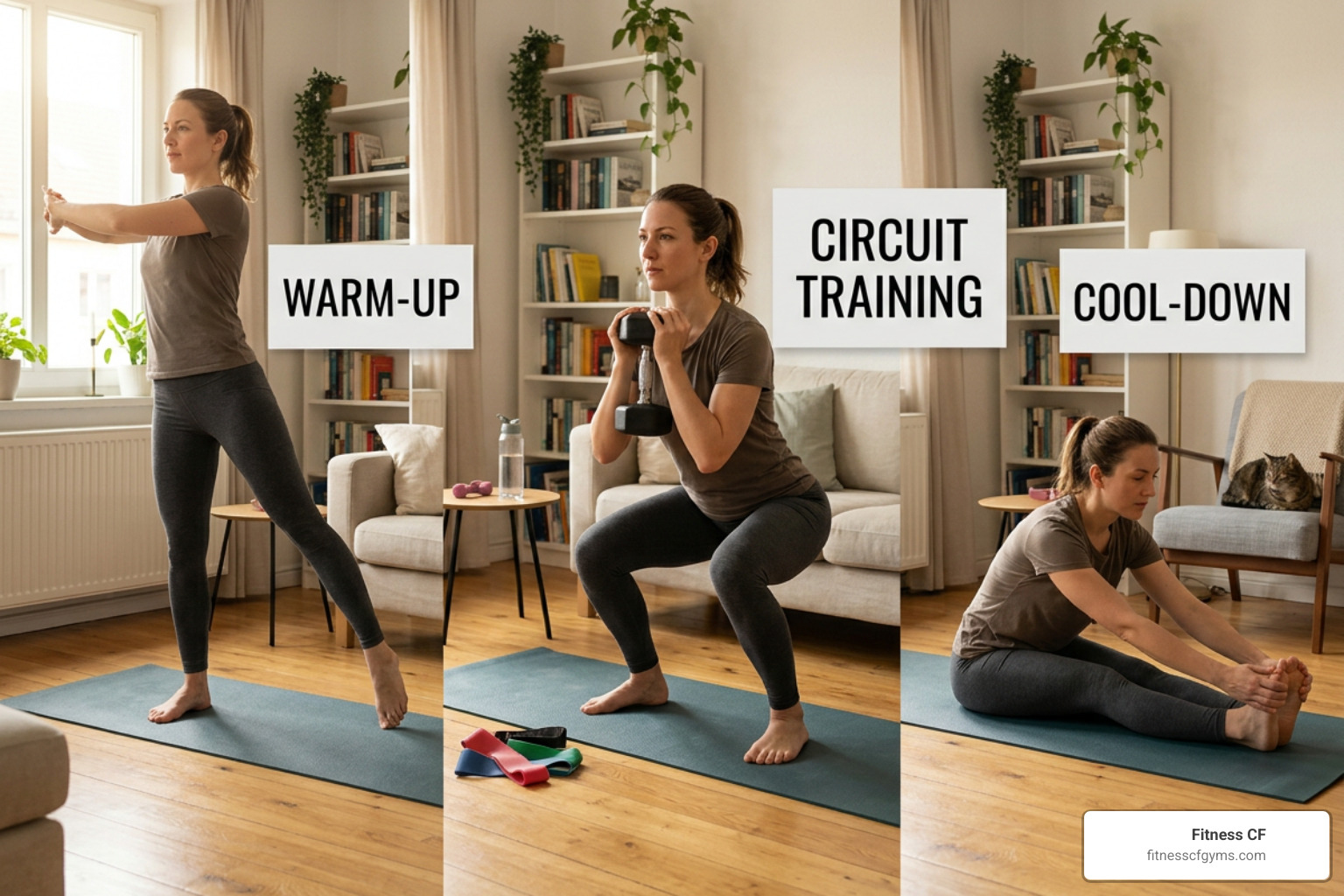
Every effective home workout should follow a simple timeline:
- The Warm-Up (5-10 minutes): Light cardio (like jumping jacks or marching in place) and dynamic stretches (like arm circles, hip openers, and cat-cow poses) to increase your heart rate and lubricate your joints.
- The Working Circuits (20-30 minutes): The core of your workout, focusing on compound movements performed in a circuit format with timed intervals.
- The Cool-Down (5 minutes): Low-impact breathing exercises and static stretches (like hamstring stretches, chest openers, and child’s pose) to lower your heart rate and kickstart the recovery process.
To keep making progress week after week, you must apply the principle of progressive overload. This means gradually increasing the difficulty of your workouts over time. You can do this by lifting slightly heavier weights, performing more repetitions, slowing down your movement tempo to increase time under tension, or shortening your rest periods.
Structuring Your At Home Workouts Full Body Plan
A highly effective way to program your home workouts is using the 3-2-1 format. This method structures your time to maximize muscle fatigue and cardiovascular conditioning in a tight 30-minute window:
- 3 Minutes of Lower Body Work: Focuses on your largest, most metabolically demanding muscle groups (squats, lunges, deadlifts).
- 2 Minutes of Upper Body Work: Focuses on pushing and pulling patterns (push-ups, dumbbell rows, shoulder presses).
- 1 Minute of Core Training: Focuses on rotational stability and deep abdominal strength (planks, dead bugs, bird dogs).
By repeating this pattern through three distinct circuits and using timed intervals (such as 40 seconds of work followed by 20 seconds of rest), you keep your heart rate elevated while giving local muscle groups time to recover. For a complete step-by-step routine using this structure, you can follow the 3-2-1 timed circuit method on Nourish Move Love. For a dumbbell-specific variation, check out this 30-Minute Full Body Workout at Home (With Dumbbells).
Frequency and Recovery Guidelines
For optimal results, we recommend performing full-body strength workouts 2 to 3 times per week, leaving at least one full rest day between sessions. For example, a Monday-Wednesday-Friday schedule works beautifully. This frequency ensures you hit your muscle groups often enough to stimulate adaptation while preventing overtraining.
On your rest days, focus on active recovery. Light walking, a gentle yoga flow, or a 20 Min Full Body Workout (No Equipment) on YouTube focused on mobility are great ways to promote blood flow and reduce muscle soreness. Additionally, prioritize sleep quality; your body releases the majority of its muscle-building growth hormones while you sleep, making 7 to 9 hours of quality rest essential for your fitness journey.
Essential Exercises and Equipment for Home Workouts
You don’t need a house packed with bulky exercise machines to build an incredible body. In fact, some of the most effective fitness routines rely on incredibly simple, space-saving gear.

If you are setting up your home workout space, here are the best tools to consider:
- Your Own Bodyweight: Always free, infinitely scalable, and perfect for mastering foundational movement patterns.
- A Set of Dumbbells: A pair of medium-to-heavy dumbbells (ranging from 8 to 25 pounds, depending on your current strength) is the single best investment you can make for home strength training.
- Resistance Bands: Perfect for adding tension to pulling movements without taking up any storage space.
- A Sturdy Chair or Bench: Excellent for modifying push-ups, performing step-ups, or doing supported split squats.
If you are looking for a comprehensive roadmap to get started with weights at home, check out The Ultimate Guide to Dumbbell Workouts for Sculpting Your Body Anywhere.
Key Exercises for At Home Workouts Full Body Success
To build a balanced body, your routine should feature exercises that cover all the fundamental human movement patterns: pushing, pulling, squatting, hinging, and carrying.
Here are the five key exercises that form the foundation of any great home workout:
- The Squat (Targets Quads, Glutes, and Core): Stand with feet shoulder-width apart, sit your hips back like you’re sitting in an invisible chair, keep your chest proud, and drive through your heels to stand back up. You can start with chair squats and progress to holding a dumbbell at your chest (goblet squat).
- The Push-Up (Targets Chest, Shoulders, Triceps, and Core): Place your hands slightly wider than shoulder-width apart, keep your body in a straight line from head to heels, lower your chest toward the floor, and push back up. Modify by placing your hands on a wall, kitchen counter, or sturdy chair.
- The Dumbbell Row (Targets Upper Back, Lats, and Biceps): Hinge forward at your hips with a flat back, hold a dumbbell in each hand with arms extended, and pull your elbows up toward your ribcage, squeezing your shoulder blades together.
- The Lunge (Targets Quads, Hamstrings, and Glutes): Step one foot backward or forward, lower your hips until both knees are bent at roughly 90-degree angles, and press through your front heel to return to the starting position.
- The Glute Bridge (Targets Glutes, Hamstrings, and Lower Back): Lie on your back with knees bent and feet flat on the floor. Squeeze your glutes to lift your hips toward the ceiling until your body forms a straight line from shoulders to knees, then lower back down.
To see how to string these movements together into a seamless session, check out these 10 Simple Dumbbell Exercises for a Full Body Workout or read about the 5 Best Dumbbell Exercises for a Quick Workout.
Safety and Proper Form with Dumbbells
When performing at home workouts full body routines with weights, safety and proper form must always come before the amount of weight you lift. It is far better to perform fewer repetitions with perfect control than to rush through extra reps with poor alignment.
Keep these essential form tips in mind during your sessions:
- Engage Your Core: Imagine pulling your belly button in toward your spine to stabilize your pelvis and protect your lower back during every single lift.
- Control the Tempo: Avoid using momentum or swinging the weights. Take 2 seconds to lower the weight (the eccentric phase) and 1 to 2 seconds to lift it.
- Mind Your Elbows: During overhead tricep extensions, keep your elbows pointing forward and close to your ears rather than letting them flare outward. During rows, pull from your elbows rather than pulling with your wrists.
- Protect Your Joints: When squatting or lunging, ensure your knees track in line with your middle toes and do not collapse inward.
Modifications for All Fitness Levels and Life Stages
One of the greatest myths in fitness is that a workout has to leave you exhausted on the floor to be effective. The truth is, the best workout is the one that meets you exactly where you are today.
Whether you are absolute beginner, recovering from an injury, or navigating a major life change like pregnancy, every single exercise can be modified to suit your body. For a simple, highly accessible routine that requires zero complex setups, take a look at the Full Body Home Workout for Beginners (Simple 20–30 Minute Routine at Home) on SyktoHealth.
Beginner Progressions
If you are new to working out, start by focusing on simple habit-building rather than high-intensity training. Use the Rate of Perceived Exertion (RPE) scale (from 1 to 10) to gauge your effort. Aim for an RPE of 5 to 7—where you are working moderately hard but could still hold a brief conversation (known as the “talk test”).
Begin with bodyweight-only movements to master your form. For example, practice sitting down and standing up from a chair to build your squat strength. If pushups on the floor feel too intense, perform them with your hands elevated on a wall or a kitchen counter. Consistency is the key to building confidence. To help you transition from the couch to a consistent routine, explore our guide From Couch to Confident – A Beginner’s Journey to Fitness.
Pregnancy and Postpartum Adjustments
Staying active during and after pregnancy is incredibly beneficial for your physical and mental well-being, but it requires a mindful approach to core and pelvic floor protection.
- First and Foremost: Always obtain clear medical clearance from your healthcare provider before starting or continuing any exercise program.
- Protect Your Core: Avoid movements that cause “doming” or “coning” along your midline (diastasis recti), such as traditional crunches or double leg lifts. Instead, focus on diaphragmatic breathing and gentle bird-dogs.
- Keep It Low-Impact: Swap out high-impact jumping exercises like burpees or jump lunges for low-impact alternatives like step-back lunges or bodyweight squats.
- Listen to Your Body: If you experience any pelvic pain, dizziness, or leaking, stop immediately and consult a pelvic floor physical therapist.
Tips for Staying Motivated and Consistent
The hardest part of any fitness journey isn’t performing the squats—it’s unrolling your exercise mat when you’d rather stay on the couch.
To build a habit that actually sticks, try these proven strategies:
- Schedule Your Workouts: Treat your exercise sessions like important doctor appointments. Put them in your calendar at the same time each day to build a reliable routine.
- Track Your Progress: Keep a simple fitness journal or use a mobile app to log your workouts. Tracking metrics like the number of reps you completed or how energized you felt helps you celebrate small, consistent wins.
- Keep It Convenient: Lay out your workout clothes the night before and keep your dumbbells in a visible, easy-to-reach spot. The fewer obstacles between you and your workout, the better.
- Find Your “Why”: Focus on how exercising makes you feel. Do you want more energy to play with your kids? Better sleep? Less stress? Connect your movement to these powerful daily benefits.
- Leverage Structured Programs: Take the guesswork out of your week by following a pre-planned guide, like our 12-Week Home Weight Loss Plan or our 5-Day Workout Routine to Get Toned.
Frequently Asked Questions about At-Home Fitness
Is 30 minutes enough for a full-body workout?
Absolutely! A 30-minute workout is highly effective if you focus on compound movements and keep your rest periods structured. By using timed circuits (like the 3-2-1 format) and limiting your transitions, you can easily target every major muscle group, elevate your heart rate, and stimulate muscle growth and fat loss in a short window.
Can you build muscle mass with bodyweight exercises?
Yes, you can build significant muscle mass using only your body weight. The key is applying progressive overload and increasing your “time under tension.” You can make bodyweight moves harder by slowing down your repetitions, holding isometric positions (like a squat hold at the bottom), performing single-leg variations, or training close to muscular fatigue.
What are some effective full-body workouts without equipment?
An excellent equipment-free workout focuses on foundational bodyweight movements. A simple circuit might look like this:
- Chair Squats or Air Squats (40 seconds)
- Incline or Floor Push-Ups (40 seconds)
- Glute Bridges (40 seconds)
- Forearm Plank Hold (30-60 seconds)
- Low-Impact Cardio Finisher (like shadow boxing or high knees) for 30 seconds. Repeat this circuit 3 times for a quick, highly effective full-body routine. For additional guidance, you can also check out this 20 Min Full Body Workout (No Equipment) on YouTube.
Conclusion
Embracing healthy living and improving your overall fitness doesn’t require a complicated setup or hours of free time. By dedicating just 20 to 30 minutes, two to three times a week, to at home workouts full body routines, you can build lasting strength, boost your daily energy, and improve your long-term health right from your living room.
The secret to fitness isn’t perfection—it’s consistency. Start with the beginner modifications, focus on your form, and celebrate every single step of your journey. If you are ready to design a personalized roadmap that fits seamlessly into your busy lifestyle, read our guide on How to Build a Full Body Workout Plan That Actually Works. Let’s get moving together!