Why Starting With a Beginners Total Body Workout Is the Smartest Move You Can Make
A beginners total body workout is the most effective way to build strength, burn calories, and develop real fitness habits — all in just two to three sessions per week.
Here’s what a beginner total body workout looks like at a glance:
- Train 3 days per week on non-consecutive days (e.g., Monday, Wednesday, Friday)
- Target all major muscle groups — legs, back, chest, shoulders, and core — in every session
- Do 2–3 sets of 8–12 reps per exercise with 90–120 seconds of rest between sets
- Sessions last 30–45 minutes including a warm-up and cool-down
- Focus on form first, weight second — always
Walking into a gym for the first time — or returning after a long break — can feel overwhelming. Rows of machines, piles of free weights, and no clear starting point. That feeling is completely normal, and it stops a lot of people before they even begin.
The good news? You don’t need a complicated plan. You don’t need to know every exercise. You just need a simple, repeatable routine built around movements your body already knows how to do.
Full body training gives you exactly that.
I’m Pleasant Lewis, owner and operator of Fitness CF, with over 40 years of experience in the fitness industry helping people at every level — including complete beginners — build strength and confidence through smart, sustainable training. I’ve seen how a well-structured beginners total body workout transforms not just bodies, but daily energy, mood, and long-term health. Let’s walk through everything you need to get started the right way.
Beginners total body workout vocab explained:
Why a Beginners Total Body Workout is the Ultimate Starting Point
When we begin our fitness journey, we often look at what experienced lifters are doing and try to copy them. We see bodybuilders performing “split routines” where they dedicate an entire day to just chest, arms, or legs. However, for someone taking their first steps, split routines are highly suboptimal.
A beginners total body workout is the ultimate starting point because of how our bodies adapt to exercise. Every time we work out, we are teaching our brains and nervous systems how to coordinate muscle fibers. This is called motor learning. Just like learning to play an instrument, practicing the fundamental movement patterns three times a week accelerates your coordination much faster than practicing them once a week.
Additionally, we must consider muscle protein synthesis — the biological process where your body repairs and builds muscle tissue. In beginners, this process peaks for about 48 hours after a workout before returning to baseline. By training your whole body every 48 hours, you keep this muscle-building window open continuously. If you only train a muscle group once a week, you miss out on days of potential adaptation.
Finally, full-body sessions create a massive metabolic demand. Because you are engaging multiple large muscle groups in a single session, your body burns significantly more energy both during and after the workout. This post-workout calorie burn, known as Excess Post-Exercise Oxygen Consumption (EPOC), keeps your metabolism elevated for hours. Transitioning From Couch to Confident: A Beginner’s Journey to Fitness is infinitely easier when we use highly efficient, science-backed methods. By starting with a structured Full Body Workout for Beginners: Get Started With Strength Training , we lay a solid foundation of movement quality that prevents injuries and builds lasting confidence.
The Science-Backed Benefits of a Beginners Total Body Workout
The benefits of a beginners total body workout extend far beyond building visible muscle. Engaging in full-body resistance training is one of the most powerful things we can do for our long-term health.
Studies show that strength training 2–3 times per week can help lower the risk of heart disease and increase longevity, particularly in women. In fact, dedicating just one hour per week to strength training can lower the risk of cancer and cardiovascular disease by 10% to 20%. Furthermore, full-body workouts are incredibly efficient for weight management, burning between 300 and 600 calories per hour depending on your training intensity.
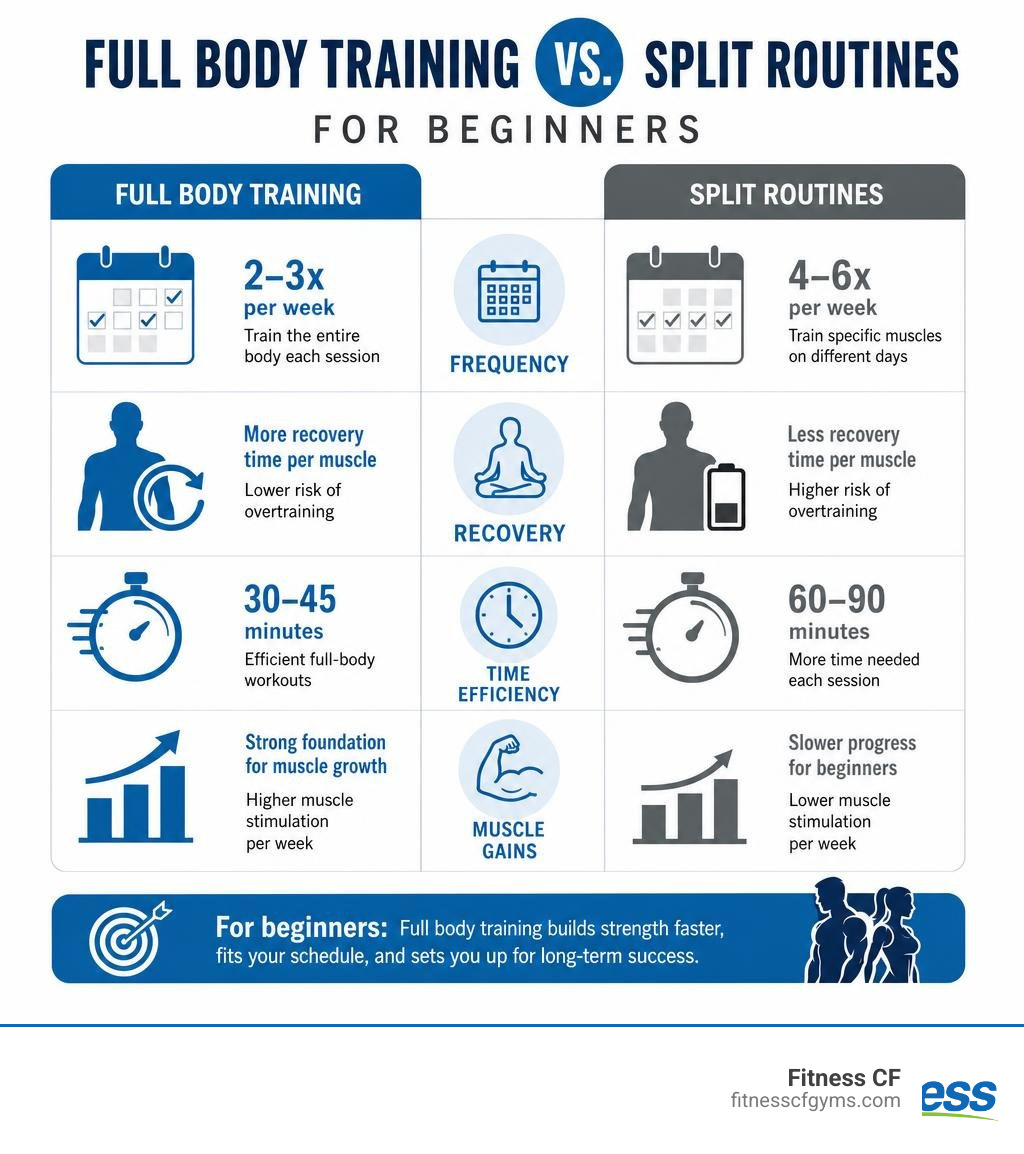
To help visualize why full-body training is superior for beginners compared to traditional isolation split routines, let’s look at the key differences:
| Feature | Full Body Workout Routine | Split Routine (e.g., Chest/Triceps) |
|---|---|---|
| Frequency per Muscle Group | 2–3 times per week | 1 time per week |
| Motor Learning & Form Practice | High (frequent practice of movements) | Low (long gaps between movements) |
| Caloric Burn per Session | Very High (uses entire body) | Moderate (uses limited muscle groups) |
| Schedule Flexibility | High (missing a day doesn’t ruin the week) | Low (missing a day disrupts the whole split) |
| Recovery Time | 48 hours of rest between sessions | Up to 7 days before retraining |
How Often Should You Train?
For beginners, the sweet spot for training frequency is 3 non-consecutive days per week. This could be a Monday-Wednesday-Friday or Tuesday-Thursday-Saturday schedule.
The most critical factor here is the 48-hour recovery rule. Muscles do not grow while we are working out; they grow when we are resting. Beginners should engage in full-body resistance training 2–3 times per week with at least 48 hours of rest between sessions targeting the same muscle groups. This rest period gives your muscle fibers, joints, and nervous system the necessary time to repair and adapt.
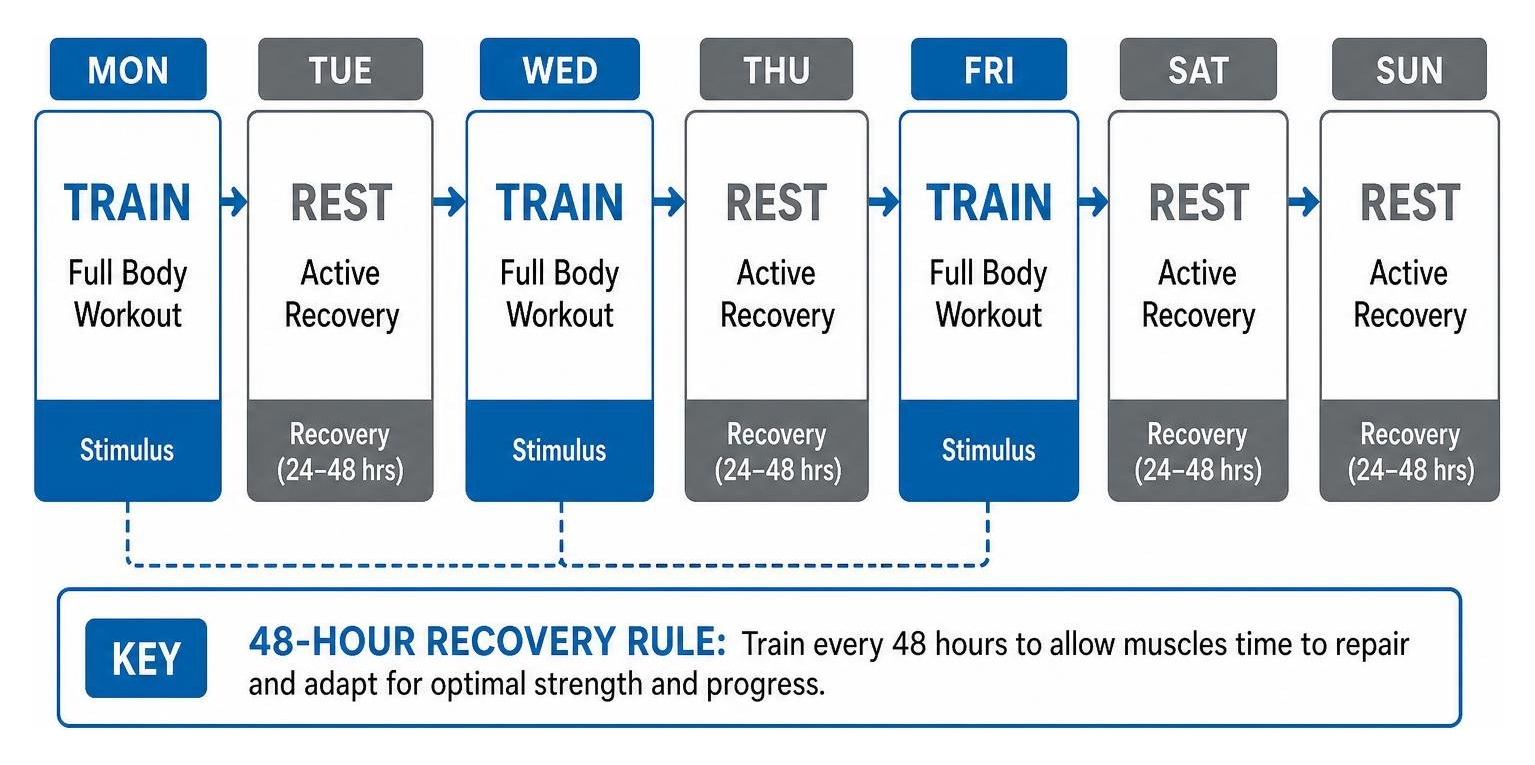
On your rest days, you do not have to sit on the couch. We highly encourage active recovery, such as going for a brisk walk, swimming, or doing light mobility work. The goal is to keep moving without putting heavy stress on your muscles.
The Five Foundational Movement Patterns for Beginners
Instead of thinking of workouts in terms of “muscle groups” like biceps or calves, we want to think in terms of movement patterns. Every human movement can be broken down into five foundational patterns. A balanced beginners total body workout should target all five to prevent muscle imbalances, protect joint health, and build functional strength.
- The Squat: A lower-body movement focused on bending at the hips and knees. This targets your quadriceps, glutes, and calves.
- The Hip Hinge: Bending primarily at the hips while keeping a flat back, pushing your glutes backward. This targets your hamstrings, glutes, and lower back (posterior chain).
- The Horizontal Push: Pushing resistance away from your chest, which works your chest, shoulders, and triceps (e.g., push-ups or bench press).
- The Pull: Pulling resistance toward your body, which targets your upper back, lats, and biceps (e.g., rows or pulldowns).
- Core Anti-Movement: Exercises where your core muscles work to resist movement and stabilize your spine, such as planks or bird dogs. Modern sports science shows that anti-movement core exercises are far superior to traditional crunches for spinal health and functional strength.
Essential Equipment for Your Beginners Total Body Workout
One of the biggest misconceptions is that you need an array of complicated gym machines to get fit. You do not. A highly effective full-body routine can be done with minimal equipment:
- Bodyweight: Your own body is the ultimate tool for mastering movement patterns. Exercises like bodyweight squats, knee push-ups, and planks build incredible foundational strength.
- Dumbbells: Dumbbells are excellent because they allow your joints to move through their natural paths. They also help correct strength imbalances between your left and right sides.
- Resistance Bands: Highly versatile, joint-friendly, and perfect for adding resistance to pulling movements.
If you are working out at home or in a basic setup, mastering 10 Simple Dumbbell Exercises for a Full Body Workout will give you everything you need to build a strong, balanced body.
The Step-by-Step Beginner Full Body Workout Routine
Before lifting any weights, we must prepare our bodies. A proper warm-up increases muscle temperature and blood flow, which significantly reduces the risk of injury.
Dynamic Warm-Up Protocol (5–8 Minutes)
Do not perform static stretching (holding a stretch) before lifting weights, as this can temporarily reduce muscle power. Instead, use dynamic movements:
- Arm Circles: 15 seconds forward, 15 seconds backward.
- Bodyweight Squats: 10 slow, controlled repetitions.
- Torso Twists: 15 reps to loosen up the spine.
- Marching in Place: 1 minute to raise your heart rate.
The Workout Session
Perform this routine on three non-consecutive days per week. We will alternate between two workouts (Workout A and Workout B) to keep things engaging and ensure balanced development.
Workout A
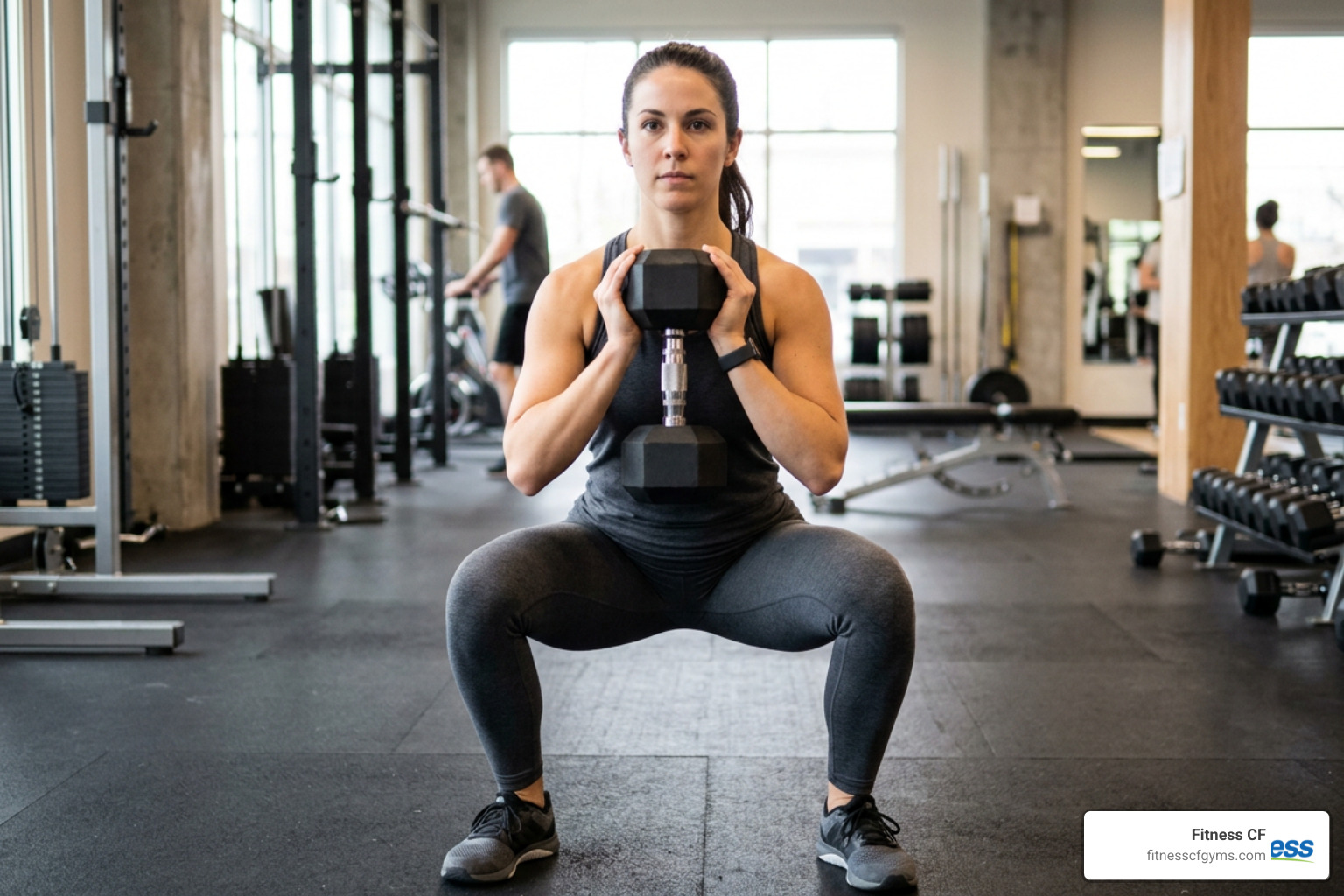
- A1. Goblet Squat (Squat Pattern): 3 sets of 8–12 reps. Tip: Keep your chest proud and knees tracking over your toes.
- A2. Dumbbell Bent-Over Row (Pull Pattern): 3 sets of 8–12 reps. Tip: Pull your elbows toward your hips, squeezing your shoulder blades.
- A3. Dumbbell Deadlift or Glute Bridge (Hinge Pattern): 3 sets of 10–12 reps. Tip: Focus on driving through your heels and squeezing your glutes.
- A4. Knee Push-Up or Incline Push-Up (Push Pattern): 3 sets of 8–12 reps. Tip: Keep your body in a straight line from head to knees.
- A5. Forearm Plank (Core Anti-Movement): 3 sets of 20–30 second holds. Tip: Keep your core tight and do not let your lower back sag.
Workout B
- B1. Reverse Lunge (Squat/Single-Leg Pattern): 3 sets of 8–10 reps per leg. Tip: Stepping backward reduces stress on the knees compared to forward lunges.
- B2. Dumbbell Overhead Press (Push Pattern): 3 sets of 8–12 reps. Tip: Press the weights straight up without arching your lower back.
- B3. Resistance Band or Dumbbell Pulldown/Row (Pull Pattern): 3 sets of 8–12 reps. Tip: Keep your shoulders down and away from your ears.
- B4. Bird Dog (Core Anti-Movement): 3 sets of 10 reps per side. Tip: Move slowly and keep your hips perfectly level with the ground.
- B5. Dumbbell Hammer Curl (Arm Isolation): 2 sets of 12 reps. Tip: Keep your elbows pinned to your sides.
Cooldown Protocol (5 Minutes)
Finish your session with gentle static stretching to promote recovery and flexibility:
- Child’s Pose: Hold for 30 seconds.
- Hamstring Stretch: Hold for 30 seconds per leg.
- Chest Opener Stretch: Hold for 30 seconds.
For a structured, week-by-week progression of these movements, you can follow a Beginner Workout Plan: A 4-Week Full-Body Routine to Start Exercising at Home | Life by Daily Burn to build your consistency.
Workout Structure: Sets, Reps, and Rest
For beginners, we recommend performing 3 sets of 8–12 repetitions for each major exercise.
- What is a Rep? A repetition is a single, complete execution of an exercise (e.g., lowering down into a squat and standing back up).
- What is a Set? A set is a group of consecutive repetitions (e.g., doing 10 squats in a row, resting, and then doing another 10).
- Why 8–12 Reps? This range is the sweet spot for building both muscular endurance and strength. Choose a weight where the last 2 reps of every set feel challenging, but you can still perform them with perfect form.
- Rest Periods: Rest 90–120 seconds between sets for compound movements (exercises that use multiple joints, like squats and rows). This gives your muscles enough time to replenish their energy stores so you can perform the next set with high quality. For smaller isolation moves, 60–90 seconds of rest is sufficient.
To learn more about tailoring these variables to your specific lifestyle, check out The Complete Guide to Creating a Workout Plan for Beginners.
How to Progress and Avoid Common Technical Mistakes
The golden rule of strength training is progressive overload. To keep getting stronger and healthier, we must gradually increase the demand on our muscles over time. However, as beginners, we do not want to rush this process.
In your first 4 weeks, your primary goal is skill acquisition. Focus on making every single rep look identical and perfect. Keep a controlled tempo: take 2 seconds to lower the weight, pause for a split second, and take 1 to 2 seconds to lift it.
Once you can perform all your sets and reps with perfect technique, use the two-for-two rule to progress: if you can complete two more reps than your target on your final set for two consecutive workouts, it is time to slightly increase the resistance (e.g., adding 2.5 to 5 pounds).

Always track your workouts. Write down the exercises, sets, reps, and weights used in a simple notebook or tracking app. Tracking provides visual proof of your progress, which is incredibly motivating.
Common Pitfalls to Avoid in the Gym
When starting a beginners total body workout, avoiding these common errors will keep you safe and consistent:
- Ego Lifting: Trying to lift weights that are too heavy. Every experienced lifter started with light weights. Form is infinitely more important than the weight on the bar.
- Spinal Flexion: Rounding your lower back during deadlifts or rows. Always maintain a neutral, straight spine to protect your discs.
- Skipping Warm-Ups: Cold muscles are much more prone to strains. Never skip your 5-minute dynamic warm-up.
- Inconsistency: Doing a massive, exhausting workout once a week is far less effective than doing three short, moderate workouts. Consistency beats intensity every single time.
Fueling Your Progress: Nutrition and Recovery Basics
To get the most out of your beginners total body workout, you must support your body outside of the gym. Training stimulates muscle growth, but nutrition and rest are what actually build and repair your body.
- Protein Intake: Protein provides the amino acids needed to rebuild muscle tissue. Aim to consume between 0.7 to 1.0 grams of protein per pound of body weight daily (or 1.6 to 2.0 grams per kilogram). Excellent sources include chicken, fish, eggs, tofu, Greek yogurt, and legumes.
- Hydration: Your muscles are made of roughly 75% water. Dehydration of just 2% of your body weight can cause your physical performance to degrade significantly. Drink water consistently throughout the day.
- Sleep: Growth hormone secretion peaks during deep sleep, and this is when the majority of muscle recovery occurs. In fact, research shows that sleep-deprived individuals on identical training programs can lose up to 60% more muscle mass than those who get adequate rest. Aim for 7 to 9 hours of quality sleep each night.
Frequently Asked Questions about Beginner Workouts
How long should a beginner full body workout take?
A beginner total body workout should take about 30 to 45 minutes of active training. When you include a 5-minute warm-up and a 5-minute cool-down, your total time commitment is under an hour. This time efficiency is what makes full-body training so sustainable for busy schedules.
Should I feel sore after every workout?
No! Muscle soreness (known as DOMS, or Delayed Onset Muscle Soreness) is common when you first start, but it is not a requirement for progress. As your body adapts to the movements, you will experience much less soreness. What matters is progressive overload and consistency, not chasing soreness. However, always distinguish between mild muscle soreness and sharp, sudden joint pain. If you experience sharp pain, stop the exercise immediately.
Can I combine cardio with this strength routine?
Absolutely. Combining strength training with cardiovascular exercise is fantastic for overall heart health and fat loss. We recommend performing 15–20 minutes of low-to-moderate intensity cardio (like walking, cycling, or using an elliptical) after your strength training session, or on your designated rest days. Doing your strength training first ensures you have maximum energy and focus for your lifting form.
Conclusion
Starting a fitness journey is one of the single best investments you can make in your long-term health, vitality, and confidence. By focusing on a structured beginners total body workout, you avoid the confusion of complicated split routines and give your body the exact stimulus it needs to grow stronger, healthier, and more energized.
Embracing a healthy lifestyle is about finding balance, staying active, and nourishing your body. Whether you are lifting weights to build bone density, doing cardio to boost your heart health, or practicing mobility to stay pain-free, every positive choice you make contributes to your overall well-being.
If you want to take the next step and learn How to Build a Full Body Workout Plan That Actually Works, focus on mastering the basics, staying consistent, and listening to your body. Show up three times this week. That is all. Just three times. Your future self will thank you!