Why Most People Never Get the Abs They Train For
Abs training with weights is one of the most effective — and most overlooked — ways to build a stronger, more defined core. Yet most people skip the weights entirely and default to endless crunches, hoping sheer volume will eventually carve out a six-pack.
It won’t. Not on its own.
Here’s a quick breakdown of what you actually need to know:
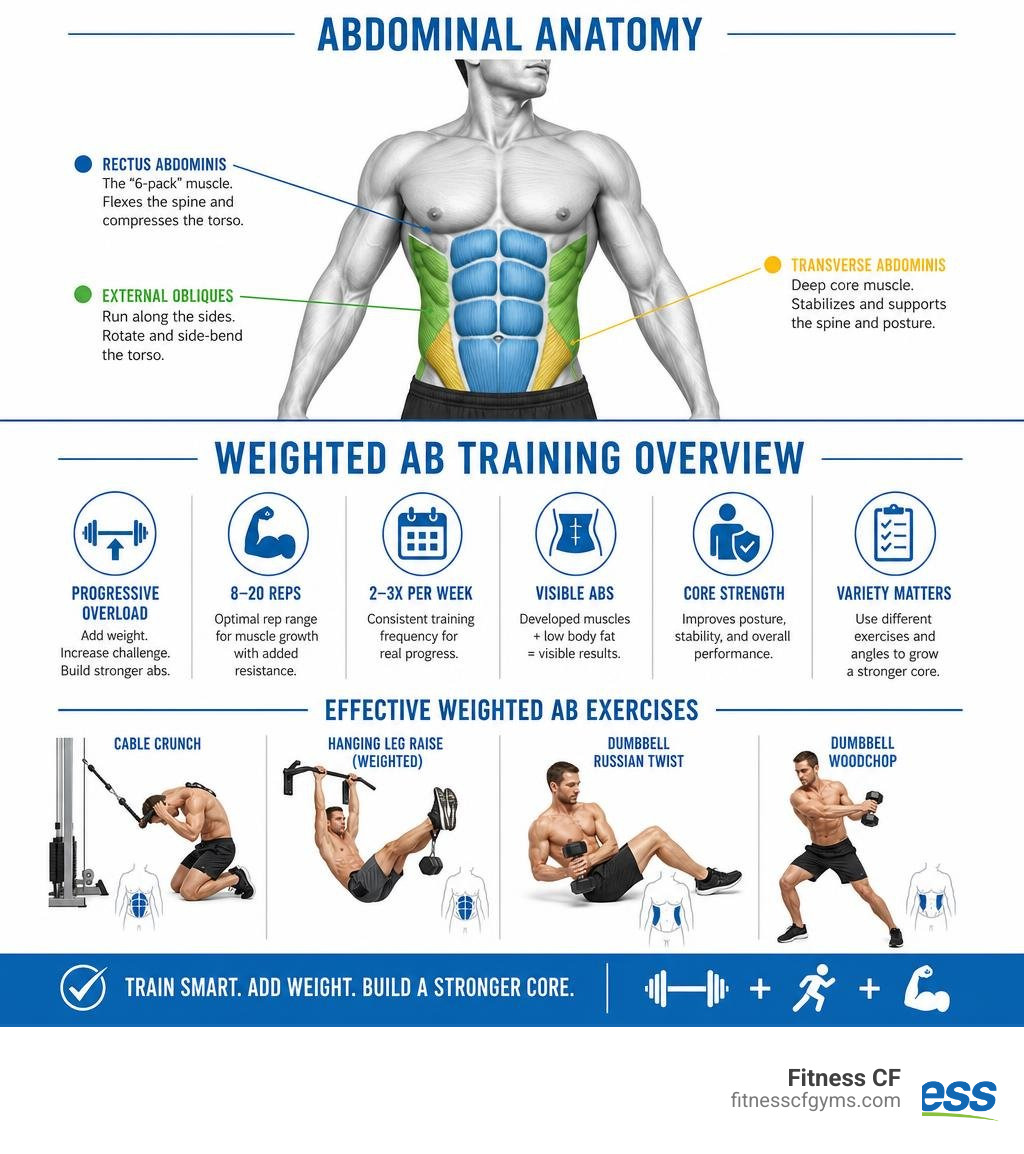
- Weighted ab training works because it applies progressive overload — the same principle that builds every other muscle in your body
- Bodyweight crunches alone build endurance, not significant muscle mass
- The best rep range for ab hypertrophy is 8–20 reps with added resistance, not 50+ unweighted reps
- Visible abs require two things: developed abdominal muscles and low enough body fat to reveal them
- Training frequency of 2–3 weighted core sessions per week is enough to see real progress
- Weighted ab exercises include cable crunches, hanging leg raises with weight, dumbbell Russian twists, and woodchops
Your abs are a muscle group like any other. They respond to tension, overload, and recovery — not just repetition.
I’m Pleasant Lewis, owner and operator of Fitness CF with over 40 years in the fitness industry, and I’ve seen how shifting from high-rep bodyweight routines to abs training with weights transforms the results members actually see. Below, I’ll walk you through exactly how to make that shift — intelligently and safely.
Similar topics to abs training with weights:
Why Bodyweight Crunches Aren’t Enough for a Strong Core

If you have ever spent twenty minutes at the end of a workout sweaty, exhausted, and desperately cranking out your three-hundredth crunch of the day, we have some comforting news for you: you can stop.
While the humble bodyweight crunch has its place in a beginner’s routine, relying on it indefinitely is like trying to build massive shoulders by lifting soup cans. It simply does not provide enough mechanical tension to force your core to grow.
The rectus abdominis — the “six-pack” muscle that runs vertically down your midsection — is primarily responsible for spinal flexion (bringing your ribs toward your pelvis). When you do a standard unweighted crunch, you are only moving the weight of your head, neck, and upper torso through a very short range of motion. Once your body adapts to this minimal load, additional reps only train muscular endurance, not muscle growth.
According to Scientific evidence on core activation, compound lifts like heavy squats and deadlifts actually activate the core stabilizers just as effectively as traditional floor planks. However, to truly sculpt and define the individual segments of the abdominal wall, we need targeted movements that push the muscle fibers to their limit. Incorporating the 6 Best Core Exercises for Abs into your routine is a fantastic starting point, but to take your midsection to the next level, we must introduce the element of external resistance.
The Limits of High-Rep Bodyweight Training
When we perform high-rep bodyweight training (think sets of 30, 50, or even 100 reps), we are primarily targeting our slow-twitch, fatigue-resistant muscle fibers. This improves core endurance — which is great for posture and long-term spinal support — but it does very little for muscle hypertrophy (growth).
Eventually, your body hits a plateau. Your abs adapt to the repetitive, lightweight stress, and the only way to make the exercise harder is to add more reps. But who has the time or the mental sanity to perform 500 crunches every single day?
Furthermore, doing hundreds of repetitive spinal flexions can place unnecessary wear and tear on your lower back. As explored in the debate on Should You Train Your Abs With Heavy Weights And Lower Reps Or Only With High Reps?, ultra-high-rep training beyond 25–30 reps offers diminishing returns for aesthetics. If you want your abs to pop, you need to treat them like your biceps, chest, or glutes: you must challenge them with load.
The Role of Progressive Overload in Abdominal Development
Progressive overload is the golden rule of muscle building. To force a muscle to adapt, grow, and become more defined, you must subject it to a level of tension it has not experienced before. This is accomplished by gradually increasing the weight, the number of reps, or the overall training volume over time.
When you begin abs training with weights, you trigger myofibrillar hypertrophy — the growth of the actual muscle fibers. This makes the “blocks” of your six-pack thicker and more prominent. When your body fat percentage drops, those thicker muscle blocks will be much more visible than flat, under-stimulated muscle fibers.
Additionally, a stronger rectus abdominis and transverse abdominis work together to pull your stomach in, acting like a natural corset. This structural support is crucial for daily life. If you want to improve your posture and stand taller, check out these Stop the Slouch: Essential Core Stability Exercises for Better Posture to build a solid foundation that supports your spine under heavy loads.
The Science Behind Abs Training with Weights

To understand why abs training with weights is so effective, we have to look under the hood at our muscle fiber composition. Your abdominal wall is made up of a mix of type I (slow-twitch) and type II (fast-twitch) muscle fibers.
Type II fibers are larger, have a higher potential for growth, and are recruited during short, explosive, or highly resistant movements. When we perform weighted core exercises, we tap directly into these fast-twitch fibers, maximizing our hypertrophy potential.
Using tools like cable machines, dumbbells, or medicine balls allows us to move our spine through its natural ranges of motion under a controlled, adjustable load. For a deeper dive into the physiological mechanics of abdominal growth, The Ultimate Abs Hypertrophy Guide for Men and Women outlines how progressive resistance is the ultimate key to unlocking visible midsection definition. If you absolutely dread traditional floor crunches, you can still build a powerful core using standing, rotational, and offset weight techniques. Check out Hard Core: The Ultimate Full Body Core Workout for People Who Hate Crunches to see how diverse your core training can truly be.
Choosing the Right Rep Range for Abs Training with Weights
Just like any other muscle group, your abs can be trained across different rep ranges depending on your specific goals. However, because the core is highly active during daily life to keep you upright, it thrives on a hybrid approach.
We recommend combining moderate weighted sets (where you reach muscular failure around 8 to 15 reps) with lighter, higher-rep bodyweight finishers (15 to 25 reps). This dual approach ensures you are targeting both the fast-twitch fibers for growth and the slow-twitch fibers for endurance.
| Rep Range | Primary Goal | Loading Intensity | Best Exercise Examples |
|---|---|---|---|
| 4–7 reps | Maximum Strength | Very Heavy | Heavy Cable Crunches, Weighted Hanging Leg Raises |
| 8–15 reps | Hypertrophy & Definition | Moderate | Dumbbell Russian Twists, Weighted Decline Sit-Ups |
| 15–25+ reps | Muscular Endurance | Light / Bodyweight | Unweighted Planks, Dead Bugs, Reverse Crunches |
To structure your progression safely, Project Abs: The Training Guide recommends starting with a weight that allows you to maintain perfect form while leaving 1 to 2 Reps in Reserve (RIR). Once you can easily complete your target reps at that weight, gradually increase the resistance.
Will Weighted Ab Training Increase Your Waist Size?
This is one of the most common fears we hear, especially from women and physique athletes: “Will lifting heavy weights make my waist look wide or bulky?”
The short answer is: only if you overdevelop your lateral obliques with extremely heavy, low-rep side bends.
The obliques run along the sides of your torso. If you train them with massive weights in a low-rep range (like 4 to 6 reps to failure), they will grow thicker, which can slightly widen your silhouette from the front. However, training your rectus abdominis (the front six-pack) and your deep transverse abdominis (the inner corset) with moderate weights will actually pull your midsection tighter, creating a flatter, more compact profile.
If your aesthetic goals prioritize a tapered, classic V-taper look, focus your heavy, loaded work on spinal flexion and anti-rotation movements while keeping your oblique-specific work (like side bends) in the moderate-to-light weight range. For a masterclass on balancing muscle development for a classic physique, take a look at the Best Ab Workouts for Men.
Frequency and Volume Guidelines for Loaded Core Work
Because you use your core in almost every movement inside and outside the gym, these muscles recover relatively quickly. However, because weighted core workouts introduce deeper muscle damage than simple bodyweight moves, you cannot train them with heavy loads every single day.
For optimal results, aim to train your abs with weights 2 to 3 times per week, leaving at least 48 hours of recovery between intense sessions.
- Weekly Volume: Aim for 6 to 12 total working sets per week dedicated specifically to direct core training.
- Integration: Add these weighted movements to the end of your workouts when your core is already warmed up from compound lifts.
- Consistency: To see how to seamlessly balance core work with your broader fitness routine, explore Your 5-Day Workout Routine to Get Toned and Terrific.
The Best Weighted Ab Exercises for Hypertrophy and Strength
Now that we have covered the science, let’s get into the practical application. Selecting the right exercises is crucial. We want movements that allow for smooth, progressive loading, keep constant tension on the abdominal wall, and minimize momentum.
Dumbbells, kettlebells, and cable machines are your best friends here. If you are working out at home or looking to maximize your gym sessions, reading through The Ultimate Guide to Dumbbell Workouts for Sculpting Your Body Anywhere will give you highly versatile ideas on how to utilize simple free weights to target every major muscle group, including your core.
How to Safely Progress Your Abs Training with Weights
Before you grab the heaviest dumbbell on the rack, your spine is a delicate structure. The goal of weighted ab training is to load the abdominal muscles, not to compress your spinal discs or strain your lower back.
- Prioritize the Mind-Muscle Connection: Focus on pulling with your abs, not your hip flexors or your arms. In a cable crunch, for example, your hands should remain anchored to your head; your abs should do 100% of the pulling.
- Control the Tempo: Avoid using momentum. Use a 2-second concentric (squeezing) phase, a 1-second hold at the peak of contraction, and a 3-second eccentric (lowering) phase.
- Brace Your Core: Before starting any rep, imagine you are about to be punched in the stomach. This “bracing” activates the deep transverse abdominis and protects your lower back.
If you are looking for a structured, step-by-step roadmap to safely build your core strength over the next two months, we highly recommend trying the 8-Week Ultimate Ab Workout Program to Build Core Strength. To ensure your lifting mechanics are flawless across all movements, keep our Ultimate Checklist for Dumbbell Workout Exercises handy during your next session.
Top Loaded Movements for a Defined Midsection
Here are our top four absolute favorite weighted core exercises to build exceptional strength and definition:
1. The Kneeling Cable Crunch
This is the undisputed king of loaded abdominal exercises because it allows for a massive range of motion and constant, adjustable tension.
- How to do it: Kneel in front of a cable pulley machine with a rope attachment set high. Hold the rope ends against your temples or upper chest. Keeping your hips locked in place, exhale completely and contract your abs to curl your elbows down toward your knees. Squeeze hard at the bottom, then slowly return to the starting position.
- Pro Tip: Keep your hips high and stationary. If your hips are rocking back and forth toward your heels, you are using your body weight and hip flexors to cheat the movement.
2. Weighted Hanging Leg Raises
An incredible challenge for the lower abs and deep stabilizing muscles.
- How to do it: Hang from a pull-up bar. Hold a light dumbbell securely between your feet (or wear ankle weights). Keeping your legs as straight as possible, contract your lower abs to raise your legs until they are parallel to the floor. Slowly lower them back down without swinging.
- Modification: If straight legs are too difficult, bend your knees and hold a dumbbell between your knees for weighted hanging knee raises.
3. Dumbbell Russian Twists
An amazing movement for rotational stability and targeting the internal and external obliques.
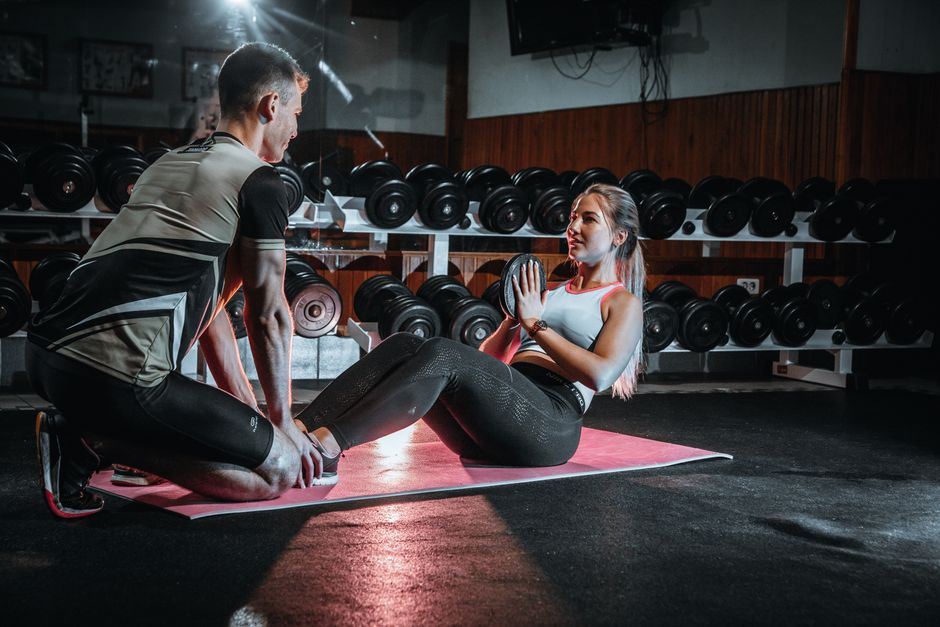
- How to do it: Sit on the floor with your knees bent and feet slightly elevated. Hold a single dumbbell or medicine ball with both hands at your chest. Lean back slightly to engage your core. Slowly rotate your torso to the right, tapping the dumbbell lightly on the floor, then rotate to the left.
- Tempo Cue: Move slowly! Rapidly flinging the weight back and forth only uses momentum and risks lower back strain. Control is key.
4. Dumbbell Woodchops
A functional, standing rotational exercise that mimics real-world movements and athletic power.
- How to do it: Stand with your feet shoulder-width apart, holding a dumbbell with both hands. Start with the dumbbell down by your left hip, knees slightly bent. In one smooth, explosive yet controlled motion, rotate your torso and swing the dumbbell diagonally up and across your body, ending with the weight above your right shoulder. Slowly reverse the movement. Complete all reps on one side before switching.
For more elite training secrets used by competitive athletes to maximize muscle definition and training efficiency, check out these Stop Wasting Time in the Gym with These Pro Bodybuilding Tips.
Frequently Asked Questions About Weighted Core Workouts
When our Central Florida members start transitioning from standard floor crunches to loaded core movements, they often have a lot of excellent questions. Let’s bust some common myths and set the record straight so you can train with absolute confidence.
Can weighted ab exercises help burn belly fat?
No. This is perhaps the single most persistent myth in the entire fitness industry.
You cannot “spot-reduce” fat. Doing weighted crunches will strengthen and build the abdominal muscles underneath, but it will not burn the fat that sits on top of them. Fat loss is systemic and requires a consistent caloric deficit — meaning you must burn more calories than you consume.
However, building more muscle tissue through strength training does slightly increase your resting metabolic rate, helping you burn more calories around the clock. To understand how to structure your workouts to burn fat while building lean muscle, check out The Definitive Guide to Full Body Exercises Routine.
Are weighted crunches bad for your lower back?
When performed with poor form, excessive ego, or pre-existing spinal issues, yes, weighted crunches can irritate the lower back. This is because spinal flexion under load increases intradiscal pressure.
However, for a healthy individual using controlled tempos, reasonable weights, and proper core bracing, weighted crunches are incredibly safe and highly effective. To protect your spine:
- Never pull on your neck or head with your hands.
- Keep your lower back pressed firmly into the floor or pad during sit-ups and crunches.
- Balance your flexion training with extension and anti-rotation movements.
Integrating regular resistance training is one of the best ways to keep your joints healthy as you age. Read more about maintaining lifelong joint health in Vitality Through Strength Training.
How do I choose the starting weight for my ab exercises?
Always err on the side of caution. Start much lighter than you think you need to.
We recommend using the Reps in Reserve (RIR) framework. For your first week of abs training with weights, choose a light dumbbell or cable setting where you can easily complete 12 to 15 reps while feeling like you could have done 3 or 4 more reps if your life depended on it (3–4 RIR). Once your form is absolutely flawless and you do not feel any strain in your lower back or neck, gradually increase the weight so that you are reaching muscular fatigue with only 1 to 2 RIR.
Conclusion
Transitioning from empty, high-rep bodyweight crunches to targeted, progressive abs training with weights is one of the single best decisions you can make for your fitness journey. Not only will it save you time in your workouts, but it will also build a core that is structurally resilient, highly functional, and visually striking.
A truly healthy lifestyle balances progressive strength training, cardiovascular health, and proper nutrition. Prioritizing overall fitness through a combination of resistance training and regular cardio is the ultimate key to boosting your metabolism, improving joint health, and enhancing your daily energy levels.
If you are ready to start building a stronger full body today, grab a set of dumbbells and try these 10 Simple Dumbbell Exercises for a Full Body Workout. Let’s put down the empty crunches, pick up some weights, and build a core that is built to last!